
Rhoda AI
Palo Alto-based robotics company building video-pretrained foundation models (marketed as FutureVision, built on what it calls a Direct Video Action model) and its own wheeled mobile-manipulator hardware for industrial and logistics tasks.
- Headquarters
- Palo AltoUnited States
- Valuation
- $1.7B
- Products
- 1
- Our coverage
- 5stories
What it builds
Rhoda AI is a Palo Alto company developing robot foundation models and, less publicly, its own robot hardware for industrial manipulation. It ended roughly 18 months of stealth on 10 March 2026, announcing $450 million in funding — which the company labels a Series A — and FutureVision, its approach to robot control based on video-predictive control. Bloomberg reported the round valued the company at $1.7 billion, and Humanoids Daily covered the $1.7B valuation and model launch at the time. The company says it works with customers across automotive, manufacturing, logistics and e-commerce.
Technical approach
Rather than training mainly on teleoperated robot trajectories, as vision-language-action pipelines typically do, Rhoda pre-trains an autoregressive video model on internet video to build a prior on motion, physics and interaction, then post-trains on smaller robot datasets to map predicted frames onto embodiment-specific actions. The company calls the result a Direct Video Action model and says it runs closed-loop, updating behaviour as conditions change rather than executing an open-loop plan. Rhoda states that this pre-training lets the model pick up new tasks with as little as ten hours of teleoperation data, and that long-context conditioning allows single-shot execution of tasks such as pick-and-place from a human demonstration without retraining. The pitch is aimed squarely at the lab-to-real-world generalization gap that CEO Jagdeep Singh has described as the sector's central problem.
Traction and hardware
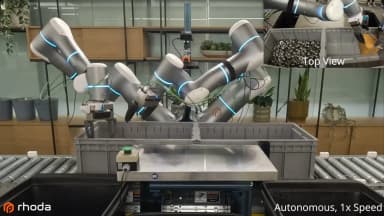
Public evidence of deployment is limited and mostly company-supplied. Rhoda says its systems have run autonomously in production settings, citing a high-volume manufacturing evaluation in which a component-processing workflow was completed in under two minutes per cycle without human intervention. Demonstrations published so far include unlatching and collapsing heavy-duty plastic totes and handling parts on an automotive assembly line. Hardware has not been formally announced. In a July 2026 interview, Singh said Rhoda has been testing proprietary hardware with customers and resisted the humanoid label, describing a mobile manipulator with seven-degree-of-freedom arms, dexterous hands and a wheeled base rather than legs — and claimed Rhoda could be the first company to deploy a manipulation-capable autonomous robot at scale.
People and backing
Singh, previously founder and CEO of QuantumScape and Infinera, is co-founder and CEO. Forbes, citing internal documents, named Stanford professor Gordon Wetzstein and former SoftBank Pepper engineer Vincent Clerc as founding team members when it first reported the company's $230 million raised in stealth. Eric Ryan Chan, formerly a generative model architect at World Labs, is chief science officer. Disclosed investors include Capricorn Investment Group, Khosla Ventures, Leitmotif, Matter Venture Partners, Mayfield, Premji Invest, Prelude Ventures, Temasek, Xora and John Doerr.
Where it sits
Rhoda occupies an unusual middle position: it competes on models with video- and world-model-centric labs, while intending to control its own stack down to the robot, as hardware-first entrants do. Its wheeled base places it closer to mobile-manipulator vendors than to bipedal humanoid programmes, despite early reporting framing it as a humanoid company.
Robots & products
A selection of the company's announced products, not a complete catalogue.
FutureVision
Pilot deploymentAI model · announced March 2026
Robot foundation model approach based on video-predictive control, built on what Rhoda calls a Direct Video Action (DVA) architecture: an autoregressive video model pre-trained on internet video, post-trained on smaller robot datasets to map predicted frames to actions in a closed loop.
Funding
$612.6M raised| Round | Date | Amount | Valuation | Lead investors |
|---|---|---|---|---|
| Series A | March 2026 | $450M | $1.7B | — |
| Series A | — | $162.6M | — | — |
Timeline
Exits stealth with $450M and unveils FutureVision
Rhoda announced its public launch after 18 months in stealth, disclosing $450 million in funding it labelled a Series A and introducing FutureVision, its video-predictive control approach built on a Direct Video Action model.
Rhoda AI Hits $1.7B Valuation, Unveils "Direct Video-Action" Model to Bridge the Real-World GapValued at $1.7 billion in launch round
Bloomberg reported the $450 million round valued Rhoda at $1.7 billion, with backers including Khosla Ventures, Temasek, Premji Invest, Capricorn Investment Group, Mayfield and John Doerr.
bloomberg.com ↗- Reported
Reports autonomous run in production manufacturing
At launch the company said its system completed a component-processing workflow in under two minutes per cycle without human intervention during a high-volume manufacturing evaluation; the result is company-reported and the customer is unnamed.
therobotreport.com ↗ Singh starts publicising Rhoda ahead of launch
After a long stealth period, the CEO began posting publicly about the lab-to-real-world generalization problem and Rhoda released a first demonstration clip of bimanual manipulation.
Rhoda AI Breaks Stealth: Jagdeep Singh Teases "Real World" GeneralizationCEO confirms wheeled mobile manipulator in customer testing
In an A3 interview published in July 2026, Singh said Rhoda has been testing proprietary hardware with customers — a mobile manipulator with seven-degree-of-freedom arms, dexterous hands and a wheeled base rather than legs — but had made no formal product announcement; the exact interview date is not stated on the page.
automate.org ↗Forbes reveals $230M raised in stealth
Forbes reported Rhoda had closed a $162.6 million Series A in April 2025, bringing total funding to $230 million at a valuation near $1 billion, and was building a general-purpose bimanual manipulation platform; the company declined to comment.
Stealth Startups Emerge With Over $300 Million to Join Crowded Humanoid Robot FieldRhoda AI founded in Palo Alto
PitchBook dates the founding to 2024 and Forbes reported Jagdeep Singh had been working on Rhoda since 2024; the company later said it spent about 18 months in stealth before its March 2026 launch.
pitchbook.com ↗
Latest on Rhoda AI

Rhoda Blindfolds Its Robot—and Lets Touch Guide the Search
Rhoda combines tactile sensing with its Direct Video-Action model to guide manipulation without vision, showing textured-ball retrieval and recovery from mistakes.
Rhoda Tests Whether Scaling Web-Video Pretraining Makes Robots Better at Real Work
Rhoda’s latest study puts video pretraining to an industrial test, adding evidence to the debate over how robots should learn.
Rhoda AI Hits $1.7B Valuation, Unveils "Direct Video-Action" Model to Bridge the Real-World Gap
Palo Alto-based Rhoda AI has officially broken stealth with a $450 million Series B and a novel "Direct Video-Action" framework that uses hundreds of millions of internet videos to teach robots the laws of physics.

Rhoda AI Breaks Stealth: Jagdeep Singh Teases "Real World" Generalization
After months of silence and a nearly $1 billion valuation, Rhoda AI CEO Jagdeep Singh has begun sharing insights into the company’s mission to solve the robotics generalization gap.

Stealth Startups Emerge With Over $300 Million to Join Crowded Humanoid Robot Field
A new report reveals two stealth companies, Rhoda AI and Genesis AI, have raised massive early-stage rounds to tackle different aspects of humanoid robotics, from heavy lifting to software-driven control systems, signaling intensified competition in the sector.
Sources
- Press Release — Rhoda AI Exits Stealth with $450 Million Series A· checked September 6, 2026
- Rhoda AI Exits Stealth with $450 Million Series A to Bring Robots Out of the Lab and Into the Real World· checked September 6, 2026
- Rhoda AI 2026 Company Profile: Valuation, Funding & Investors· checked September 6, 2026
- Startups Rhoda AI And Genesis AI Are Building Humanoid Robots In Stealth· checked September 6, 2026
- AI Robotics Startup Rhoda Valued at $1.7 Billion in New Funding· checked September 6, 2026