- Published on
NVIDIA DreamZero explained: how its robot AI differs from a VLA
One tap, and our reporting appears more often in your Google Top Stories. It makes a real difference to a small newsroom.

Supported by RoboStrategySupport for Humanoids Daily comes from RoboStrategy
Sponsored
Investing involves risk, including possible loss of principal. Read the prospectus before investing.
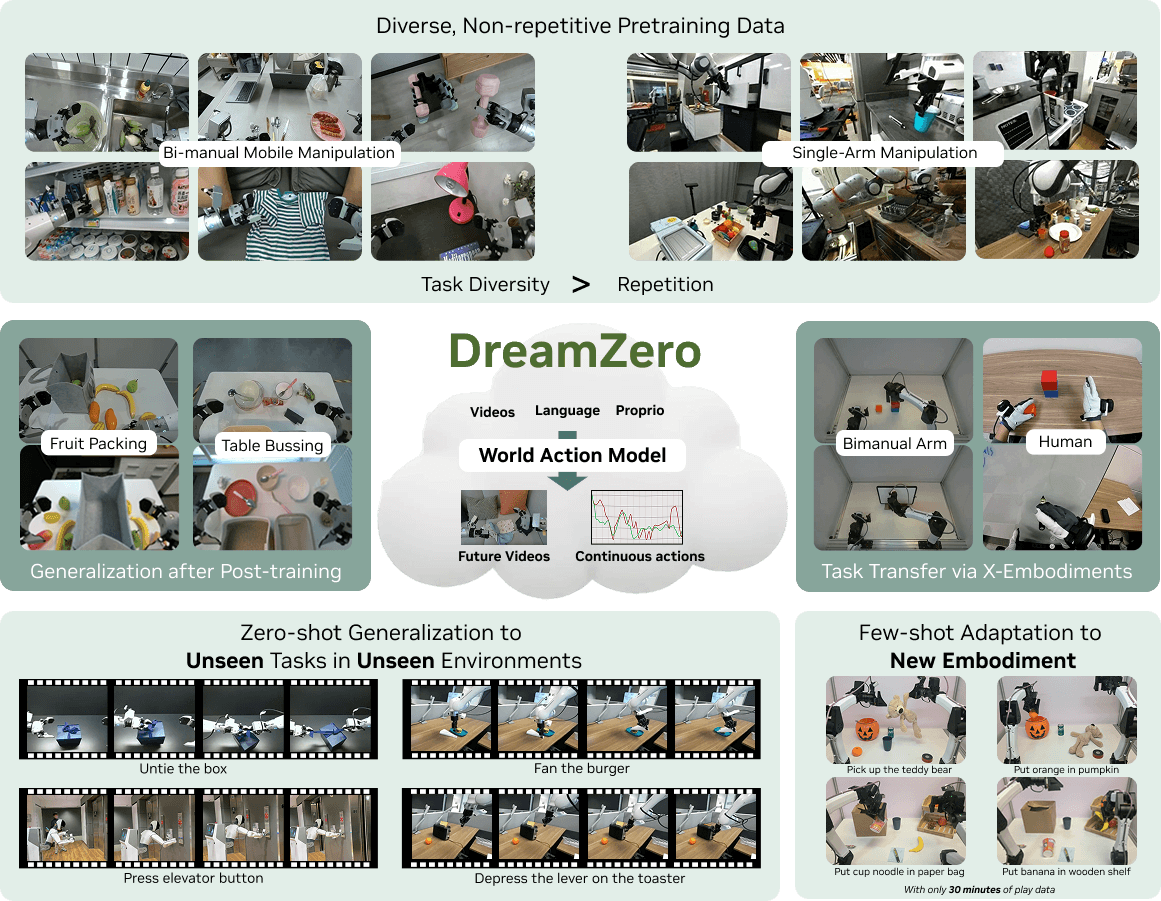
DreamZero is a robot AI model from NVIDIA GEAR Lab that predicts future video and robot actions together. The aim is to help robots handle unfamiliar tasks using what they have learned about how the world moves. NVIDIA’s project page includes experiments and demonstrations.
The interesting question is how much a robot can reuse when the task changes. Learning to pick up one object in one setting is useful. Transferring that ability to unfamiliar objects, movements and workplaces would make robots far easier to put to work.
How is DreamZero different from a VLA?
A vision-language-action model, or VLA, turns visual observations and instructions into robot actions. Many build on models pretrained to connect images and language. DreamZero instead starts from a video-generation model and learns to predict movement alongside the actions that produce it.
| A typical VLM-based VLA | DreamZero | |
|---|---|---|
| Starting point | A pretrained vision-language model | A pretrained video model |
| Robot-control prediction | Actions | Future video and actions jointly |
| Central idea | Adapt visual and language knowledge to control | Adapt knowledge of visual change to control |
This is a comparison of approaches, not a division between robots that understand physics and robots that do not. Both need to connect their learned representations to actual movement.
The weekly humanoid robotics briefing
One email a week: the launches, funding and research that mattered, with context from Humanoids Daily.
Read recent issuesOur original article described DreamZero as generating a visual future and then extracting actions through inverse dynamics. The more accurate description is joint prediction: video and actions are modeled together. NVIDIA distinguishes these approaches in its technical overview of world-action models.
What has DreamZero demonstrated?
NVIDIA’s evaluations include unfamiliar actions such as untying shoelaces and drawing. In its DROID experiments, DreamZero achieved 49% average task progress on unseen verbs, versus 25–32% for the compared VLAs. Task progress measures partial completion; it is not the percentage of attempts that finished successfully. The evaluation gallery shows examples, including failures.
These results are encouraging evidence of transfer. They are not a test of an entire customer shift. For a deployment, the questions extend to recovery after mistakes, human assistance and consistent performance over time.
What does “zero-shot” mean here?
Zero-shot does not mean untrained. It means attempting a task without task-specific training examples in the relevant experiment.
Changing robots is a separate problem. NVIDIA adapted DreamZero to the YAM robot with 30 minutes of robot play data, then tested generalization. That was adaptation to new hardware, not installation on an unfamiliar robot with no training. The research paper describes the different evaluation settings.
Keeping those distinctions clear matters when comparing models. “A new task,” “a new room” and “a new robot” are different challenges, even when all three are described as generalization.
Can you download or use DreamZero?
Yes. Code and pretrained checkpoints are public. As checked on September 14, 2026, the official repository provides DreamZero-DROID and DreamZero-AgiBot checkpoints, training and fine-tuning scripts, and instructions for adapting the model to another robot. It also describes an access-request route for a hosted simulation-evaluation API.
This is a research setup rather than a consumer application. The documented local inference configuration uses multiple GPUs, with a minimum of two, and has been tested on GB200 and H100 hardware. Running it on a physical robot also requires the appropriate integration.
How fast does it run?
NVIDIA reports optimized closed-loop control at around 7 Hz in the research demonstration.
The public README separately lists inference times of roughly 0.6 seconds on GB200 and 3 seconds on H100 for its documented setup. These are not interchangeable performance promises. Reproducing a demonstration means checking the model, hardware and software configuration used, rather than assuming every public checkpoint delivers the fastest reported result. Public inference instructions.
Where does DreamZero fit now?
DreamZero is also part of NVIDIA’s subsequent robotics work. NVIDIA describes Isaac GR00T 2 as a world-action model based on DreamZero research, with availability planned for the end of 2026. That roadmap is separate from the DreamZero checkpoints already released. NVIDIA’s world-action-model overview.
For humanoid developers, the lasting question is whether advances in the AI reduce the work needed to deploy each robot. Our reporting on DYNA-2 and human-video training and Generalist GEN-1.5’s one-shot learning follows other efforts to tackle that problem.
This article was originally published on February 4, 2026. This revision clarifies DreamZero’s architecture and evaluation results and adds public-access information.
Share this article
Read next
- Published on
- Reading time
- 4 min read
NVIDIA Open-Sources DreamDojo: A 44,000-Hour "Dream" to Solve the Robotics Data Gap
- Published on
- Reading time
- 3 min read
NVIDIA "Supersizes" Humanoid Control: SONIC Open-Sources Whole-Body Tracking at Scale
- Published on
- Reading time
- 4 min read
NVIDIA’s "DoorMan" Teaches Humanoids to Open Doors Faster Than Humans Can
- Published on
- Reading time
- 4 min read
The Great Parallel: NVIDIA’s Jim Fan Outlines the Robotics "End Game" Strategy
- Published on
- Reading time
- 4 min read
The Human Scale: NVIDIA’s EgoScale Unlocks High-Dexterity Robotics via 20,000 Hours of Human Video
- Published on
- Reading time
- 5 min read
Imagination as Policy: 1X Director Daniel Ho on Leveraging the World Model Flywheel


The weekly humanoid robotics briefing
One email a week: the launches, funding and research that mattered, with context from Humanoids Daily.
Read recent issues