- Published on
Morgan Stanley’s "Humanoid Tech 25": Betting on the Components, Not the Brands
One tap, and our reporting appears more often in your Google Top Stories. It makes a real difference to a small newsroom.


Your guide
Rich Robinson
Jee Chee Ren · Executive tour
See China’s AI and robotics ecosystem first-hand.
Six days exploring AI, robotics and advanced manufacturing.
With Rich Robinson, Clinical Professor of Entrepreneurship at Peking University
Beijing · Guangzhou · Shenzhen
29 November–4 December 2026
Referral partnership · We earn a commission on referred bookings.
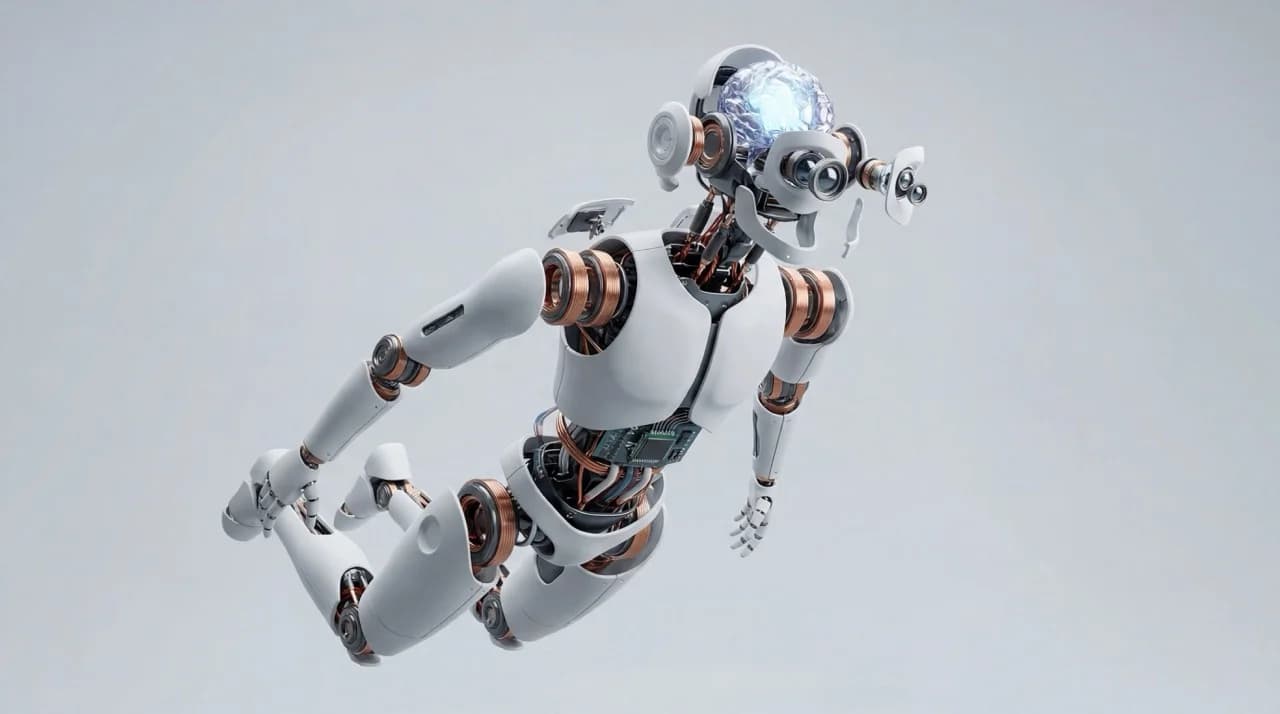
The projection is staggering, if distant: a global market worth $5 trillion by 2050, with over one billion humanoid units in operation. But according to a new analysis from Morgan Stanley, the smartest way to play this robotic future isn't to bet on the robots themselves.
In a comprehensive report released this month, the bank unveiled its "Humanoid Tech 25"—a list of companies poised to dominate the sector not by building the machines, but by supplying their guts, eyes, and brains.
The report advocates for a classic "picks and shovels" strategy. With over 150 humanoid startups currently operating in China alone—a density that Beijing has warned is creating a "bubble"—picking the ultimate winner among OEMs (Original Equipment Manufacturers) is a high-risk gamble.
Instead, Morgan Stanley argues that whether the future is dominated by Tesla, Unitree, or Figure, the machines will all require the same underlying infrastructure: specialized sensors, power management chips, and massive compute capabilities.
The weekly humanoid robotics briefing
One email a week: the launches, funding and research that mattered, with context from Humanoids Daily.
Read recent issuesThe "Picks and Shovels" Ecosystem
The bank breaks the opportunity down into three distinct "buckets," revealing a supply chain that is heavily weighted toward Asian hardware giants and specialized component makers rather than the American software firms that often dominate AI headlines.
1. The Brains (AI, Compute & Design)
While NVIDIA, AMD, and ARM are the expected heavyweights for onboard compute—necessary for processing visual data and maintaining balance in real-time—the report highlights a less obvious sector: Electronic Design Automation (EDA).
As humanoid robots evolve, they will increasingly require specialized Application-Specific Integrated Circuits (ASICs) rather than off-the-shelf chips. This shifts leverage to firms like Synopsys and Cadence, which provide the software architecture used to design these custom silicon brains.
On the software side, the inclusion of Chinese giants Baidu, iFlytek, and Alibaba acknowledges the geopolitical reality of the market. While the West relies on OpenAI or Google, China’s domestic robot army will run on domestic Large Language Models (LLMs) and Vision-Language-Action (VLA) systems.
2. The Eyes & Senses (Perception)
Humanoid robots require a density of sensors far exceeding that of autonomous vehicles, often needing six or more cameras per unit alongside depth sensors.
- Sony: Identified as a volume beneficiary due to its dominance in CMOS image sensors.
- Hesai: A leader in LiDAR. The report notes a divergence here: while Tesla famously rejects LiDAR, most industrial humanoids (like those from Xiaomi or XPeng) rely on it for precise mapping and safety in factory environments.
- Melexis: Perhaps the most specific technical call in the report, this Belgian firm is highlighted for its Tactaxis technology. Using magnetic sensors, this allows robots to develop a "sense of touch" delicate enough to handle fragile objects—a possibly critical hurdle for moving robots from factories to homes. The firm also specializes in stray-field-immune sensors, which are vital when packing sensitive electronics next to the high-interference magnetic fields of electric motors.
3. The Body (Actuation & Power)
The report identifies a massive pivot occurring among traditional automotive suppliers. Companies like Joyson Electronics and Desay SV are retrofitting manufacturing lines designed for car parts to mass-produce robot actuators.
Similarly, Samsung (including both its Electronics and Electro-Mechanics divisions) is aggressively targeting the actuator and battery markets. The company recently confirmed its entry into the humanoid race with a distinct "provider and customer" strategy, planning to use the machines in its own manufacturing lines while selling the underlying technology to others. To support this component ecosystem, Samsung Electro-Mechanics has invested in Norwegian motor specialist Alva Industries, securing access to "FiberPrinting" technology—a method for creating lightweight, ironless motors critical for next-generation robotic hands.
The list also leans heavily on legacy chipmakers—Texas Instruments, STMicroelectronics, Infineon, and Renesas—which produce the Motor Control MCUs and Power Management ICs (PMICs) required to regulate the 20–40 motors found in a typical humanoid.
The $200,000 Barrier
Despite the $5 trillion forecast, Morgan Stanley offers a sobering reality check on the near-term timeline. The bank predicts adoption will remain "relatively slow" until 2035, primarily due to cost.
Currently, a capable humanoid robot costs roughly $200,000 to produce. The survey data corroborates this friction; as we reported regarding Morgan Stanley's survey of Chinese executives, 92% of potential buyers indicated that unit costs must fall below $28,000 (200,000 yuan) for widespread adoption to become feasible.
The bank estimates the price needs to drop to $50,000 to trigger the first wave of mass adoption, a target that puts immense pressure on the very supply chain identified in the "Tech 25" list to lower Bill of Materials (BOM) costs.
The Vertical Integration Risk
The report's optimistic view of suppliers does face one existential threat: Vertical Integration.
The primary competitor to these component makers is not another supplier, but the customers themselves. Tesla, for instance, is famously attempting to build its own actuators and sensors for Optimus to strip out cost. If the largest players succeed in bringing component manufacturing in-house, suppliers like Joyson or Hesai could lose their biggest potential revenue streams.
However, the "Tech 25" list suggests that Morgan Stanley believes the market will be too fragmented for full vertical integration to become the norm. With governments in the U.S. and Japan pushing for national supply chain alliances, the industry appears to be moving toward a collaborative ecosystem rather than a "winner-take-all" manufacturing model.
The Humanoid Tech 25
The key companies identified by Morgan Stanley as the backbone of the humanoid era:
- AI & Compute: NVIDIA, AMD, ARM, Synopsys, Cadence, Baidu, iFlytek, Alibaba.
- Sensors & Vision: Sony, Hesai, Melexis, Ambarella, Horizon Robotics.
- Actuation & Power: Samsung Electronics, Samsung Electro-Mechanics, Texas Instruments, STMicroelectronics, Infineon, NXP, Renesas, Onsemi, ROHM, Microchip.
- Auto-to-Bot Pivots: Joyson Electronics, Desay SV.
Share this article
Read next
- Published on
- Reading time
- 3 min read
SoftBank Reportedly Agrees to Buy Marc Raibert’s Robotics Institute
- Published on
- Reading time
- 3 min read
AGIBOT Says A3 Ultra Is Going to Work in Hotels, Shops and Metro Inspection
- Published on
- Reading time
- 3 min read
Boston Dynamics IPO Unlikely in 2027, Hyundai Executive Says
- Published on
- Reading time
- 3 min read
Unitree Says It Won’t Become a Robot Integration Company
- Published on
- Reading time
- 5 min read
Unitree’s Stock Slump Puts China’s Robot IPOs Under Scrutiny
- Published on
- Reading time
- 6 min read
Global Humanoid Shipments Surpass 22,000 in H1 2026 as AGIBOT Leads and Form-Factor Debates Intensify
The weekly humanoid robotics briefing
One email a week: the launches, funding and research that mattered, with context from Humanoids Daily.
Read recent issues