- Published on
Humanoid Unveils Bipedal HMND 01 Alpha, Claims "Walking Within 48 Hours" of Assembly
One tap, and our reporting appears more often in your Google Top Stories. It makes a real difference to a small newsroom.

Supported by RoboStrategySupport for Humanoids Daily comes from RoboStrategy
Sponsored


Investing involves risk, including possible loss of principal. Read the prospectus before investing.
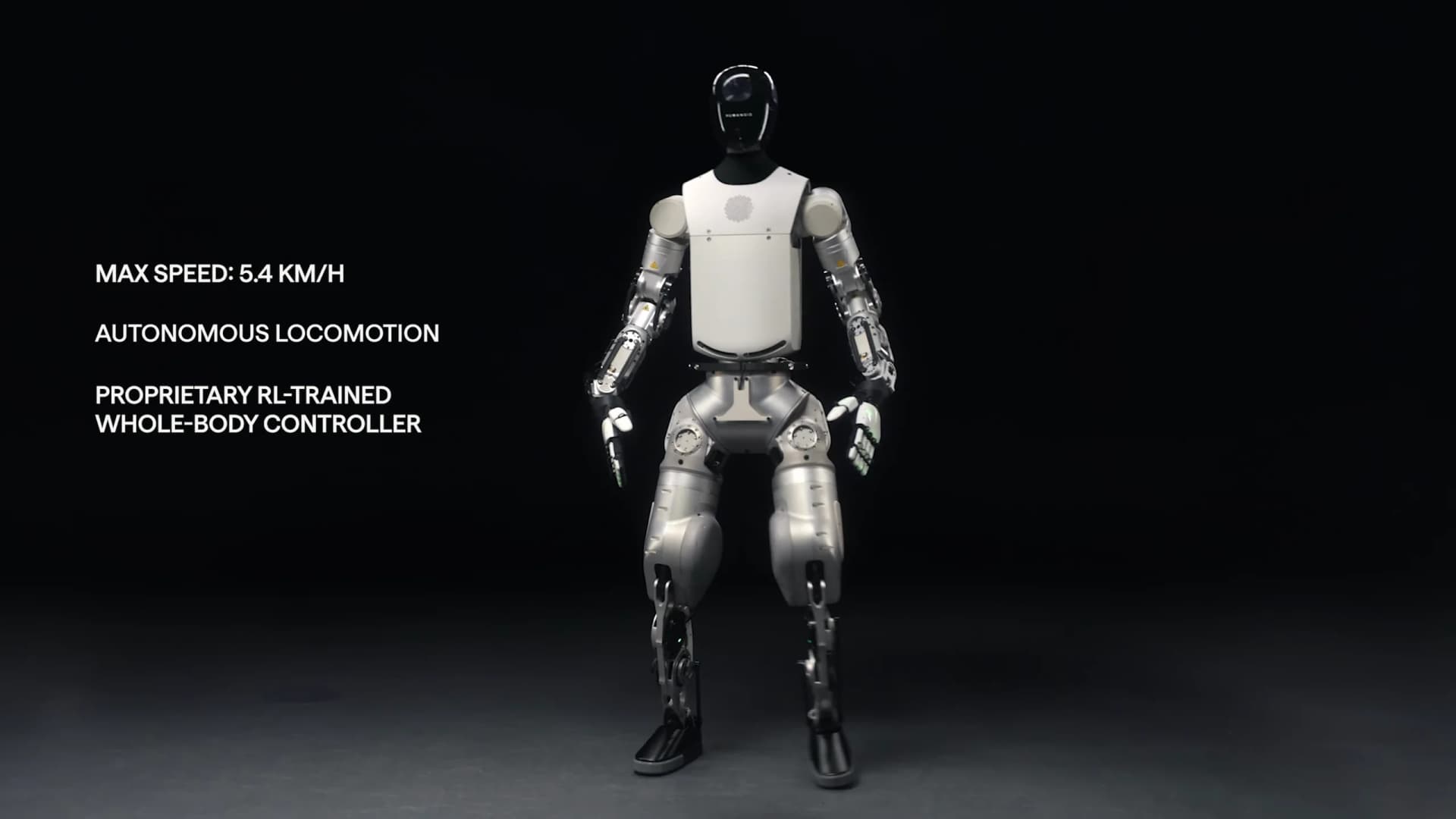
UK-based robotics startup Humanoid has officially revealed the bipedal version of its HMND 01 Alpha platform, delivering on a promise made during its initial brand launch in September.
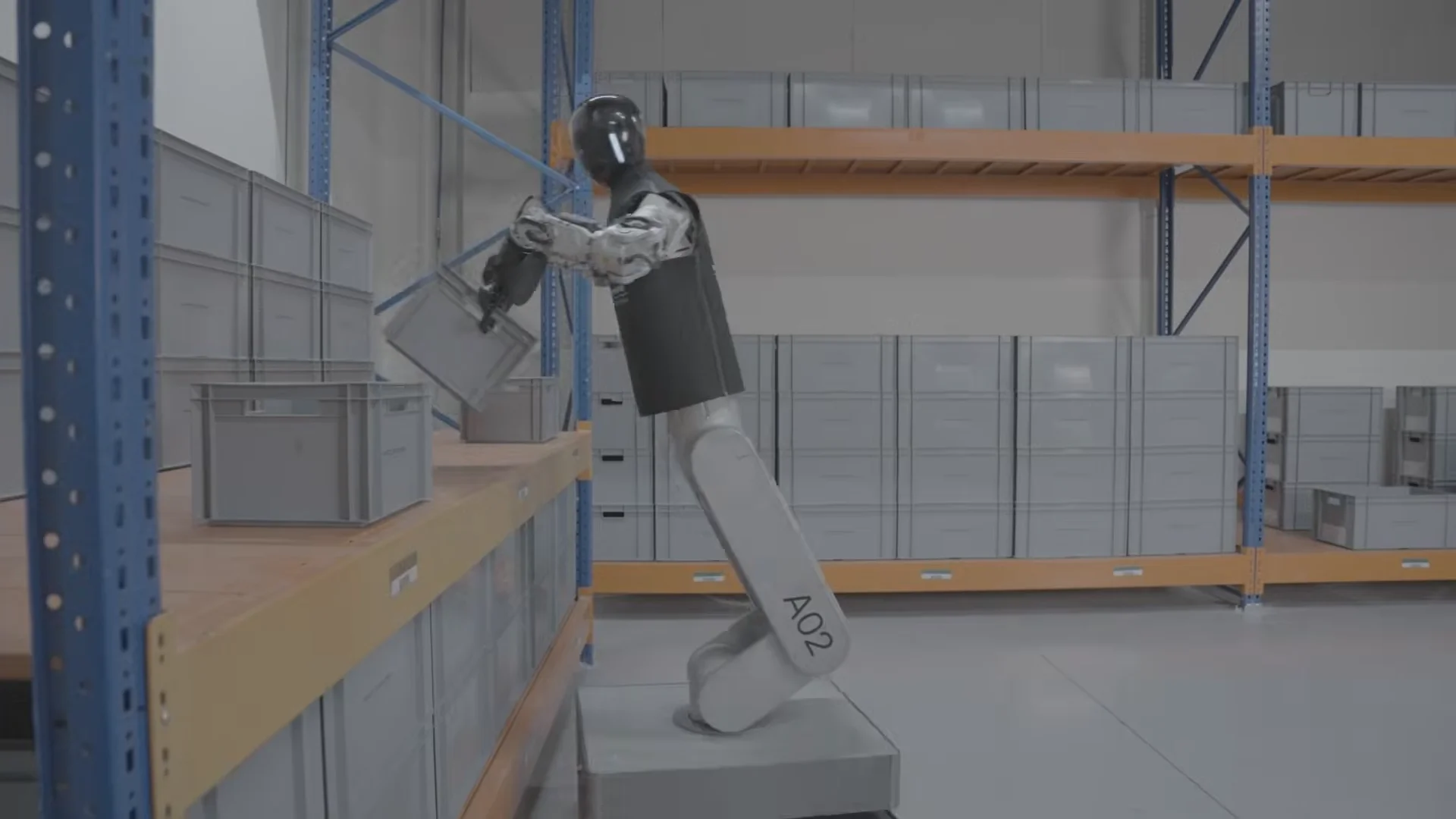
Teased yesterday with a silhouette of robotic legs and fully revealed today via social media and a YouTube demonstration, the bipedal model marks a significant form-factor shift for the company. While Humanoid’s previous milestones and recent Saudi Arabian partnership relied on a heavy, wheeled chassis, this new iteration targets multi-terrain adaptability with human-like legs.
Consistent with the company’s aggressive marketing regarding speed, Humanoid claims the bipedal robot was developed in just five months and was "walking within 48 hours of assembly."
Shrinking the Footprint
The transition from wheels to legs has resulted in a drastically different physical profile for the HMND 01.
The weekly humanoid robotics briefing
One email a week: the launches, funding and research that mattered, with context from Humanoids Daily.
Read recent issuesThe wheeled Alpha, which is currently slated for deployment in Riyadh's logistics sector, was a massive machine—standing 220 cm (7'3") tall and weighing 300 kg. The new bipedal version is much closer to human scale:
- Height: 179 cm (5'10")
- Weight: 90 kg (198 lbs)
- Payload: 15 kg (33 lbs) bimanual
- Runtime: 3 hours
The robot features 29 degrees of freedom (excluding end-effectors) and is powered by a proprietary Vision-Language-Action (VLA) framework running on NVIDIA compute.
Simulation and Stability
The reveal video highlights the role of simulation in achieving the "walking in 48 hours" claim. Humanoid states the robot utilized 13,680 hours of simulation training data to refine its locomotion before the physical hardware was even built.
The results of this reinforcement learning (RL) approach are visible in the demonstration. The robot is shown performing a "push recovery" test—a standard rite of passage in humanoid robotics popularized by Boston Dynamics. In the clip, a human operator shoves the robot with a rod; the machine stumbles, shifts its weight to regain its center of mass, and stabilizes without falling.
The company lists an array of locomotion capabilities, including walking in curved trajectories, sidestepping, squat-walking, and hopping. The robot has a maximum speed of 1.5 m/s (5.4 km/h), making it slightly slower than its wheeled counterpart (2 m/s), but significantly more versatile in environments with stairs or uneven terrain.
Modular Manipulation and "Uniforms"
While legs draw the attention, the update also sheds light on Humanoid's manipulation strategy. The bipedal Alpha features a modular end-effector design, allowing operators to swap between a complex 12-DOF five-finger hand and a simpler 1-DOF parallel gripper depending on the task.
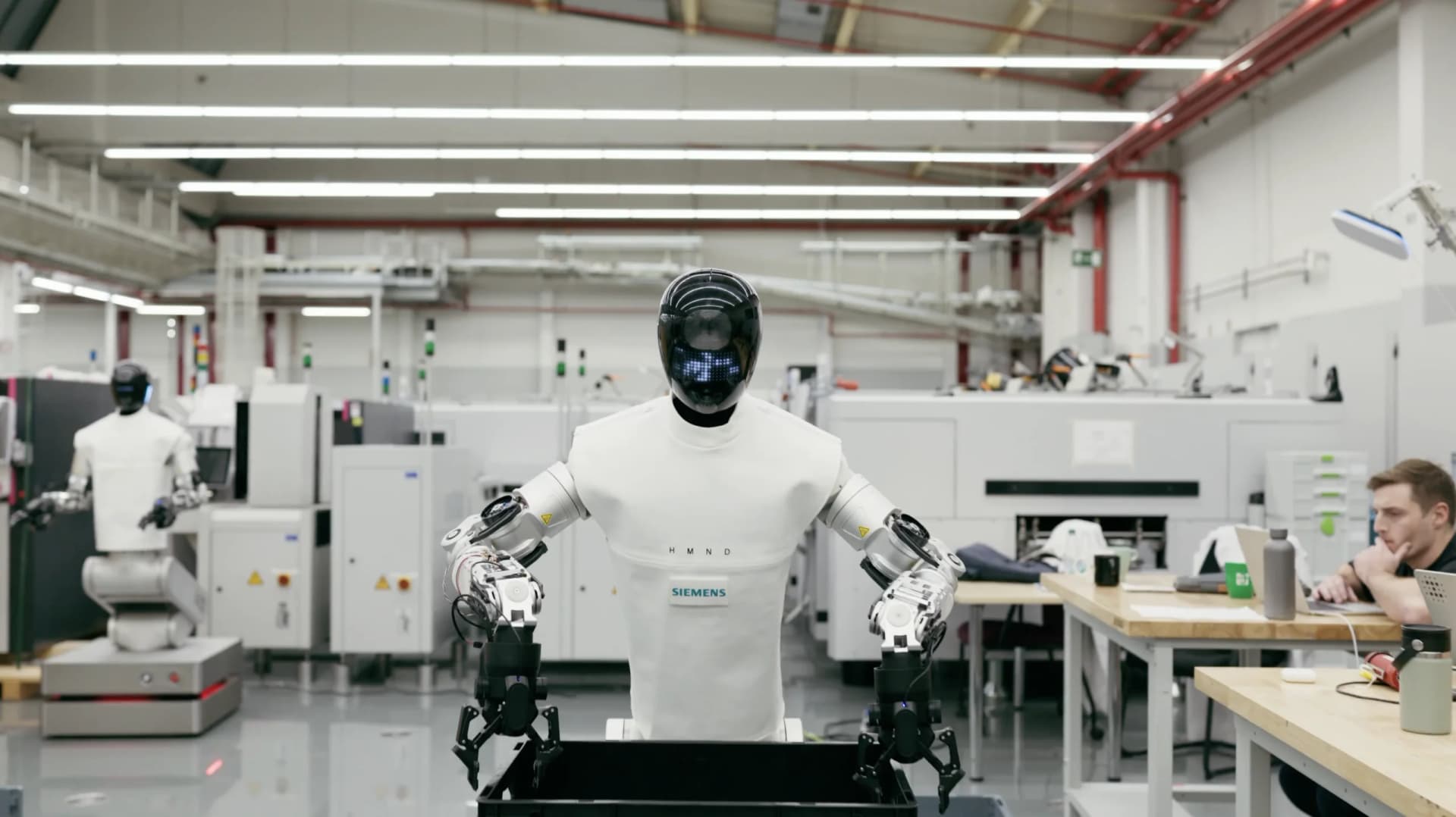
In one segment of the reveal video, the robot is shown manipulating delicate objects like an orange and a coffee cup. In another, it selects a garment from a rack—highlighting the company's unique "clothed" design philosophy. Unlike the bare metal aesthetic common in the industry, Humanoid intends for its robots to wear protective, interchangeable "uniforms."
The "Alpha" Family
The arrival of the bipedal Alpha clarifies Humanoid's broader strategy: a multi-modal hardware family sharing a common AI brain.
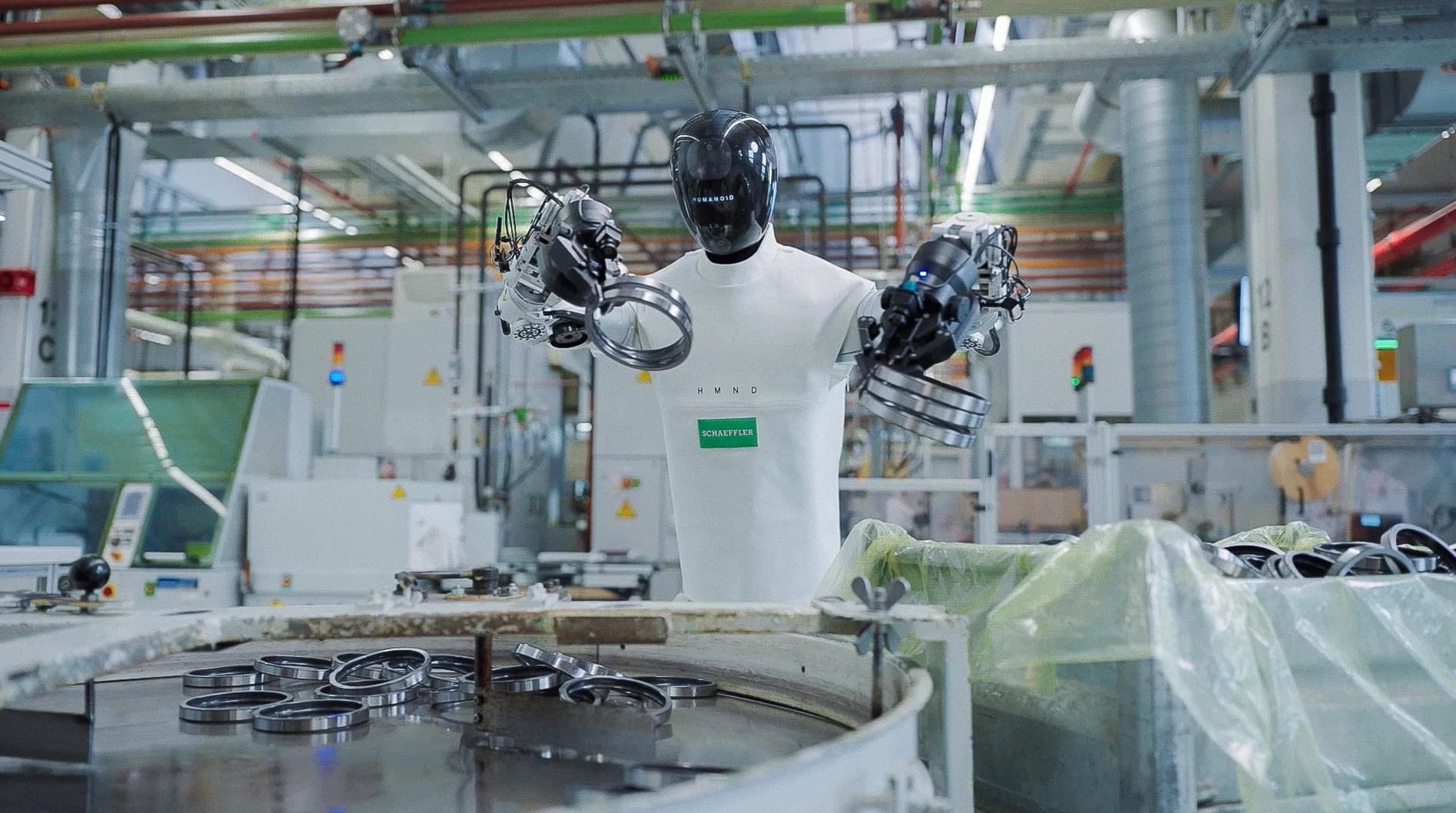
By offering both a stable, heavy-lifting wheeled version and a lighter, agile bipedal version, the company can address a wider range of industrial use cases. The wheeled variants are likely suited for the flat concrete of the Schaeffler factories where the company is already testing, while the bipedal units could eventually handle more complex brownfield environments.
Share this article
Read next
- Published on
- Reading time
- 25 min read
The Humanoids of Europe: Built by Their Customers
- Published on
- Reading time
- 5 min read
Europe’s First Pure-Play Humanoid Unicorn: Humanoid Raises $152M at $1.35B Valuation
- Published on
- Reading time
- 4 min read
From Prototype to Production: Humanoid Taps Bosch for European Manufacturing Push
- Published on
- Reading time
- 4 min read
Scale at Speed: Humanoid and Schaeffler Move to Massive Multi-Thousand Unit Rollout
- Published on
- Reading time
- 4 min read
Siemens and Humanoid Formalize Partnership Following Successful "Physical AI" Trials in Erlangen
- Published on
- Reading time
- 3 min read
From ERP to the Edge: Humanoid and SAP Bridge the Gap in Martur Fompak Logistics Trial

The weekly humanoid robotics briefing
One email a week: the launches, funding and research that mattered, with context from Humanoids Daily.
Read recent issues