- Published on
New ''Iron'' Robot Display Model Inspected in Video, Appears to Use Older-Generation Hands
One tap, and our reporting appears more often in your Google Top Stories. It makes a real difference to a small newsroom.


Your guide
Rich Robinson
Jee Chee Ren · Executive tour
See China’s AI and robotics ecosystem first-hand.
Six days exploring AI, robotics and advanced manufacturing.
With Rich Robinson, Clinical Professor of Entrepreneurship at Peking University
Beijing · Guangzhou · Shenzhen
29 November–4 December 2026
Referral partnership · We earn a commission on referred bookings.
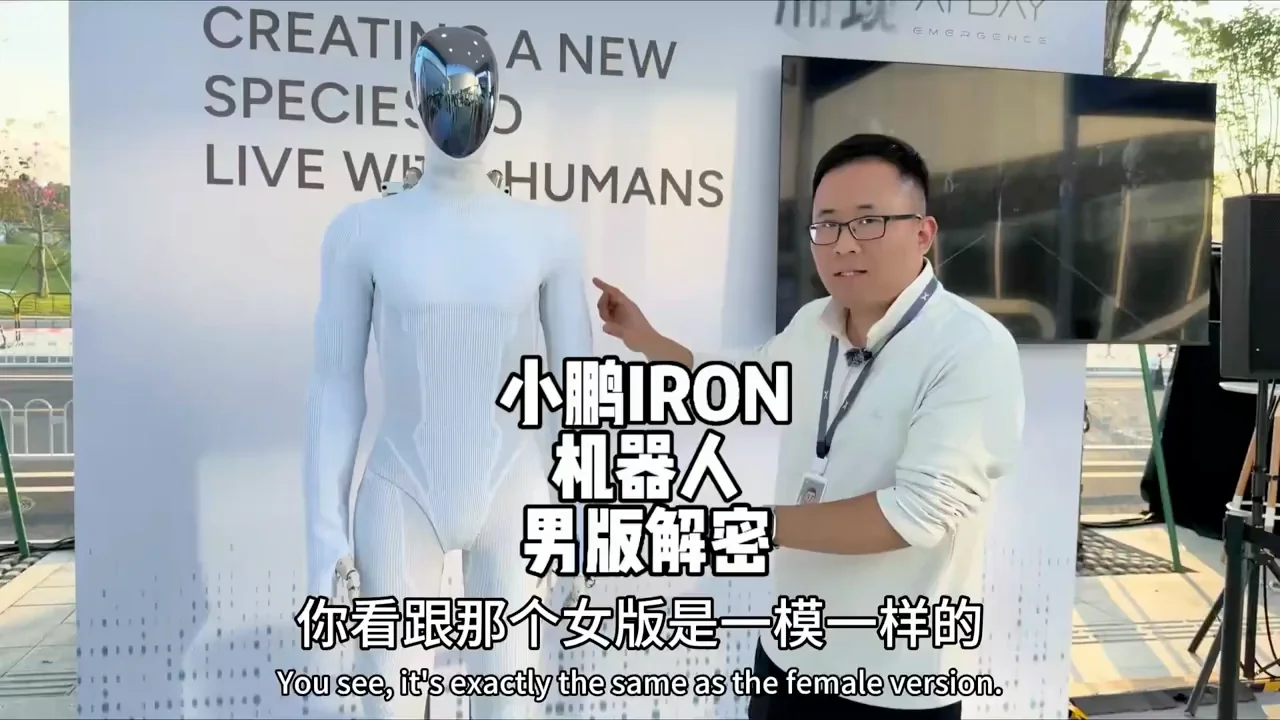
New footage posted to the Chinese social media platform Douyin is providing the closest public look yet at the next-generation 'Iron' humanoid robot, adding a new layer of detail to the story of Xpeng's controversial AI Day 2025 demonstration.
The video, filmed by a journalist, shows a hands-on inspection of both the male and female 'Iron' models that were on display for attendees outside the event venue. While the inspection confirms many of the robot's new design philosophies, it also appears to settle a key question that emerged from the event's "human-in-a-suit" debate.
A "Hands-On" Inspection
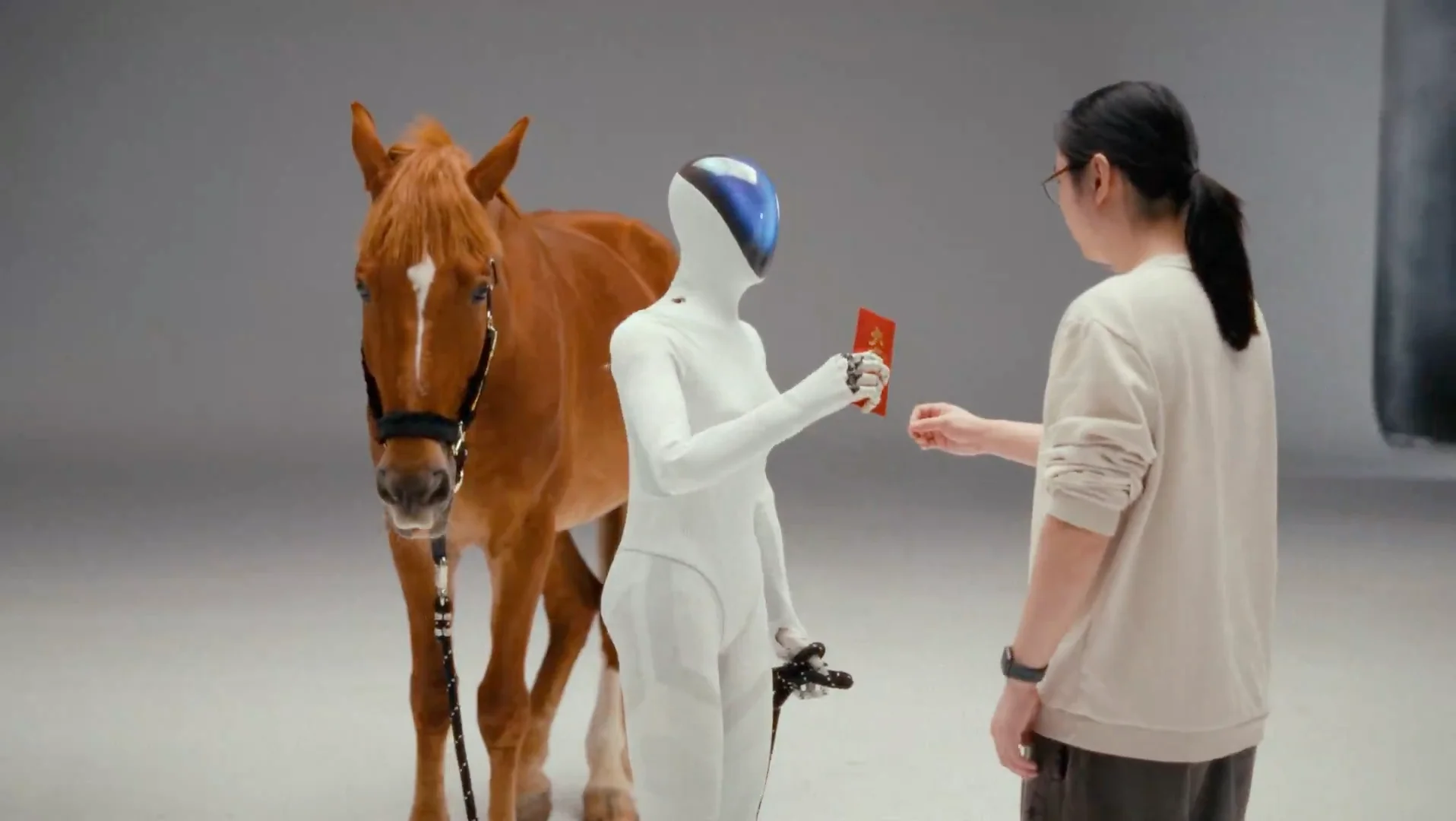
In the video, the journalist touches the robot's exterior, describing the outer shell as feeling "similar to an astronaut suit" and noting the "muscular and fleshy appearance" is due to "some muscle tissue filled inside." This observation aligns with analyst speculation following the keynote that the robot's smooth locomotion was aided by a "bionic muscle" or compliant "fascia" layer between the actuators and the skin.
The journalist notes that the male version appears "strong" and "muscular," and that the soft material on its arms and legs mimics human muscle, complete with realistic-looking wrinkles. He also points out folds in the suit around the "butt area," which he suggests is evidence of the waist-driven movement—a motion Xpeng's CEO previously credited to the new "human-like spine".
The weekly humanoid robotics briefing
One email a week: the launches, funding and research that mattered, with context from Humanoids Daily.
Read recent issuesOther details observed include:
- Head: A "mirror-like material" for a face, with no visible "eyes" or sensors.
- Audio: A square shape near the head is identified as a microphone for "audio import," likely to interface with the robot's VLT (Vision-Language-Task) AI brain.
- Structure: The journalist repeatedly shows that a metal "skeletal structure" is visible at the wrist and through the suit on the robot's back, jokingly reinforcing that it is, in fact, a machine.
The Key Detail: Old Hands
The most significant confirmation in the video relates to the robot's hands. The journalist inspects the metal wrist and hands and explicitly states that they are not the new generation.
"It is said that the latest from Xiaoping has a very small motor in the fingers," the journalist explains, "though this generation model hasn't been released yet".
This observation from the display model directly supports the arguments made by robotics analysts, including Scott Walter, immediately following the AI Day keynote.
This new video, showing an in-person inspection of the display models, strongly suggests that the robots shown at AI Day were hybrid platforms. The new models were not yet equipped with the new, more complex hands—a component that remains one of the most difficult engineering challenges in all of robotics.
Watch the video on Douyin here.
Share this article
Read next
- Published on
- Reading time
- 6 min read
Inside XPENG’s Bet on IRON: He Xiaopeng on Why the Hardest Path in Humanoid Robotics Is Never Crowded
- Published on
- Reading time
- 6 min read
XPENG Launches Mass Production of IRON Humanoid
- Published on
- Reading time
- 4 min read
XPENG's Head of Robotics Admits Hardware is 'Bottleneck' as 2026 Production Goal Looms
- Published on
- Reading time
- 4 min read
Xpeng to Break Ground on "Full-Chain" Humanoid Factory to Meet 2026 Production Goal
- Published on
- Reading time
- 3 min read
XPENG CEO Targets Late 2026 for Massive IRON Deployment
- Published on
- Reading time
- 5 min read
Simulating the 'Masterpiece': XPENG Robotics Unveils Design Framework and Lattice Musculature for IRON

The weekly humanoid robotics briefing
One email a week: the launches, funding and research that mattered, with context from Humanoids Daily.
Read recent issues