- Published on
DeepMind CEO Demis Hassabis: World Models and 'Infinite Training Loops' are the Keys to AGI
One tap, and our reporting appears more often in your Google Top Stories. It makes a real difference to a small newsroom.

Supported by RoboStrategySupport for Humanoids Daily comes from RoboStrategy
Sponsored

Investing involves risk, including possible loss of principal. Read the prospectus before investing.
While the AI industry spent 2025 focused on the raw scaling of large language models, Google DeepMind CEO Demis Hassabis is looking toward the "messy" reality of the physical world. In the season finale of Google DeepMind: The Podcast, Hassabis sat down with Professor Hannah Fry to discuss why the path to Artificial General Intelligence (AGI) relies less on text and more on the mastery of world models and simulations.
For Hassabis, the next phase of AI is about moving from "passive systems" that summarize information to "agentic systems" that understand the cause-and-effect of the universe.
The Limits of Language
Hassabis acknowledged that while Gemini 3 has achieved remarkable breakthroughs, language has inherent limitations when it comes to robotics. "There’s a lot about the spatial dynamics of the world—spatial awareness and the physical context we're in and how that works mechanically—that is hard to describe in words," Hassabis explained.
To solve this, DeepMind is prioritizing world models—AI that doesn't just predict the next word, but predicts the next state of a physical environment. These models encapsulate "intuitive physics," understanding how objects move, how liquids behave, and how mechanics function without needing a verbal manual.
The weekly humanoid robotics briefing
One email a week: the launches, funding and research that mattered, with context from Humanoids Daily.
Read recent issuesThe 'Infinite Training Loop': SIMA and Genie
The most significant strategic revelation from the interview was the convergence of two major DeepMind projects: Genie (an interactive world-generator) and SIMA (Simulated Agents).
Hassabis described a "training loop" that could potentially solve the data bottleneck currently facing the robotics industry:
- Genie as the 'Teacher': Genie can generate realistic, interactive virtual worlds on the fly.
- SIMA as the 'Student': Agents are dropped into these worlds and given millions of tasks to solve, driven by curiosity-based exploration.
- The Loop: Because Genie can create any environment, the agent can practice millions of tasks—like unzipping a bag or navigating a room—in a virtual "boot camp" before ever touching a physical robot.

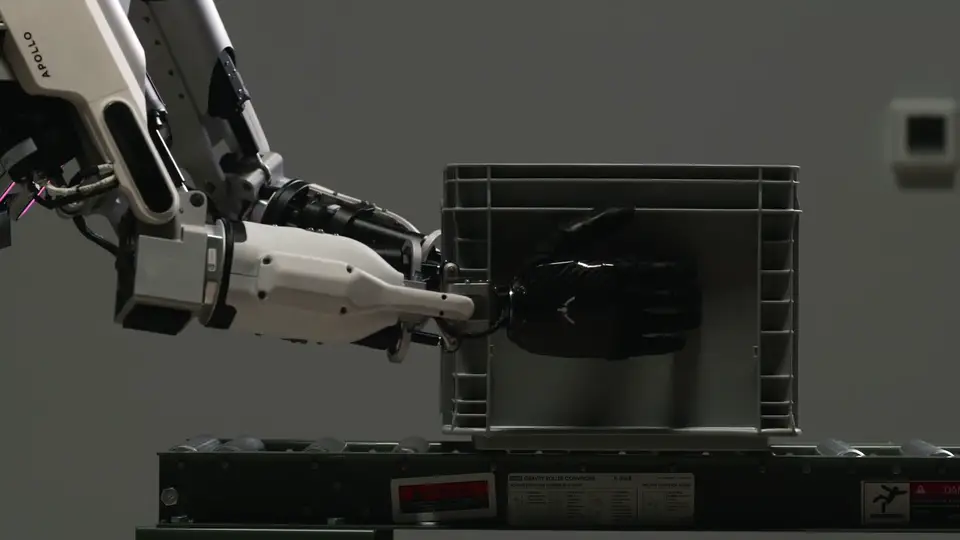
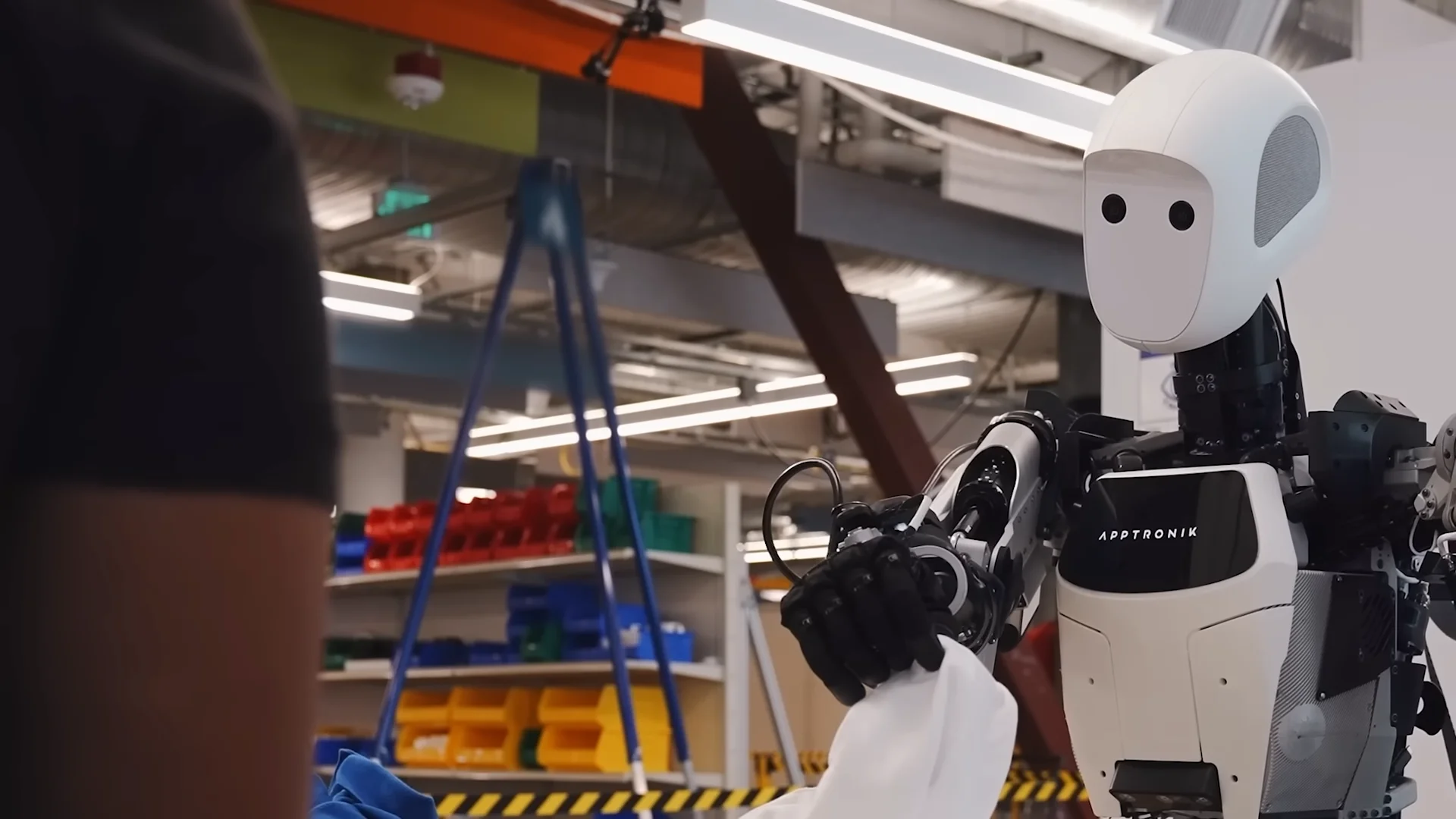
"Whatever the SIMA agent is trying to learn, Genie can basically create on the fly," Hassabis said. This creates a path to "proto-AGI," where the system learns the fundamental motions of the world in simulation, which could potentially be deployed via cross-embodiment strategies onto hardware like the Apptronik Apollo.
Turning Hallucinations into Creativity
One of the more analytical points Hassabis made involved the transition from "hallucinations" to "grounded physics." While hallucinations are a bug in a chatbot, they can be a feature in creative exploration. However, for Physical AI, the stakes are higher.
Hassabis noted that current video models like Veo look realistic to the naked eye but aren't yet "physics-grade." DeepMind is now building physics benchmarks—re-running simple lab experiments like pendulums and rolling balls in simulation—to ensure their world models adhere to Newton’s laws of motion with 100% accuracy.
A Decade of Radical Change
Looking ahead, Hassabis predicts that agent-based systems will become "really impressive and reliable" in just the next two to three years. He warned that the societal shift following AGI will be "10 times bigger than the Industrial Revolution" and will likely unfold over a decade rather than a century.
By focusing on world models as the "root node" for robotics, DeepMind is positioning itself not just as a builder of chatbots, but as the architect of a "universal assistant" that understands the physical world as well as—or better than—humans do.
Share this article
Read next
- Published on
- Reading time
- 4 min read
Google DeepMind Opens the Portal: Project Genie and the Quest for the "Infinite Training Loop"
- Published on
- Reading time
- 7 min read
Google DeepMind Unveils Gemini Robotics 2, Bringing Whole-Body Intelligence and Multi-Robot Teams to Physical AI
- Published on
- Reading time
- 4 min read
Agile Robots and Google DeepMind Partner to Bring Gemini to the Factory Floor
- Published on
- Reading time
- 5 min read
Waymo Leverages Genie 3 to Launch "Waymo World Model" for Hyper-Realistic Simulation
- Published on
- Reading time
- 5 min read
Google DeepMind Robotics Director: We Need "One More Big Breakthrough" to Solve General Purpose Robots
- Published on
- Reading time
- 4 min read
Google DeepMind Unveils Gemini Robotics-ER 1.6: A Leap in Spatial Reasoning and Industrial Utility


The weekly humanoid robotics briefing
One email a week: the launches, funding and research that mattered, with context from Humanoids Daily.
Read recent issues