- Published on
US Humanoid Robot Ambitions Hit Supply Chain Snag Amid China Tariffs
One tap, and our reporting appears more often in your Google Top Stories. It makes a real difference to a small newsroom.


Your guide
Rich Robinson
Jee Chee Ren · Executive tour
See China’s AI and robotics ecosystem first-hand.
Six days exploring AI, robotics and advanced manufacturing.
With Rich Robinson, Clinical Professor of Entrepreneurship at Peking University
Beijing · Guangzhou · Shenzhen
29 November–4 December 2026
Referral partnership · We earn a commission on referred bookings.
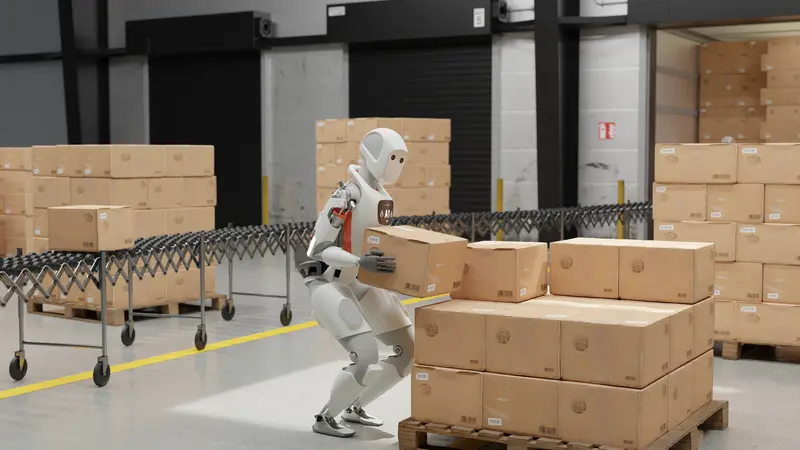
TL;DR: The U.S. push to lead in humanoid robotics is being complicated by new tariffs on Chinese imports — a key source of components like actuators, sensors, and vision systems. While companies like Apptronik and Rapid Robotics aim to build domestically, they still rely on China’s advanced and cost-effective supply chain. Rising costs and uncertainty threaten to stall momentum just as U.S. investment in humanoid robotics is gaining steam.
US Tariffs Complicate Push to Compete with China on Humanoid Robots
A recent push by US companies and lawmakers to bolster the domestic humanoid robotics industry faces significant headwinds from tariffs, particularly those impacting components sourced from China.
Washington Showcase Meets Market Reality
In late March, several US robotics firms, including Apptronik and Tesla, demonstrated their humanoid robots to a bipartisan group of lawmakers in Washington D.C. The event, organized by the House Select Committee on the Chinese Communist Party, aimed to highlight American capabilities and galvanize efforts to compete with China in this emerging field.
However, subsequent tariff announcements, including significant levies on Chinese imports, have introduced considerable uncertainty into the US robotics supply chain. This is particularly challenging for humanoid robots, which rely on a complex array of specialized parts.
China's Role in the Humanoid Supply Chain
Humanoid robots demand sophisticated components like actuators (making up over half the material cost), advanced sensory systems, and computing chips. According to analysis by Bank of America cited in a recent Bloomberg report, China is a dominant manufacturer for many of these critical parts. For instance, actuators often incorporate Chinese-made frameless torque motors and precision bearings. Furthermore, four out of five major suppliers for humanoid vision systems are reportedly Chinese firms.
The weekly humanoid robotics briefing
One email a week: the launches, funding and research that mattered, with context from Humanoids Daily.
Read recent issues"If you look across a robot, it’s a complicated machine that has computers, batteries, cameras, motors — a lot of different components," Jeff Cardenas, CEO of Apptronik, told Bloomberg. While Apptronik assembles its robots in the US, it acknowledges reliance on some Chinese materials. The shifting tariff landscape creates daily uncertainty for companies navigating their supply chains.
Cost and Competition Concerns
The tariffs risk increasing the cost of building humanoid robots in the US, potentially slowing down development and hindering competitiveness against Chinese counterparts. Jeff Burnstein, president of the Association for Advancing Automation (A3), highlighted the difficulty, noting that even if companies want to source domestically, suppliers for certain essential components may not exist in the US or are significantly more expensive.
"If the cost of these parts skyrockets, it’s going to slow our ability to compete," Burnstein stated.
This situation arises even as China actively promotes robotics innovation through initiatives like "Made in China 2025," leveraging its strong manufacturing base and supply chain.
Momentum Meets New Hurdles
The US humanoid robotics sector had recently seen a surge in investment and activity, partly driven by advances in AI and, significantly, the decreasing cost of hardware components often sourced from China. Venture capital firms had poured significant funding into startups like Apptronik, Figure AI, and Dexterity.
"China now produces a lot of components and the cost of the hardware has come way down," Aaron Jacobson, a partner at New Enterprise Associates (NEA), explained to Bloomberg, noting this enabled startups to pursue ambitious projects.
The new tariffs, however, have abruptly changed the dynamic. Kim Losey, CEO of Rapid Robotics (an NEA-backed startup that recently pivoted towards industrial humanoids), described the tariffs as throwing "this whole new wrench in the momentum." Losey indicated that the affordability of the Chinese supply chain was key to their recent strategy shift, and the company is now actively exploring supplier diversification, potentially looking to Canada or Taiwan.
“China is extremely advanced in robotics components, and it's hard to ignore”
While alternatives exist in places like Germany or Japan, Losey pointed out potential trade-offs in speed, contrasting the weeks or months needed by some alternative suppliers with the faster turnaround times often available from China. "China is extremely advanced in robotics components, and it's hard to ignore," she said.
The uncertainty surrounding tariffs presents a complex challenge for the US humanoid robotics industry as it strives to innovate and compete on the global stage.
Share this article
Read next
- Published on
- Reading time
- 10 min read
The Great Valuation Chasm: A 2025 Guide to the Humanoid Robotics Capital Race
- Published on
- Reading time
- 6 min read
Humanoid Hype vs. Hardware Reality: New Report Scrutinizes Startup IP Strength
- Published on
- Reading time
- 4 min read
Podcast Recap: Inside the Rotary-vs-Linear Actuator Showdown Shaping Humanoid Robots
- Published on
- Reading time
- 5 min read
Investor Chris Camillo: Humanoid Robots are 'Embodied AI' with Trillion-Dollar Potential
- Published on
- Reading time
- 4 min read
Actuator Architecture Sparks Debate: Figure CEO Refutes Claim of Using Planetary Roller Screws
- Published on
- Reading time
- 3 min read
Humanoid Robots: Insights from Agility Robotics and Apptronik Executives


The weekly humanoid robotics briefing
One email a week: the launches, funding and research that mattered, with context from Humanoids Daily.
Read recent issues