- Published on
Parkour for Humanoids: Amazon’s PHP Framework Masters Agile Traversal
One tap, and our reporting appears more often in your Google Top Stories. It makes a real difference to a small newsroom.



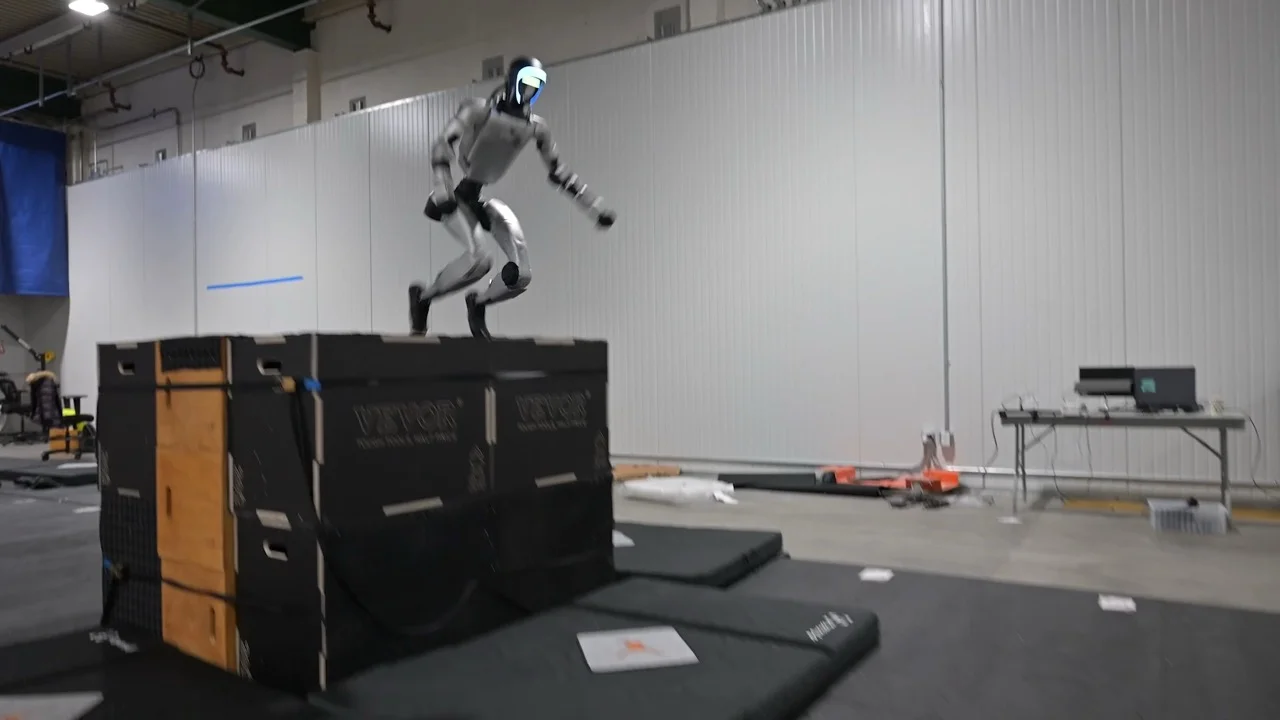
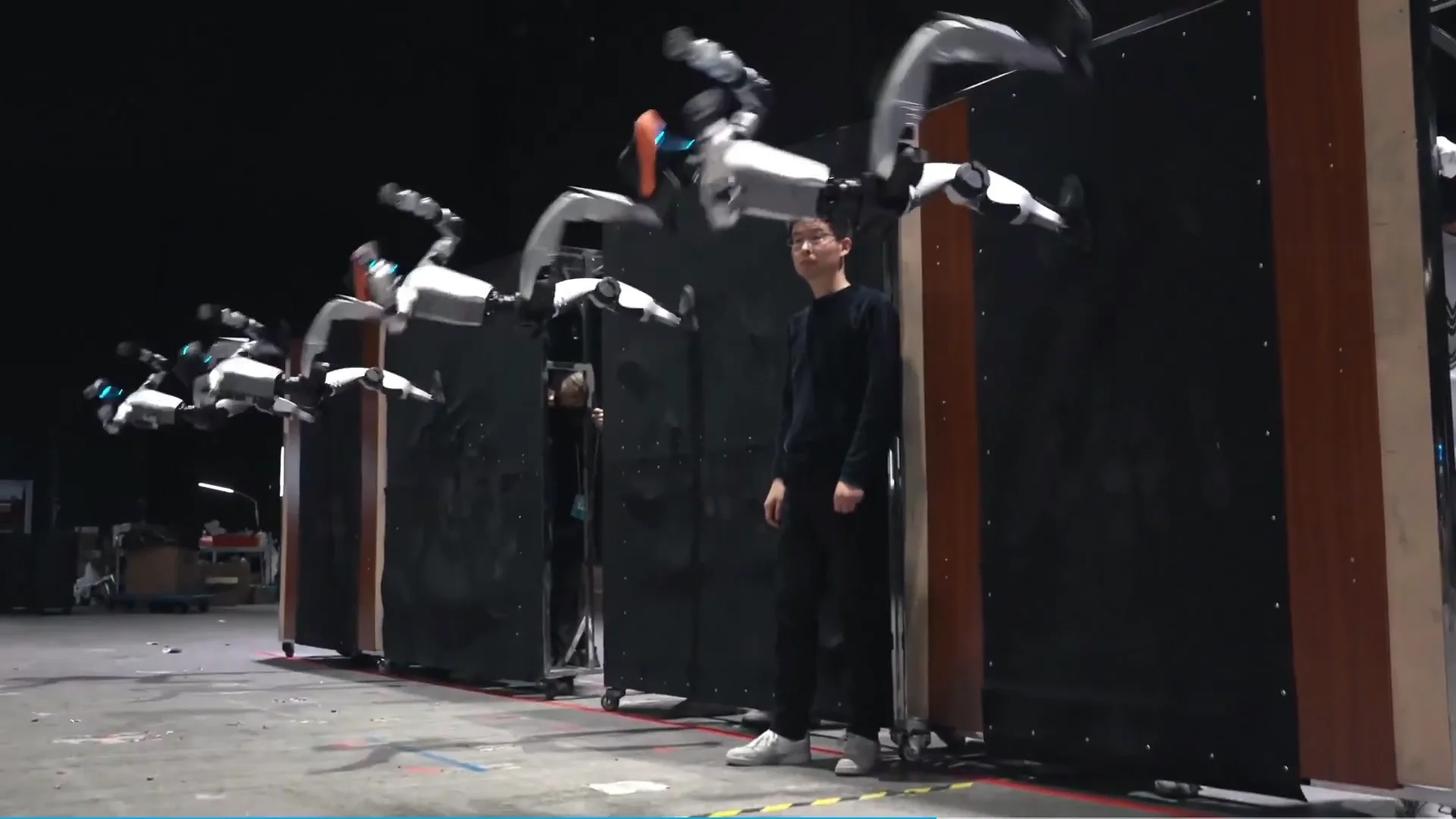
Amazon’s Frontier AI & Robotics (FAR) team, in collaboration with researchers from UC Berkeley, Stanford, and CMU, has unveiled Perceptive Humanoid Parkour (PHP). This new framework enables humanoid robots to autonomously navigate complex, multi-obstacle environments with a level of agility that mirrors human parkourists.
Demonstrated on the Unitree G1 humanoid, the system allows the robot to execute high-speed vaults, roll off platforms, and climb walls reaching 1.25 meters—approximately 96% of its own height.
Solving the Composition Challenge
The primary hurdle in humanoid parkour is not just executing a single jump, but the "long-horizon" problem: chaining diverse, contact-rich skills into a seamless traversal. Traditional reinforcement learning (RL) often struggles with this "embodiment gap" and the scarcity of high-quality dynamic motion data.
To address this, the PHP framework utilizes motion matching, a technique borrowed from the video game industry. By stitching together locomotion segments and atomic parkour clips, the system generates diverse kinematic reference trajectories. This process "densifies" sparse motion data, allowing the robot to learn how to approach obstacles from various distances and angles.
The weekly humanoid robotics briefing
One email a week: the launches, funding and research that mattered, with context from Humanoids Daily.
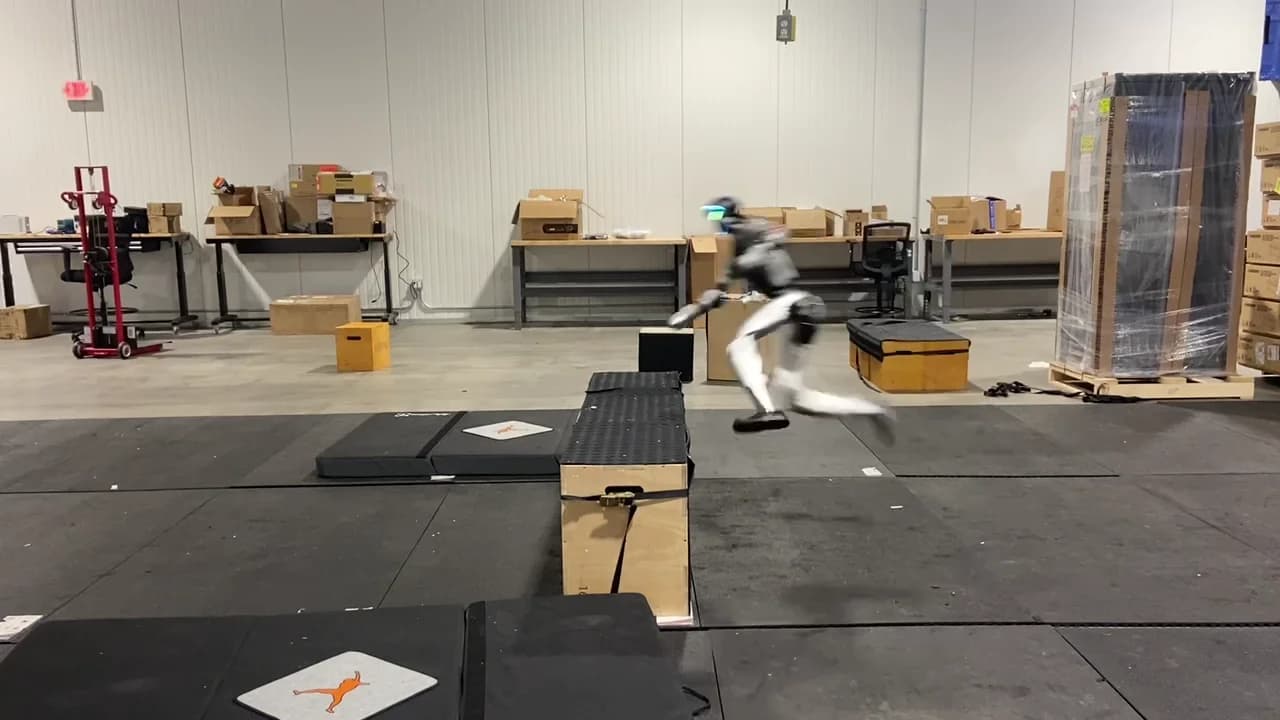
Read recent issuesThis pipeline builds directly on Amazon’s previous work with OmniRetarget, which translates human motion-capture data into physically feasible robot movements. By using OmniRetarget to create the initial library of skills, PHP can scale to complex maneuvers like cat-vaulting at speeds of approx 3~m/s.
Why Imitation Isn’t Enough
While imitation learning (specifically DAgger, Dataset Aggregation) is often used to train robots, the FAR team found it insufficient for the high-torque bursts required in parkour. A robot imitating a human might "stall" during a pull-up phase because the imitation loss doesn't prioritize the explosive power needed to clear an obstacle.
PHP solves this through a hybrid training objective that combines DAgger with RL.
- DAgger provides a regularization that keeps motions looking natural and human-like.
- RL provides a success-driven signal, encouraging the high-magnitude torque actions necessary for success.
The resulting "student" policy is trained in massive simulations—using up to 16,384 parallel environments—and is distilled into a single visuomotor policy that runs entirely on onboard depth sensing.
Zero-Shot Real-World Performance
One of the most significant results of the PHP research is the successful zero-shot sim-to-real transfer. The policies trained in simulation worked on the physical Unitree G1 without real-world fine-tuning.
In experiments, the robot demonstrated:
- Human-Level Agility: Climbing a 1.25-meter wall in 3.63 seconds, matching the timing of human parkourists.
- Closed-Loop Adaptation: Navigating a 60-second continuous course where obstacles were displaced mid-run.
- Autonomous Skill Selection: Using vision to decide whether to step, vault, or climb based on the height and geometry of detected objects.
The Strategic Blueprint
The release of PHP follows the open-sourcing of Holosoma, Amazon’s unified framework for humanoid simulation and training. Together, these tools form an interconnected ecosystem aimed at creating "generalist" robotic brains.
While parkour might seem like an academic exercise, it is a critical testbed for robots that must eventually navigate the "unstructured environments" of warehouses and delivery routes. As Amazon pursues its goal of 75% automation in its operations, the ability for a robot to autonomously overcome physical obstacles becomes a core business imperative rather than just a technical feat.
The FAR team notes that future iterations will likely focus on adding semantic scene understanding and more capable hardware, such as stronger grippers for more extreme climbing and hanging maneuvers. For now, PHP represents a significant step toward making humanoids as agile and adaptive as the humans they are designed to work alongside.
Share this article
Read next
- Published on
- Reading time
- 3 min read
A Humanoid Robot in Aisle 5? Unitree G1 Appears on Walmart Website for $21,600
- Published on
- Reading time
- 3 min read
One-Click Humanoid: Unitree G1 Hits Amazon US with a 'Convenience Premium'
- Published on
- Reading time
- 3 min read
Amazon's ResMimic Teaches Humanoids to Handle Objects by Adding Precision to General Motion
- Published on
- Reading time
- 5 min read
BitRobot and Hugging Face Drop HIW-500: A Massive 10TB Real-Home Humanoid Dataset
- Published on
- Reading time
- 3 min read
Sacred Ground, Silicon Swarm: Unitree’s G1 Fleet Performs at the Temple of Heaven
- Published on
- Reading time
- 2 min read
Watch: Unitree Previews "Cluster Cooperative" Tech with Mass Humanoid Performance



The weekly humanoid robotics briefing
One email a week: the launches, funding and research that mattered, with context from Humanoids Daily.
Read recent issues