- Published on
LiberAI Unveils Liber-0: Learning from Human Experience for Zero-Shot Robot Manipulation
One tap, and our reporting appears more often in your Google Top Stories. It makes a real difference to a small newsroom.

- Liber-0 learns from over 2.2 million hours of human experience, combining broad visual learning with action and motion supervision for robot manipulation.
- On a separate suite of 60 GPT-6-proposed target tasks, Liber-0 achieved task success rates of 63.5% on pick-and-place tasks, 34.0% on non-pick-and-place manipulation tasks and 10.5% on challenging non-PnP and long-horizon tasks, for 36.0% overall across 600 trials. The evaluated checkpoint was not trained on robot demonstrations collected specifically for these target tasks.
- Glove-recorded motion, visual and kinematic alignment, and embodiment-conditioned learning work together to support human-to-robot transfer.
- In controlled single-source tests with identical robot post-training, 10,000 hours of glove recordings outperformed 2 million hours of web video; the full staged Liber-0 recipe performed best overall.
- In a controlled evaluation, glove demonstrations enabled policies to perform actions absent from their robot-demonstration set.
- In an eight-task evaluation, 25% of the robot pool plus the full glove pool achieved a progress score of 75.6, versus 72.8 with the full robot pool. The complete robot and glove pools contained equal numbers of demonstrations.
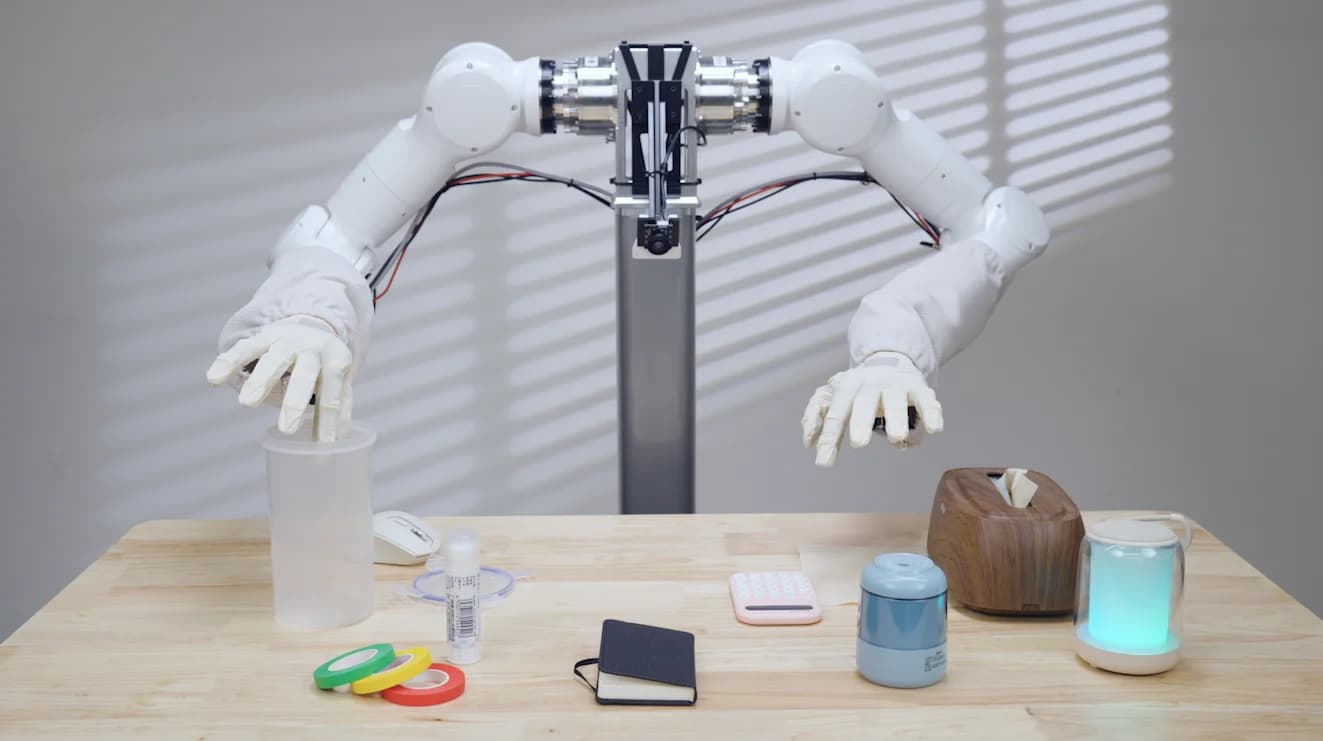
People carry an enormous amount of practical knowledge about the physical world. We pick up a cup we have never seen before, open an unfamiliar drawer or turn a stiff knob, usually without a second thought. LiberAI, a Beijing startup founded in December 2025, is building its approach to robotics around the idea that this accumulated experience can be put to work.
Its new model, Liber-0, is a world action model (WAM) pretrained on more than 2.2 million hours of human experience. That figure does not describe millions of hours of people demonstrating tasks to robots. Large-scale human video gives the model broad exposure to people, objects, and environments. Glove-recorded human demonstrations and robot demonstrations then connect visual observations with the physical actions that produce them. The central question is whether this human experience can help robots perform tasks without robot demonstrations collected specifically for them.
The comparison with language models comes naturally. Large language models learned from vast quantities of human text rather than being programmed one answer at a time, and LiberAI is pursuing a similar idea for physical action. Its technical report argues that human experience transfers to robots most effectively when broad visual coverage is paired with reliable action grounding and a robot body aligned with the people it learns from.
Three gaps between watching and doing
A person watching someone open a bottle can readily understand what is happening. The video, though, does not tell an AI system the exact finger poses or wrist trajectory. Text provides language models with a common representation of human knowledge. Human video, by contrast, does not directly specify commands a robot can execute.
Follow humanoid robotics without following every announcement.
Get the week’s most important launches, funding and research—and why they matter—in one email from Humanoids Daily.
Once a week. Unsubscribe anytime.
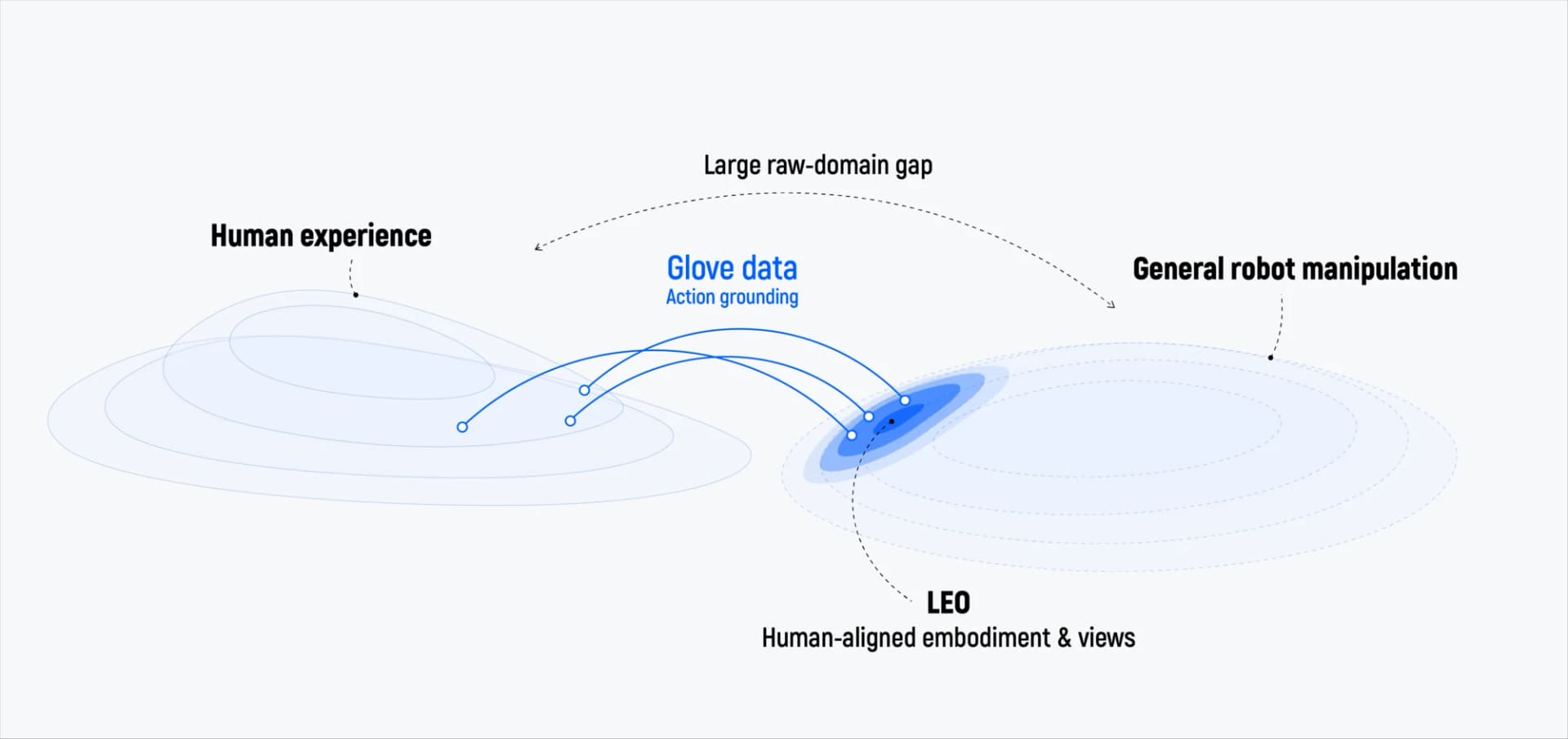
Read recent issuesLiberAI identifies three gaps. The first is visual: human recordings and robot cameras see the same activity from different viewpoints, and human hands and bodies look different from a robot's. The second is action supervision: hand positions estimated from ordinary video can be noisy or incomplete because of occlusion and depth errors. The third is embodiment: humans and robots have different bodies, so the same goal can call for different movements. Liber-0's design tackles each in turn.
Grounding human video in measured action
The first step is to give video an action signal. LiberSense Glove, LiberAI's data-collection system, directly records hand poses and trajectories as people manipulate objects. A first-person camera and two wrist-mounted cameras capture the scene from viewpoints closely aligned with those available to the company's robot. The gloves are 0.3 mm thick and weigh 131 g, with a skin-toned exterior that resembles the bare hands seen in everyday video. These recordings link visual observations with measured motion, helping Liber-0 learn transferable skills from a much larger pool of human video. Because collection does not require a robot at each site, demonstrations can be gathered from many people, tasks and environments.
Liber-0 is trained to predict what happens next. As a world action model, it jointly predicts future video frames and the actions that produce them. Clips without action labels still teach the model through visual prediction, while glove and robot clips also supervise its actions. Training runs in three stages: broad visual prediction across human activity, then joint learning of frames and actions, then a manipulation-focused stage that increases the sampling weight of glove and teleoperation recordings.
LiberAI's scaling experiments examine how each data source contributes to manipulation performance. The company pretrained separate models on single data sources, applied the same robot post-training to each, and measured progress scores, a 0 to 100 measure that credits partial completion. Every source beat the baseline, and performance generally rose with more data, despite some fluctuation at intermediate scales. Web video scaled to 2 million hours reached 64.6 on pick-and-place (PnP) and 51.2 on non-PnP manipulation, both below a model pretrained on 10,000 hours of glove recordings, despite a 200-fold difference in recording duration.
Glove data showed the strongest non-PnP scaling among the evaluated sources: increasing it from 1,000 to 10,000 hours added 14.7 points on PnP and 13.1 on non-PnP. After the full staged pretraining recipe and robot post-training, Liber-0 reached progress scores of 83.6 on PnP and 73.8 on non-PnP, the highest among the evaluated configurations.
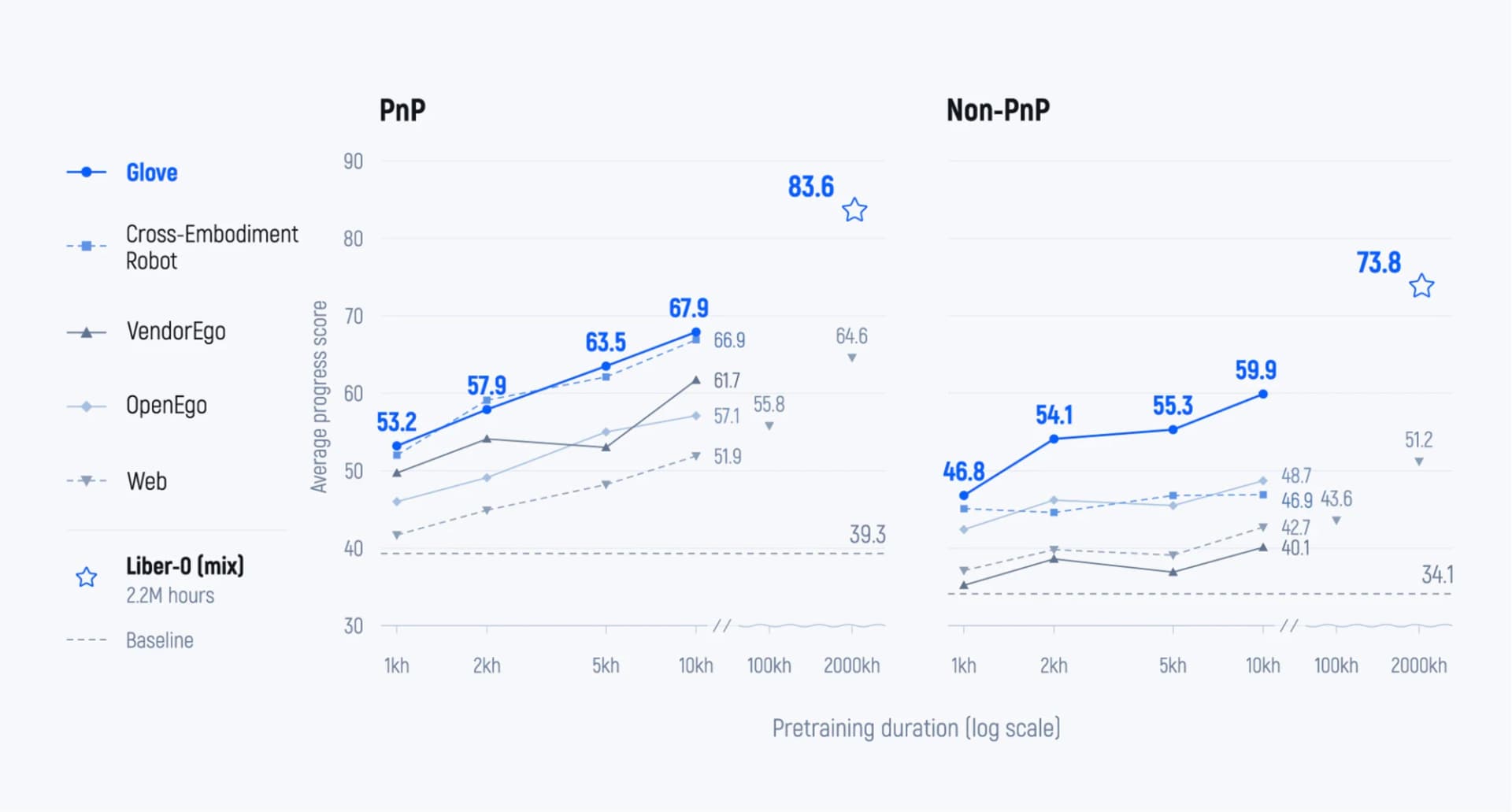
LiberAI reads this as a division of labor. Broad experience helps a robot choose and move objects, while precise, sustained manipulation depends more on the quality of motion supervision. For LiberAI, scaling human experience therefore requires not only broader visual coverage, but also an action signal that robots can learn from.
Bringing the robot to the data
LiberAI also attacks the problem from the robot's side. Rather than retarget human motion onto robots with very different bodies, the company designed its robotic platform, LEO, to sit closer to the human data, with dexterous hands, articulated wrists, an adjustable waist and first-person camera placement.
The reasoning is easy to picture. Turning a knob requires the fingers to hold their grip while the wrist rotates. Opening a drawer requires the fingers to hook the handle while hand, wrist and arm pull together. Reaching for slippers near the floor requires the upper body to bend as well. A robot that can make these movements is better placed to use human demonstrations of them.
A Unified Embodiment Representation handles the differences that remain. It encodes human height, arm length, body configuration and hand geometry alongside robot arm and hand kinematics, and the policy conditions its actions on this context. A tall person, a shorter person and a robot may open the same drawer in slightly different ways; the model learns the shared behavior while accounting for the body performing it. At deployment, it receives LEO's representation.
That framing makes human variety useful rather than noisy. Holding the total number of glove episodes constant, with the same tasks and environments across groups, LiberAI varied the number of demonstrators from 1 to 100 and evaluated on two PnP and four non-PnP tasks. Progress rose from 60.6 to 69.5 when glove data was combined with a small, fixed set of robot demonstrations. For policies trained on glove data alone, it rose from 12.7 to 40.1, narrowing the gap to a robot-only reference of 51.8. More demonstrators also means more variety in movement strategy, so the result reflects broader human coverage generally rather than body shape alone.
Actions the robot data lacked
A controlled experiment tests whether human demonstrations can transfer behaviors absent from a policy's robot-demonstration set. LiberAI restricted a policy's robot demonstrations to pick-and-place, while glove demonstrations included actions such as folding, pressing and opening. Evaluated on four PnP and six non-PnP tasks, the policy trained on robot data alone reached a non-PnP progress score of 2.2, having no examples of those actions to learn from. Glove recordings of the missing actions raised it to 47.5. Adding shared pick-and-place glove recordings as well lifted it to 54.6, close to the 56.3 of a policy trained on robot demonstrations of every action, and raised PnP progress from 54.3 to 69.5. LiberAI's interpretation is that behaviors performed by both humans and robots act as anchors, helping the model relate human motion to robot action. The actions appeared in the glove demonstrations but not in the policies' robot demonstrations, and the experiment is separate from the company's zero-shot evaluation.
Glove data also stretched a limited robot budget. In an eight-task evaluation on LEO, where the full robot and glove pools contained equal numbers of demonstrations, using 25% of the robot pool plus the full glove pool achieved a progress score of 75.6, versus 72.8 with the full robot pool. That is 75% fewer robot demonstrations, not 75% less data overall. With no robot demonstrations in policy training at all, the full glove pool alone reached 60.3.
From watching to doing
LiberAI's separate zero-shot evaluation brings the central question into focus: can the model perform target tasks without robot demonstrations collected specifically for them? Across 60 GPT-6-proposed tasks and 600 trials, Liber-0 achieved an overall task success rate of 36.0%, including 63.5% on PnP tasks, 34.0% on non-PnP manipulation tasks and 10.5% on challenging non-PnP and long-horizon tasks. The evaluated checkpoint was not trained on robot demonstrations collected specifically for these target tasks.
The supporting experiments help explain the approach: glove recordings improved manipulation performance, reduced the need for robot demonstrations and introduced behaviors absent from robot training data. Together, the results suggest that human experience can support broader robot capabilities when paired with reliable action grounding and embodiment alignment.
Most of the results are progress scores on LiberAI's internal benchmarks rather than task success rates, and the gloves do not yet capture contact or force, which matter for insertion, fastening and handling soft materials. LiberAI identifies tactile and force sensing, and collection across a wider range of everyday homes, as future research directions.
The idea underneath is a simple one. People rarely need a lesson to open an unfamiliar drawer, because they draw on a lifetime of related experience. Liber-0 is LiberAI's attempt to give robots access to that same source.
Share this article
Follow humanoid robotics without following every announcement.
Get the week’s most important launches, funding and research—and why they matter—in one email from Humanoids Daily.
Once a week. Unsubscribe anytime.
Read recent issuesRead next
- Published on
- Reading time
- 3 min read
AiMOGA Opens Global Pre-Orders for MOBO Home Companion Robot
- Published on
- Reading time
- 3 min read
Xiaomi Shows Humanoids Sorting Car Parts in Eight-Hour Factory Demonstration
- Published on
- Reading time
- 3 min read
DEEP Robotics Humanoids Join Traffic Police at Hangzhou Marathon
- Published on
- Reading time
- 3 min read
AGIBOT Livestreams Six G2 Robots in a 24-Hour Convenience Store Challenge
- Published on
- Reading time
- 4 min read
Meta Reportedly Built “Max” Humanoid With Fourier, With a Second Version Underway
- Published on
- Reading time
- 5 min read
What Is Worken? AGIBOT’s Proposed Measure of Productive Robot Work