- Published on
What Is Worken? AGIBOT’s Proposed Measure of Productive Robot Work
One tap, and our reporting appears more often in your Google Top Stories. It makes a real difference to a small newsroom.

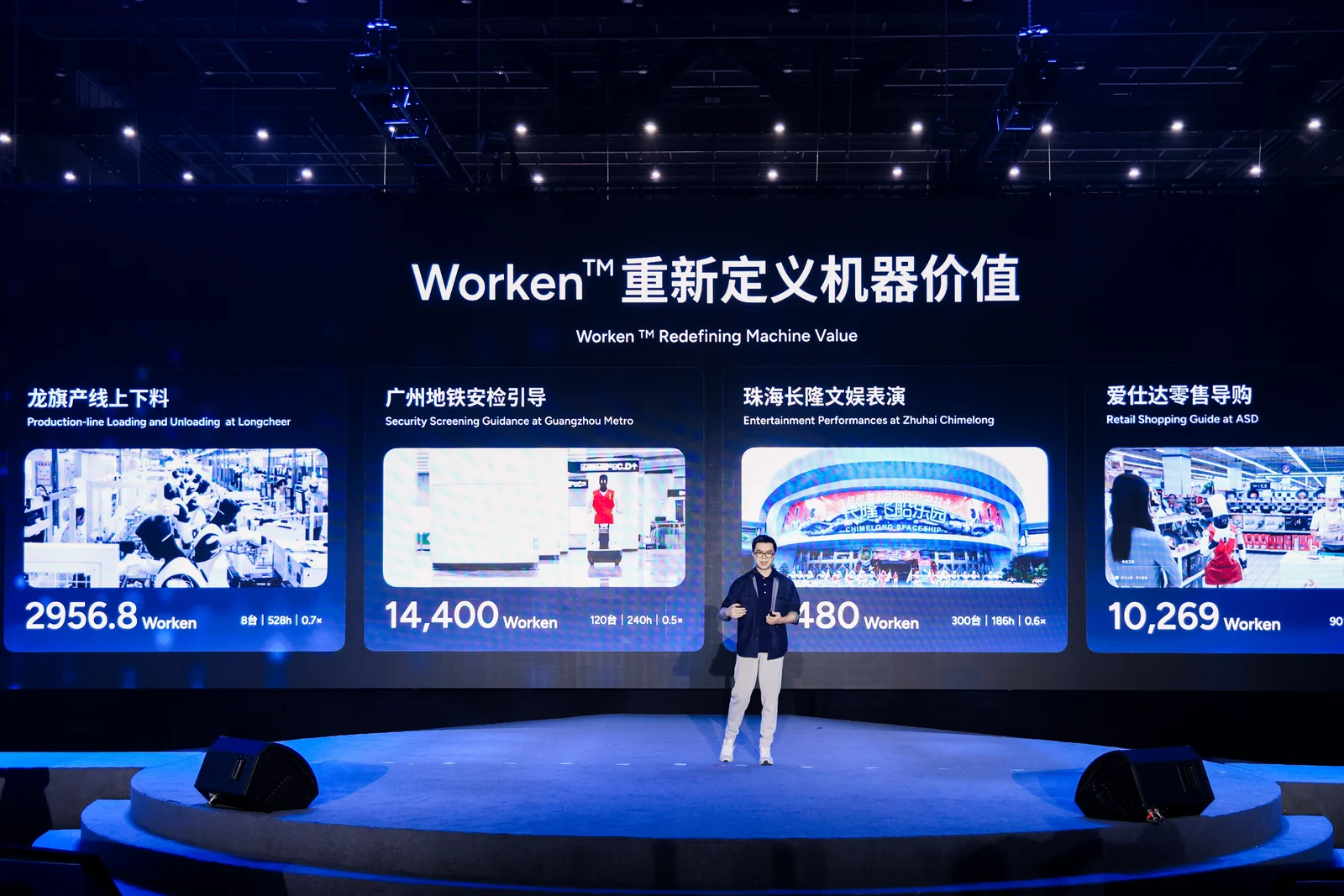
- Worken measures productive operation: the proposed formula combines active robots, autonomous working hours and an output efficiency ratio.
- Powered-on time is not enough: the measure distinguishes independent task execution from waiting, manual intervention and other nonproductive periods.
- Benchmarks determine what the number means: acceptable output and reference performance must be defined for the particular task.
- Worken is not a price for robot labor: equal figures from different tasks do not automatically represent equal financial value.
- The framework is still evolving: AGIBOT says practical use will depend on operational data, consistent definitions and further testing in deployments.
Two factories can deploy the same number of robots and get very different results. In one, the machines work independently for most of a shift and consistently meet production requirements. In the other, they need frequent intervention or complete fewer acceptable tasks. Counting installed robots does not capture that difference.
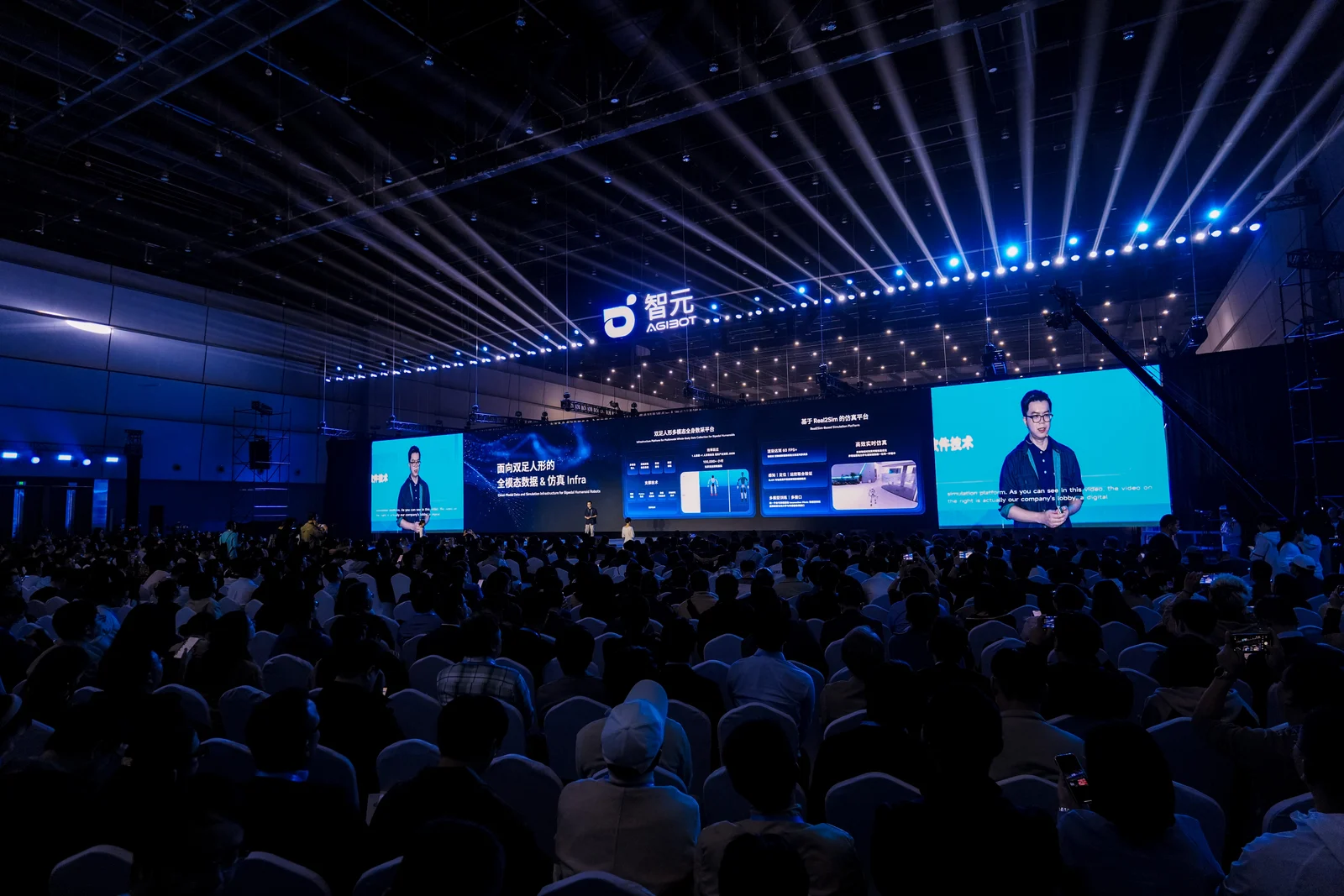
AGIBOT's proposed Worken framework is designed to measure that gap. Introduced at AGIBOT's Innovation Day 2026, Worken combines the number of actively working robots, their autonomous working hours and their output relative to a task-specific benchmark. The name combines “Work” and “Token,” and AGIBOT describes the measure as “Effective Intelligent Work Hours.”
The three parts of the formula
The formula AGIBOT proposes multiplies three factors:
Worken = Number of Active Robots × Autonomous Working Hours × Output Efficiency Ratio
Follow humanoid robotics without following every announcement.
Get the week’s most important launches, funding and research—and why they matter—in one email from Humanoids Daily.
Once a week. Unsubscribe anytime.
Read recent issuesThe first factor counts robots actually performing tasks in an operating environment. Machines that have been manufactured, delivered or installed are not necessarily contributing useful work at a given moment.
The second factor measures time spent carrying out tasks autonomously, without continuous human control. A robot can remain powered on throughout a shift while spending some of that time waiting or requiring intervention. Those periods should not be confused with autonomous productive operation.
The third factor compares acceptable output with a defined benchmark for the task. On a manufacturing line, that could be an established hourly production standard. Measuring qualifying output matters because completing more operations is not necessarily useful if the results fail the workplace's quality requirements.
Together, the factors connect fleet size with independent working time and the work actually delivered. The framework supplements measures such as manufacturing scale and technical capability; it does not make those measures irrelevant.
A worked example: 10 robots, six hours, 48 Worken
AGIBOT illustrates the calculation with a hypothetical production line. Suppose 10 active robots each work autonomously for six hours during a shift, with qualifying output corresponding to an efficiency ratio of 0.8 against the selected benchmark:
10 robots × 6 hours × 0.8 = 48 Worken
This is an illustrative calculation, not a reported result from an AGIBOT deployment. The 48 Worken represent benchmark-adjusted autonomous working hours under the stated conditions.
The arithmetic is straightforward. The harder part is deciding which hours qualify, what counts as acceptable work and how to establish the reference benchmark. Without consistent definitions, the same formula could produce numbers that look comparable but describe different operating conditions.
The example also assumes the robots share the stated working hours and efficiency ratio. Real deployment records would need to account for differences between machines and tasks rather than assume every robot contributes equally.
Where the measure could be useful
A practical starting point is a repeatable task with clear performance requirements, such as material handling on a production line. An operator could record which robots are working, how long they work independently and how much acceptable output they complete, then compare that output with the chosen task standard.
Repeating the measurement could help track changes after a software or model update. A fleet might need less intervention, operate autonomously for longer or complete more qualifying work without adding any robots. Worken is intended to make those changes visible beyond a simple deployment count.
AGIBOT points to industrial applications, including material handling at Longcheer, as environments in which such measurement methods could be developed. Production lines already assess cycle time, quality and operational stability. The release does not present a measured Worken result for Longcheer.
Service work requires different definitions. Successfully guiding a visitor or answering a request is not interchangeable with moving a component on a factory line. Comparing similar operations using the same standards could be useful; treating every Worken figure as equivalent across unrelated tasks would obscure those differences.
Productivity is not the same as financial value
AGIBOT explicitly distinguishes measuring productive output from putting a price on it. Worken is not a universal rate for robotic labor, and a given figure does not automatically carry the same economic value in different settings.
For buyers, it could provide another input to an investment decision alongside purchase price, integration, maintenance and operating costs. Software and model improvements may allow a machine to perform more useful work during its lifetime, even as its hardware depreciates. Tracking output could help operators assess whether those improvements translate into better productivity.
The company also suggests that more consistent measurement could eventually inform commercial arrangements based on completed tasks or verified service outcomes. It presents that as a longer-term possibility, not an established Worken-based business model.
What still needs to be established
Worken remains AGIBOT's proposed framework, rather than an established industry standard. Its practical usefulness depends on reliable operating records, clear task definitions and benchmarks that can be tested and refined across deployments.
Safety, reliability, quality and operating cost still need to be assessed alongside the resulting number. A productivity measure cannot answer every question about whether a robot is suitable for a workplace.
The useful shift in emphasis is toward what happens after installation: how often a robot works independently, whether its output meets requirements and whether that performance improves over time.
Share this article
Follow humanoid robotics without following every announcement.
Get the week’s most important launches, funding and research—and why they matter—in one email from Humanoids Daily.
Once a week. Unsubscribe anytime.
Read recent issuesRead next
- Published on
- Reading time
- 6 min read
How AGIBOT’s Physical Reasoning Dataset Connects Planning With Robot Actions
- Published on
- Reading time
- 7 min read
AGIBOT Introduces Worken, New AI Models and G2 Max at Innovation Day 2026
- Published on
- Reading time
- 3 min read
AGIBOT Coordinates 110 Production Humanoids in Guinness-Certified Dance Performance
- Published on
- Reading time
- 3 min read
AGIBOT Releases Physical Reasoning Dataset to Connect Robot Decisions With Actions
- Published on
- Reading time
- 3 min read
IDC Puts H1 Humanoid Shipments Near 25,000, With AGIBOT Leading
- Published on
- Reading time
- 4 min read
AGIBOT Says 100 X2 Humanoids Are Working Across 100 ASD Retail Stores