- Published on
Rhoda AI Shows Robots Recovering From Factory Edge Cases in Schrep Visit
One tap, and our reporting appears more often in your Google Top Stories. It makes a real difference to a small newsroom.

Rhoda AI’s latest demonstration focuses on a practical question for factory robots: what happens when a job stops going to plan?
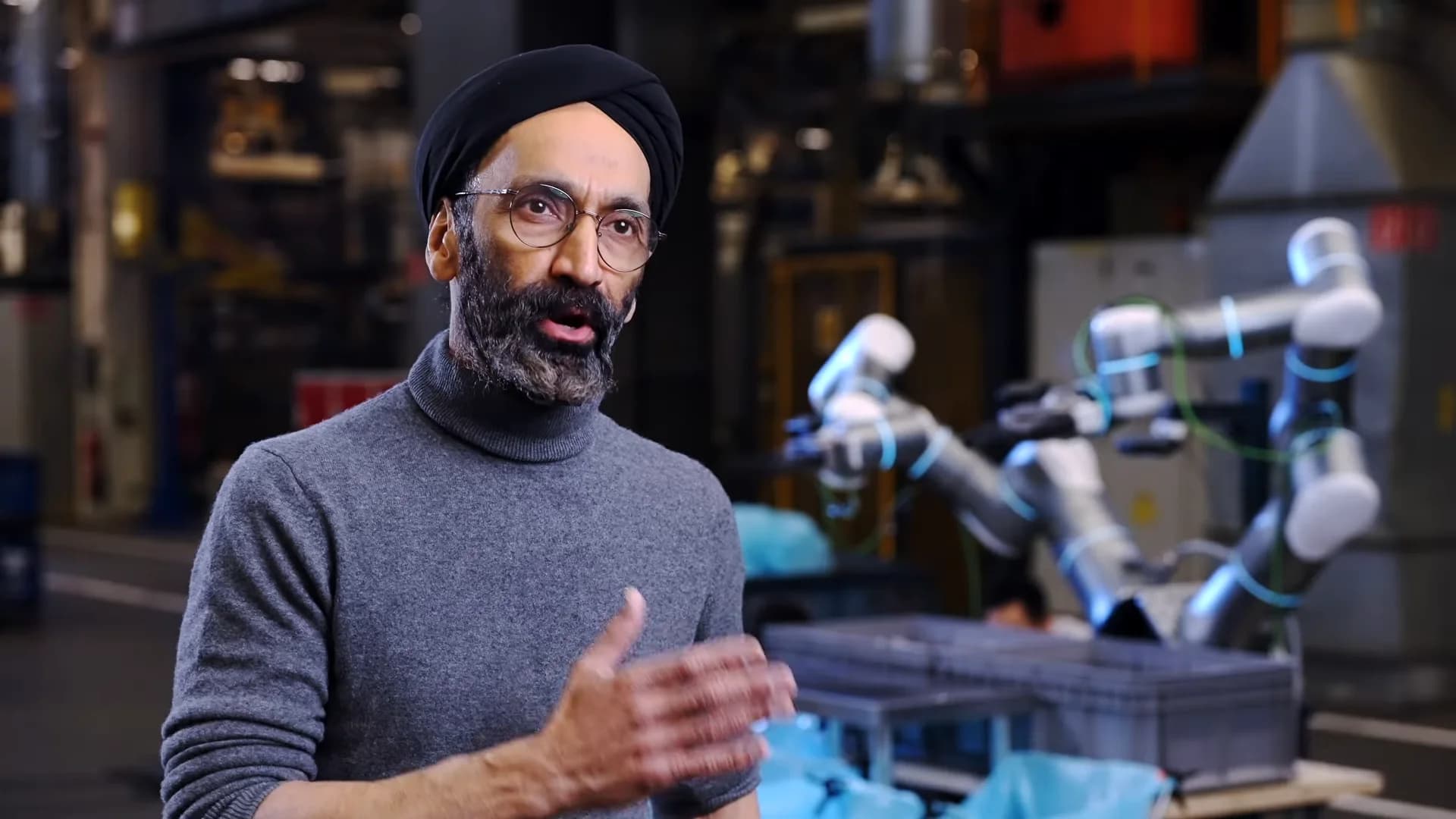
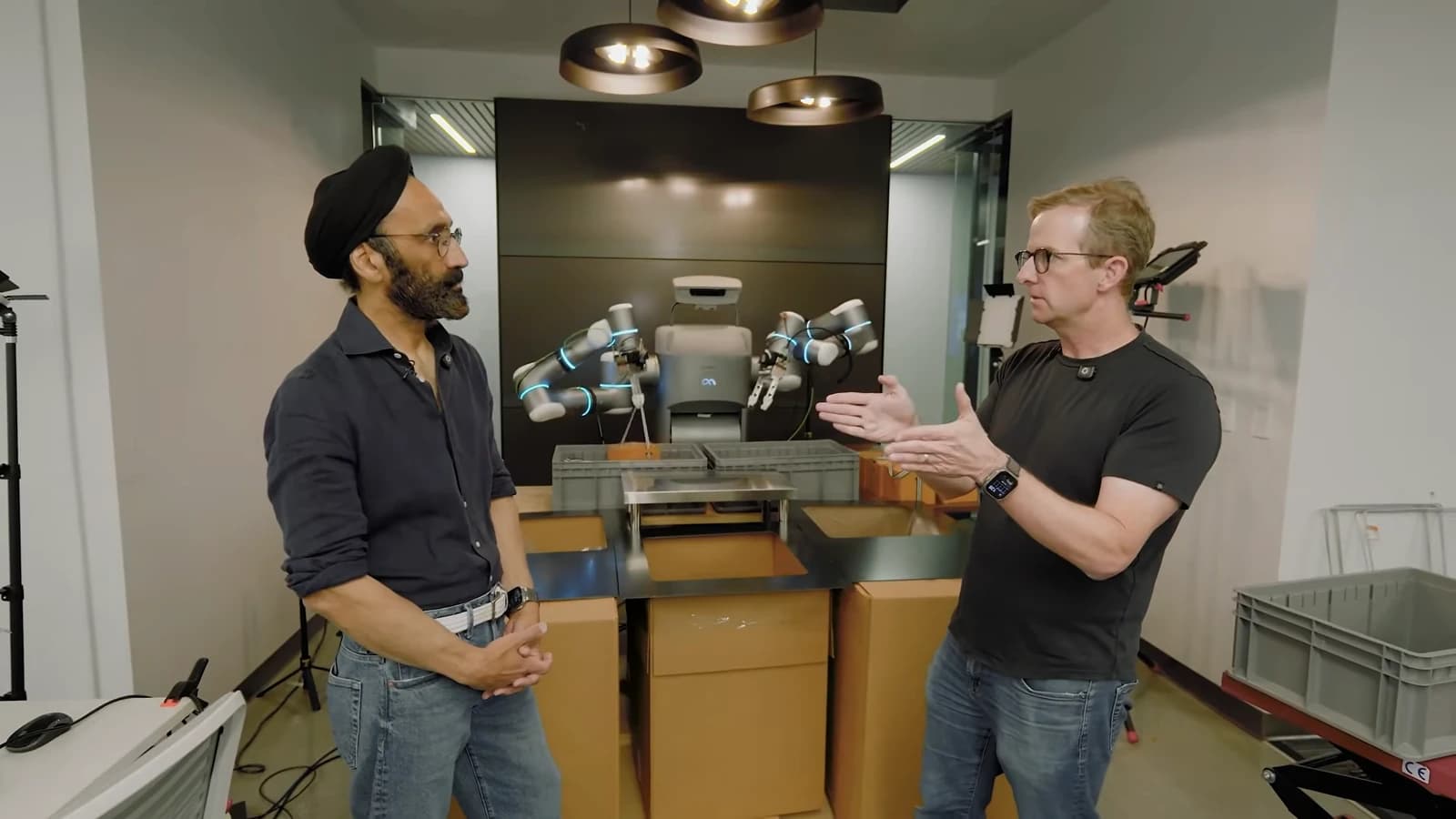
In a Field Trips with Schrep visit, Mike Schroepfer joins founder and CEO Jagdeep Singh to explore robots unpacking automotive parts, handling inspection equipment and recovering from disturbances introduced during the demonstration. The visit also offers a closer look at Rhoda’s Direct Video-Action architecture and its plans for paid production deployments before the end of 2026.
- The demonstrations include recovering from an accidental grasp, removing extra rubbish and retrieving paper trapped inside a plastic bag.
- Rhoda uses video prediction to guide robot actions, with a separate model translating predicted frames into movement commands.
- Singh says tasks can be learned with 10–20 hours of teleoperation data after extensive video pre-training.
- The company is targeting wheeled industrial robots and paid production deployments; the visit does not establish sustained factory reliability.
When unpacking becomes a recovery problem
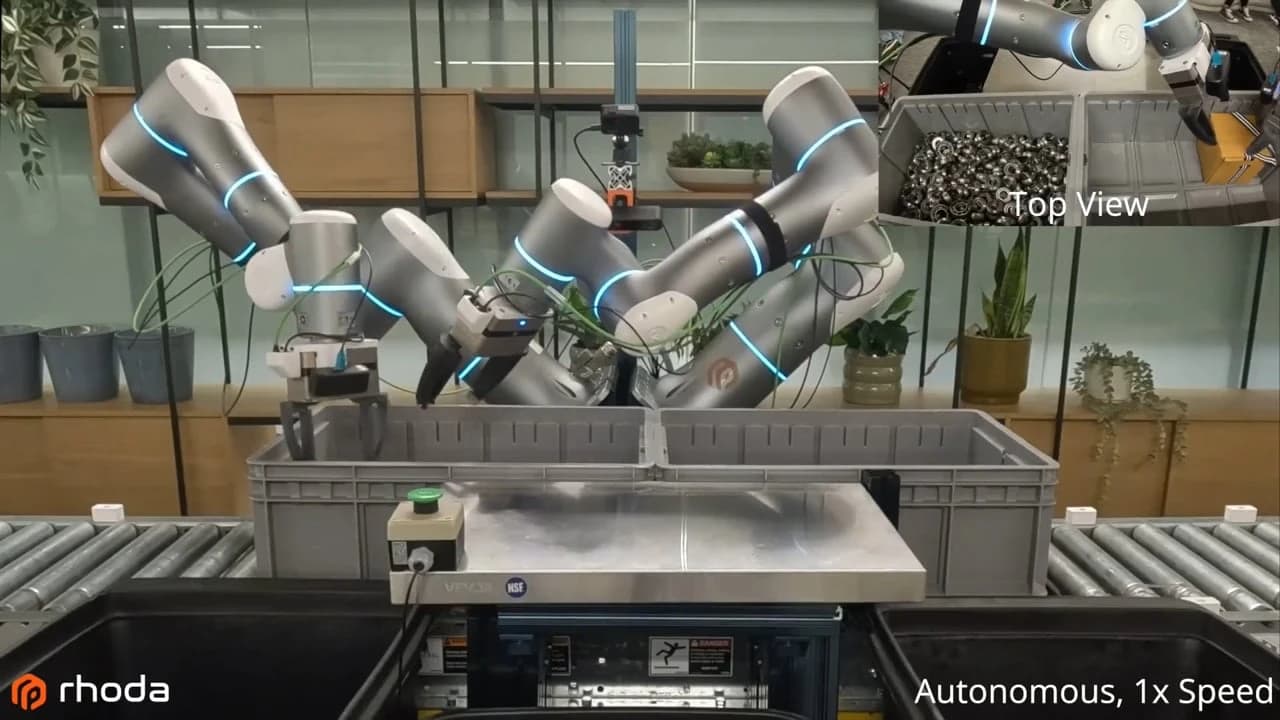
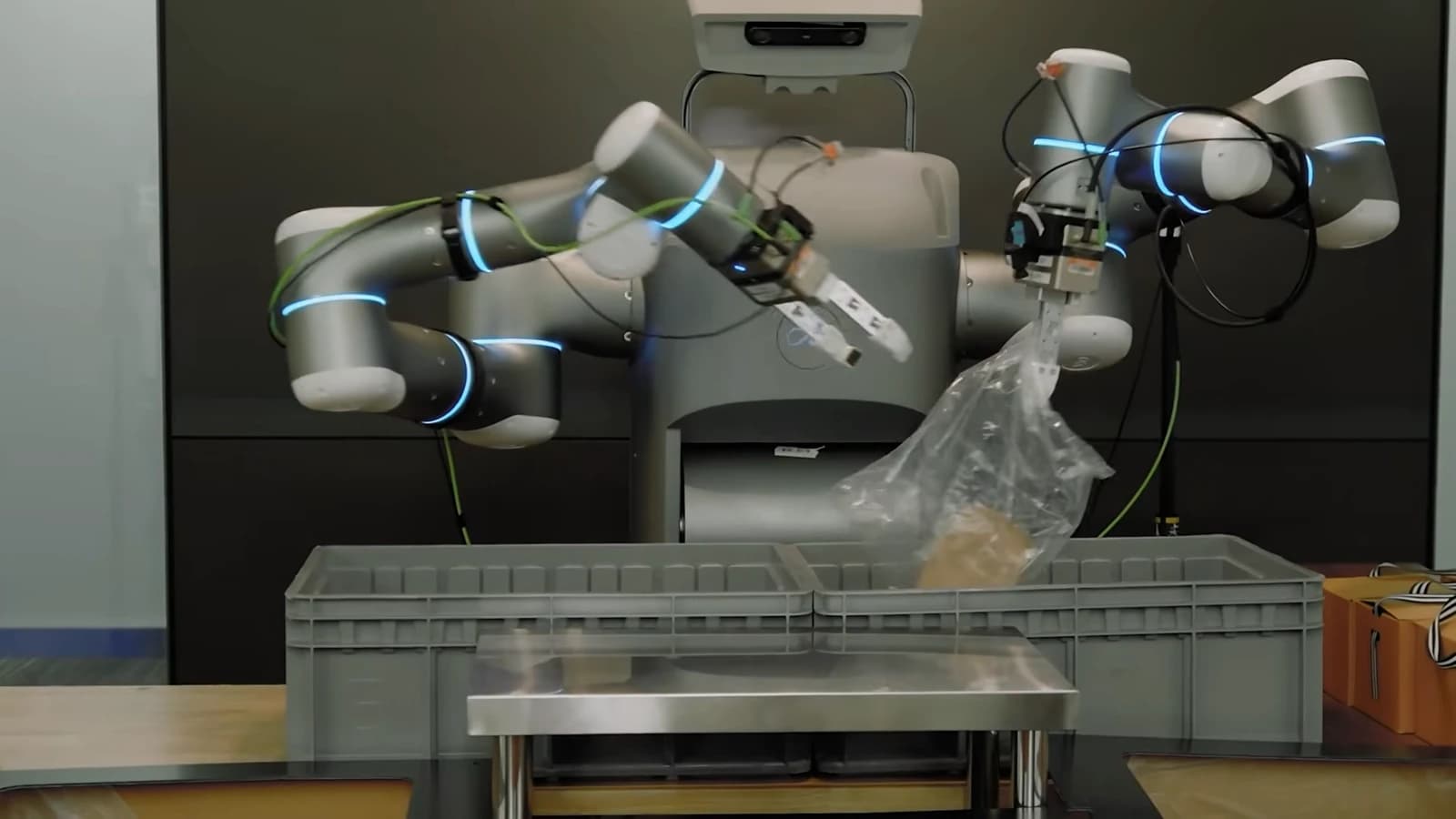
The most revealing sequence involves unpacking a 10 kg box of ball bearings. The robot must open the packaging, remove paper from a plastic liner, empty the bearings into a metal tote and separate the waste.
The task becomes more interesting when things go wrong. In one instance, the gripper catches a bearing along with the paper it is removing, then returns the bearing and grasps the paper again. Singh and Schroepfer also add crumpled paper to the tote, leaving the robot to find and remove the additional rubbish.
Follow humanoid robotics without following every announcement.
Get the week’s most important launches, funding and research—and why they matter—in one email from Humanoids Daily.
Once a week. Unsubscribe anytime.
Read recent issuesAnother complication requires both arms: paper becomes trapped in an upside-down plastic bag, prompting the robot to reposition the bag and extract it before disposal. These are useful examples of recovery within a task, where success requires responding to the current state rather than simply continuing a predetermined sequence.
A second demonstration involves moving automotive radar units from a conveyor into an inspection fixture and then into an output slot. When Singh changes a unit’s position and orientation on the conveyor, the robot adjusts its grasp. A separate electronics-manufacturing segment shows teleoperation data collection for handling component reels, rather than an autonomous demonstration.
Video prediction as the policy
Rhoda’s approach starts with pre-training on hundreds of millions of video clips. Its DVA research description explains that the model uses recent observations to predict a short sequence of future frames. A separate inverse dynamics model translates that visual prediction into robot actions, and the cycle repeats as new observations arrive.
The distinction is that video prediction specifies the desired behavior itself. It is more than a simulator used to generate training examples for another policy.
Singh describes 10–20 hours of teleoperation data for learning a task. That is task-specific adaptation on top of substantial pre-training, not the system’s total training requirement. It also should not be compared directly with the full robot-data corpus used to build a general-purpose VLA.
In the visit, Singh says model inference runs in the cloud while low-level control remains onboard. He also describes the demonstrated models as undistilled and unquantized, leaving optimization work ahead. For deployment, network availability and recovery from interruptions remain practical considerations alongside model capability.
An industrial route to deployment
Rhoda’s hardware choices reflect its intended customers. The demonstrated systems use two seven-degree-of-freedom arms with two-finger grippers, while Singh describes wheeled mobile bases for production. He presents wheels as a response to industrial customers’ concerns about complexity and safe stopping.
The company is targeting paid production deployments before year-end, supported by a remote Robot Operations Center. That remains a rollout target rather than evidence that the demonstrations already represent commercial production performance.
For a more quantitative view, Rhoda’s earlier web-video scaling study reported an 84.7% at-speed completion rate for its largest tested model on one industrial task. As we covered at the time, that experiment provides a more bounded measure than a successful demonstration.
The visit makes the recovery behavior tangible. The next test is how consistently it works across shifts, changing materials and customer sites—and how often a human needs to step in.
Share this article
Follow humanoid robotics without following every announcement.
Get the week’s most important launches, funding and research—and why they matter—in one email from Humanoids Daily.
Once a week. Unsubscribe anytime.
Read recent issuesRead next
- Published on
- Reading time
- 3 min read
Rhoda Blindfolds Its Robot—and Lets Touch Guide the Search
- Published on
- Reading time
- 4 min read
Rhoda Tests Whether Scaling Web-Video Pretraining Makes Robots Better at Real Work
- Published on
- Reading time
- 5 min read
Rhoda AI Hits $1.7B Valuation, Unveils "Direct Video-Action" Model to Bridge the Real-World Gap
- Published on
- Reading time
- 4 min read
Rhoda AI Breaks Stealth: Jagdeep Singh Teases "Real World" Generalization
- Published on
- Reading time
- 3 min read
Stealth Startups Emerge With Over $300 Million to Join Crowded Humanoid Robot Field
- Published on
- Reading time
- 4 min read
Meta Reportedly Built “Max” Humanoid With Fourier, With a Second Version Underway