- Published on
ETH Zürich Teaches a Humanoid to Climb, Vault and Recover by Planning Body Contacts
One tap, and our reporting appears more often in your Google Top Stories. It makes a real difference to a small newsroom.


Your guide
Rich Robinson
Jee Chee Ren · Executive tour
See China’s AI and robotics ecosystem first-hand.
Six days exploring AI, robotics and advanced manufacturing.
With Rich Robinson, Clinical Professor of Entrepreneurship at Peking University
Beijing · Guangzhou · Shenzhen
29 November–4 December 2026
Referral partnership · We earn a commission on referred bookings.
Researchers at ETH Zürich's Robotic Systems Lab and collaborators have demonstrated a Unitree G1 climbing ladders, scaling obstacles and recovering from falls with a single learned locomotion policy. Their approach, Attention-based Contact Planning (ACP), focuses on where the robot should place its body against the environment, allowing a controller to work out the movements between those contacts.
- One policy supports a range of mobility skills, including climbing, stepping across sparse footholds and getting up after falls.
- The system uses 13.2 minutes of human motion data alongside reinforcement learning, then operates without reference motions at deployment.
- The researchers report 92.5% average success on eight simulated composite courses, compared with 58.8% for their MGMT baseline. This is not a measured real-world success rate.
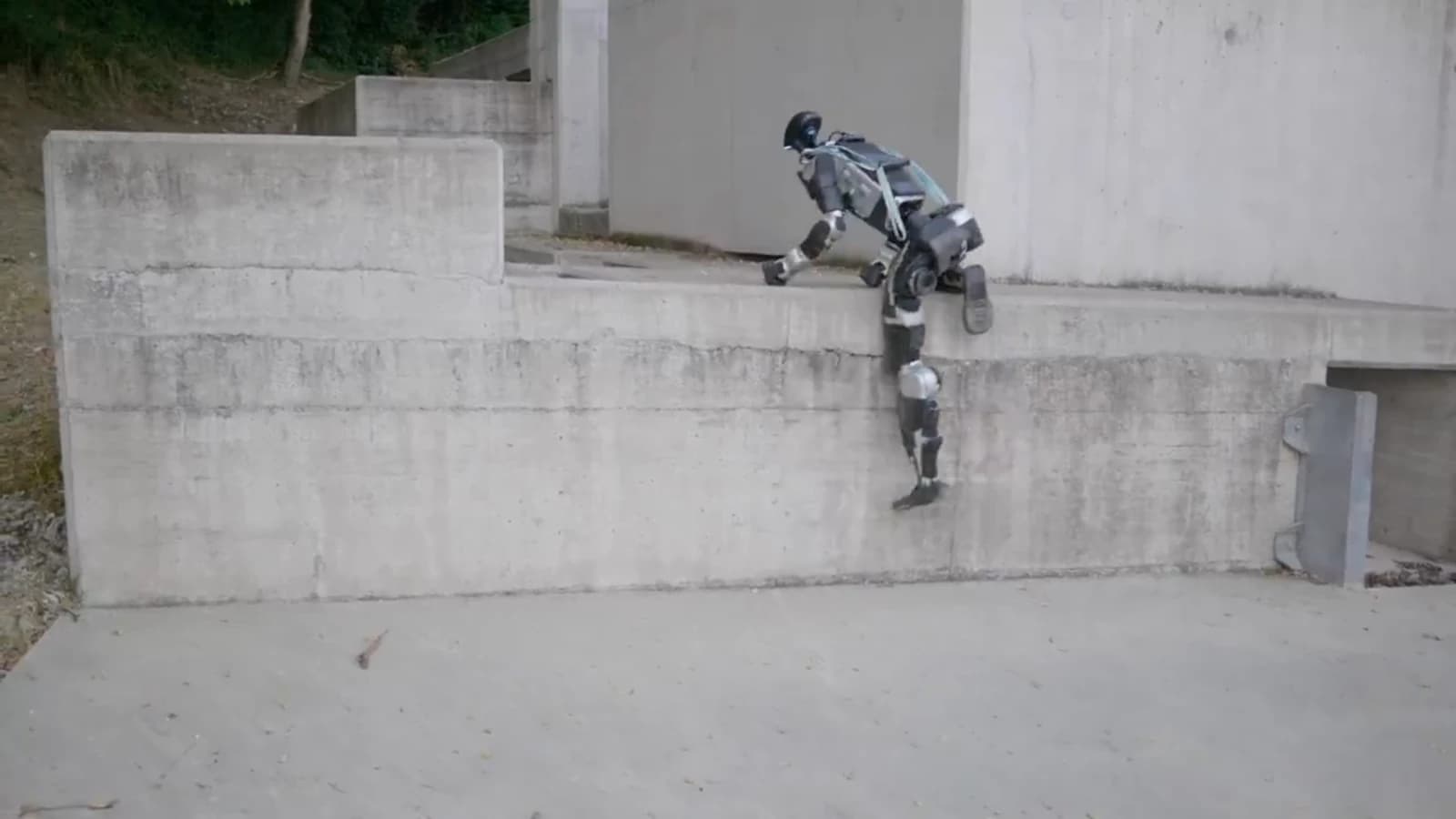
The work, titled Humanoid Mobility via Attention-based Contacts, was submitted to arXiv on October 22 and is listed as under review. The project credits ETH Zürich, Apple, the ETH AI Center and NVIDIA.
Learning where to make contact
The project overview describes a system that learns useful contacts from human motion data, with reinforcement learning determining how the rest of the body moves.
At deployment, a planner uses a LiDAR-derived height map, the robot's own sensed state and a target to predict contact positions for nine body parts: its hands, elbows, knees, feet and pelvis. It looks up to 1.5 seconds ahead. A second network turns those contact targets into actions for 23 joints. Both networks run onboard at 50 Hz, without a reference motion to replay.
Follow humanoid robotics without following every announcement.
Get the week’s most important launches, funding and research—and why they matter—in one email from Humanoids Daily.
Once a week. Unsubscribe anytime.
Read recent issuesThis makes the contact plan an intermediate step between perceiving the terrain and moving through it. Instead of supplying a complete pose-by-pose movement, the planner identifies the supports the robot should use.
The perception system uses a head-mounted LiDAR and neural mapping running on the onboard Jetson Orin NX CPU. The team reports map updates within 30 milliseconds for each 10 Hz scan, using a three-centimeter grid.
Skills that connect, and failures that recover
The researchers' skill demonstrations cover ladders, stages, stairs, stepping stones and a balance beam, alongside vaulting, jumping down, sitting and getting up. The site also includes repeat demonstrations of climbing and vaulting.
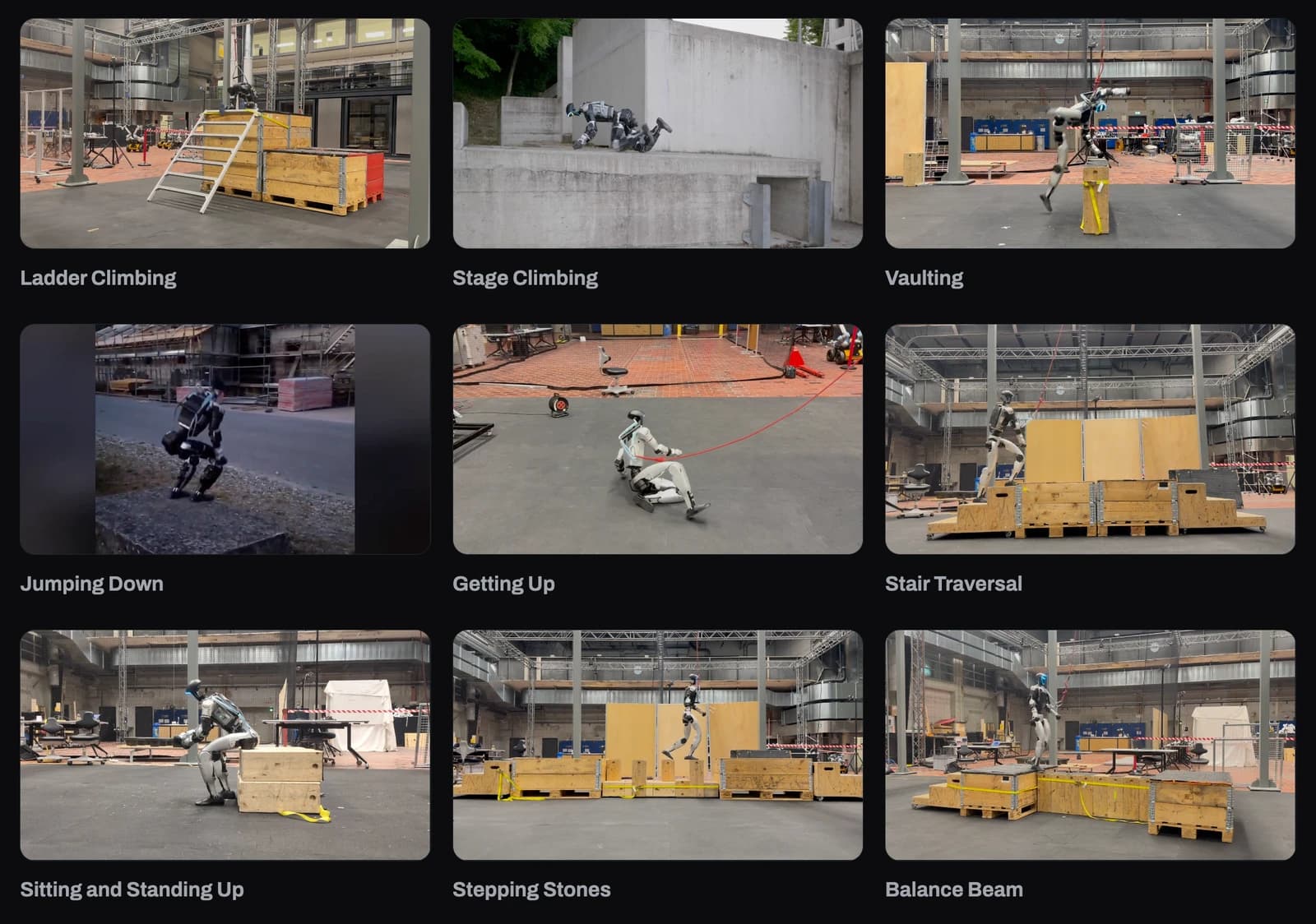
The combined courses are especially striking: they pair ladder climbing with jumping down, or vaulting with climbing onto another obstacle. These sequences illustrate why being able to connect skills matters as much as executing them individually.
The team also publishes recovery examples, including trouble during ladder climbing, a failed jump down and a fall caused by mapping artifacts. Showing those failures makes the research more informative: the examples reveal both where the system can go wrong and how it can regain a usable posture.
What the results establish
In the paper's simulation evaluation, ACP averaged 92.5% success across eight combined obstacle courses, versus 58.8% for MGMT, a motion-generation-and-tracking approach. Sensor noise, physics randomization and action delay were disabled for these evaluations to isolate terrain-dependent performance.
The scope remains local mobility toward specified goals. Some unstructured routes use manually supplied intermediate waypoints; global navigation is outside the study. The authors also identify limits in representing overhead contacts, hanging and manipulation. Contact sequences alone cannot distinguish a vertical jump from a backflip, so the approach does not cover every kind of acrobatic motion.
For humanoid research, the contribution is a practical way to combine human examples with terrain-dependent control: learn useful physical interactions, then adapt the movement around them.
Share this article
Follow humanoid robotics without following every announcement.
Get the week’s most important launches, funding and research—and why they matter—in one email from Humanoids Daily.
Once a week. Unsubscribe anytime.
Read recent issuesRead next
- Published on
- Reading time
- 3 min read
Apple Robotics Researcher Joins Tesla Optimus, Citing ‘Scale and Sophistication’
- Published on
- Reading time
- 4 min read
Mimic Robotics Open-Sources "mimic-video" Recipe to Accelerate Video-Action Models
- Published on
- Reading time
- 5 min read
Watch: Inside the Zurich Lab Building the "Android" of Humanoids
- Published on
- Reading time
- 4 min read
Audi Partners with Mimic Robotics for AI-Driven Automotive Assembly
- Published on
- Reading time
- 4 min read
Neura Robotics Moves Humanoid R&D to Zurich, Tapping into Europe’s "Robotics Valley"
- Published on
- Reading time
- 5 min read
Skild AI’s S1 Learns Soccer Through More Than 140 Years of Simulated Self-Play