- Published on
Boston Dynamics Employee Petition Against ICE Robot Deal Tests Its Ethical Guardrails
One tap, and our reporting appears more often in your Google Top Stories. It makes a real difference to a small newsroom.


Your guide
Rich Robinson
Jee Chee Ren · Executive tour
See China’s AI and robotics ecosystem first-hand.
Six days exploring AI, robotics and advanced manufacturing.
With Rich Robinson, Clinical Professor of Entrepreneurship at Peking University
Beijing · Guangzhou · Shenzhen
29 November–4 December 2026
Referral partnership · We earn a commission on referred bookings.
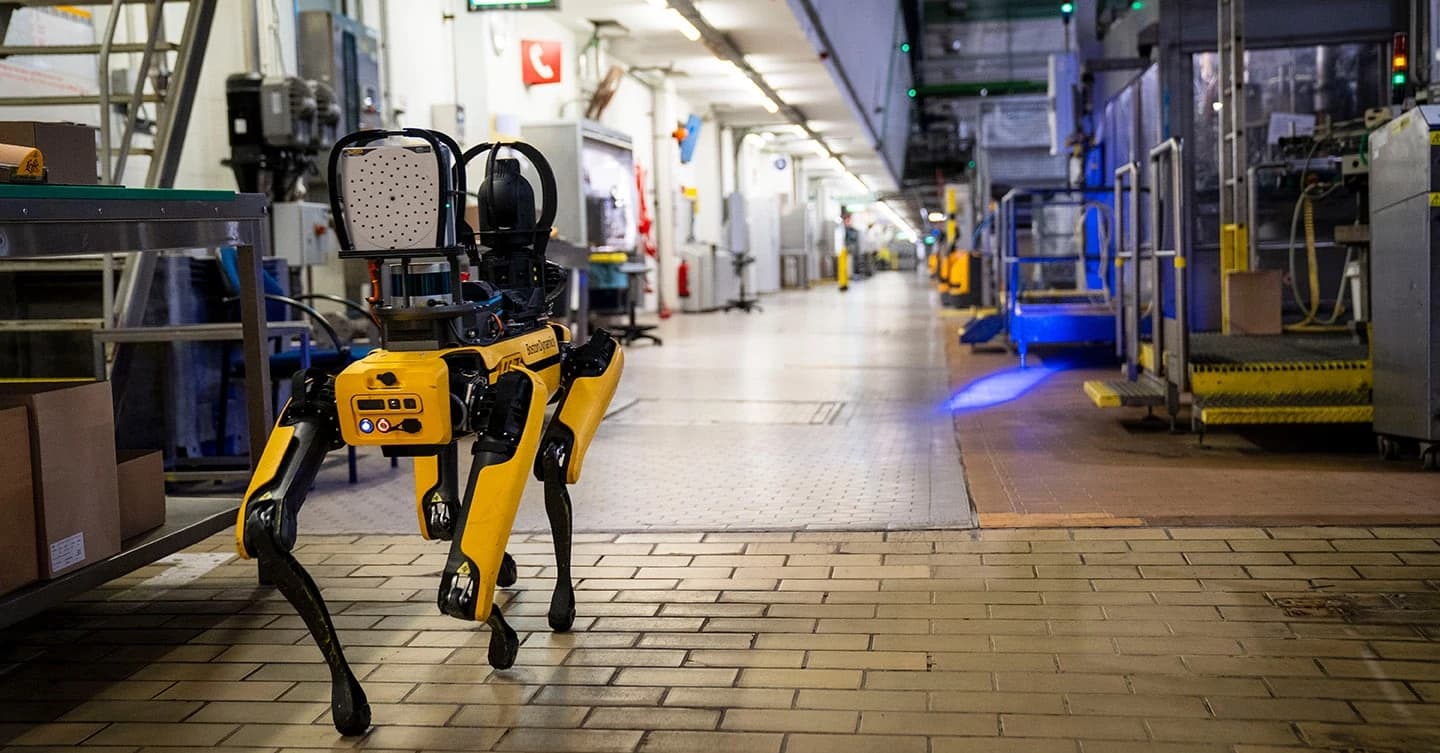
Boston Dynamics is standing by a deal to supply modified Spot robots to U.S. Immigration and Customs Enforcement despite an employee petition urging it to stop. The dispute concerns quadrupeds, but raises a question relevant to humanoids and the wider physical AI industry: how much responsibility should a robot maker retain for what customers do with its machines?
- A petition opposing the ICE sale carried about 300 signatures, nearly half anonymous, according to Boston Dynamics’ response to WBUR.
- ICE’s roughly $1.3 million procurement covers four modified Spot robots and accessories supplied by RADeCO.
- The disagreement extends beyond weaponization to customer selection, acceptable uses and enforcement of safeguards after a sale.
Employees object; management stands by the sale
WBUR reported on October 23 that employees sent the petition to leadership in early September. The signatories argued that association with ICE could damage the company’s reputation, discourage recruits and cause staff to leave. Boston Dynamics confirmed the petition and noted that nearly half the signatures were anonymous.
The company’s response, conveyed in an email from then-interim CEO Amanda McMaster, was to proceed. Boston Dynamics told WBUR the robots were intended for Homeland Security Investigations, ICE’s investigative arm, and emphasized restrictions against weaponization, harm and intimidation. ICE described the machines as tools for assessing dangerous situations before sending people in, with human officers retaining judgment.
The dispute therefore concerns an already-awarded procurement, rather than a newly announced proposal. It also does not establish that the robots have been used unlawfully.
Follow humanoid robotics without following every announcement.
Get the week’s most important launches, funding and research—and why they matter—in one email from Humanoids Daily.
Once a week. Unsubscribe anytime.
Read recent issuesWhat ICE is buying
The supplier is RADeCO, which describes Cerberus as a customized Boston Dynamics Spot platform with upgraded cameras, communications and equipment for hazardous-material detection and explosive-ordnance work. This is a sale through an integrator, rather than a direct ICE purchase from Boston Dynamics.
The ICE procurement justification published by WBUR totals $1,304,296. It lists four robot platforms, manipulation arms, thermal inspection cameras, radio equipment and training. The document describes inspecting dangerous or confined spaces, checking oxygen levels in tunnels and supporting tactical teams with remote observation.
Its stated scope also includes immigration enforcement, detention and investigative missions. Those categories are broader than hazardous-material inspection alone, although a procurement description is not evidence of how a particular robot has subsequently been deployed.
What the safeguards cover
Boston Dynamics’ published ethical principles oppose weaponization and autonomous targeting, as well as uses that violate privacy and civil rights laws. They also explicitly allow work with government customers when consistent with the company’s terms.
Its industry open letter against weaponization calls for reviewing intended applications and exploring technical safeguards. It acknowledges that company pledges alone cannot fully address misuse.
In a further response to Ars Technica, Boston Dynamics said responses to violations could include withdrawing warranty coverage and software updates, terminating licenses, legal action and refusing future sales. The company said it had not encountered violations of its terms in its work with DHS and other public-safety agencies.
Those are enforcement measures the company says it can take. They do not, by themselves, explain how a disputed use would be detected or judged.
Why this matters beyond Spot
For physical AI companies, the case illustrates a distinction between preventing a robot from carrying a weapon and deciding which activities it should support. Cameras, mobility and manipulation can protect people during hazardous work while also expanding an operator’s ability to inspect spaces and gather information.
The employee objections and management response show that agreement on a no-weapons policy does not necessarily produce agreement on customers. As more capable robots reach workplaces and public settings, manufacturers will face practical decisions about reviewing applications, monitoring compliance and responding when staff, customers and affected communities disagree about acceptable use.
Share this article
Follow humanoid robotics without following every announcement.
Get the week’s most important launches, funding and research—and why they matter—in one email from Humanoids Daily.
Once a week. Unsubscribe anytime.
Read recent issuesRead next
- Published on
- Reading time
- 4 min read
Boston Dynamics Says Atlas Takes a Day to Build—and Wants to Cut That to an Hour
- Published on
- Reading time
- 2 min read
Boston Dynamics Names Former Amazon AI Leader Rohit Prasad as CEO
- Published on
- Reading time
- 4 min read
Boston Dynamics Gives Atlas Four-Finger Hands Built for Tools and AI Training
- Published on
- Reading time
- 4 min read
Boston Dynamics Makes Its Case for Atlas and a Two-Year Payback Target
- Published on
- Reading time
- 4 min read
Boston Dynamics Takes a Drone Through Atlas Production in New Hiring Push
- Published on
- Reading time
- 5 min read
Dynamic Creatures Emerges From Stealth With Boston Dynamics Backing to Build Expressive Guest-Facing Robots