- Published on
DeepMind Pairs Genie 4 With Gemini Argon to Simulate Apollo Playing Checkers
One tap, and our reporting appears more often in your Google Top Stories. It makes a real difference to a small newsroom.

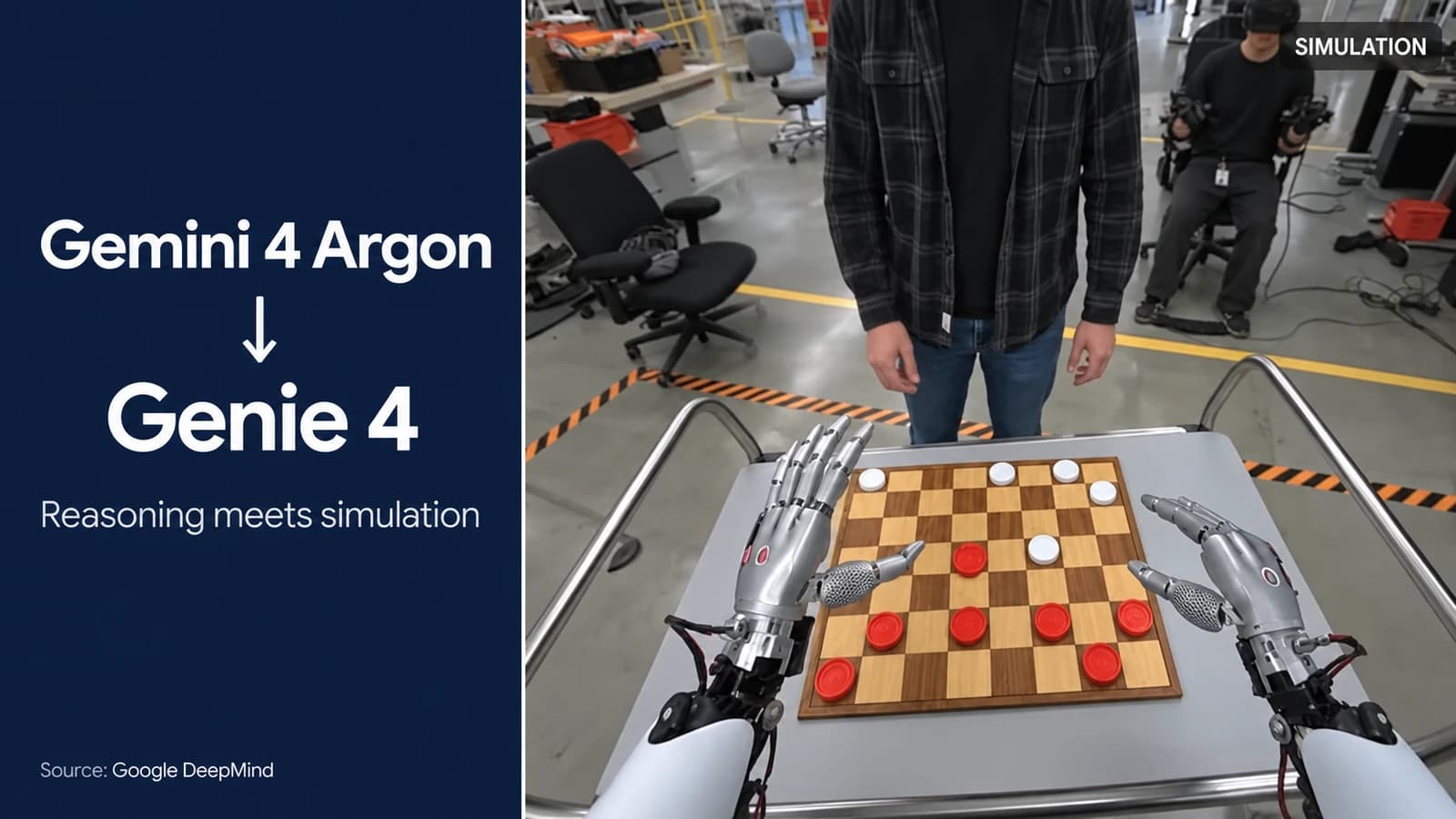
Google DeepMind has announced Genie 4, an interactive world model, with a robotics experiment that pairs it with Gemini 4 Argon to simulate Apptronik's Apollo playing checkers. The example explores how a reasoning model can guide a generated environment through a task, adjusting the simulation while it runs.
- Gemini 4 Argon breaks a user-directed task into steps and sends text captions to Genie 4 as it renders the simulated Apollo scene.
- DeepMind sees a path toward varied training environments for robots and agents, but the announcement does not report transferring the checkers behavior to a physical robot.
- Genie 4 is rolling out as a research preview for trusted testers. Physics, spatial accuracy and long-term consistency remain research challenges.
The October 27 announcement presents Genie 4 as a world model that generates interactive scenes with native audio and can respond to text instructions while a simulation is underway. Users can change the environment, introduce objects or steer events rather than simply watch a fixed video.
For robotics, the interesting development is the connection between that generated world and another model that plans what should happen within it.
Argon plans, Genie renders
DeepMind describes two related uses of Gemini in the loop. In the broader world-simulation system, Gemini 3.8 Flash observes the scene, divides goals into steps and reviews incoming frames to check progress. It can revise its plan as the scene changes or a user intervenes.
Follow humanoid robotics without following every announcement.
Get the week’s most important launches, funding and research—and why they matter—in one email from Humanoids Daily.
Once a week. Unsubscribe anytime.
Read recent issuesThe robotics experiment instead brings together Gemini 4 Argon and Genie 4, alongside DeepMind's Gemini Robotics research. Argon decomposes a user-instructed task into steps, which are supplied to Genie as text captions during generation. DeepMind's example depicts Apollo playing checkers, with the task broken down in real time.
The distinction matters: Argon is guiding what the simulation renders. The launch does not establish that a real Apollo learned to play checkers from those generated frames, nor does it report a measured improvement in a physical robot's performance.
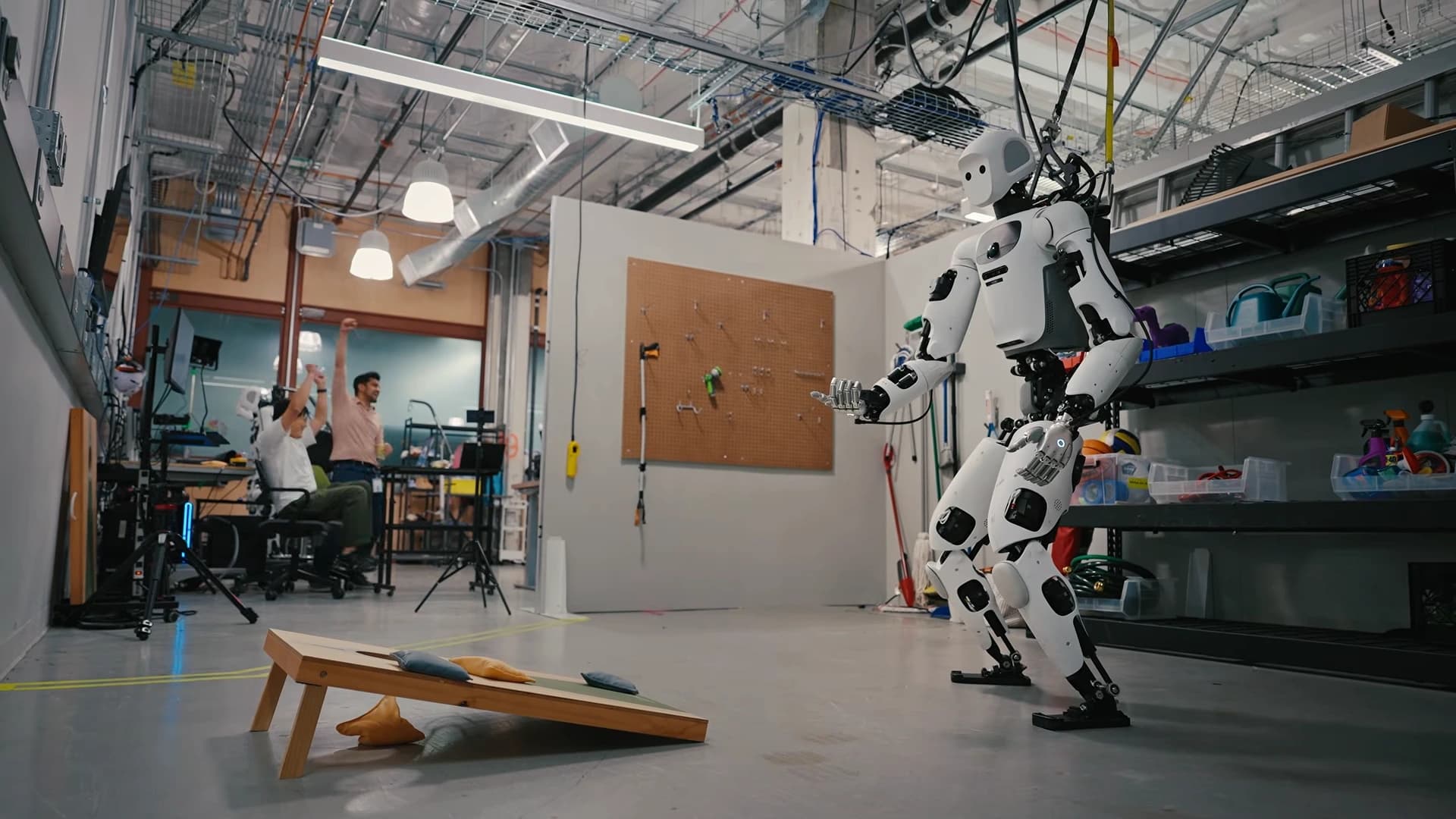
Our earlier coverage of Argon's Apollo cornhole demonstration followed a workflow involving human video, simulation and physical feedback. This new example explores a different part of the pipeline: generating and steering imagined scenarios as a task progresses.
More scenarios, but fidelity still matters
The potential attraction is flexibility. A system that can generate new surroundings and alter events during a task could give developers more situations in which to explore an agent's decisions, including changes that would be expensive or awkward to stage repeatedly with hardware.
Whether those scenarios are useful for training or evaluating robots depends on more than convincing imagery. Object positions, contact events and the consequences of actions need to remain sufficiently faithful to the task being tested. A generated scene that appears to complete a step is not, by itself, proof that the same action would succeed in the physical world.
DeepMind acknowledges that visual details and object permanence can drift, particularly during longer sessions, complex edits or movement through a scene. It also identifies complex physical interactions, spatial accuracy and long-term consistency as ongoing research areas.
A research preview
Genie 4 is initially available to trusted testers. DeepMind says access is coming to Google AI Ultra subscribers through Project Genie and to early-access partners through the Gemini API and Google AI Studio.
For humanoid developers, the announcement offers an early look at reasoning-guided world generation. The next evidence to watch is whether these adaptable simulations can support repeatable evaluation or training that produces measurable gains on real robots.
Share this article
Follow humanoid robotics without following every announcement.
Get the week’s most important launches, funding and research—and why they matter—in one email from Humanoids Daily.
Once a week. Unsubscribe anytime.
Read recent issuesRead next
- Published on
- Reading time
- 4 min read
Agile Robots and Google DeepMind Partner to Bring Gemini to the Factory Floor
- Published on
- Reading time
- 4 min read
Gemini 4 Argon Takes Apollo From Human Video to Seven Straight Cornhole Shots
- Published on
- Reading time
- 7 min read
Google DeepMind Unveils Gemini Robotics 2, Bringing Whole-Body Intelligence and Multi-Robot Teams to Physical AI
- Published on
- Reading time
- 3 min read
Cartwheel Robotics Founder Scott LaValley Joins Google DeepMind
- Published on
- Reading time
- 4 min read
Google DeepMind Unveils Gemini Robotics-ER 1.6: A Leap in Spatial Reasoning and Industrial Utility
- Published on
- Reading time
- 5 min read
Waymo Leverages Genie 3 to Launch "Waymo World Model" for Hyper-Realistic Simulation