- Published on
HALO Teaches Humanoids to Coordinate With Human Partners During Shared Carrying Tasks
One tap, and our reporting appears more often in your Google Top Stories. It makes a real difference to a small newsroom.

Carrying something with another person requires constant adjustment: slowing down, changing direction and keeping the load level when one partner stops or crouches. The HALO research project tackles that coordination problem with humanoid robots, demonstrating shared pushing and carrying tasks with a human partner.
- HALO explores how humanoids can coordinate with people during physically coupled tasks, including transport through confined spaces.
- Its mathematical stability result concerns how policies learn, rather than a blanket guarantee of safe physical behavior.
- Real-robot results are promising but limited: the experiments used motion capture and a small number of trials.
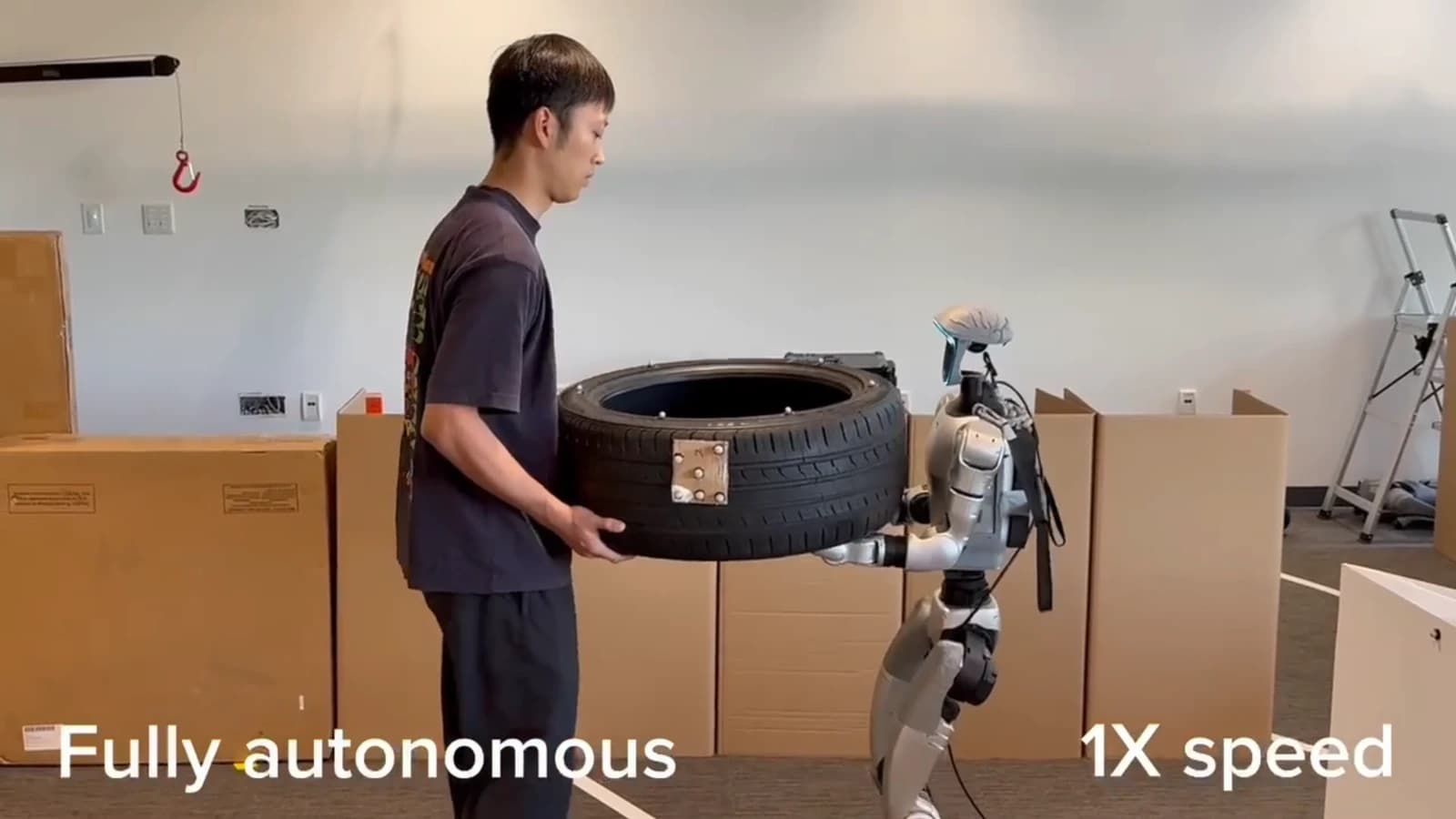
The work comes from researchers at the University of Texas at Arlington and Carnegie Mellon University. The project page identifies it as an ICML 2026 oral presentation. Its arXiv record dates the first submission to March 4, with a revision on May 31.
Learning to cooperate
The central difficulty is that independently learning agents can improve their own strategies while undermining coordination. HALO adjusts those learning updates to reduce disagreement with the shared objective. The authors distinguish this learning-stability result from methods that constrain physical trajectories for safety.
The project’s demonstrations cover pushing with precise orientation, moving through narrow spaces and handling long objects. Additional clips examine coordination when a partner is obstructed or changes height. Those are useful tests because a shared object makes each participant’s movements immediately consequential for the other.
Follow humanoid robotics without following every announcement.
Get the week’s most important launches, funding and research—and why they matter—in one email from Humanoids Daily.
Once a week. Unsubscribe anytime.
Read recent issuesWhat the physical tests show
According to the paper, training took place in Isaac Lab, followed by experiments pairing a Unitree G1 with a person using motion-capture support.
Results averaged over five trials show confined-space transport taking 76.2 seconds with HALO, compared with 81.5 seconds for PCGrad and 101.6 seconds for a scripted-partner baseline. HALO and PCGrad both recorded no drops in that condition. In the long-object halting test, both still had a 20% drop rate; HALO reduced post-halt drift relative to PCGrad.
These are encouraging comparative results, not evidence of failure-free collaboration. The limited trials and instrumented setup leave broader reliability unestablished.
The authors link a shared SafeHRC code repository, which covers HALO and a separate project called SAGE. Its detailed training instructions currently describe the SAGE configuration, a distinction worth retaining when assessing reproducibility.
For humanoid deployment, the practical question is compelling: can a robot become a useful physical teammate when the person beside it behaves unpredictably? HALO offers a research approach to that problem, with demonstrations and measured results that make the remaining gaps visible.
Share this article
Follow humanoid robotics without following every announcement.
Get the week’s most important launches, funding and research—and why they matter—in one email from Humanoids Daily.
Once a week. Unsubscribe anytime.
Read recent issuesRead next
- Published on
- Reading time
- 4 min read
Don’t Forget the Salt: Physical Intelligence Equips Robots with 15-Minute "Multi-Scale" Memory
- Published on
- Reading time
- 4 min read
The Human Scale: NVIDIA’s EgoScale Unlocks High-Dexterity Robotics via 20,000 Hours of Human Video
- Published on
- Reading time
- 3 min read
NVIDIA "Supersizes" Humanoid Control: SONIC Open-Sources Whole-Body Tracking at Scale
- Published on
- Reading time
- 4 min read
NVIDIA DreamZero explained: how its robot AI differs from a VLA
- Published on
- Reading time
- 4 min read
Amazon FAR Open Sources Holosoma to Unify Humanoid Simulation and Training
- Published on
- Reading time
- 4 min read
ETH Zürich Teaches a Humanoid to Climb, Vault and Recover by Planning Body Contacts