- Published on
Can a Simulated Robot Score Predict Real Performance? X Square Releases X2Real
One tap, and our reporting appears more often in your Google Top Stories. It makes a real difference to a small newsroom.


Your guide
Rich Robinson
Jee Chee Ren · Executive tour
See China’s AI and robotics ecosystem first-hand.
Six days exploring AI, robotics and advanced manufacturing.
With Rich Robinson, Clinical Professor of Entrepreneurship at Peking University
Beijing · Guangzhou · Shenzhen
29 November–4 December 2026
Referral partnership · We earn a commission on referred bookings.
X Square Robot has introduced X2Real, a benchmark aimed at answering a practical question for robot developers: how much does a good simulation score tell you about performance on physical hardware?
In its October 19 announcement, the company described tests spanning visual and language reasoning, precise manipulation, coordinated arm movements and tool use. X2Real builds on NVIDIA’s Isaac Lab-Arena simulation infrastructure.
- X2Real covers 44 tasks across 10 capability dimensions, with a public evaluation runtime available on GitHub.
- The paper reports a 0.84 correlation for task progress and 0.74 for success rates in an eight-task simulation-versus-hardware comparison.
- The current public release provides in-distribution evaluation; out-of-distribution task definitions and training tools are excluded.
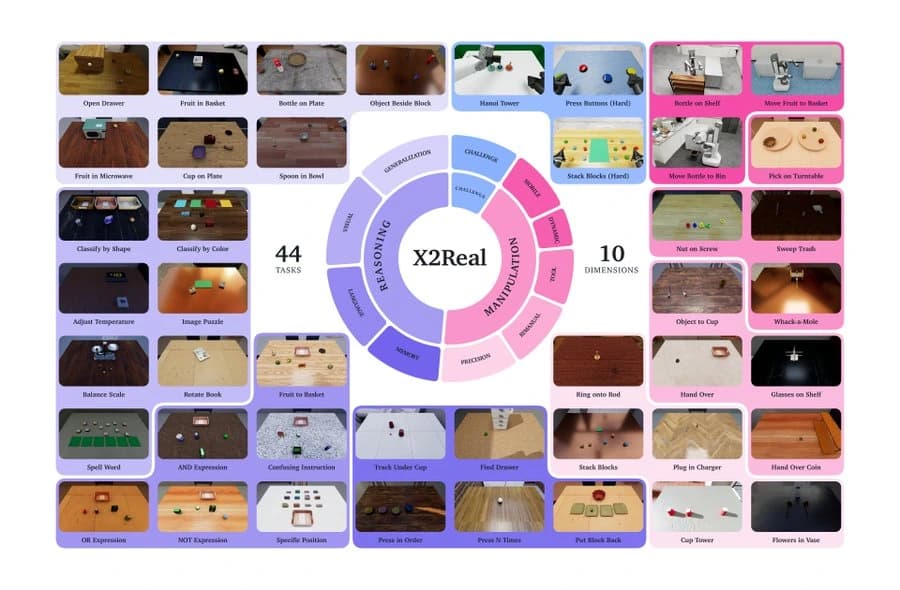
Checking simulation against hardware
The technical report compares WALL-OSS-0.5, trained without simulation data, on eight real and simulated tasks. Across those tasks, progress scores correlated at 0.84, while success rates correlated at 0.74. Neither figure means 84% of tasks transferred successfully.
Precision remained a weakness: placing glasses on a shelf succeeded in 70% of physical trials but none of the simulated trials. That matters because a simulator can underestimate a capable policy as well as overestimate one.
The weekly humanoid robotics briefing
One email a week: the launches, funding and research that mattered, with context from Humanoids Daily.
Read recent issuesThe authors also identify limits in task coverage: rigid objects dominate, while deformable materials, fluids, dexterous hands and tactile sensing remain outside the current scope. The reported comparison supports a bounded evaluation tool, rather than a replacement for testing physical robots.
What developers can use
The GitHub release lists 73 runnable configurations across ArtiXon Arm-6A, Quanta X1, ARX R5 and Franka platforms. These are configurations of the benchmark’s tasks, rather than 73 distinct tasks. Simulation assets and demonstration data are distributed separately.
Its Mana environment handles task execution and scoring, while a separate interface connects the robot-control model being tested. This separation lets developers compare different models without embedding each model’s software dependencies into the evaluator.
There is an important release boundary: the published scope excludes out-of-distribution definitions, training and several automatic data-generation tools. The broader research system and the downloadable package therefore should not be treated as identical.
For developers, the immediate opportunity is a reproducible test environment with an explicit attempt to check its scores against hardware. Whether that relationship holds across more models, robots and tasks will determine how useful it becomes beyond the reported experiments.
Share this article
Read next
- Published on
- Reading time
- 5 min read
Isomorphism Over Imitation: X Square Unveils TwinDEX to Bridge the Robot-Free Data Gap
- Published on
- Reading time
- 5 min read
No Fingers, No Problem: X Square Robot’s 1,816-Parcel-Per-Hour Livestream Challenges Figure
- Published on
- Reading time
- 3 min read
X Square’s Robot Starts Work at Lululemon’s Wuhan Warehouse
- Published on
- Reading time
- 9 min read
The UMI Effect: Why Robotics Companies Are Building the Data Collector First
- Published on
- Reading time
- 1 min read
AiMOGA Heads Home With Mobo, Opening Robot Pre-Orders on October 21
- Published on
- Reading time
- 3 min read
Unitree’s UniUni Lets Operators Choreograph Robot Teams With Natural Language

The weekly humanoid robotics briefing
One email a week: the launches, funding and research that mattered, with context from Humanoids Daily.
Read recent issues