- Published on
1X Will Ship NEO to Developers in December, Plans Weekly Leaderboard and Live Robot Runs
One tap, and our reporting appears more often in your Google Top Stories. It makes a real difference to a small newsroom.
Supported by RoboStrategySupport for Humanoids Daily comes from RoboStrategy
Sponsored
Investing involves risk, including possible loss of principal. Read the prospectus before investing.
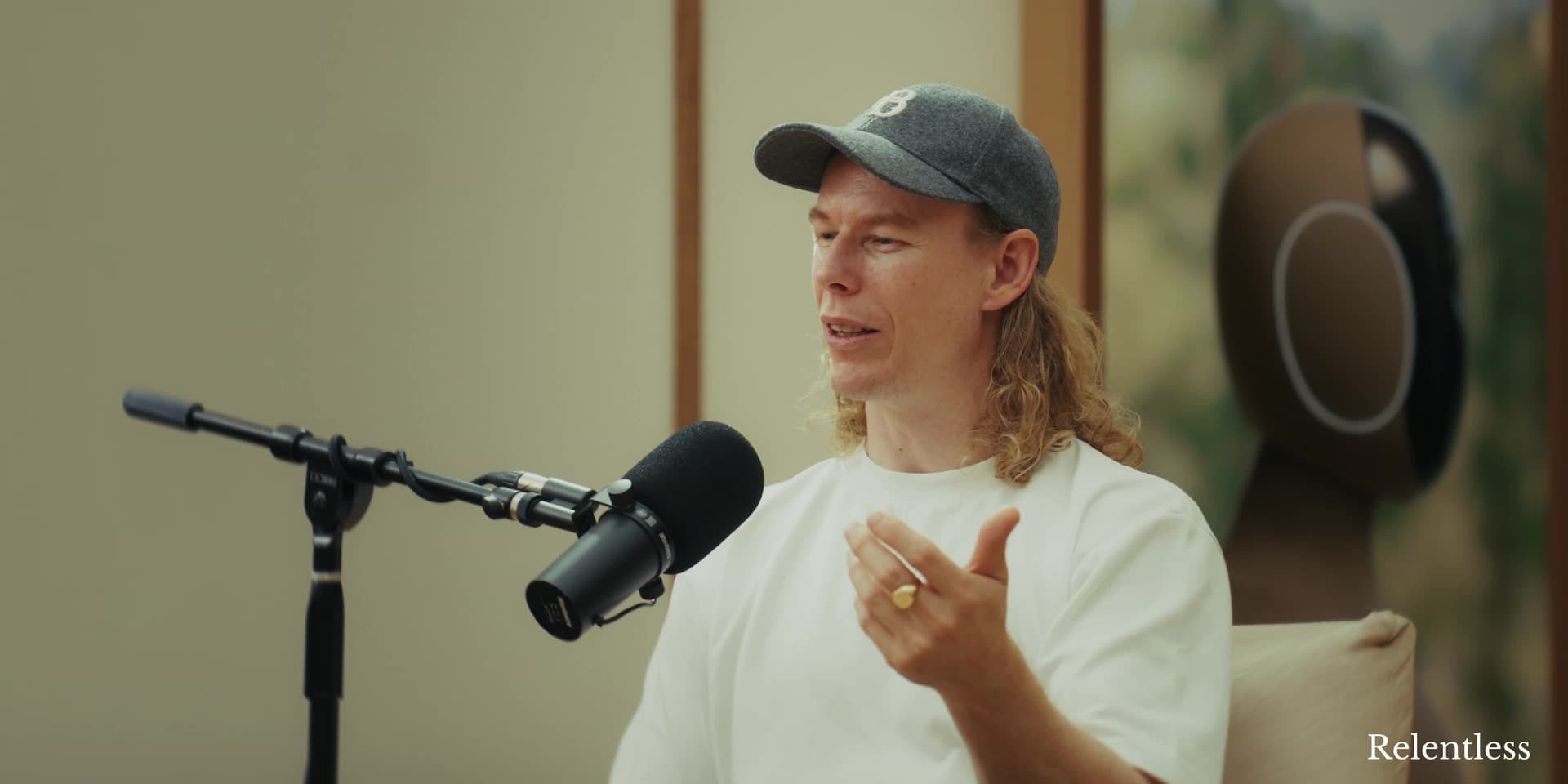
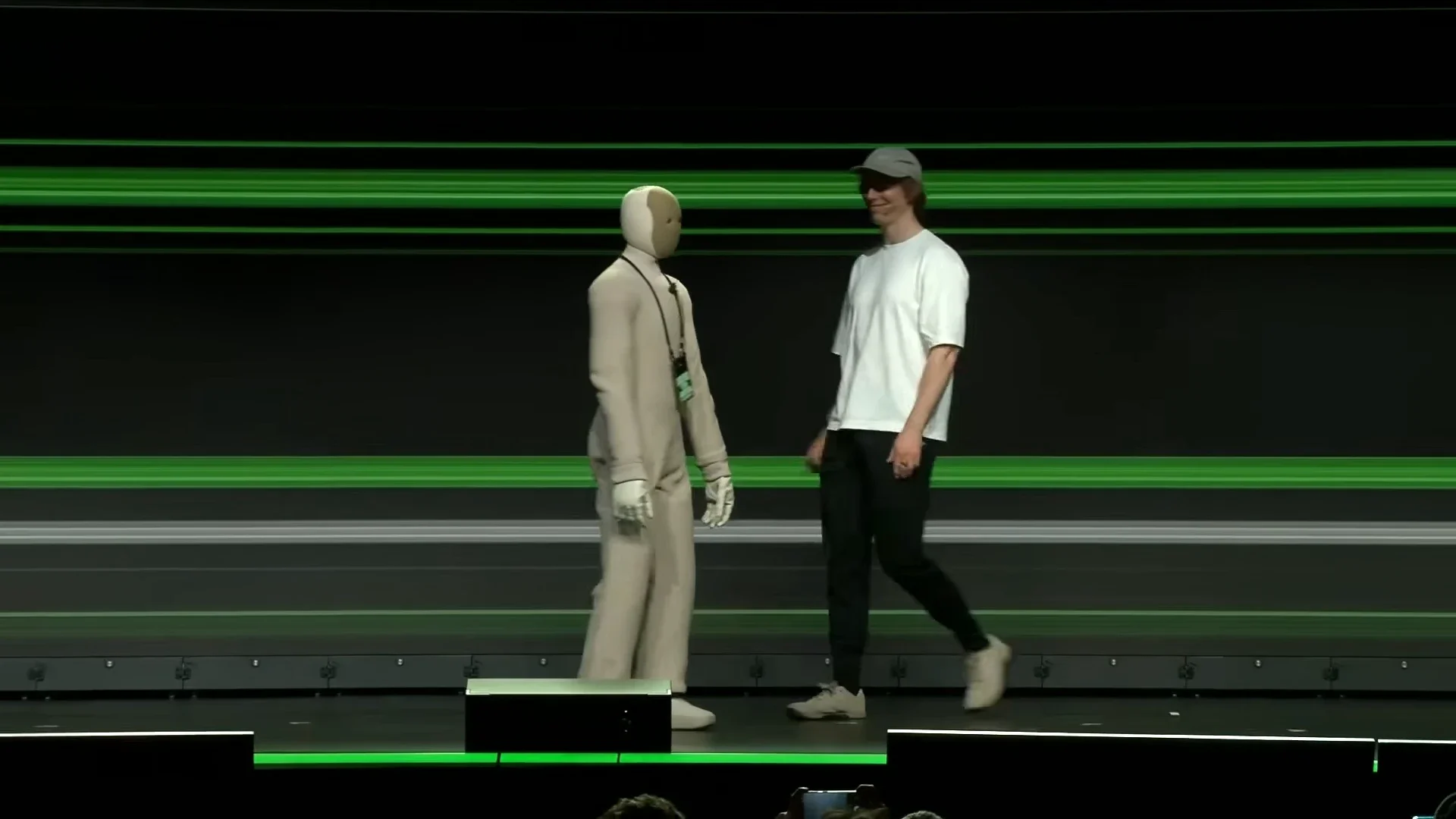
1X will start shipping its NEO humanoid to developers and "some consumers" in December, according to founder and CEO Bernt Børnich. He made the commitment on stage at Runtime 2026, the San Francisco conference organized by AI cloud company Modal, on October 1, in a talk that recast NEO as a development platform as much as a home robot.
"Neo is shipping in December to developers and to some consumers. So very excited to get the product out there," Børnich said. A recording of the 13-minute talk was published on YouTube by Modal on November 2.
- Bernt Børnich told the Runtime 2026 audience that NEO ships in December to developers and to some consumers.
- Developers get more than the robot: a wearable data collection rig that matches NEO's cameras and hand sensors, simulation tools, an automated data pipeline and APIs.
- 1X plans a Discord community with a weekly policy leaderboard; the top three each Friday will see their policy run on a real NEO, streamed on Twitch.
- Hackathons at 1X offices will let developers who can't afford a NEO deploy code to the company's robots.
- A slide compared NEO with Tesla's Optimus Gen 2, Figure 03 and Unitree H2, listing NEO as the lightest of the four at 36 kg and the only one rated "human safe."
A consumer front and a developer back end
Børnich opened by comparing 1X to NVIDIA, which he described as having "a consumer front and an enterprise backend." NEO is marketed as a household robot, but he told the audience that "ultimately, the back end of this is going to be built by developers."
That framing follows Børnich's June 24 announcement that 1X would accelerate NEO's release to developers, which came after the House Select Committee on China singled out Unitree robots sold on Amazon. At the time, the company said specific dates would follow.
Follow humanoid robotics without following every announcement.
Get the week’s most important launches, funding and research—and why they matter—in one email from Humanoids Daily.
Once a week. Unsubscribe anytime.
Read recent issuesHe also gave a timeline for the industry as a whole: "As 2026 goes by, not that much is going to change about physical AI, but I think 2027 is going to be one heck of a year." He made a similar prediction in September, when he said 1X aims to ship 50,000 robots.
Safety as a data problem
Most of the first half of the talk argued that safety determines what a robot can learn, not only where it can be sold. "Since these systems are actually learning in the real world, they will be as intelligent as their experiences," Børnich said. "If you can't go there and can't experience it, then you really cannot get that part of the distribution."
A slide titled "Safety Unlocks Data" rated the data diversity of six settings. Security, hospitality, healthcare, office and retail were marked "High," and manufacturing "Low." Børnich tied this to reinforcement learning on physical robots, which he called being "very bullish on RL in real."
To illustrate, he showed footage of an earlier, uncovered NEO next to a conventional robot arm, labelled "harmonic drives / planetary gears" against 1X's "Revo drive." The geared arm crushed a carrot, a can, an apple and a cucumber, while NEO handled the same objects without damaging them.
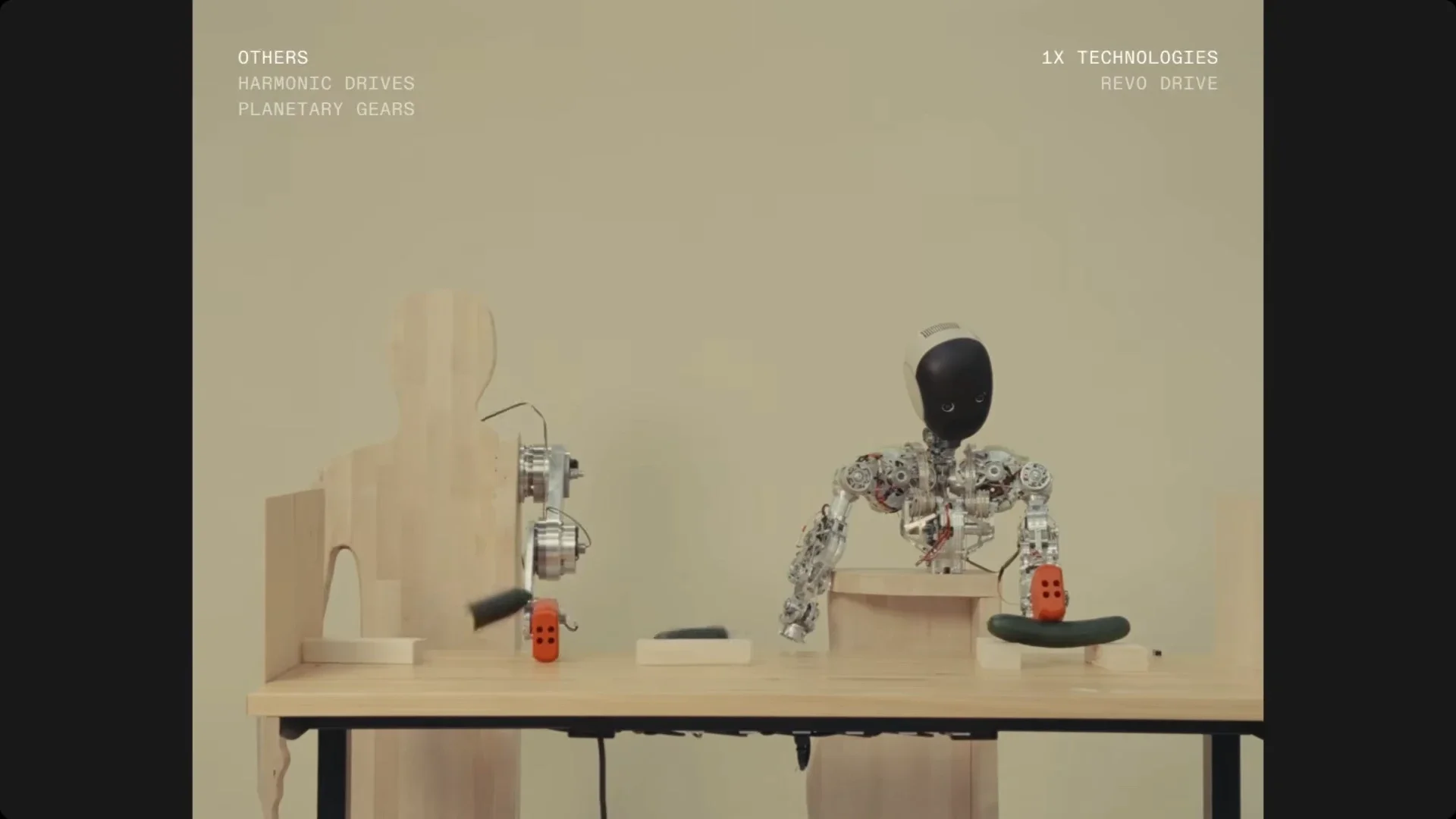
"Neo is built with tendons, kind of loosely inspired by muscle," Børnich said. "This layer of the very capable motors with the tendon drive is really what enables Neo, just like a person, to be very strong and capable, but not have that much kinetic energy in motion when doing things, because there's no gears that are spinning very fast."
He said the point goes beyond produce: "It's about if you're in logistics and you're picking up that box and you got it wrong, you can try again and the box isn't flat."
Børnich said 1X builds its own stack "from the material science we develop with motors and tendons" through manufacturing and up to the foundation model. He likened conventional geared robots to gasoline cars and NEO to an electric car, and claimed NEO is "not just lighter and safer. It is more capable." He asked the audience to "keep me honest here" if they found something better.
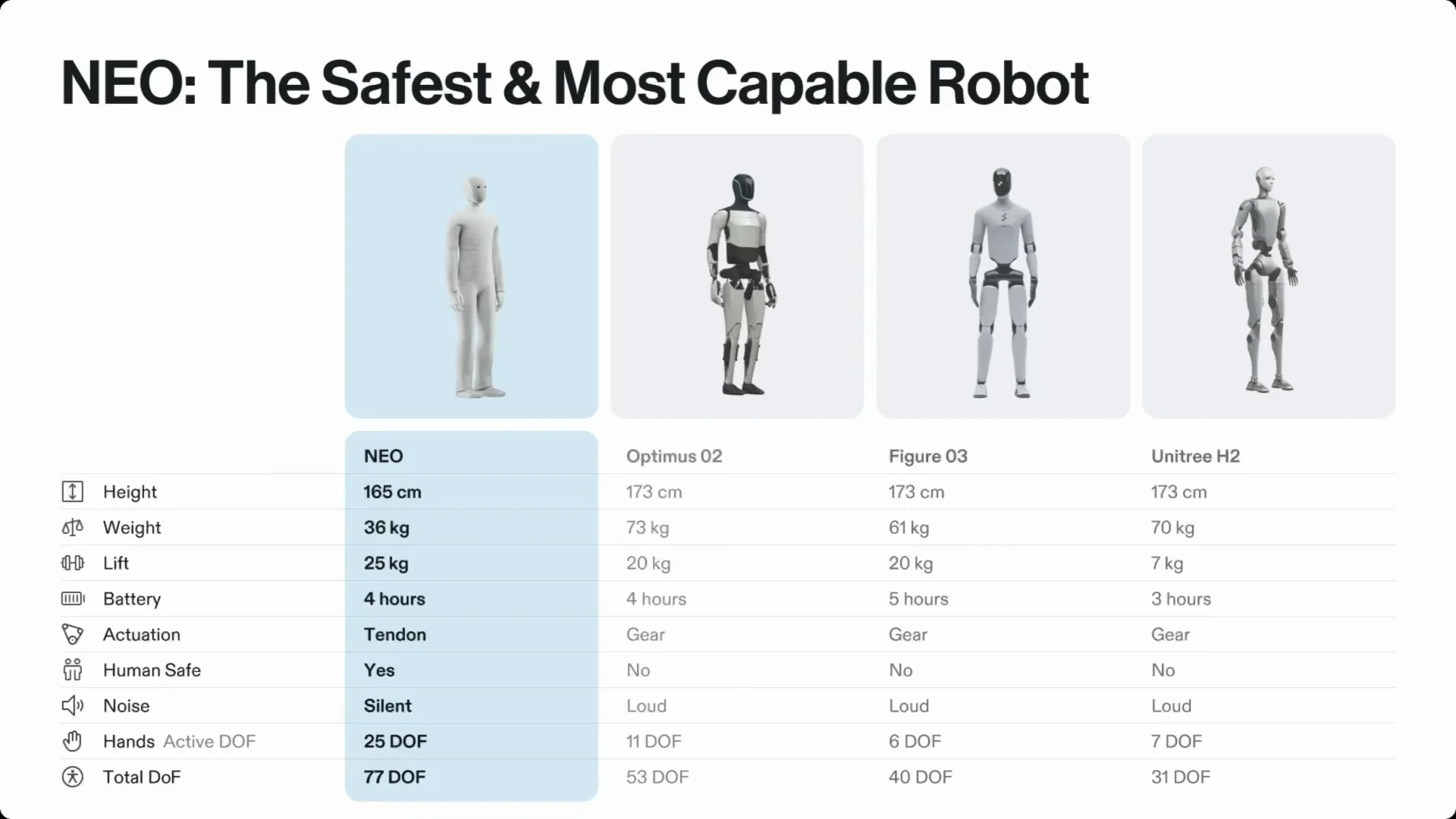
The comparison slide, titled "NEO: The Safest & Most Capable Robot," listed these figures:
| NEO | Optimus Gen 2 | Figure 03 | Unitree H2 | |
|---|---|---|---|---|
| Height | 165 cm | 173 cm | 173 cm | 173 cm |
| Weight | 36 kg | 73 kg | 61 kg | 70 kg |
| Lift | 25 kg | 20 kg | 20 kg | 7 kg |
| Battery | 4 hours | 4 hours | 5 hours | 3 hours |
| Actuation | Tendon | Gear | Gear | Gear |
| Human safe | Yes | No | No | No |
| Noise | Silent | Loud | Loud | Loud |
| Active hand DOF | 25 | 11 | 6 | 7 |
| Total DOF | 77 | 53 | 40 | 31 |
The "human safe" and noise rows are 1X's own ratings, not results from a standard test. The 25 active degrees of freedom match the tendon-driven hands 1X unveiled in July. Børnich called hands "the final boss of robotics" and argued tendons are the only practical way to build them, since "nature put all of your muscles for your hands, or most of them, up in your lower arm."
What developers get
Børnich said 1X does not yet know what developers will build on NEO. "Our goal is to just create a holistic platform where everything is available and everything is extremely hackable," he said.
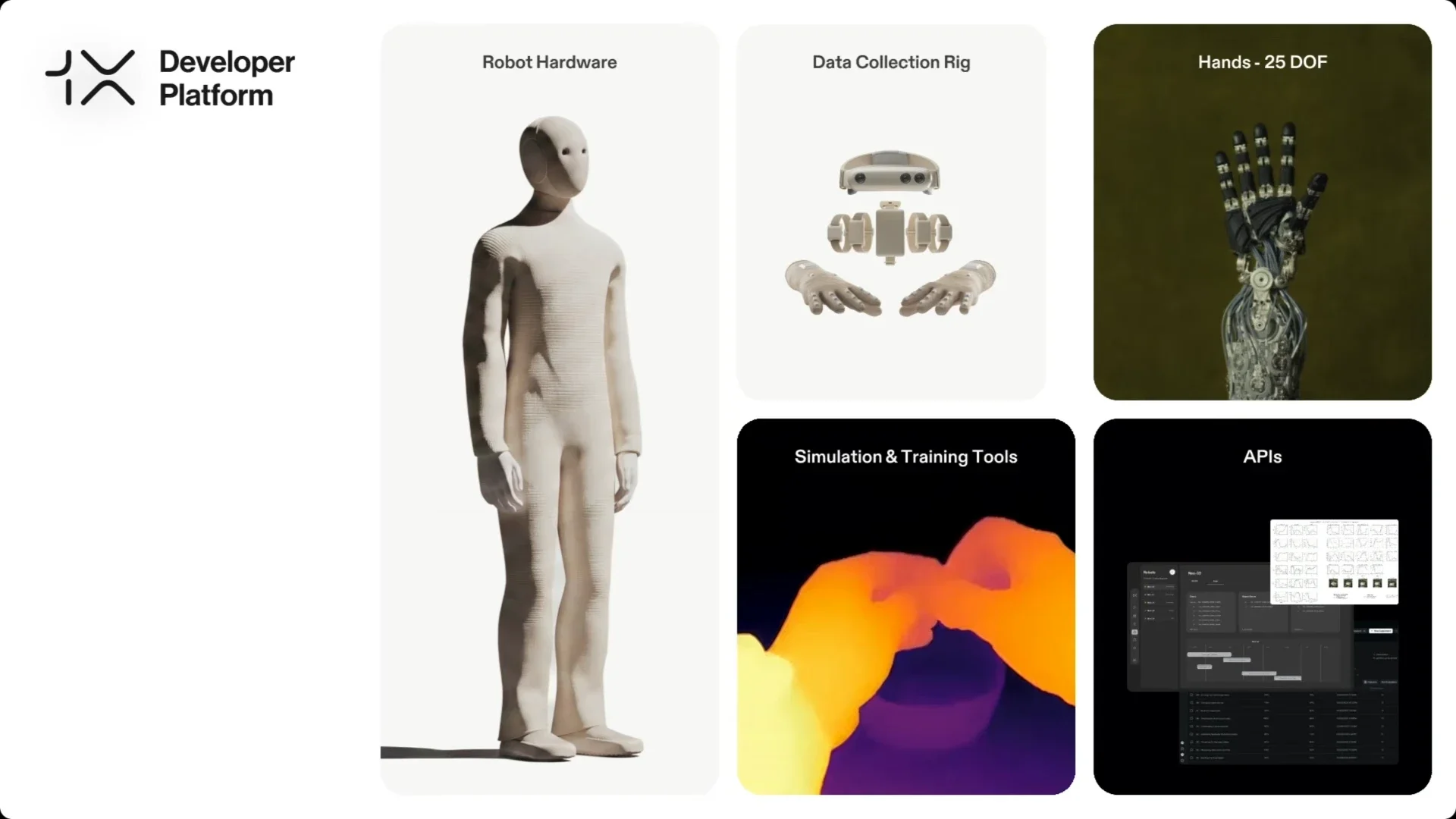
A slide split the platform into five parts:
- The robot. "Nothing replaces the real world," he said.
- A data collection rig. It mirrors the robot's sensors, with the same cameras and the same tactile sensing as NEO's hands. It tracks the wearer's head, fingers and the rest of the body, so whole-body poses can be retargeted to the robot. Børnich described it as "a consumer electronics device that we manufacture at scale." The slide showed a head-mounted camera unit, wrist and body trackers, and a pair of gloves.
- NEO's hands, listed separately with 25 degrees of freedom.
- Simulation and training tools.
- APIs and an automated pipeline that takes data from the rig, from teleoperation or from a policy running on the robot. Børnich said the pipeline, which 1X built "from scratch the last six months," automatically segments tasks, writes dense captions, and filters and checks the data. He described it as state-of-the-art "as far as we know."
Developers will not be locked into 1X's tools. "If you want to plug in your own stuff, you can plug in your own stuff," Børnich said, adding that 1X is "a small team" and expects others to build things "that we just didn't think about or where we just didn't execute well enough."
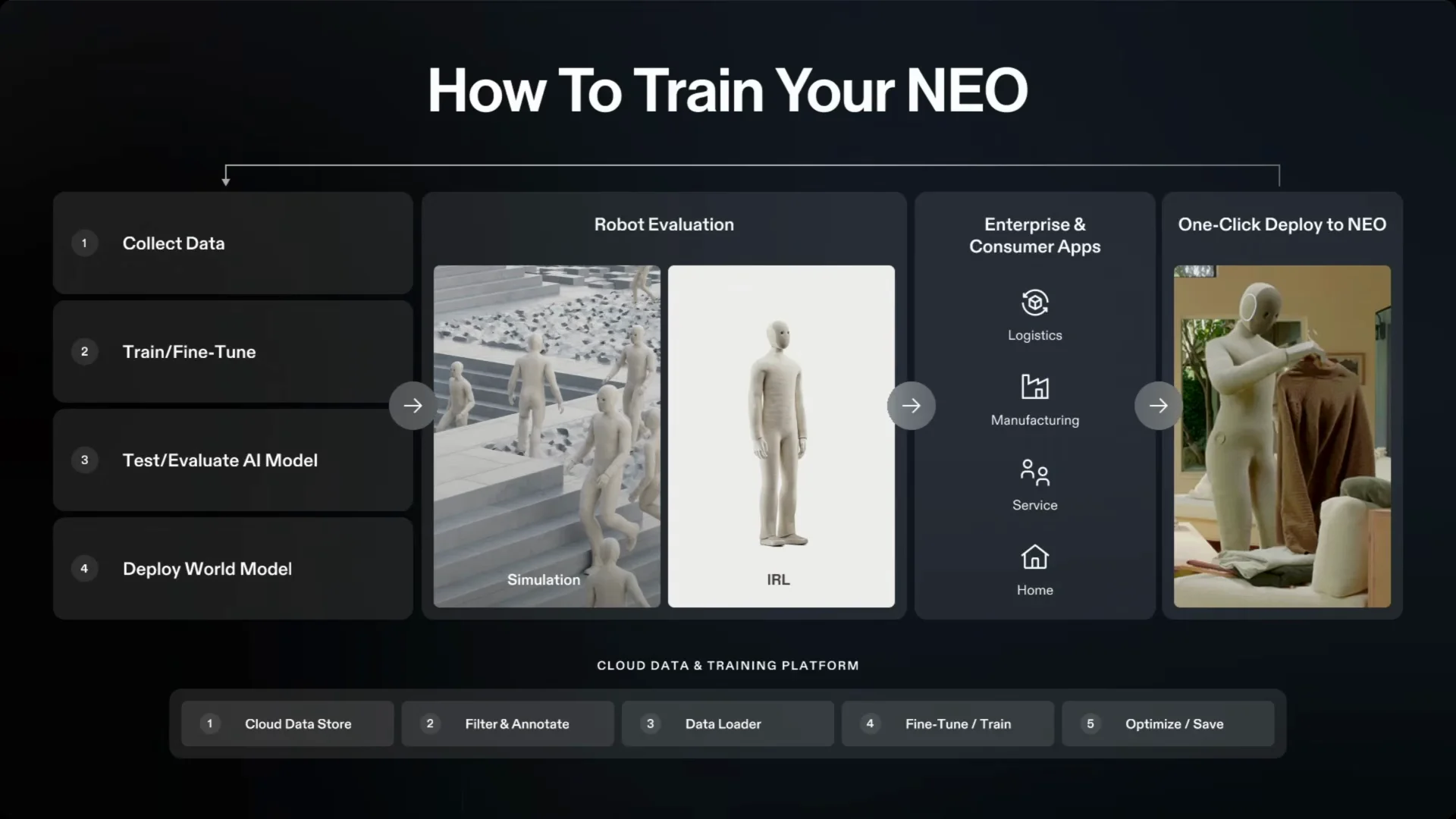
A "How To Train Your NEO" slide laid out the workflow: collect data, train or fine-tune, test and evaluate a model in simulation and on the real robot, then deploy what the slide called a "world model." Applications were grouped under logistics, manufacturing, service and home, ending in "one-click deploy to NEO." Underneath sat a "cloud data & training platform" in five steps: cloud data store, filter and annotate, data loader, fine-tune or train, and optimize or save. The world-model step fits 1X's research direction since it reorganized around world models in June.
Discord, Friday leaderboard and hackathons
Børnich urged developers to join 1X's Discord, which the closing slide listed at 1x.tech/discord. "I feel the field is fragmented today, and there's no real community where everyone is just building together to solve this problem," he said. 1X will launch the platform with research partners "not just in industry, but also in academia," though he did not name any.
He described a weekly event he called "Friday NEO Live": "I want to make a leaderboard where everyone who's trained policies for Neos, the top three on the leaderboard every Friday gets to see their policy run on Neo, and we're going to stream it on Twitch."
1X also plans hackathons "at our offices around the world, where people can come in and actually deploy their code to Neos if they can't afford one." 1X opened NEO pre-orders at $20,000 or $499 a month for consumers in October 2025. Børnich did not give a separate price for the developer package.
He closed by setting the developer push against 1X's broader goal of "an abundance of labor," which he said reaches past household chores to running particle accelerators and staffing "the largest amount of wet labs."
Share this article
Follow humanoid robotics without following every announcement.
Get the week’s most important launches, funding and research—and why they matter—in one email from Humanoids Daily.
Once a week. Unsubscribe anytime.
Read recent issuesRead next
- Published on
- Reading time
- 4 min read
1X Reveals the RL Core That Gives Its NEO Humanoid Fluid, Whole-Body Mobility
- Published on
- Reading time
- 3 min read
1X Unveils Redwood AI: A Unified, Onboard Brain for Its NEO Humanoid Robots
- Published on
- Reading time
- 3 min read
1X Teammates Use Spare NEO Heads to Test Home Integrations, Starting With the TV
- Published on
- Reading time
- 5 min read
1X Aims to Ship 50,000 Robots—But Keeping Them Working Is the Test
- Published on
- Reading time
- 6 min read
1X CEO Bernt Børnich Predicts "Hard Takeoff" in 3 Years, Details NEO Platform and Data Strategy
- Published on
- Reading time
- 4 min read
One Roof, Four Weeks: Inside 1X’s Vertical Speed Hack as NEO Ramps for 2026 Deliveries