- Published on
The UMI Effect: Why Robotics Companies Are Building the Data Collector First
One tap, and our reporting appears more often in your Google Top Stories. It makes a real difference to a small newsroom.

Supported by RoboStrategySupport for Humanoids Daily comes from RoboStrategy
Sponsored
Investing involves risk, including possible loss of principal. Read the prospectus before investing.
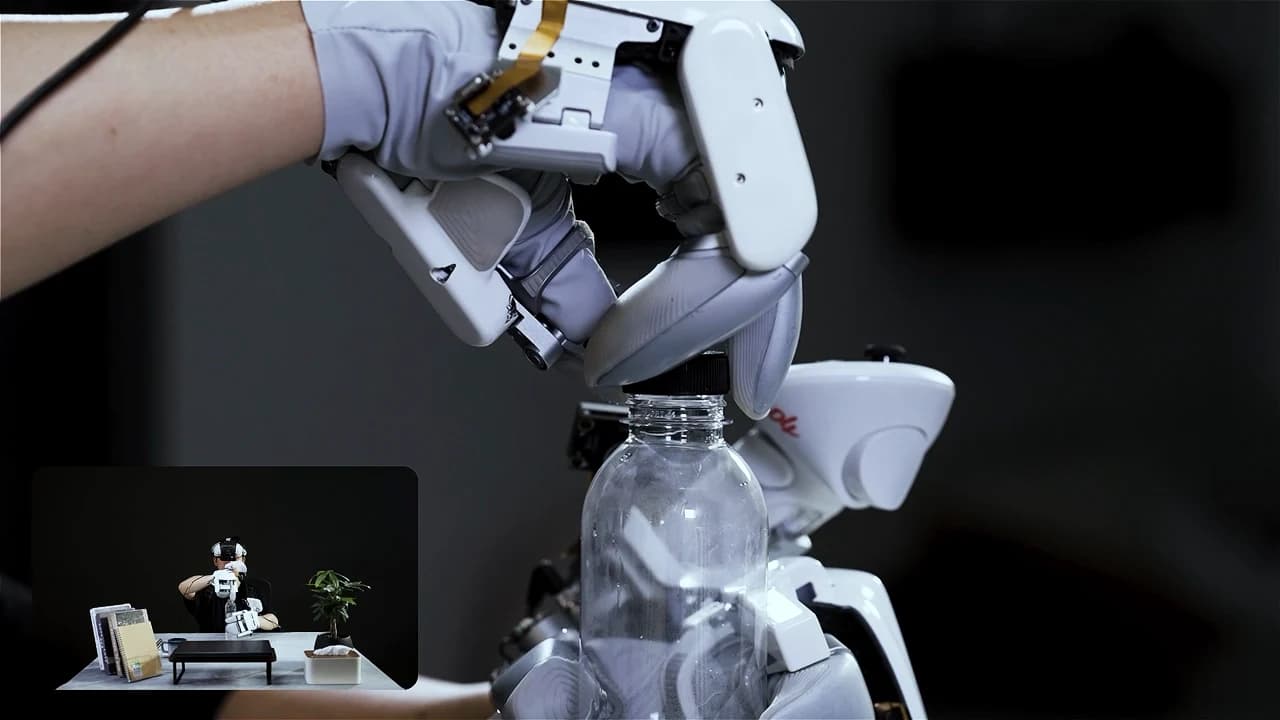
- UMI’s handheld GoPro gripper helped make it possible to collect transferable robot demonstrations in everyday environments without bringing a robot along.
- Sunday Robotics and X Square’s TwinDEX match their human collection devices to robot hands, making hardware design part of the learning strategy.
- Reward AI’s Omnibody Hand builds on the separate DexCap research lineage, pursuing human-to-robot skill transfer across different robot bodies.
- Company results measure different things: Sunday’s 99.1% folding success concerns unseen environments, while TwinDEX’s 5.3× figure concerns data collection throughput.
- The practical test is how efficiently demonstrations become reliable robot behavior, including the processing and robot-based iteration still required.
The latest robotics data race is taking shape around the human hand.
Sunday Robotics built its Skill Capture Glove alongside the hand of its household robot, Memo. X Square Robot’s TwinDEX pairs a wearable collection device with a matching robotic end effector. Reward AI’s newly revealed Omnibody Hand feeds human demonstrations into its OM-1 policy. Across these projects, a shared idea is emerging: collect useful manipulation data without requiring a complete robot for every demonstration.
One important reference point is the Universal Manipulation Interface, or UMI, introduced in 2024. Its distinctive hardware—a handheld gripper carrying a GoPro—made a larger proposition tangible: people could teach robot skills in everyday environments while leaving the robot behind.
The commercial significance is becoming clearer. A demonstration device can influence the robot’s hand, its sensors and the way its model learns. Choosing how to collect data becomes an early engineering decision with consequences throughout the system.
The weekly humanoid robotics briefing
One email a week: the launches, funding and research that mattered, with context from Humanoids Daily.
Read recent issuesBefore UMI: taking demonstrations out of the lab
UMI emerged from an existing research effort to make human demonstrations easier to collect.
In late 2023, Dobb·E introduced “The Stick,” a collection tool assembled from a reacher-grabber, an iPhone and 3D-printed parts. People demonstrated household tasks with the device, supplying examples from which a robot could learn. The project showed how modest hardware could bring data collection into real homes.
UMI followed in February 2024, with a team spanning Stanford, Columbia and Toyota Research Institute, including joint first authors Cheng Chi and Zhenjia Xu. The work appeared at Robotics: Science and Systems that year.
Its contribution was to tackle the details that determine whether a recorded demonstration can become reliable robot behavior. Earlier handheld approaches had already established portability. UMI sought to extend what could transfer, including fast movements and coordinated two-arm tasks.
What the GoPro gripper actually solved
The original UMI device let a person manipulate objects through a parallel-jaw gripper. A similarly configured camera and gripper on the robot helped make its view resemble the demonstration. The project demonstrated cup arrangement, dynamic tossing, cloth folding and dish washing, and released code and hardware guides.
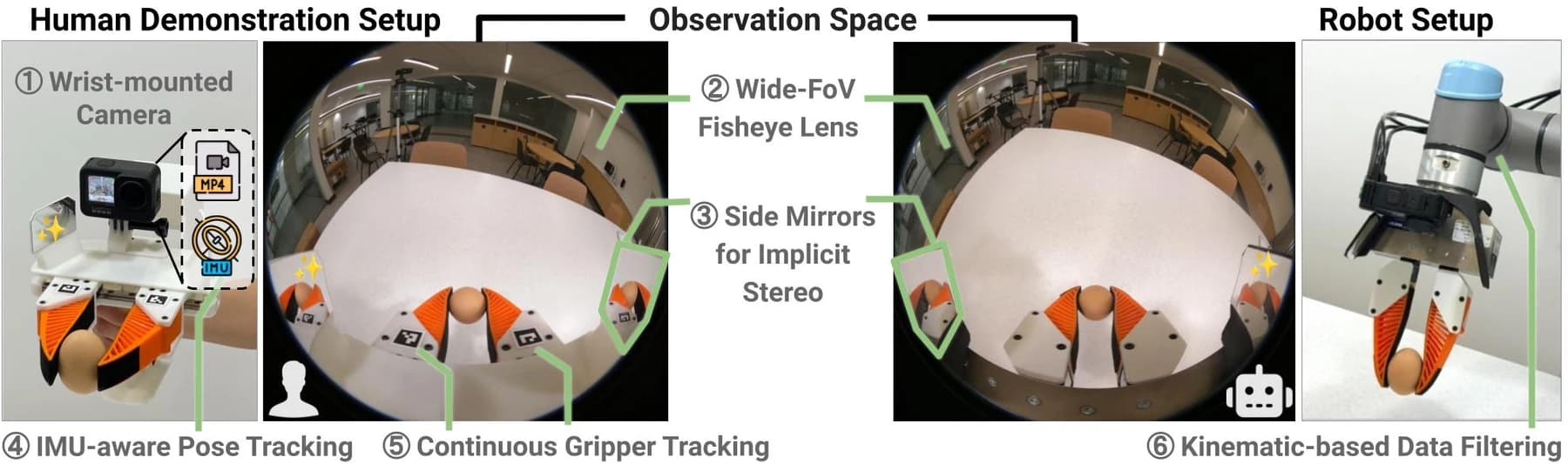
The less visible engineering was equally consequential. UMI combined wide-angle imagery, side mirrors and inertial measurements to capture visual context and movement. It represented actions relative to the gripper’s current position and compensated for the delays introduced by robot sensing and execution. Those timing differences matter when, for example, a gripper must release an object during a throw.
The broader lesson is that a video of successful manipulation is only a starting point. A training system needs a usable account of what moved, when it moved and what the robot should do next.
UMI made those requirements part of the collection interface. The newer commercial systems are pursuing that principle with different hands, richer sensing and different assumptions about the target robot.
Sunday: designing the robot around the glove
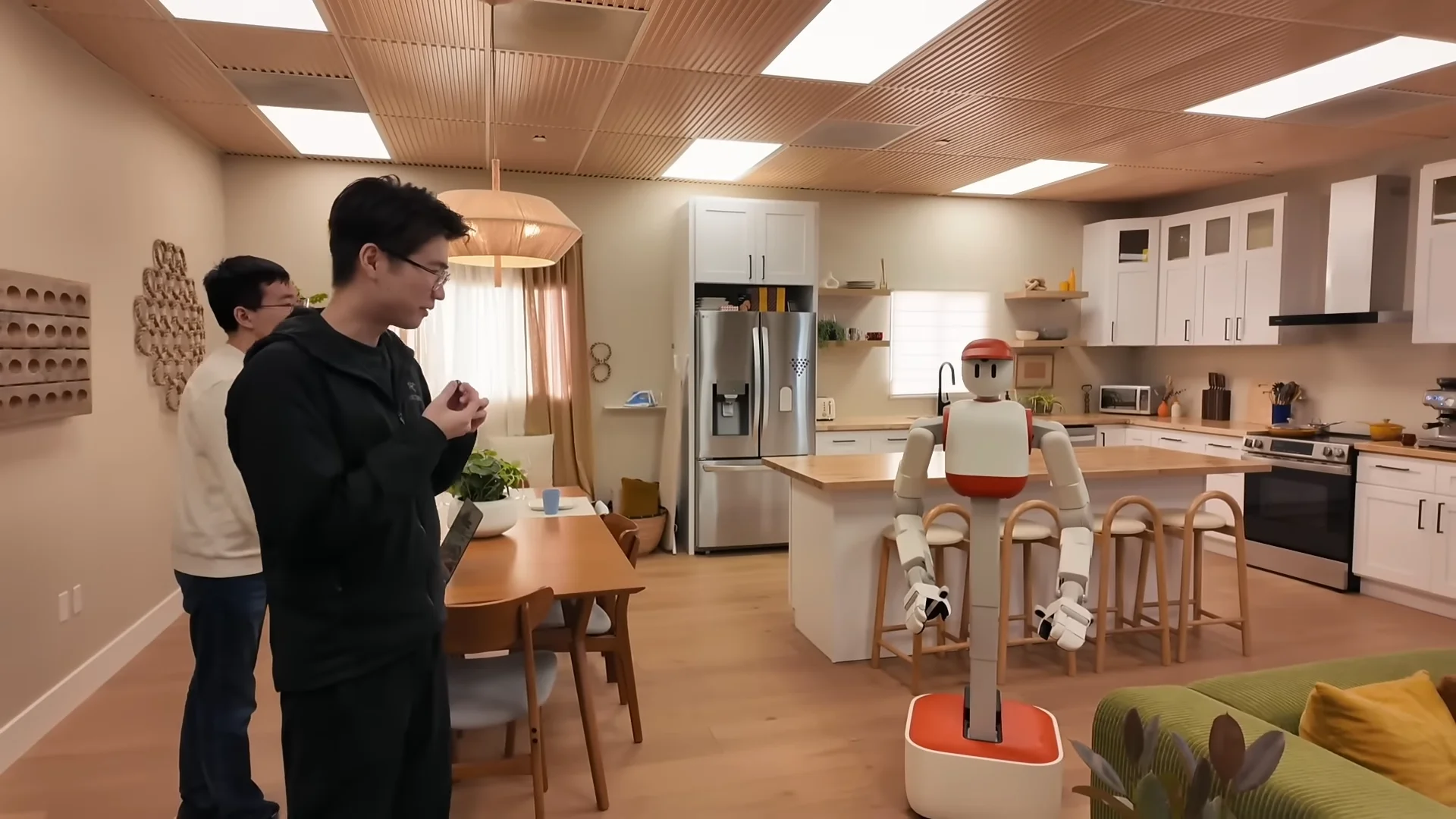
Sunday has a direct connection to UMI through co-founder Cheng Chi. In the interview covered in Humanoids Daily’s report on Sunday’s glove-first development, Chi described almost 100 glove iterations and a robot designed around the hand.
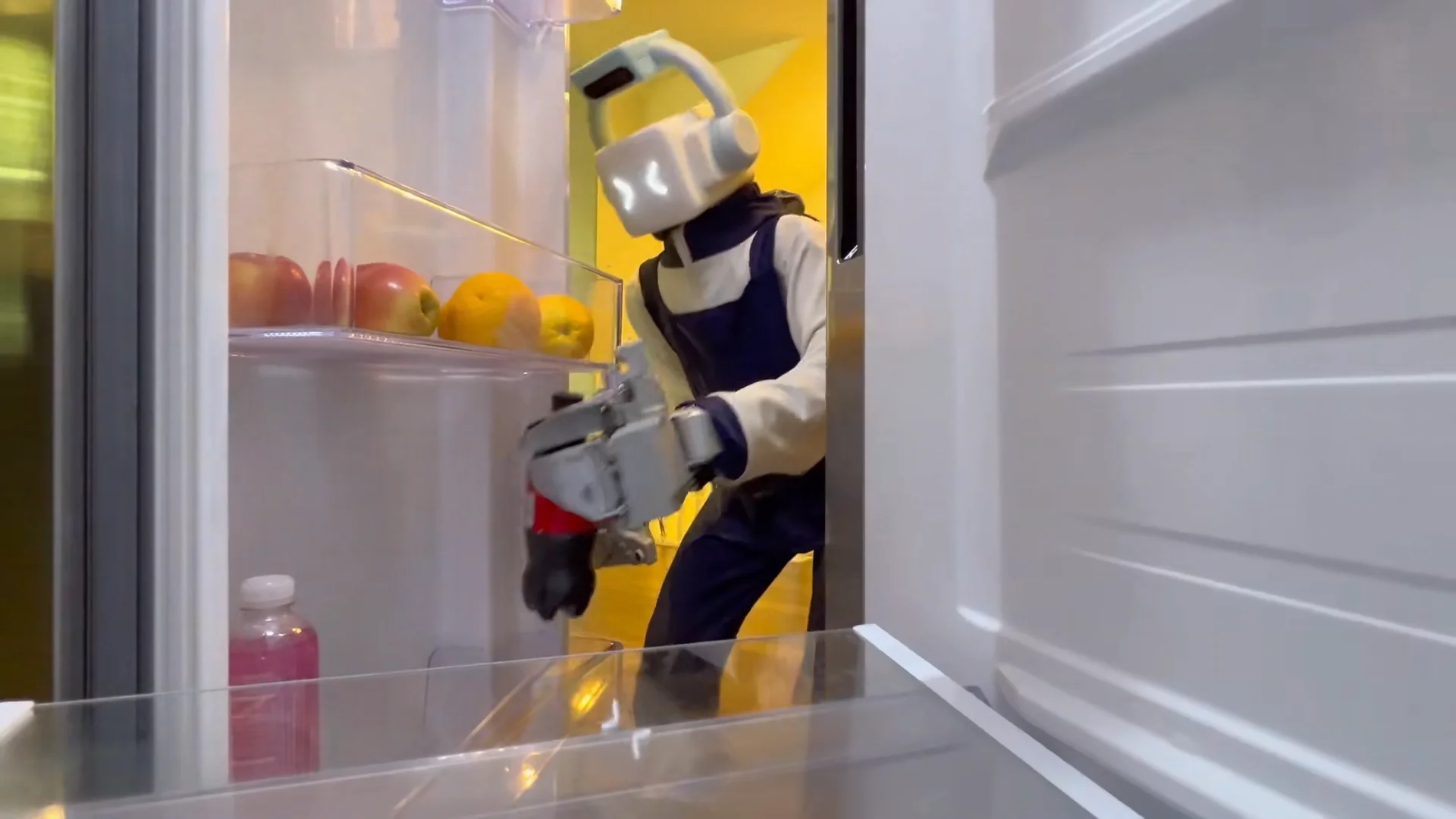
Sunday’s technical account explains the reasoning. The Skill Capture Glove and Memo’s hand share geometry and sensor placement, making human demonstrations easier to translate into robot training data. A processing system called Skill Transform then handles remaining differences, including human body proportions and the appearance of human arms in the observations.
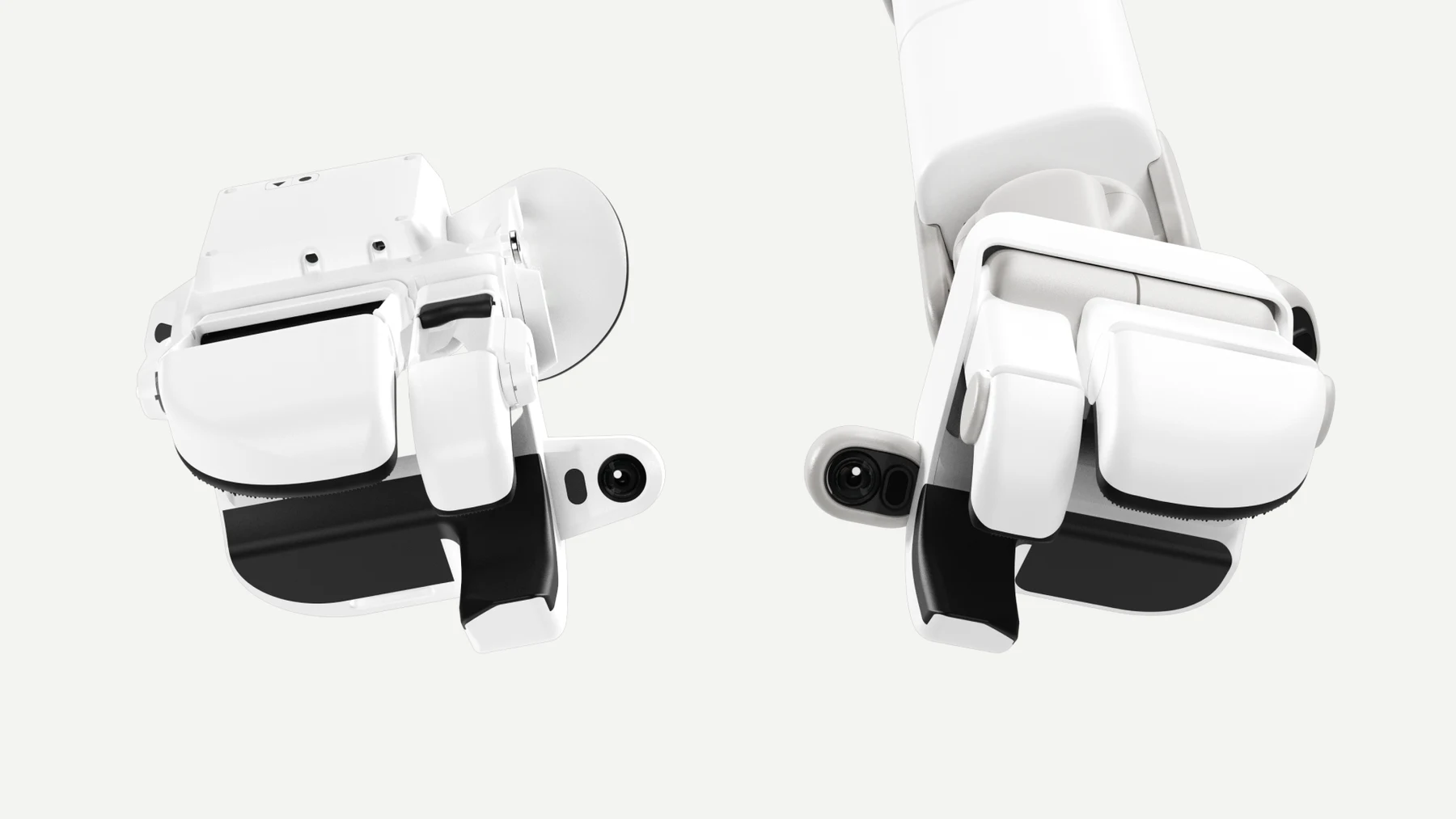
This turns the hand into a shared interface between the person collecting data and the machine learning from it. The robot’s physical design becomes part of the learning strategy.
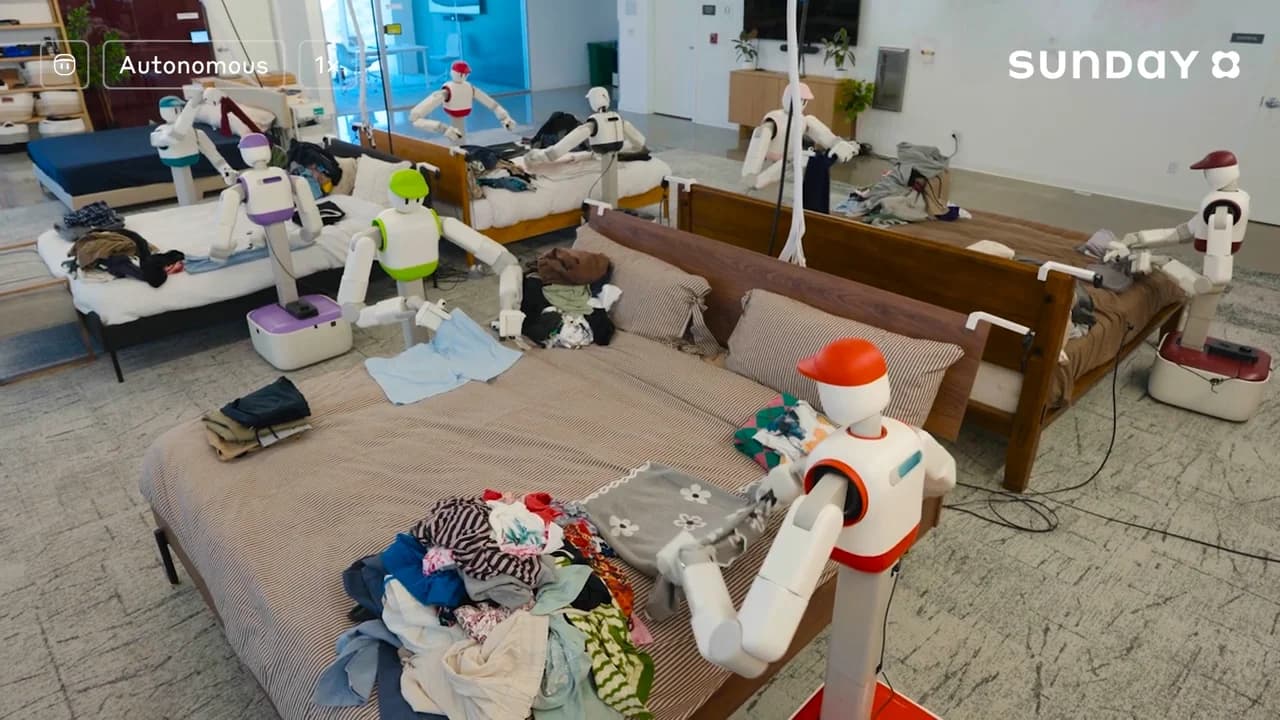
Sunday’s subsequent ACT-2 laundry result adds a test of reliability. The company reports 778 successful folds across 785 attempts, or 99.1%, covering nine garment categories in unseen environments.
The scope matters. Sunday defines zero-shot here as requiring no adaptation to the evaluation homes. ACT-2 combines broad sensorized human pretraining with an in-house post-training process; the result should not be read as evidence that robot-based iteration played no role. Its stated folding scope also excludes socks, bras, underwear and accessories.
That makes the result relevant to the data collection thesis without establishing that a glove alone solves household robotics.
TwinDEX: making both sides physically match
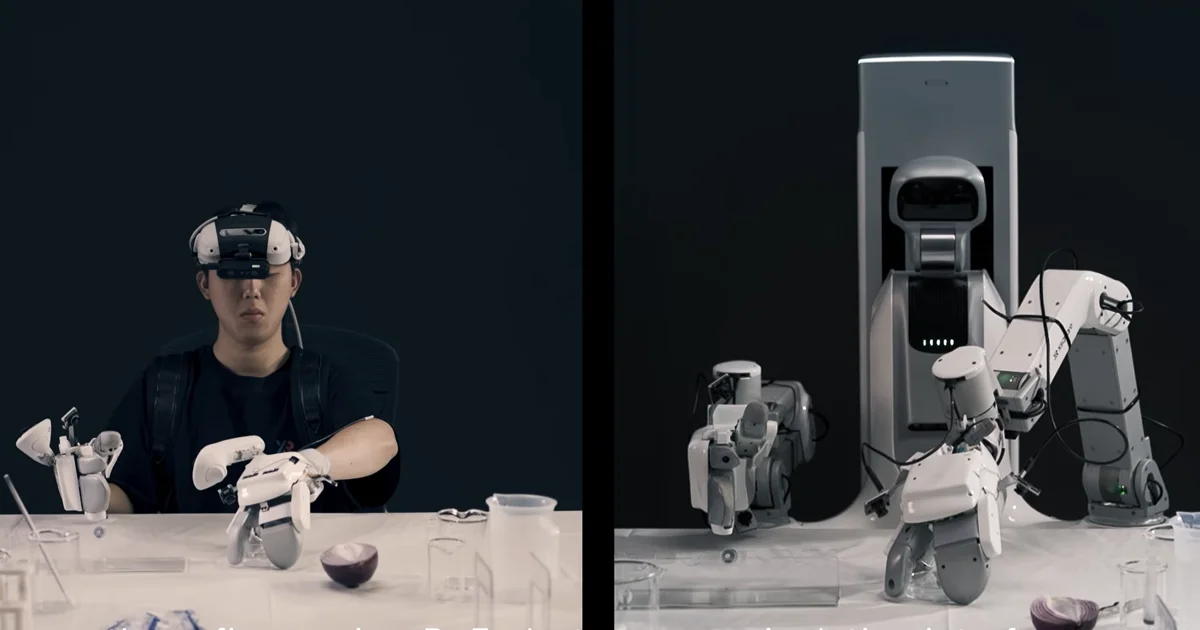
X Square’s TwinDEX applies the shared-interface idea to a wearable device and a robotic hand with the same three-finger, nine-degree-of-freedom architecture. The company reports up to 5.3 times the effective collection throughput of on-robot teleoperation, alongside manipulation learned from a few hundred robot-free demonstrations.
As detailed in Humanoids Daily’s TwinDEX coverage, the design emphasizes matching the collection hardware and robot across geometry, contact and sensing.
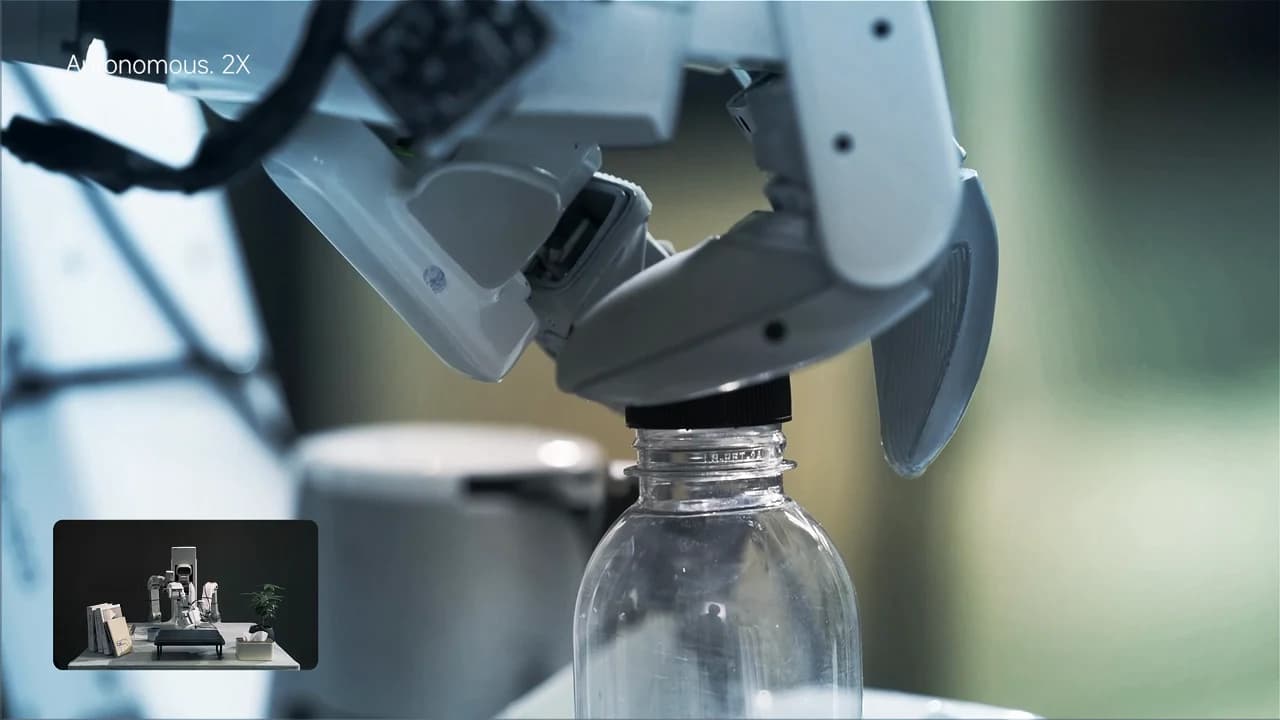
The attraction is straightforward: a closer physical match should reduce the amount of translation required between demonstration and execution. It also creates a design tradeoff. Matching a particular hand closely can simplify transfer to that hand, while reuse across substantially different hardware remains a separate challenge.
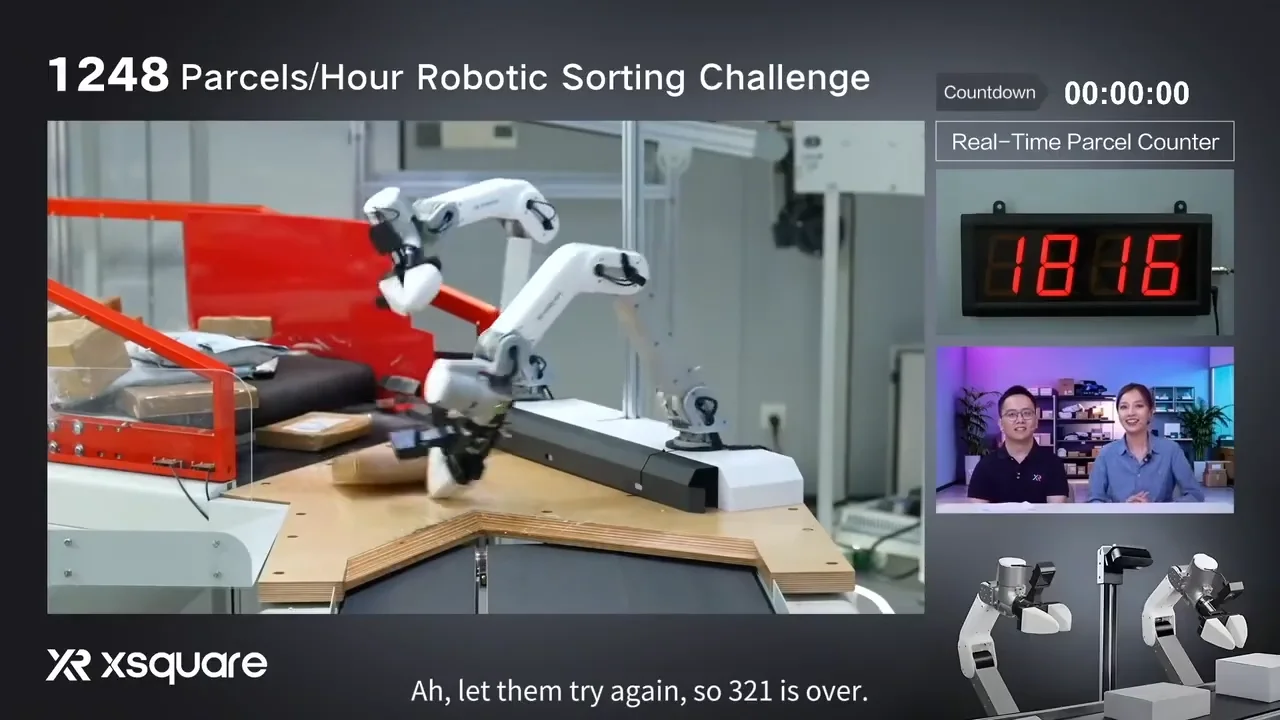
The throughput figure measures collection efficiency under X Square’s test conditions. It is not a direct comparison with Sunday’s folding success rate, which measures a different part of the system.
Reward AI: a separate research lineage converges on the hand
Reward AI explicitly traces Omnibody Hand to DexCap, a separate 2024 research project.
DexCap used wearable motion capture to record human wrist and finger movements alongside observations of the scene. Its learning pipeline translated those demonstrations to robot actions, and it also supported optional human corrections during robot execution. This was another route toward portable teaching, with a stronger emphasis on capturing articulated human-hand motion.
Reward’s new device uses seven degrees of freedom and combines tactile, proximity, visual and motion information. The company says OM-1 learns from human demonstrations without teleoperation or on-robot experience entering the policy’s training data. A separate control layer, trained with reinforcement learning in simulation, handles execution on the robot.
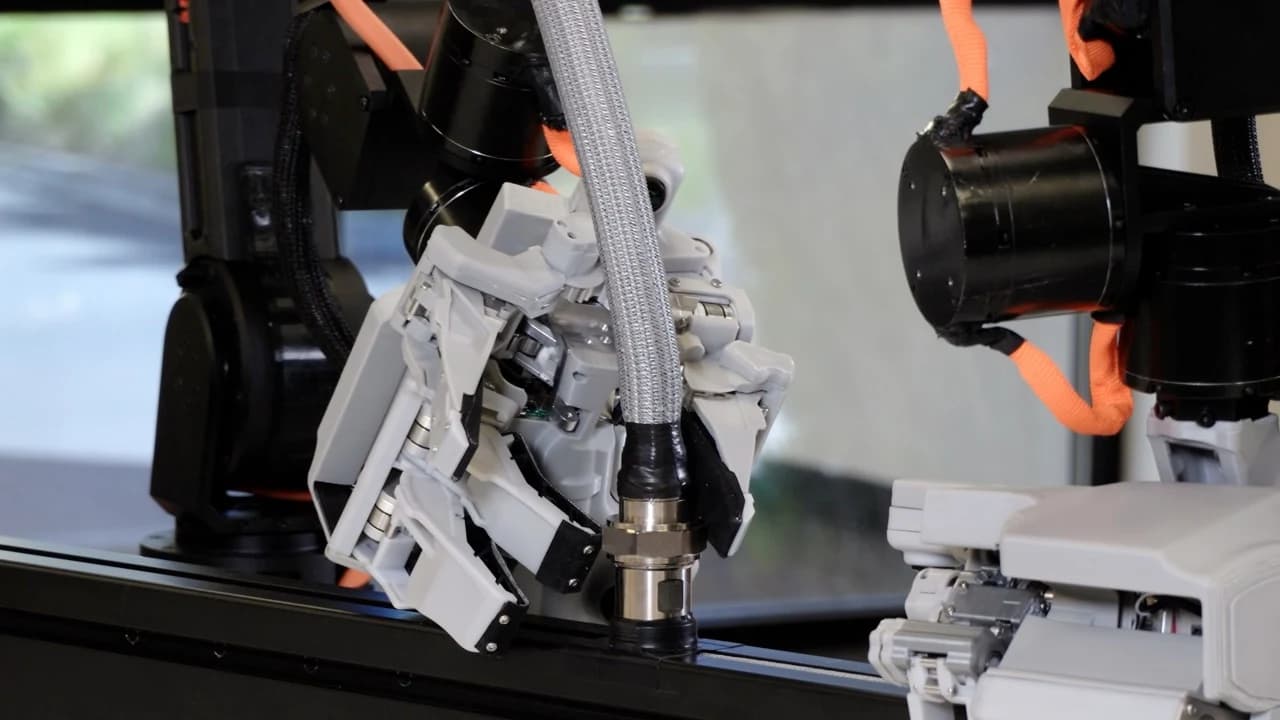
Reward therefore belongs in the same broader trend, but describing it simply as a UMI derivative would obscure its stated origins.
Its ambition also puts a different emphasis on transfer: a common manipulation interface serving multiple robot bodies. The launch presents company demonstrations and technical claims; those should be assessed separately from Sunday’s task-specific reliability evaluation.
The next question is how much useful learning each demonstration buys
Taken together, these projects suggest that robotics companies increasingly see data collection hardware as part of their core technology.
That changes what deserves scrutiny. Collection speed matters, but so does the proportion of recordings that survive processing. A comfortable wearable matters if people must use it repeatedly. Matching the robot matters if otherwise valuable demonstrations require extensive translation. And broad data coverage matters only if the resulting behavior survives unfamiliar objects, rooms and failures.
The most revealing future comparisons will follow the entire process: the effort required to collect demonstrations, the usable data they produce, the robot training still needed and the reliability achieved at deployment.
UMI supplied an influential example of how those pieces could be designed together. Sunday, X Square and Reward are now exploring different commercial answers to the same underlying question: what should a person wear or hold today to teach the robots that will work tomorrow?
Sources and further reading
- Sunday Robotics — ACT-1: A Robot Foundation Model Trained on Zero Robot Data
- X Square Robot — TwinDEX announcement and company news
- Reward AI — OM-1: Frontier Robot Intelligence, Learned Firsthand from Humans
- UMI — project, demonstrations, team and hardware resources
- Dobb·E — On Bringing Robots Home
- UMI — research paper and publication history
- UMI — original research paper, full text
- Sunday Robotics — ACT-2 Preview: Generalizing Reliability
- DexCap — project, methodology and demonstrations
Share this article
Read next
- Published on
- Reading time
- 5 min read
Isomorphism Over Imitation: X Square Unveils TwinDEX to Bridge the Robot-Free Data Gap
- Published on
- Reading time
- 7 min read
Reward AI Exits Stealth with OM-1, Pitching Zero-Shot Human-to-Robot Manipulation
- Published on
- Reading time
- 5 min read
No Fingers, No Problem: X Square Robot’s 1,816-Parcel-Per-Hour Livestream Challenges Figure
- Published on
- Reading time
- 5 min read
Beyond the Viral Demo: Sunday Robotics Claims 99.1% Zero-Shot Success in Laundry Folding with ACT-2
- Published on
- Reading time
- 5 min read
Watch: Inside Sunday Robotics’ Mission to Move Beyond the "Viral Demo"
- Published on
- Reading time
- 4 min read
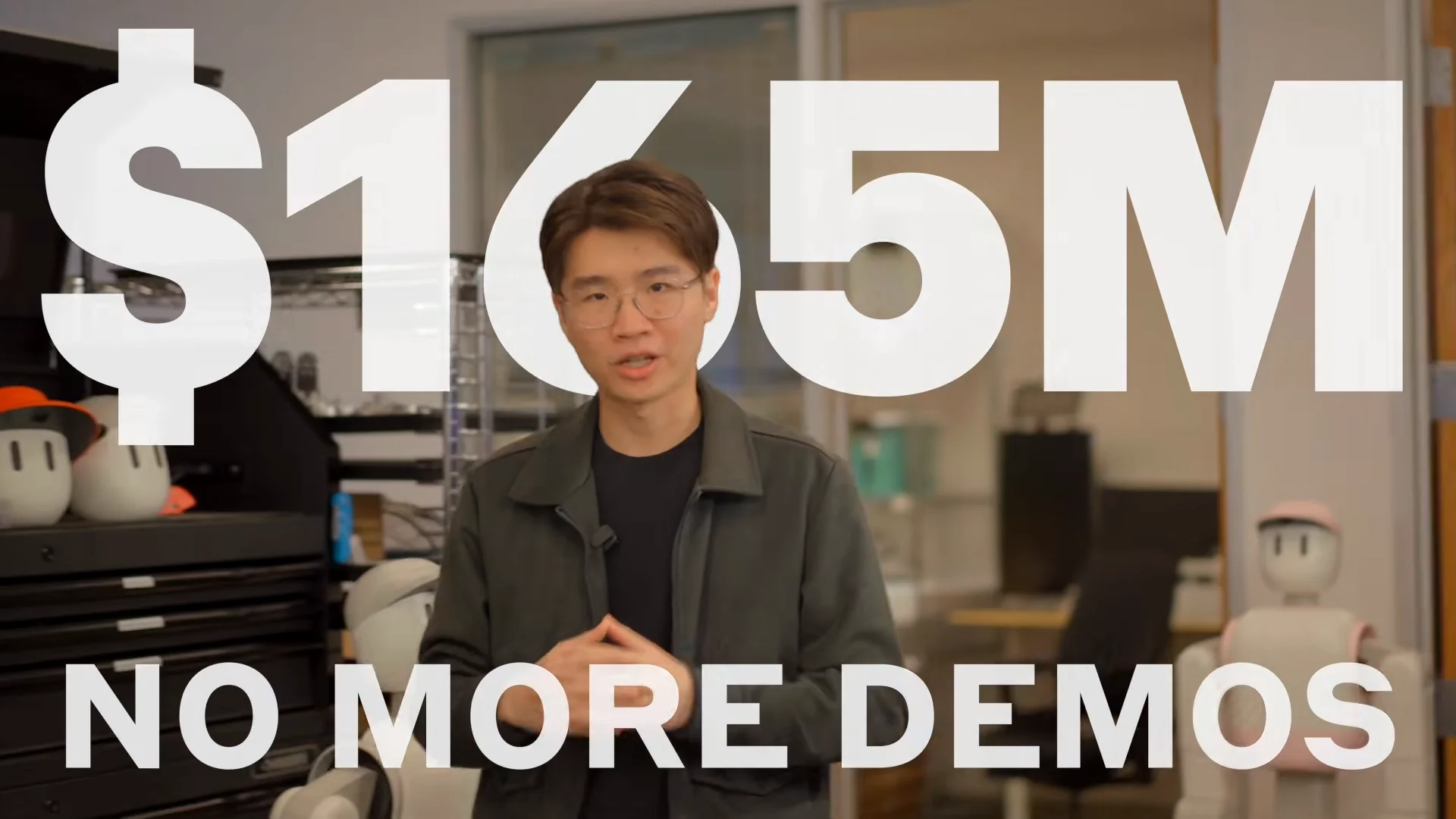
Sunday Robotics Raises $165M to Transition from Demos to Real-World Deployment
The weekly humanoid robotics briefing
One email a week: the launches, funding and research that mattered, with context from Humanoids Daily.
Read recent issues