- Published on
AgiBot Claims Factory Breakthrough: Robots 'Learn' New Tasks in Minutes Using Real-World RL
One tap, and our reporting appears more often in your Google Top Stories. It makes a real difference to a small newsroom.


Your guide
Rich Robinson
Jee Chee Ren · Executive tour
See China’s AI and robotics ecosystem first-hand.
Six days exploring AI, robotics and advanced manufacturing.
With Rich Robinson, Clinical Professor of Entrepreneurship at Peking University
Beijing · Guangzhou · Shenzhen
29 November–4 December 2026
Referral partnership · We earn a commission on referred bookings.
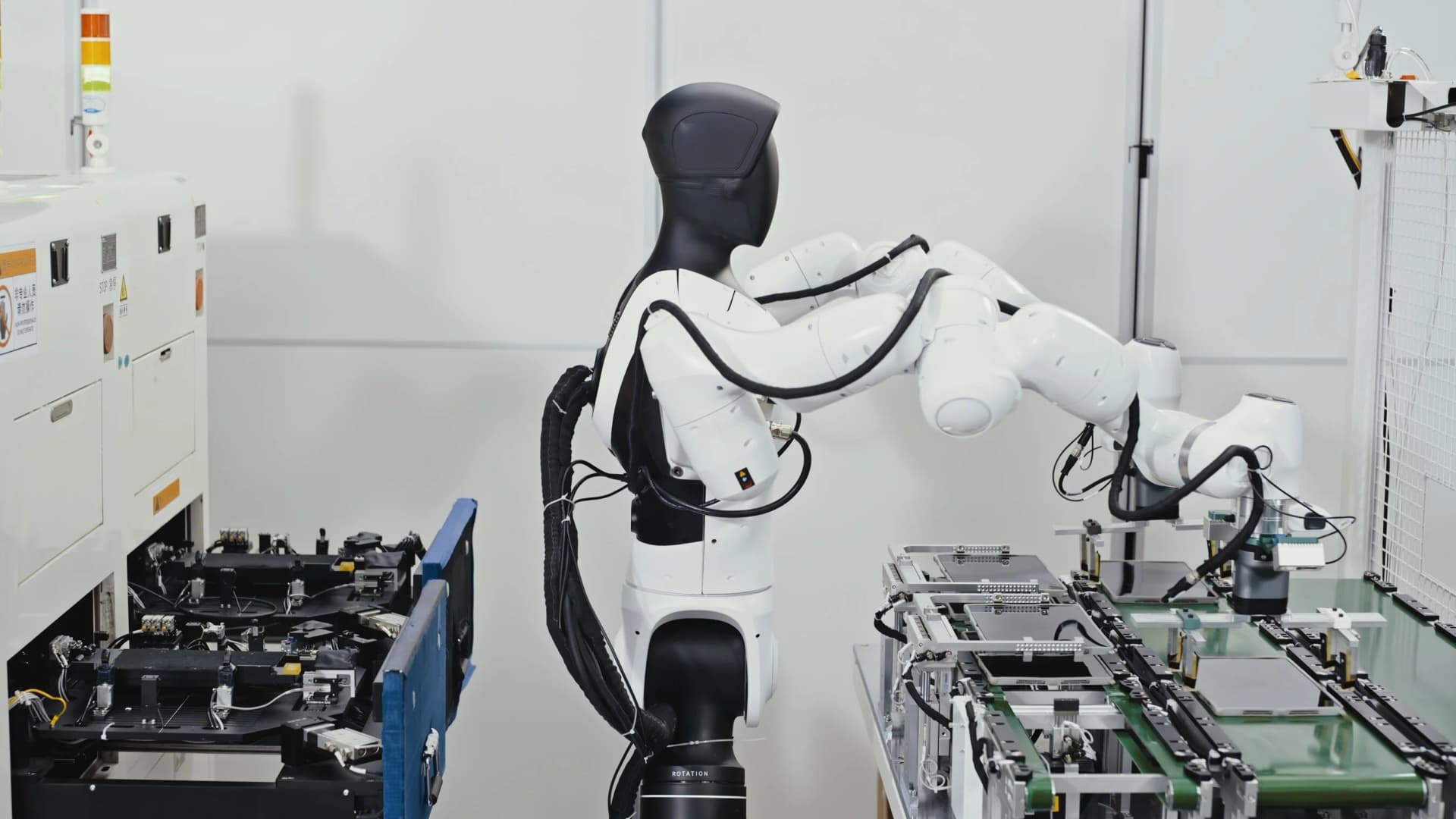
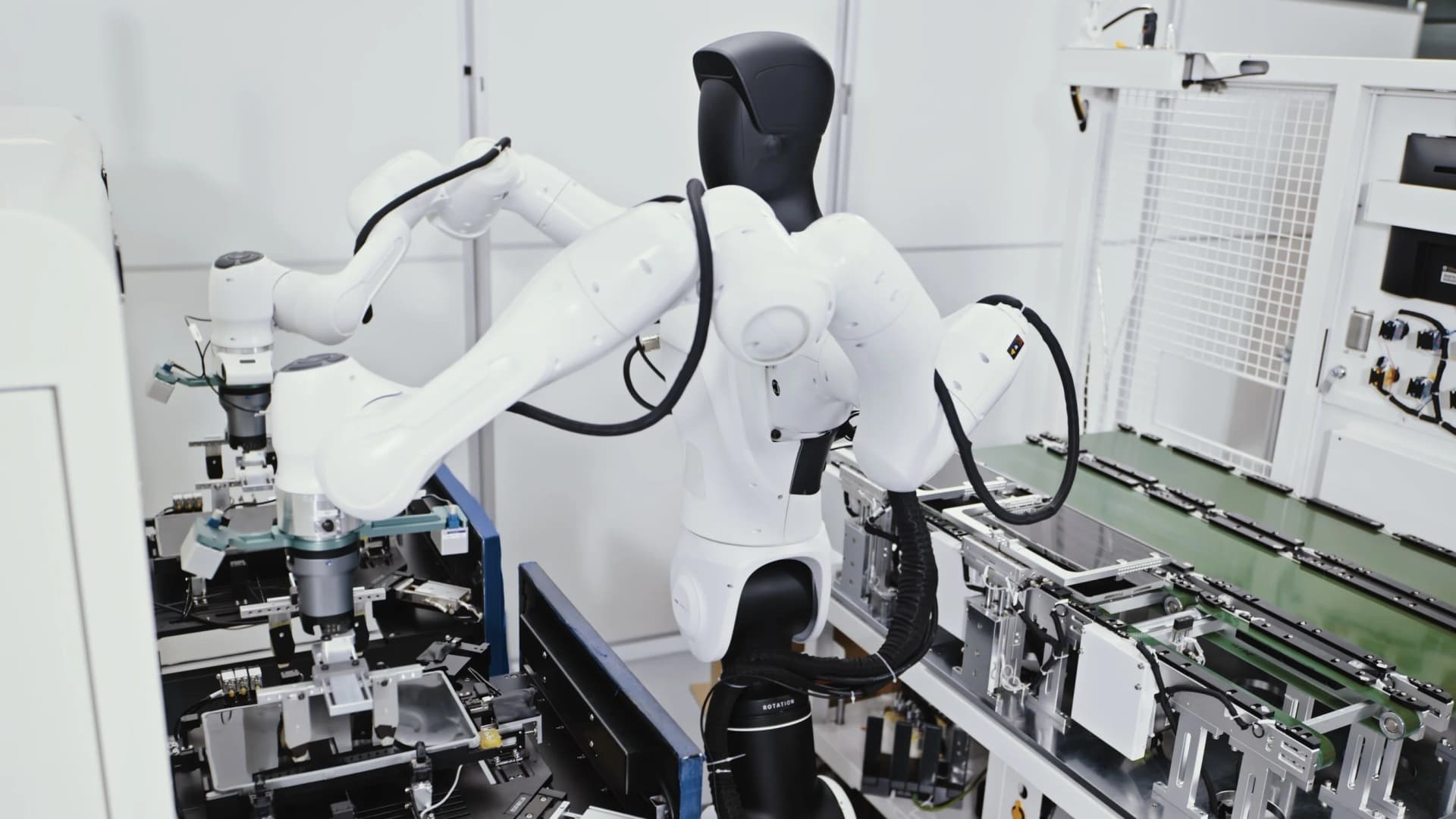
AgiBot, a robotics company specializing in embodied intelligence, has announced what it claims is the "first application of real-world reinforcement learning (RW-RL) in real industrial robotics."
In a press release, the company stated the system has been successfully deployed on a pilot production line with Longcheer Technology, a partner in the precision manufacturing space.
The core claim is one of radical efficiency: AgiBot's system allows robots to "acquire new skills" in "tens of minutes." This directly tackles one of the biggest challenges in modern manufacturing, where programming robots for new tasks can take weeks of extensive tuning and fixture design.
The Problem of 'Rigid' Automation
Precision manufacturing, such as for consumer electronics, has long relied on "rigid automation." While effective, these systems are expensive and slow to reconfigure. When a new product model is introduced, the entire line often needs costly and time-consuming adjustments.
The weekly humanoid robotics briefing
One email a week: the launches, funding and research that mattered, with context from Humanoids Daily.
Read recent issuesAgiBot says its RW-RL system addresses these pain points by enabling robots to learn and adapt directly on the factory floor. According to the company, the system can autonomously compensate for common variations, such as slight shifts in a part's position or component tolerances, while maintaining a 100% task completion rate.
This "flexible reconfiguration" means that when product lines change, manufacturers could potentially retrain their robots quickly without needing to design entirely new custom tooling.
From Demos to Deployment
This announcement is a significant step in AgiBot's push for aggressively pursuing commercialization. While the company has previously demonstrated its G2 industrial robot performing precision manufacturing tasks like inserting RAM, this new system represents the underlying AI software becoming a product itself.
The move also highlights AgiBot's multi-track strategy. The company has garnered attention for its public-facing LinkCraft "zero-code" platform for its humanoid robots, but this RW-RL deployment is aimed squarely at high-value industrial automation.
AgiBot emphasizes that this system was "validated under near-production conditions," not just in a research lab, marking a crucial step in bridging the gap between academic breakthroughs and industrial-grade reliability.
A Different Path to Robot Intelligence
AgiBot's announcement wades into the industry's central debate: What is the best way to build an intelligent robot?
While some companies, like the recently unveiled Generalist AI, are betting on "scaling laws" derived from a massive 270,000-hour dataset of pre-training, AgiBot's approach here is different. It's focused on in-situ learning—giving the robot the ability to adapt quickly to its specific, real-world task rather than trying to pre-train it on all possible tasks.
Moving forward, AgiBot and Longcheer plan to expand the RW-RL system to a broader range of applications, including automotive components. The success of this pilot will be a key proof point for AgiBot's AI-first strategy as it competes to prove the real-world utility of its technology.
A Growing Focus on Dexterity
While AgiBot's breakthrough focuses on the AI models that control industrial robots, other companies are tackling the same automation problem by upgrading the hardware.
Zurich-based Mimic recently raised $16 million to build AI-driven "humanoid robotic hands". Their strategy is to bypass the complexity of developing bipedal locomotion and instead pair these highly dexterous hands with the same "proven, off-the-shelf robot arms" that AgiBot is working with. Mimic argues that for many industrial tasks, the full-body humanoid form is unnecessary.
This approach also relies on a different data-gathering strategy: using proprietary devices to capture detailed movement data from skilled human operators as they perform their jobs on the factory floor. This data is then used to train the AI models via imitation learning, enabling the robotic hands to reproduce human techniques.
This highlights a converging trend in the industry: whether through faster AI learning on the robot itself (AgiBot) or by adding new hardware and imitating human data (Mimic), the race is on to make industrial robots more flexible and human-like in their capabilities.
Share this article
Read next
- Published on
- Reading time
- 3 min read
IDC Puts H1 Humanoid Shipments Near 25,000, With AGIBOT Leading
- Published on
- Reading time
- 4 min read
AGIBOT Says 100 X2 Humanoids Are Working Across 100 ASD Retail Stores
- Published on
- Reading time
- 5 min read
AGIBOT Has Built 20,000 Robots—Twice Its March Total
- Published on
- Reading time
- 4 min read
AGIBOT Brings 300-Plus Robots to Chimelong Theme Park
- Published on
- Reading time
- 3 min read
AGIBOT Says A3 Ultra Is Going to Work in Hotels, Shops and Metro Inspection
- Published on
- Reading time
- 7 min read
AGIBOT Open-Sources GE-Act 2.0, Challenging Unitree in the Open Embodied AI Race

The weekly humanoid robotics briefing
One email a week: the launches, funding and research that mattered, with context from Humanoids Daily.
Read recent issues