- Published on
AWS Introduces Physical AI Toolchain to Connect Robot Training and Simulation
One tap, and our reporting appears more often in your Google Top Stories. It makes a real difference to a small newsroom.


Your guide
Rich Robinson
Jee Chee Ren · Executive tour
See China’s AI and robotics ecosystem first-hand.
Six days exploring AI, robotics and advanced manufacturing.
With Rich Robinson, Clinical Professor of Entrepreneurship at Peking University
Beijing · Guangzhou · Shenzhen
29 November–4 December 2026
Referral partnership · We earn a commission on referred bookings.
- AWS introduced the toolchain on October 7 as a collection of reference architectures and deployment automation.
- It connects NVIDIA robotics tools with AWS infrastructure, with modules that teams can adopt individually.
- The public repository still lists edge deployment as planned and its Isaac Lab Arena evaluation integration as preview.
AWS is making a pitch for the infrastructure behind robot development. Its Physical AI Toolchain brings together cloud resources and NVIDIA software to help teams move between collecting demonstrations, training models and testing robot behavior.
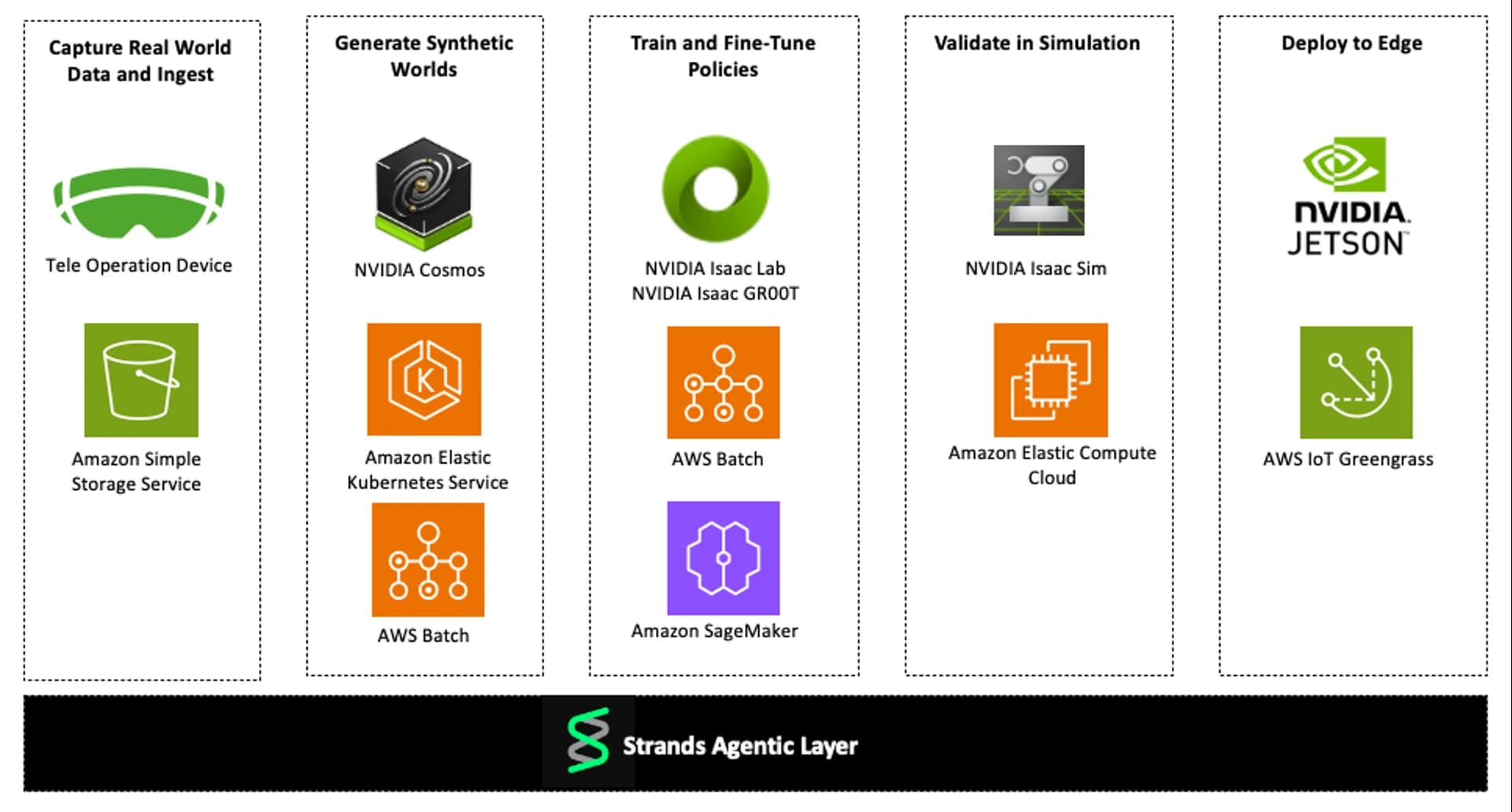
In its announcement, AWS argues that connecting development stages consumes engineering time that could otherwise go toward improving robots. The toolchain targets those handoffs, providing infrastructure patterns rather than finished robot behaviors.
Connecting the development stages
The proposed workflow connects NVIDIA GR00T for learning from demonstrations, Isaac Lab for reinforcement learning, Isaac Sim for simulation and Cosmos for synthetic data. OSMO coordinates workloads across different computing resources. AWS supplies the cloud services for storage, training and simulation.
The architecture also keeps a distinction between cloud development and on-robot operation. AWS says motion-related inference for safety-relevant tasks must remain local because of latency and hardware constraints.
The weekly humanoid robotics briefing
One email a week: the launches, funding and research that mattered, with context from Humanoids Daily.
Read recent issuesFor a humanoid developer, the potential benefit is practical: a demonstration dataset, a training run and a simulation test need to fit together before an updated policy can be evaluated on hardware. Reusable infrastructure could make that iteration easier, particularly for teams that would otherwise build those connections themselves.
What developers can use now
The public AWS sample repository contains infrastructure code and deployment guides. Its current status table lists GR00T, Isaac Lab, Isaac Sim, Cosmos and OSMO components as available. Teams can use individual tools with an existing workflow or adopt OSMO for broader coordination.
However, the table marks model packaging to Jetson through EKS Hybrid Nodes and Greengrass as planned. The Isaac Lab Arena evaluation integration is preview. Developers should distinguish the full architecture from the implementation status of each component.
The supplied pick-and-place example uses a UR3 arm, a Robotiq gripper and 27 real teleoperation episodes. It offers a starting point for exercising the infrastructure; it is not a demonstration of a general-purpose humanoid performing household work.
The sample code is Apache-2.0 licensed, while running the cloud resources incurs costs. Getting started requires an AWS account with GPU quotas, an NVIDIA NGC key and access to model downloads through Hugging Face.
The significance for humanoids is the effort to make robot development more repeatable. Better infrastructure can help teams run and compare experiments, but the results still depend on their data, models, task design and testing on real machines.
Share this article
Read next
- Published on
- Reading time
- 3 min read
Amazon Acquires Soft-Bodied Humanoid Maker Fauna Robotics
- Published on
- Reading time
- 3 min read
One-Click Humanoid: Unitree G1 Hits Amazon US with a 'Convenience Premium'
- Published on
- Reading time
- 4 min read
Parkour for Humanoids: Amazon’s PHP Framework Masters Agile Traversal
- Published on
- Reading time
- 4 min read
Amazon FAR Open Sources Holosoma to Unify Humanoid Simulation and Training
- Published on
- Reading time
- 4 min read
Amazon’s 75% Automation Goal Revealed in Leaked Documents, Highlighting Push for Advanced Robotics
- Published on
- Reading time
- 3 min read
Amazon's ResMimic Teaches Humanoids to Handle Objects by Adding Precision to General Motion

The weekly humanoid robotics briefing
One email a week: the launches, funding and research that mattered, with context from Humanoids Daily.
Read recent issues