- Published on
Agility's Investor Day: Digit 5 Launches at a $150,000 Bill of Materials, and Its $300M Order Unlocks Skill by Skill
One tap, and our reporting appears more often in your Google Top Stories. It makes a real difference to a small newsroom.


- Digit 5 will cost about $150,000 in parts at launch, above Digit 4's roughly $125,000, putting launch-era RaaS product margins near 50%. The "in excess of 70%" figure from the S-4 corresponds to a production rate of 1,000 units a year.
- The $300 million, 1,000-robot order unlocks in tranches: each use case Digit 5 proves releases a new batch of robots, with three years of service spread over four.
- General availability is now described as end of 2027 "and early 2028"; early-access units ship in the first half of 2027. The S-4 had pointed to an initial release in late 2026.
- Robots deployed under RaaS sit outside Agility's roughly $8 million annual capex, and the CFO said the company wants sub-10% debt to fund that fleet once public.
- A Schaeffler engineer said the company still has to fence off every humanoid it runs until robots are certified to safety standards.
Agility used its Analyst & Investor Day on October 6 to walk analysts through the economics behind its $2.5 billion SPAC merger with Churchill Capital Corp XI, which it expects to close this quarter under the Nasdaq ticker AGLT. Most of the headline figures, including the $300 million Digit 5 backlog, the roughly $125,000 Digit 4 bill of materials and the $500,000 Customer Acceleration Program, were already in the Form S-4 filed in September. The two-and-a-half-hour session added detail on the conditions attached to those numbers, and a higher starting cost for Digit 5 than for the robot it replaces.
Digit 5 starts out more expensive than Digit 4
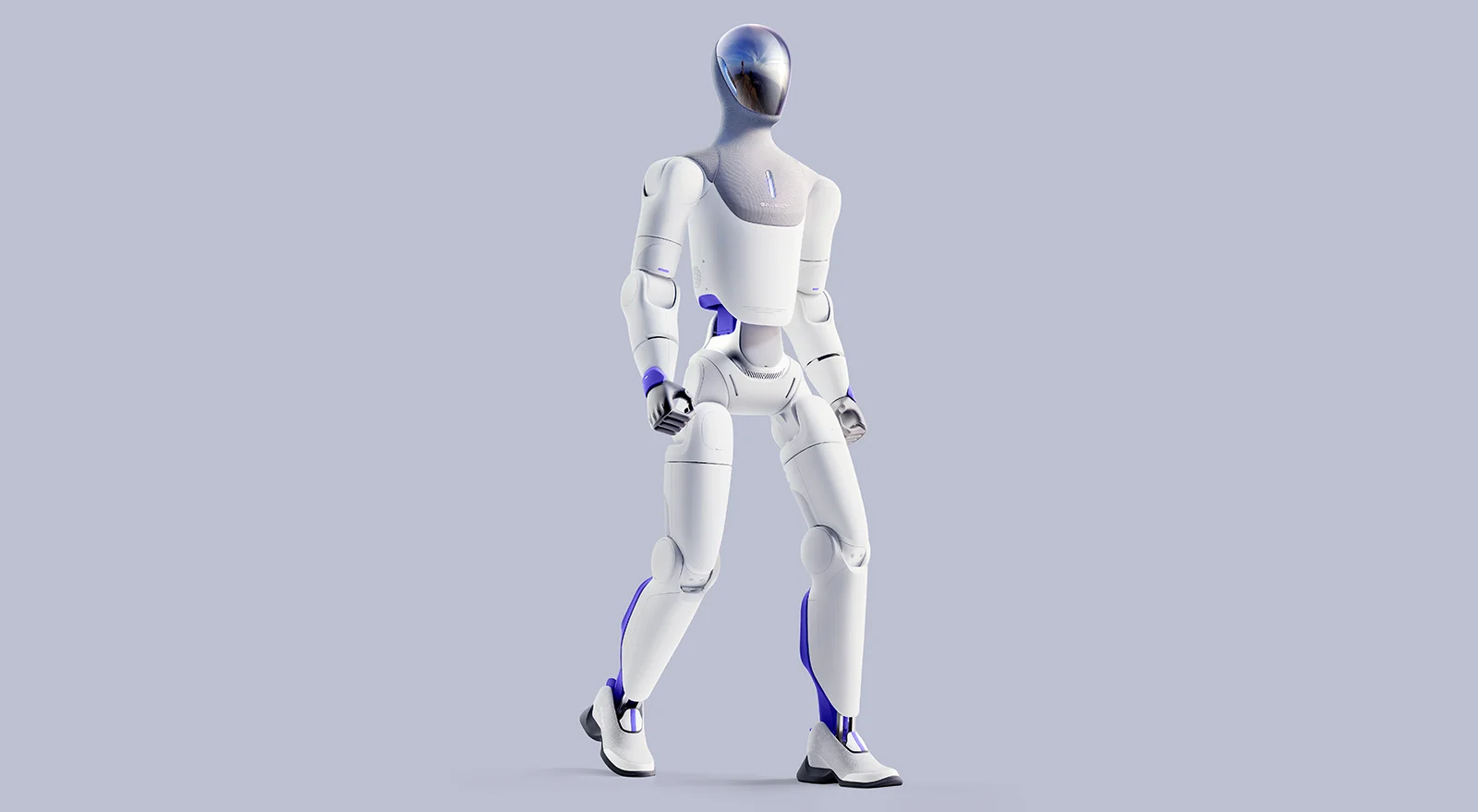
Chief Operating Officer Jen Hunter, who spent a decade in Amazon's operations organization before joining Agility, put Digit 5's bill of materials at about $150,000 at commercial launch, falling to a target of $30,000 per unit at 10,000 units a year. Digit 4 costs roughly $125,000 to build today.
Co-founder and Chief Robot Officer Jonathan Hurst had earlier explained where the extra cost comes from. Asked by a Canaccord Genuity analyst whether the safety work had forced compromises, he said "there's a lot more robot in that robot," and that the added sensors and safety computing make Digit 5 "bigger" and "heavier" than it would otherwise be.
Hunter attributed the planned reduction to three levers: redesign of Agility's in-house cycloidal actuators, which she said make up about 25% of Digit's bill of materials; supply partnerships for standardized parts such as cameras, sensors and circuit boards; and volume-tier discounts, which account for roughly 20% of the planned reduction.
The weekly humanoid robotics briefing
One email a week: the launches, funding and research that mattered, with context from Humanoids Daily.
Read recent issuesChief Financial Officer Michael Beer, a former equity analyst at Citi and Wolfe Research who has previously served as a public-company CFO, ran the resulting unit economics. Under robots-as-a-service, a Digit generates about $500,000 over an assumed five-year life: an annual subscription plus a deployment fee of roughly $25,000. Against a $150,000 bill of materials, about $15,000 to deploy and about $15,000 a year in software and maintenance, he put cumulative cost at about $240,000. That works out to a product margin of roughly 50%, with the hardware paid back in about 1.5 years.
Margins reach about 70%, with payback under a year, at 1,000 units a year, and about 75%, with payback under six months, at 10,000. Beer said the progression assumes no price increases. Customers who buy Digit outright would generate around 40% product margin at launch, rising toward 70% at scale.
None of those figures include corporate costs. Beer's model assumes about $115 million in R&D and $60 million in SG&A for 2026, growing roughly 15% and 20% a year respectively through 2028. Agility reported $1.78 million in revenue for 2025.
The $300 million order is released skill by skill
Agility again declined to name the customer behind its $300 million Digit 5 commitment, which the S-4 identifies as a related party receiving warrants that vest as robots are deployed. Chief Business Officer Daniel Diez described it as "one of our most experienced customers with Digit 4," a company that has run the robot "for years" in "a real factory" and plans to expand it "across multiple facilities, moving beyond material handling."
In the closing Q&A, a Roth Capital analyst asked how well defined the tasks in that order are. "The robot is required to be able to perform certain use cases. And each use case unlocks new tranches of robots," Diez said. Throughput targets for each use case must be agreed with the customer, he added, and every use case in the contract is part of the Digit 5 design program. CEO Peggy Johnson had earlier described the orders as subject to "contractual milestones, product features, and specifications."
Beer said the contract covers "three years of service over a four-year period," so revenue will ramp with deployments rather than arrive at a steady rate.
A later path to general availability
Johnson said early adopters would receive Digit 5 in the first half of 2027, with general availability "by the end of 2027." Diez, describing when customer pilots could scale into wider rollouts, put it at "the end of 2027 and early 2028." The S-4 had described Digit 5's initial release as expected in late 2026.
Debt for the fleet
Beer said the capital raised through the SPAC, about $620 million gross including roughly $420 million from Churchill's trust and a $200 million PIPE anchored by Foxconn, will go to deployment, starting with the build-out for the $300 million order. Robots deployed under RaaS stay on Agility's balance sheet and are funded separately from its roughly $8 million a year in infrastructure capex.
Asked by a UBS analyst how Agility would fund faster RaaS growth, Beer said access to "sub-10 percent debt capital market type resources" was one of the reasons to go public. He put an installed base of 2,500 robots at about $250 million in annual revenue and 10,000 robots at about $1 billion, scenarios he said come "with no deployment date attached."
The customer view: still caged
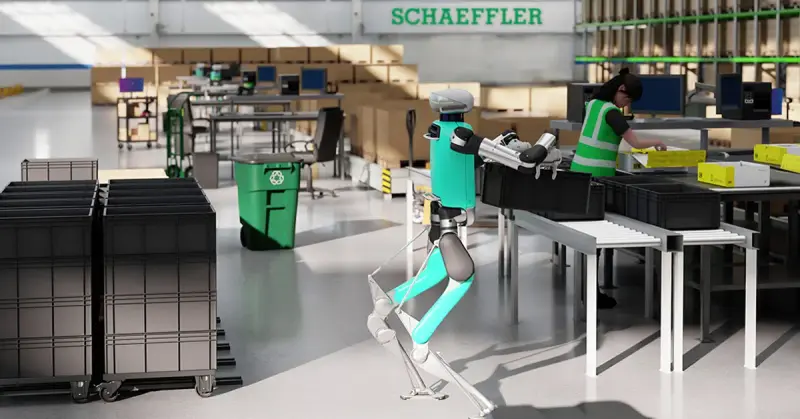
Schaeffler's David Kehr, president of humanoid robotics, and Courtney Baines, an advanced production technology engineer at its Cheraw, South Carolina plant, joined Diez on stage. Baines said the deployment began about 18 months ago on a "Digit V4 alpha," doing bulk handling of bearing components. Diez said it has since moved "well over a million pounds of material."
"Given the lack of ISO safety standards, it is necessary to put guarding around any humanoid deployment we have," Baines said, which rules out use cases that would block walkways or access to machines. Schaeffler has a list of such use cases it wants to run, she said, but needs humanoids certified to safety standards first. Agility's presentation lists the new ISO 25785-1 standard as "approved," and Johnson said certification of Digit 5 will come from a nationally recognized testing laboratory, as it did when Digit 4 passed a field evaluation inside a work cell. Diez described the recently announced FORT Robotics partnership as "a years-long effort" that will be tested with early-access customers before general availability.
Kehr said Schaeffler already sells about €1 billion a year in actuators for automotive and industrial customers and estimates its portfolio can cover half the bill of materials of a typical humanoid. Schaeffler is not exclusive to Agility as a buyer: it has also committed to deploying 1,000 Hexagon AEON humanoids and thousands of NEURA robots.
Foxconn's reasons
Nelson Hsieh, a director in Foxconn's Central Strategic Investment Department, said Foxconn screened humanoid makers in the US, Europe and China on three criteria: paying customers, ability to scale, and ability to work safely alongside people. "Just a few" passed, he said. He described labor availability, not equipment cost, as Foxconn's problem, citing a shortage of "people who are willing to do repetitive job... especially now in China." Foxconn, which the S-4 does not mention, is developing its own wheeled industrial robot and expects wheeled and legged machines to split the market by task.
Competition
Asked by a Deutsche Bank analyst to name Agility's strongest rivals, Hurst said "almost none of the humanoid robots that exist compete with us," because they are not doing industrial bin handling and lack safety systems. The one company he singled out was Boston Dynamics. The S-4 lists Tesla, Figure AI, Apptronik, 1X Technologies, Sanctuary AI, Hexagon and NEURA Robotics alongside it.
Share this article
Read next
- Published on
- Reading time
- 4 min read
Schaeffler Explores AI-Driven Factories and Humanoid Co-Workers with Accenture, NVIDIA, Microsoft
- Published on
- Reading time
- 5 min read
Breaking the Cage: Agility CEO Peggy Johnson Outlines Vision for "Unconstrained" Humanoids at Abundance Summit 2026
- Published on
- Reading time
- 3 min read
Agility Robotics Reportedly Nearing $400M Funding Round to Mass Produce Digit Humanoid
- Published on
- Reading time
- 3 min read
Corporate Investors Bet Big on Robotics Revolution: CVC Deals Jump 183% in Q1
- Published on
- Reading time
- 4 min read
Agility’s Digit 5 Reveal Includes a Wheeled Robot Concept
- Published on
- Reading time
- 8 min read
Uncaged: Agility CEO Peggy Johnson and Co-Founder Jonathan Hurst Detail Digit 5 Architecture, AI Stack, and Supply Chains


The weekly humanoid robotics briefing
One email a week: the launches, funding and research that mattered, with context from Humanoids Daily.
Read recent issues