- Published on
Google DeepMind Robotics Head Details 'Surprising' Cross-Embodiment AI, Calls Home 'The Hardest Environment'
One tap, and our reporting appears more often in your Google Top Stories. It makes a real difference to a small newsroom.


Google DeepMind's robotics lead, Carolina Parada, has provided a detailed look into the strategy behind its latest AI models, highlighting a "surprising" breakthrough in skill generalization and offering a pragmatic timeline for when robots might tackle domestic life.
In a wide-ranging interview with The Humanoid Hub, Parada, who was inspired to enter the field by "The Jetsons" (or "Robotina," as the robot maid was known in Spanish cartoons), explained that DeepMind's "north star" is solving "AGI in the physical world".
However, she emphasized that this goal is not tied to a single form factor. The team's core belief is in a "rich ecosystem of many different robot types," and its mission is to build a single, general-purpose AI smart enough to "embody into any robot".
The 'Two-Part Brain' of Gemini 1.5
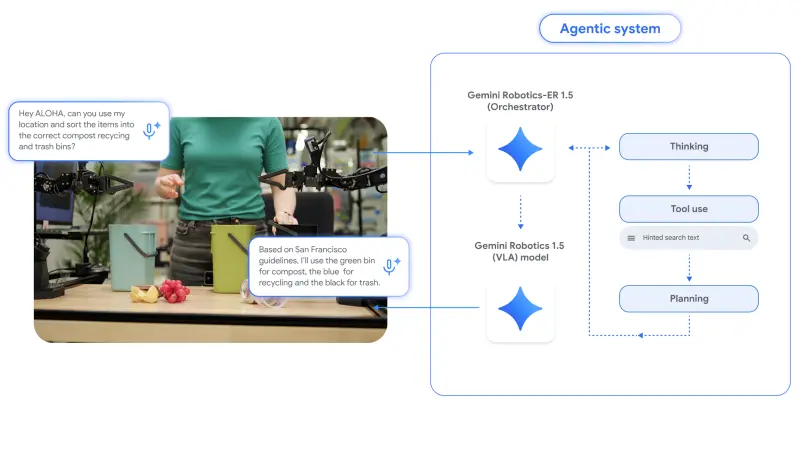
At the heart of this strategy is the new Gemini 1.5 robotics framework. Parada described a "two-model architecture" that functions like a high-level brain and a specialized motor cortex.
Follow humanoid robotics without following every announcement.
Get the week’s most important launches, funding and research—and why they matter—in one email from Humanoids Daily.
Once a week. Unsubscribe anytime.
Read recent issues- Gemini Robotics-ER 1.5 (Embodied Reasoning): This is the "high-level brain" or strategic planner. It interprets complex goals, breaks them down into steps, and can orchestrate tools—including using Google Search to find information it lacks, such as local recycling rules for sorting trash.
- Gemini Robotics 1.5 (Vision-Language-Action): This is the execution-focused VLA model. It takes simple instructions from the reasoning "brain" and translates them into the robot's physical motor commands.
This separation allows the system to become a "physical agent" that can problem-solve. Parada also noted a key upgrade to the VLA model itself: an ability to "think while acting". The model generates an "internal monologue" of reasoning tokens alongside its action commands, which she said allows it to operate for much longer—15 minutes or more—and handle more complex, multi-step tasks without interruption.
A 'Surprising' Leap in Generalization
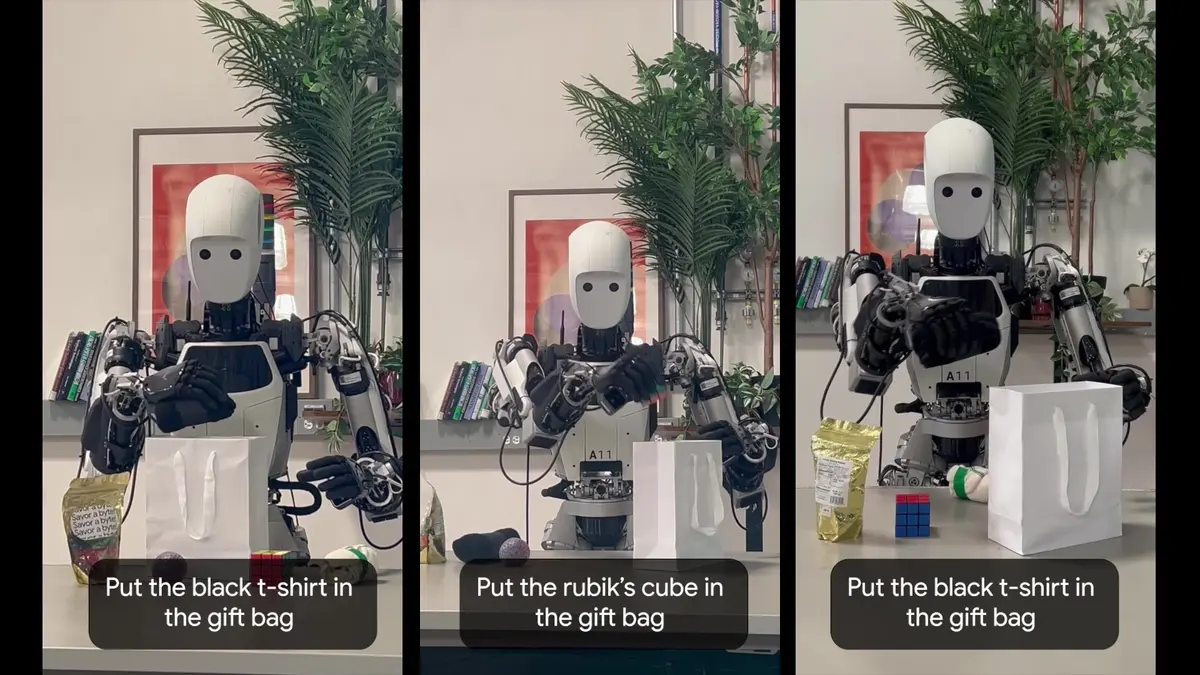
The most significant breakthrough, Parada said, was in cross-embodiment transfer. The team found that skills trained exclusively on one type of robot, like the dual-arm ALOHA, could be successfully performed by entirely different platforms—including a Franka industrial arm and Apptronik's Apollo humanoid—without any specific fine-tuning for the new hardware.
"It really is the same set of weights that works in all of them," Parada stated.
This result was "surprising" even to the team, which had expected some degree of adaptation would be necessary. The discovery confirmed the model wasn't just generalizing objects, but the fundamental motions themselves, a key step toward the "dream" of robots learning from watching videos of humans.
This "robot agnostic" approach is powered by data from multiple different robots, with teleoperation being the "strongest data source" and simulation used heavily for evaluation.
World Models and the Humanoid Debate
Parada's comments land in the middle of a heated industry debate. Meta's AI chief Yann LeCun recently argued that most humanoid companies "have no idea" how to build generally useful AI because they lack the necessary "world models".
Parada's interview suggests DeepMind is squarely focused on this exact problem. She confirmed a "deep engagement" with Google's other AI teams, including the Genie world model project. "We already have... efforts where we're using basically these models... to like evaluate our models and be able to test put the robots in new scenarios," she said.
While acknowledging the current humanoid "boom" as "really cool," Parada maintained her team's agnostic stance. She called humanoids an "important form factor" because they can navigate human spaces and offer a "complete representation" of physical AI, but stressed they will be just one part of a diverse robotic future.
The 'Last Frontier': Robots in the Home
As for when these robots might arrive in our homes, Parada was pragmatic, calling the home "probably the hardest environment to go into" and "one of the last frontiers".
While she noted the internal discussion at DeepMind has encouragingly shifted from "this will happen after my career" to "are we talking 5 years... 10 years," she cautioned that the primary hurdles go beyond AI.
"There's aspects of safety and privacy and social adoption... and policy," Parada listed as the key challenges.
When that day does come, her own motivation remains clear. "I joke all the time that the real reason that I got into this field is that I didn't want to do chores," she said. "So definitely I'll be super happy to let a robot do my dishes, my laundry, and pick up around the house".
Watch the interview here
Share this article
Follow humanoid robotics without following every announcement.
Get the week’s most important launches, funding and research—and why they matter—in one email from Humanoids Daily.
Once a week. Unsubscribe anytime.
Read recent issuesRead next
- Published on
- Reading time
- 4 min read
Google DeepMind Gives Robots a 'Thinking' Brain with Agentic Gemini 1.5 Models
- Published on
- Reading time
- 5 min read
Google DeepMind Unveils On-Device Gemini Robotics, Pushing AI Closer to Autonomous Dexterity
- Published on
- Reading time
- 4 min read
Google DeepMind Unveils Gemini Robotics-ER 1.6: A Leap in Spatial Reasoning and Industrial Utility
- Published on
- Reading time
- 5 min read
Waymo Leverages Genie 3 to Launch "Waymo World Model" for Hyper-Realistic Simulation
- Published on
- Reading time
- 5 min read
Tesla AI Chief Details Unified 'World Simulator' for FSD and Optimus
- Published on
- Reading time
- 6 min read
Meta AI Chief Yann LeCun Claims Humanoid Firms "Have No Idea" How to Build Generally Useful AI