- Published on
Eka Robotics Raises $150 Million to Give Robots a Better Feel for the Physical World
One tap, and our reporting appears more often in your Google Top Stories. It makes a real difference to a small newsroom.


Your guide
Rich Robinson
Jee Chee Ren · Executive tour
See China’s AI and robotics ecosystem first-hand.
Six days exploring AI, robotics and advanced manufacturing.
With Rich Robinson, Clinical Professor of Entrepreneurship at Peking University
Beijing · Guangzhou · Shenzhen
29 November–4 December 2026
Referral partnership · We earn a commission on referred bookings.
Eka Robotics has raised $150 million in Series A funding to develop robots that can handle objects with both speed and adaptability. Andreessen Horowitz and F-Prime led the round, which the company says will support its AI model and customer deployments.
TechCrunch reports a $1.45 billion post-money valuation. At the center of Eka’s approach is a vision-force-action model: robot intelligence that uses the forces felt during contact alongside visual information to guide movement.
- Eka Robotics has raised 1.45 billion valuation.
- Its vision-force-action model learns manipulation through reinforcement learning in simulation, using contact forces as part of its feedback.
- Eka reports 1,500 picking operations per hour; sustained performance in production remains the next test.
In its October 20 announcement, Eka also named returning seed leads Obvious Ventures and E14 Fund, alongside MFV Partners, Bison Ventures, Glasswing Ventures, Samsung Next and unnamed Fortune 500 strategic investors.
The company’s founders are MIT researcher Pulkit Agrawal and former Google DeepMind researcher Tuomas Haarnoja. Haarnoja co-created the Soft Actor-Critic reinforcement-learning algorithm, while Agrawal’s work at MIT’s Improbable AI Lab spans robot learning and transferring skills from simulation to hardware.
The weekly humanoid robotics briefing
One email a week: the launches, funding and research that mattered, with context from Humanoids Daily.
Read recent issuesTeaching robots what contact feels like
We covered Eka’s approach in our first look at the startup and its vision-force-action model. The new funding gives that work a larger financial backing as Eka pursues customer deployments.
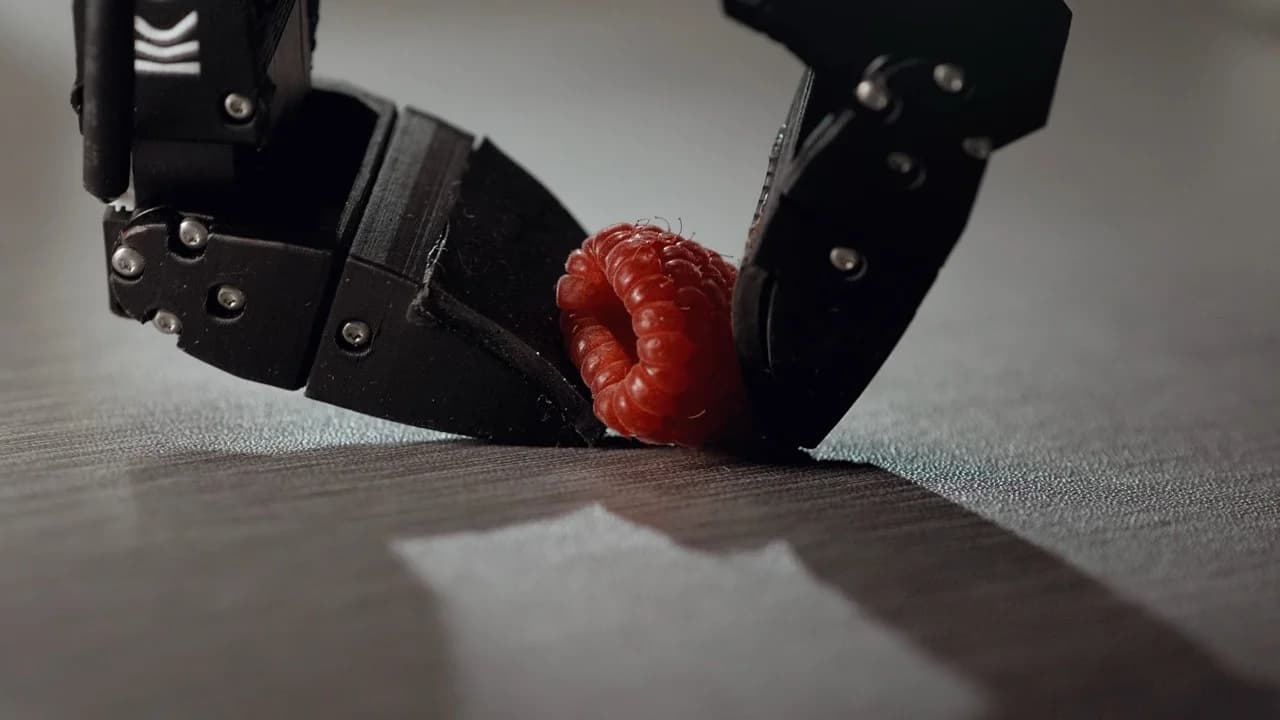
Eka is tackling a practical difficulty in automation: recognizing an object is only part of handling it. Once a gripper makes contact, the robot needs to respond to resistance, slipping and changes in alignment.
In its investment announcement, a16z describes a system in which Eka develops the model, sensing, controller and robotic hardware together. Force feedback can help the robot adjust a slipping grasp or change its movement when a connector resists insertion.
Agrawal’s launch post frames the problem as a tradeoff between versatility and useful performance: a robot that handles many situations still needs to execute reliably and quickly enough for customers. He identifies fast physical execution as the bottleneck Eka is targeting.
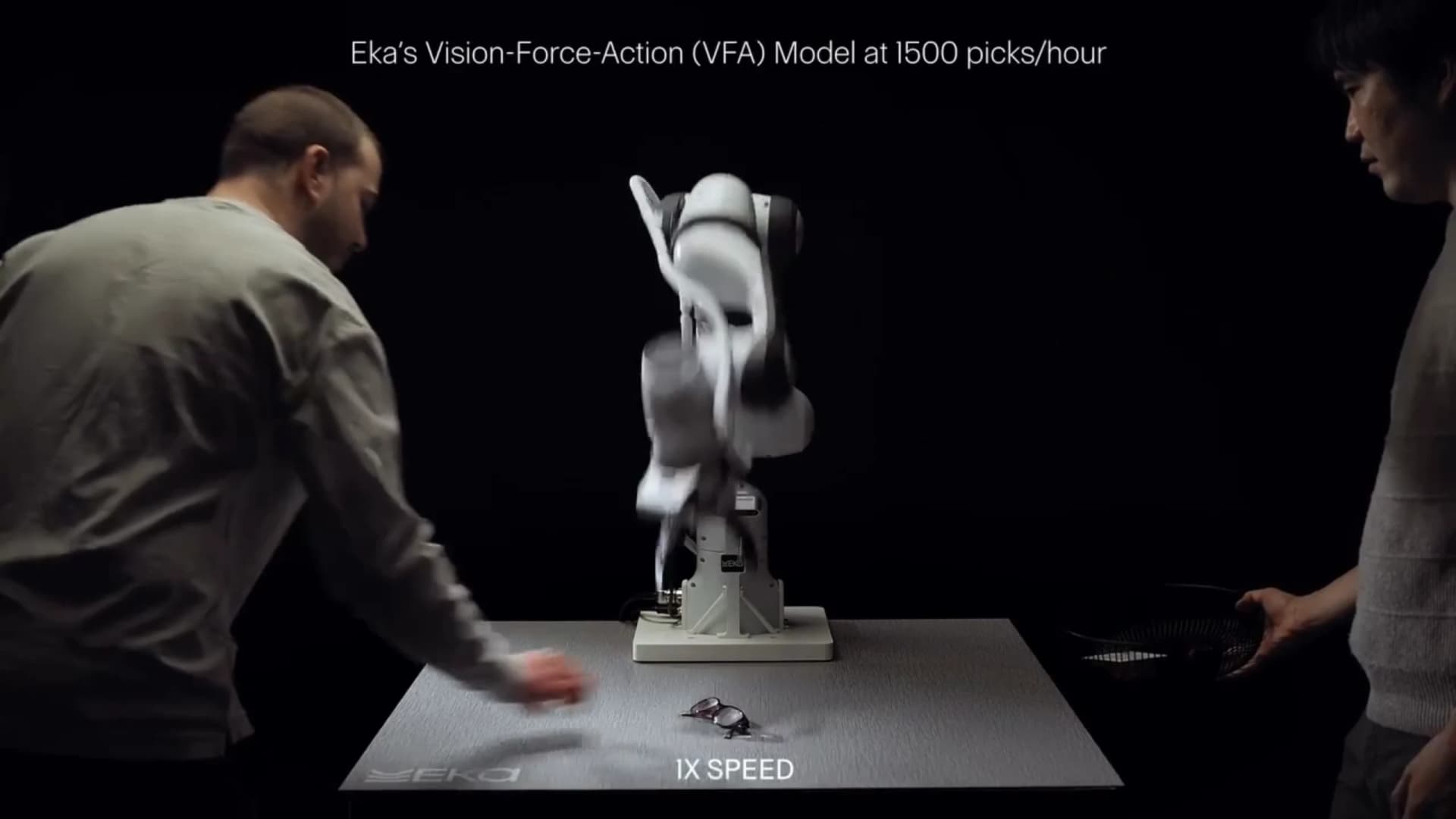
The accompanying demonstration is particularly striking for its pace. A person places a succession of different objects on the table, including glasses, a hairbrush and a light bulb, and the robot rapidly picks them up and passes them to another person. The sequence conveys an unusual sense of speed and fluency for a robot manipulation demo. Just as notable are the recoveries: when an initial grasp misses, the robot quickly adjusts and tries again. Those moments make the demonstration more compelling, showing how it responds when the first attempt does not work. The clip is not a controlled comparison with competing systems, but it makes Eka’s emphasis on fast, adaptable execution tangible.
Eka trains its manipulation model through reinforcement learning in simulation. The company says this allows it to generate thousands of hours of robot experience in minutes while varying objects, environments and physical conditions. Its bet is that this breadth of practice can produce skills that transfer to unfamiliar real-world situations.
From picking speed to production reliability
Eka says its robots can pick objects outside their training distribution at 1,500 operations per hour, compared with a human baseline of about 600. It also describes the same robot screwing in a light bulb and inserting wires. These are company-reported results; a16z places the picking figures in laboratory induction and bin-picking tasks.
The funding announcement centers on manipulation rather than a new humanoid body. That focus is relevant to the wider robotics industry: useful physical work requires more than identifying a task or planning a sequence of actions. A machine must also manage each contact with the objects around it.
Eka plans to expand its model to more tasks and accelerate customer deployments. The commercial question is whether the adaptability and speed described in its demonstrations can hold up over sustained operations. Even its lead investor identifies full production shifts as the next test.
Share this article
Read next
- Published on
- Reading time
- 4 min read
Physical Intelligence in Talks for $1 Billion Round, Eyeing an $11 Billion Valuation
- Published on
- Reading time
- 4 min read
Sunday Robotics Raises $165M to Transition from Demos to Real-World Deployment
- Published on
- Reading time
- 3 min read
Apptronik Nears $1 Billion Milestone with Massive $520 Million Funding Extension
- Published on
- Reading time
- 4 min read
Skild AI Secures $1.4 Billion Series C, Tripling Valuation to Over $14 Billion
- Published on
- Reading time
- 3 min read
Figure AI Secures Over $1B to Accelerate Humanoid Robot Rollout
- Published on
- Reading time
- 4 min read
The Era of Eka: New Startup Unveils Vision-Force-Action Model to Crack Dexterity



The weekly humanoid robotics briefing
One email a week: the launches, funding and research that mattered, with context from Humanoids Daily.
Read recent issues