- Published on
Lightberry’s Lumi Gains Conditional FCC Covered List Exemption
One tap, and our reporting appears more often in your Google Top Stories. It makes a real difference to a small newsroom.

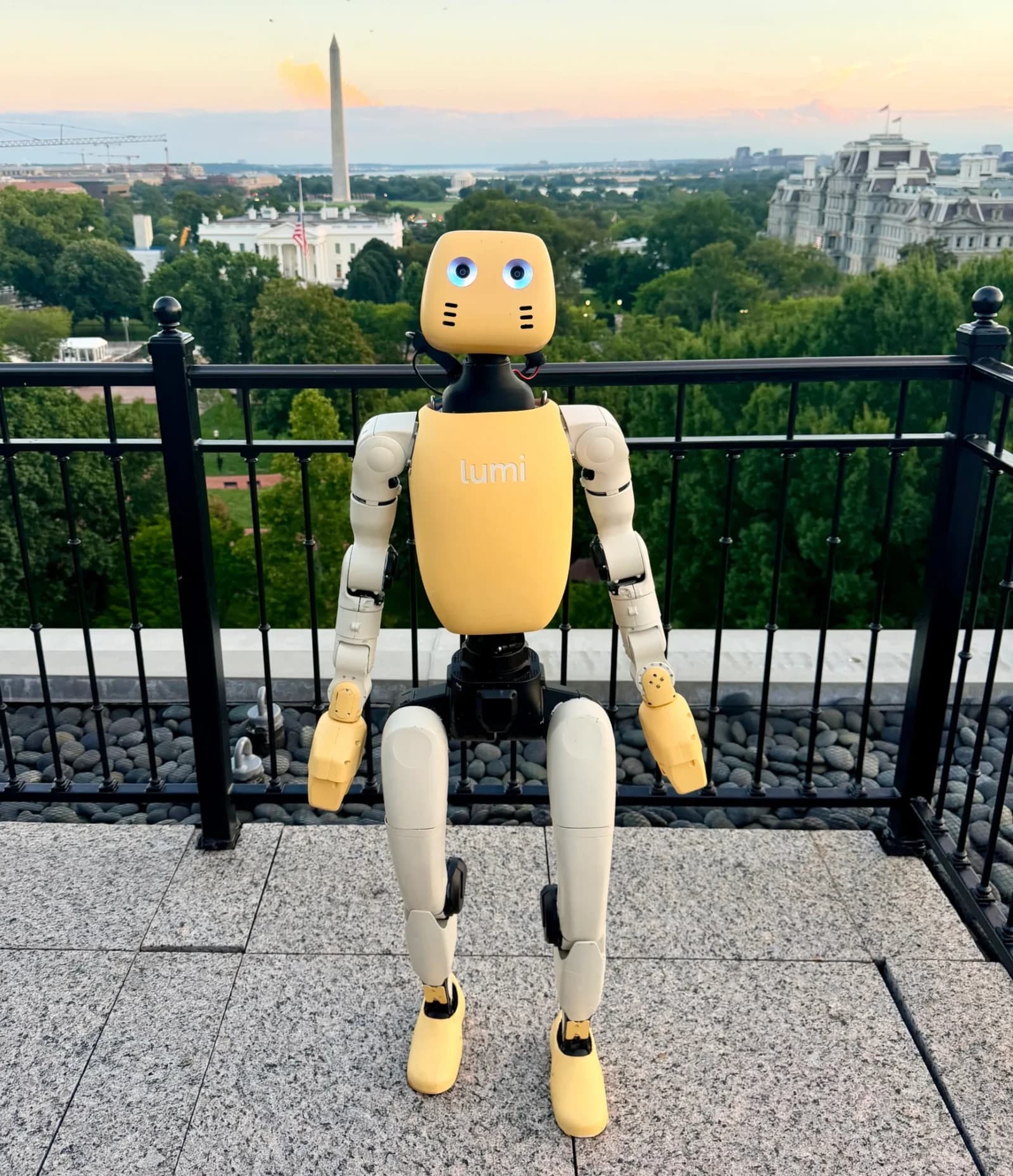
Lightberry’s Lumi has received a conditional exemption from the Federal Communications Commission’s Covered List, giving the Unitree-based humanoid a specific regulatory clearance tied to a plan to move manufacturing to the United States.
CEO Ali Attar told Humanoids Daily that the exemption allows Lightberry to apply for independent FCC certification, a further step before off-the-shelf customer sales. He expects shipments “very soon,” but did not give a delivery date.
The FCC’s October 30 public notice explicitly names Lightberry Holdings’ Lumi interactive mobile robots among devices granted Conditional Approval by the U.S. Department of War. The commission consequently exempts those devices from the Covered List.
- The FCC has confirmed a Covered List exemption for Lumi following a national-security review.
- Approval depends on compliance with Lightberry’s onshoring plan and continued product vetting; it can be withdrawn.
- Lightberry says it replaces Unitree’s sensors, computer and software, and plans U.S. manufacturing starting with the body, head and hands.
- Attar says independent FCC certification is still the next step before off-the-shelf sales; he expects shipping “very soon,” without specifying a date.
What the FCC approved
The notice follows the July 28 addition of foreign-produced advanced robotic devices to the Covered List, with an exception for devices granted Conditional Approval. The October decision also covers robotic equipment from ARAPL, ATI Motors, SunScout, Swap Robotics and OMRON.
Follow humanoid robotics without following every announcement.
Get the week’s most important launches, funding and research—and why they matter—in one email from Humanoids Daily.
Once a week. Unsubscribe anytime.
Read recent issuesFor Lumi and the other newly approved robotic devices, the exemption remains subject to compliance with the onshoring plans submitted in their applications and updated vetting of the products. The FCC says failure to follow those plans—or discovery of false statements or misrepresentations in an application—could terminate approval and return the equipment to the Covered List.
The notice does not give Lumi a termination date. It explains that approvals without such dates remain effective indefinitely while the applicable conditions are met, unless superseded by another national-security determination.
Asked what ongoing vetting involves, Attar told Humanoids Daily: “This just means we will be engaging with the relevant authorities to make sure that we’re working in the direction of the regulation.” His response did not specify a review schedule, manufacturing milestones or whether hardware and supplier changes would trigger a new review.
From a Unitree foundation to an American manufacturing plan
In its announcement, Lightberry calls Lumi the first humanoid to receive this approval. It attributes the decision to control over the robot’s sensing, computing and software, alongside a commitment to American manufacturing.
The company says domestic production will begin with Lumi’s body, head and hands, with the rest to follow. Asked whether that means a fully Lightberry-designed platform, a manufacturing partnership or another hardware supplier, Attar did not commit to a particular route or timeline.
“Our focus is on deploying robots,” he said. He added that “it makes sense with this regulation to start moving manufacturing to the USA, but the product quality thresholds need to be met.”
As we reported when Lumi launched, Lightberry used a Unitree G1 mechanical foundation while adding custom interaction hardware and replacing the onboard computer. Lumi targets conversation, entertainment and customer engagement rather than heavy industrial work. Its Founder Edition was priced at $39,990.
At that time, CEO Ali Attar told Humanoids Daily the company was working with its legal team on import compliance. The new exemption provides a concrete development in that process.
A separate decision for a modified product
The distinction matters for the broader pattern explored in our feature on American startups building around the Unitree G1. That reporting identified the G1 as a previously authorized platform, while noting that substantial modifications or separately marketed configurations can raise their own authorization questions.
Lumi’s exemption therefore should not be read as proof that every existing G1 was barred, or that other G1-based products now share Lightberry’s approval. It is a decision naming Lumi, with conditions attached to Lightberry’s own application.
Certification comes before customer sales
Attar drew a clear distinction between the exemption and the next regulatory step.
“Exemption means we can now apply for independent FCC certification which will allow us to sell the product off the shelf to a customer,” he told Humanoids Daily. “This means we will be able to ship very soon.”
His response does not establish that certification has already been granted or give a firm shipping date. The exemption opens a path forward, while certification and the manufacturing plan remain milestones to follow.
Attar described the broader ambition as bringing “the robots from the movies to the real world: kind, proactive, natural to be around.” For Lumi, the next concrete test is turning that ambition and the regulatory progress into customer deliveries.
Share this article
Follow humanoid robotics without following every announcement.
Get the week’s most important launches, funding and research—and why they matter—in one email from Humanoids Daily.
Once a week. Unsubscribe anytime.
Read recent issuesRead next
- Published on
- Reading time
- 5 min read
The FCC Bans Foreign Humanoids: Unpacking the Sweeping New Restrictions on Robotic Devices
- Published on
- Reading time
- 8 min read
The Unitree G1 Is Becoming a Platform for American Robot Startups
- Published on
- Reading time
- 7 min read
Lightberry Unveils Lumi: A $40k Interactive Humanoid Built on a Unitree Core
- Published on
- Reading time
- 4 min read
Tau Robotics Launches $30 Hour Humanoid Cleaning Service Amidst FCC Ban Turmoil
- Published on
- Reading time
- 5 min read
Beyond Imitation: MotionDisco Uses LLMs to Discover Whole-Body Humanoid Skills From Scratch
- Published on
- Reading time
- 3 min read
Racing for the Future: The Complex Dynamics of Humanoid Robotics