- Published on
Lightberry Unveils Lumi: A $40k Interactive Humanoid Built on a Unitree Core
One tap, and our reporting appears more often in your Google Top Stories. It makes a real difference to a small newsroom.


Your guide
Rich Robinson
Jee Chee Ren · Executive tour
See China’s AI and robotics ecosystem first-hand.
Six days exploring AI, robotics and advanced manufacturing.
With Rich Robinson, Clinical Professor of Entrepreneurship at Peking University
Beijing · Guangzhou · Shenzhen
29 November–4 December 2026
Referral partnership · We earn a commission on referred bookings.
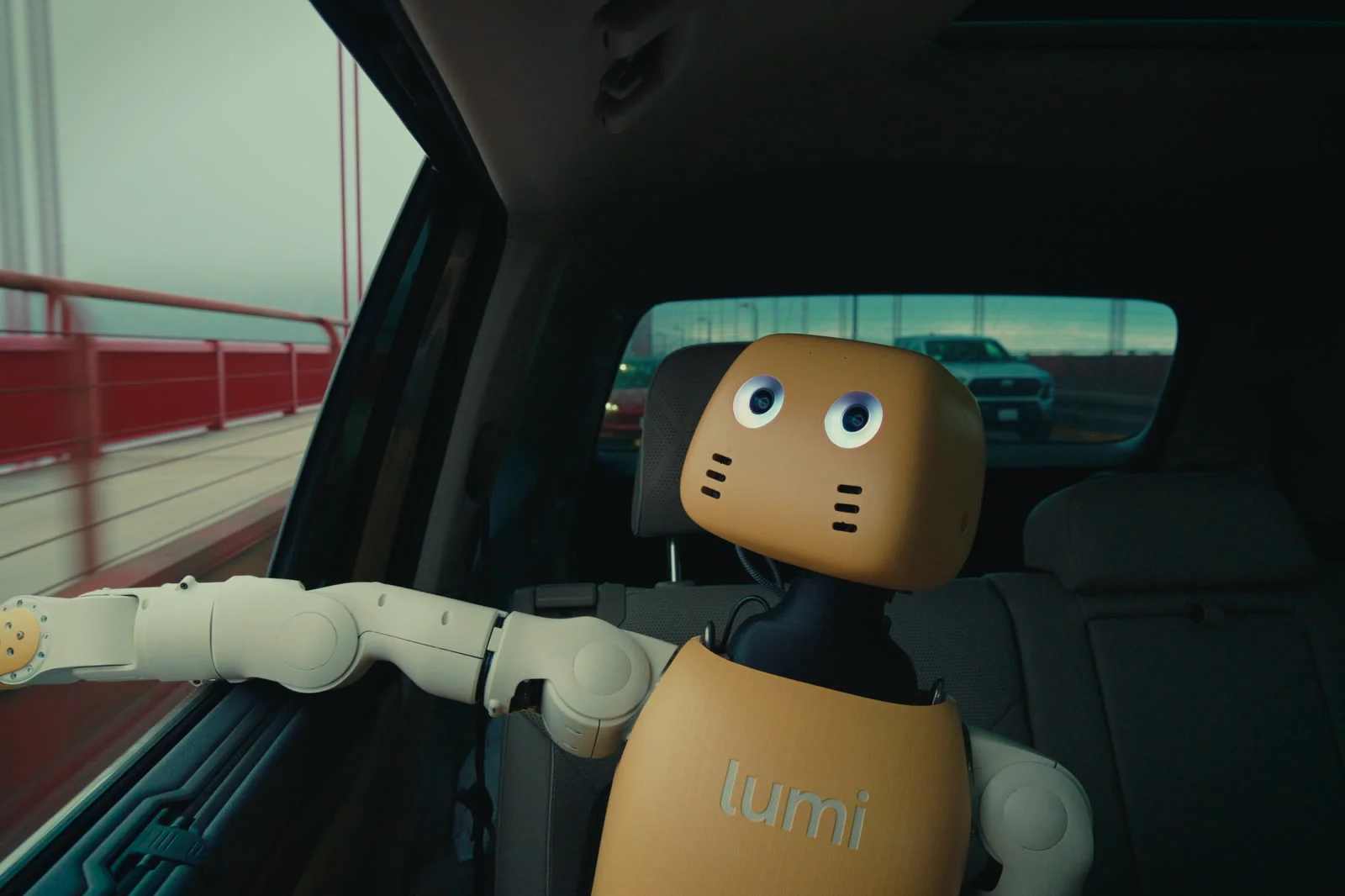
- San Francisco startup Lightberry has launched reservations for Lumi, a $39,990 bipedal robot aimed at commercial entertainment, marketing, and developer deployments.
- While mechanically derived from the Unitree G1 platform, Lumi replaces stock components with custom sensors, an 8-microphone beamforming array, and an NVIDIA Jetson Thor T4000 compute module.
- Lightberry confirmed to Humanoids Daily that its software platform carries a $20,000 annual baseline cost, which will transition to usage-tiered subscriptions after the initial 100 "Founder Edition" units.
- Amid sweeping FCC import restrictions on foreign robotic platforms, CEO Ali Attar emphasizes that Lightberry operates as a hardware-agnostic interaction layer already running on third-party hardware.
San Francisco robotics startup Lightberry has officially opened reservations for Lumi, a 4-foot-2-inch bipedal robot designed to lower the barrier for interactive commercial deployments. Priced at $39,990 for an initial run of 100 "Founder Edition" units, the machine represents an aggressive bid to commercialize expressive, context-aware humanoids for businesses lacking in-house robotics engineering teams.
Lumi pairs a heavily upgraded mechanical foundation with custom perception hardware and a dedicated turn-taking conversational stack. However, the launch also lands at a volatile moment for domestic robotics: beneath its bright yellow exterior and American-assembled sensor suite, Lumi relies on a mechanical chassis from Chinese manufacturer Unitree, navigating the same regulatory headwinds currently transforming the North American hardware landscape.
Ripping Out the Compute
Rather than designing an entire bipedal chassis from scratch, Lightberry built Lumi on top of a 29-degree-of-freedom (DoF) Unitree G1 body. From there, the team executed a sweeping internal overhaul.
"We completely ripped out the computer that's in there to put our own board," Lightberry CEO and founder Ali Attar explained in an interview demonstration with tech commentator Robert Scoble.
The weekly humanoid robotics briefing
One email a week: the launches, funding and research that mattered, with context from Humanoids Daily.
Read recent issuesThe resulting machine boasts 34 total degrees of freedom—adding a 3-DoF neck and 1-DoF parallel grippers to the standard G1 baseline. More notably, Lightberry bypassed the standard Jetson Orin NX modules typically found in research-grade bipedal platforms, outfitting Lumi with NVIDIA's next-generation Jetson Thor T4000 system-on-module featuring 64 GiB of unified memory.
The custom sensory stack, integrated and assembled in San Francisco, focuses squarely on real-time human interaction:
- Acoustic Engineering: A custom 8-microphone beamforming array—developed and manufactured in Brooklyn—uses 3D spatial positioning and digital signal processing to filter out internal cooling fan noise and isolate speaker voices in crowded venues.
- Vision & Spatial Tracking: Dual stereo cameras (1920 × 1200 resolution per eye) provide color-calibrated visual input for real-time face tracking and scene analysis.
- On-Robot Power: A 421 Wh battery pack delivers an estimated 2.5 to 3.5 hours of continuous active operation.
Lightberry previously deployed an early prototype –– Beach Boy Robot –– at the ElevenLabs Summit, where the robot operated for 10.5 hours as an automated event photographer, interacting with attendees and uploading images autonomously.
The Split-Brain Software Architecture
Lightberry positions Lumi not as a heavy industrial worker or a household chore bot, but as an interactive platform for marketing, hospitality, and customer engagement.
The software architecture operates on a distinct "split-brain" model. High-frequency perception, motor control, visual voice-activity detection (V-VAD), and face tracking execute locally on the Jetson Thor compute module. High-level language comprehension, character persona generation, and multi-step planning are routed to frontier AI models hosted in the cloud.
This architectural division makes conversational fluidness contingent on network reliability. When asked how Lumi handles connectivity drops, Attar framed the challenge around resilient system design.
"We believe that robot deployment is a design problem as much as an engineering problem," Attar told Humanoids Daily. "On-device fallback and graceful failures are necessary for failure cases, i.e., connection drops."
Lightberry is also avoiding the temptation to train its own foundational large language models, focusing instead on the engineering layer that dictates social cadence. "In most cases, if you take ChatGPT or a simple speech-to-speech model and slap it into a robot, it'll just speak all the time," Attar noted during the demonstration. "One of the really hard things is making this contextually aware so it knows when it should jump into conversation."
Privacy in public spaces remains another operational hurdle. While Lumi creates facial embeddings to remember past interactions, Attar clarified that data retention is strictly opt-in. "Face tracks and face embeddings are only saved on request," Attar said. "The main intention for face recognition is for Lumi to recognize its managers and operators, so we can do permission management. Face-tracking runs on-device, so this is not an issue from a privacy perspective."
Other ambitious capabilities highlighted during initial demonstrations—such as voice identification and spatial semantic mapping (allowing users to query the robot about where it last saw misplaced items)—remain internal prototypes slated for future software updates based on customer demand.

The Economics: Hardware Baseline vs. Software Subscriptions
At $39,990, the Founder Edition undercuts many academic humanoid packages. Fully configured research variants of the Unitree G1 equipped with dexterous hands often range between $54,000 and $66,000 through regional distributors.
However, software licensing forms the core of Lightberry's long-term business model. The purchase price includes one year of full software access, which the company values at $20,000. Attar confirmed to Humanoids Daily that this figure represents the platform's actual baseline renewal rate, though future pricing will reflect consumption tiers.
"Full software access is currently $20k," Attar stated. "We'll have different tiers at renewal based on what people are deploying Lumi for. In entertainment use cases running 24/7, for example, you'd use many more credits from different models than for a functional robot working security and speaking for 10 minutes per day."
Attar noted that Lightberry eventually aims to drive the base hardware cost down toward the $20,000 threshold after completing the initial 100-unit production run, expanding access for commercial clients without dedicated software teams.
Navigating the Regulatory Firewall
Lumi's arrival comes as American robotics startups face strict regulatory scrutiny. Late last month, the Federal Communications Commission enacted sweeping import bans on foreign advanced robotic devices, effectively cutting off unreleased Chinese humanoids and mobile platforms weighing over 4.4 pounds from entering the U.S. market.
The restrictions have created substantial friction across the domestic robotics ecosystem, prompting hardware distributors to pivot toward domestic assembly facilities and forcing service startups utilizing G1 units to navigate complex compliance hurdles.
When questioned about how Lightberry plans to manage import compliance given its Unitree structural base, Attar declined to detail specific legal mechanisms, stating only that the company is "actively working on this with our legal team."
Crucially, Lightberry does not view its fortunes as permanently tied to a single physical chassis. The company views Lumi primarily as an embodied reference design for its interaction operating system.
"I think overall it's probably not great overall," Attar said regarding the trade restrictions. "But for us it's not necessarily a bad thing and it doesn't slow things down. We're still very excited to build our software and deploy it on different robot manufacturers' platforms."
Attar confirmed that Lightberry already generates revenue from enterprise clients running its software stack on third-party, non-Lumi hardware. If supply chain barriers restrict access to imported mechanical frames, Lightberry’s interaction platform is built to jump ship to alternative domestic or international chassis—underscoring a growing industry conviction that the most durable value in embodied AI may ultimately reside in the software layer.
Share this article
Read next
- Published on
- Reading time
- 5 min read
Musk Details Optimus Hand Challenges, Warns of Slow Initial Production Ramp
- Published on
- Reading time
- 3 min read
Google DeepMind Is Building a New Cambridge-Area Robotics Lab, Aaron Saunders Says
- Published on
- Reading time
- 3 min read
Ultra Raises $50 Million Series A for Warehouse Robots, Deepens Physical Intelligence Partnership
- Published on
- Reading time
- 3 min read
ARC Brings Human-Piloted Humanoid Fights to Singapore
- Published on
- Reading time
- 2 min read
Dyna Robotics’ Taku to Join Nasdaq Closing Bell at RoboStrategy Event
- Published on
- Reading time
- 6 min read
From X to San Francisco: Devang Adhyaru Brings Humanoid Hub Together


The weekly humanoid robotics briefing
One email a week: the launches, funding and research that mattered, with context from Humanoids Daily.
Read recent issues