- Published on
Physical Intelligence Finds 'Emergent' Bridge Between Human Video and Robot Action
One tap, and our reporting appears more often in your Google Top Stories. It makes a real difference to a small newsroom.

Supported by RoboStrategySupport for Humanoids Daily comes from RoboStrategy
Sponsored
Investing involves risk, including possible loss of principal. Read the prospectus before investing.
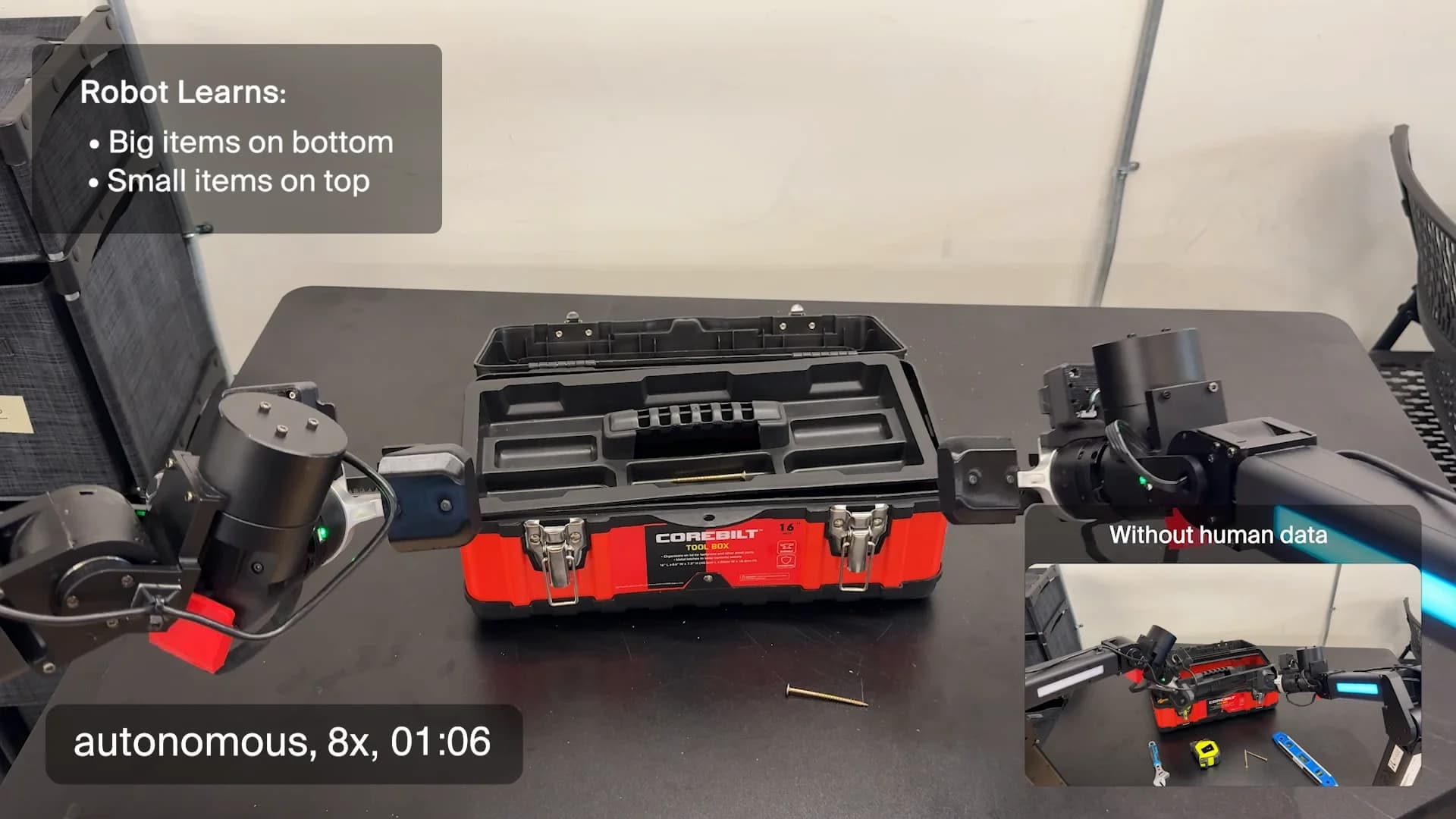
Right after Generalist AI released its deep dive into the "science of pretraining," Physical Intelligence (Pi) has countered with a technical revelation of its own—one that might fundamentally change how the industry views human data.
In a new research update released Tuesday, Pi disclosed that its Vision-Language-Action (VLA) models, such as and , exhibit an "emergent property" as they scale: they spontaneously learn to align human movements with robot actions.
This finding suggests that the "domain gap"—the notorious difficulty of teaching robots by showing them videos of human hands—might not require complex translation layers or specialized hardware like Sunday Robotics' gloves. Instead, the problem may simply dissolve with sufficient scale.
The "Emergence" of Alignment
The core of Pi's discovery is that as a robot model is pre-trained on larger and more diverse datasets of robot data, its internal representation of the world begins to generalize. Surprisingly, this generalization extends to human anatomy.
The weekly humanoid robotics briefing
One email a week: the launches, funding and research that mattered, with context from Humanoids Daily.
Read recent issues"To a scaled-up model, human videos 'look' like robot demos," the company explained in a post on X.
To validate this, Pi researchers ran an experiment using their model. They fine-tuned the model using egocentric (first-person) video of humans performing tasks, such as sorting colored eggs into cartons or organizing a dresser.
The results were stark:
- Small Models: Struggled to learn from the human video, viewing the human hands as foreign objects unrelated to the robot's grippers.
- Scaled Models: The pre-trained model, when fine-tuned on the same human video, achieved roughly 2x the performance on generalization tasks.
"We were surprised," the company wrote. "We did not include any special mechanism to facilitate transfer. Simply using the pre-trained model... enabled emergent human to robot transfer."
Visualizing the Bridge
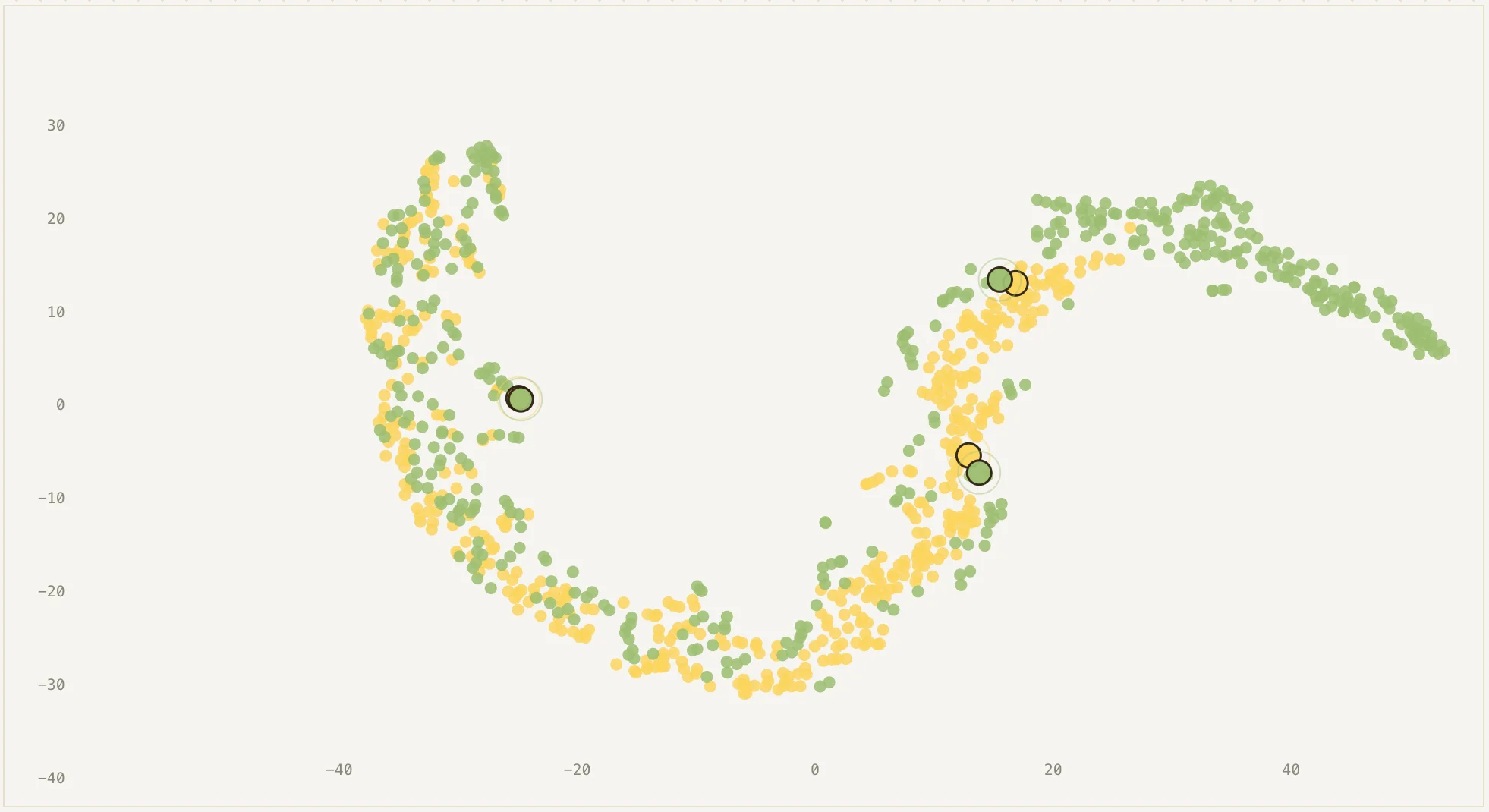
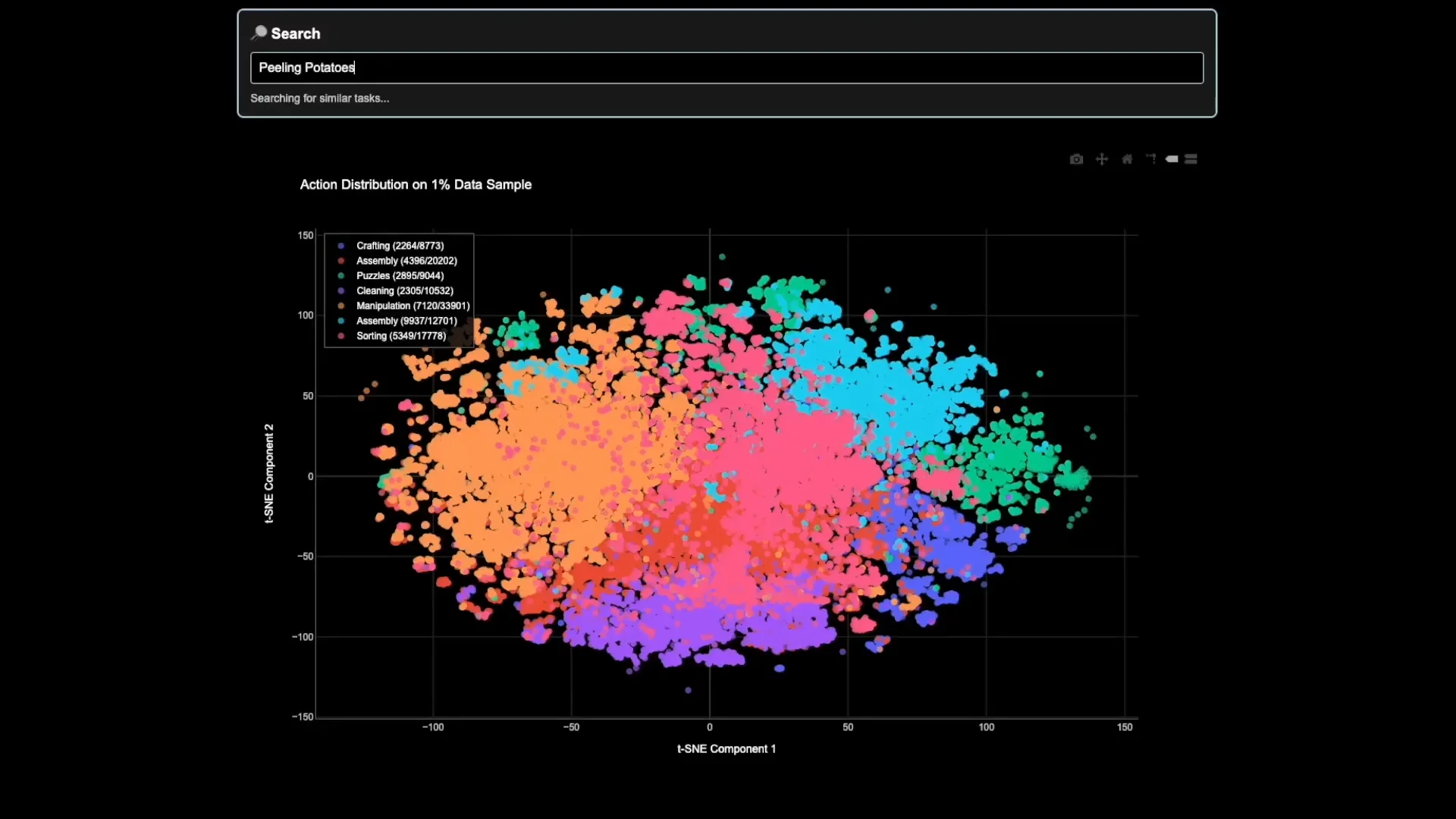
The company released 2D projection plots to visualize this phenomenon. In smaller models, the data clusters for "human hands" and "robot grippers" remain distant and distinct. However, as the pre-training scale increases, these clusters drift toward each other, eventually overlapping.
This "alignment" means the model effectively realizes that a human hand picking up an egg is semantically and physically equivalent to a robot gripper doing the same—without being explicitly told so.
This outcome challenges the prevailing wisdom that utilizing human video requires heavy-handed interventions, such as using generative AI to "paint" robot arms over human hands in video frames, or relying on complex mathematical "retargeting."
The "Sunday" Connection: Hardware vs. Software
Pi’s findings create a fascinating contrast with the strategy pursued by Sunday Robotics, which we profiled recently.
Sunday’s approach to the "data bottleneck" is hardware-centric. By distributing their Universal Manipulation Interface (UMI)—a capture glove that mimics a robot’s gripper—they force the human data to look like robot data from the moment of capture. This ensures high-fidelity training data but requires physical hardware distribution.
Pi is taking a software-centric counter-position. Their research suggests that if the "brain" (the VLA model) is smart enough, it doesn't matter if the input data is a glove or a bare human hand.
However, the two approaches may prove complementary rather than competitive. UMI offers precision for complex manipulation, human video (YouTube, GoPro footage) offers scale. Pi's discovery could allow companies to build a "base" understanding using high-quality robot data (potentially collected via teleoperation or UMI), and then massively scale their generalizability using cheap, abundant human video.
Implications for the "Data Wall"
This development comes at a critical time. As noted in Generalist AI's recent report, the industry is grappling with "ossification," where models stop learning even as more data is poured in.
Generalist AI argued that "mixture" and "quality" are the keys to breaking through that wall. Physical Intelligence is adding a new dimension: Scale enables translation.
If Pi's findings hold true across broader applications, the roadmap for humanoid robotics becomes clearer. We may not need to teleoperate robots for every possible task. Instead, we can build a sufficiently smart "base" model, and then let it watch YouTube to learn the rest.
Share this article
Read next
- Published on
- Reading time
- 4 min read
Don’t Forget the Salt: Physical Intelligence Equips Robots with 15-Minute "Multi-Scale" Memory
- Published on
- Reading time
- 4 min read
Gold Medals and Greasy Pans: Physical Intelligence Tackles the "Robot Olympics"
- Published on
- Reading time
- 4 min read
Build AI Scales to 100,000 Hours as Data Scaling Becomes Robotics’ New Frontier
- Published on
- Reading time
- 4 min read
Generalist AI Releases "Science of Pretraining" Deep Dive: Why Data Quality Trumps Volume in Robotics
- Published on
- Reading time
- 5 min read
Research Spotlight: X-Humanoid ‘Robotizes’ Human Videos to Train the Next Generation of Androids
- Published on
- Reading time
- 4 min read
Generalist AI Unveils GEN-0, Claims Scaling Laws for Robotics Backed by 270,000 Hours of Real-World Data
The weekly humanoid robotics briefing
One email a week: the launches, funding and research that mattered, with context from Humanoids Daily.
Read recent issues