- Published on
Generalist AI Releases "Science of Pretraining" Deep Dive: Why Data Quality Trumps Volume in Robotics
One tap, and our reporting appears more often in your Google Top Stories. It makes a real difference to a small newsroom.

Supported by RoboStrategySupport for Humanoids Daily comes from RoboStrategy
Sponsored

Investing involves risk, including possible loss of principal. Read the prospectus before investing.
When Generalist AI unveiled GEN-0 in early November, the headline figure was the sheer scale of the data: 270,000 hours of real-world physical interaction. It was a brute-force argument for solving the robotics bottleneck.
However, in a significant technical addendum released today, the company has pulled back the curtain on the quality of that data, offering a rare glimpse into the "Science of Pretraining" that governs their foundation models. The new details suggest that while volume is necessary, the specific "mixture" of data—collected from diverse partners and environments—is the primary driver of intelligence.
Beyond the "Data Wall"
The updated documentation challenges the simplistic "more is better" narrative. Through large-scale ablation studies—experiments where specific parts of the system are removed to test their impact—Generalist AI claims to have found that "data quality and diversity matters more than sheer volume."
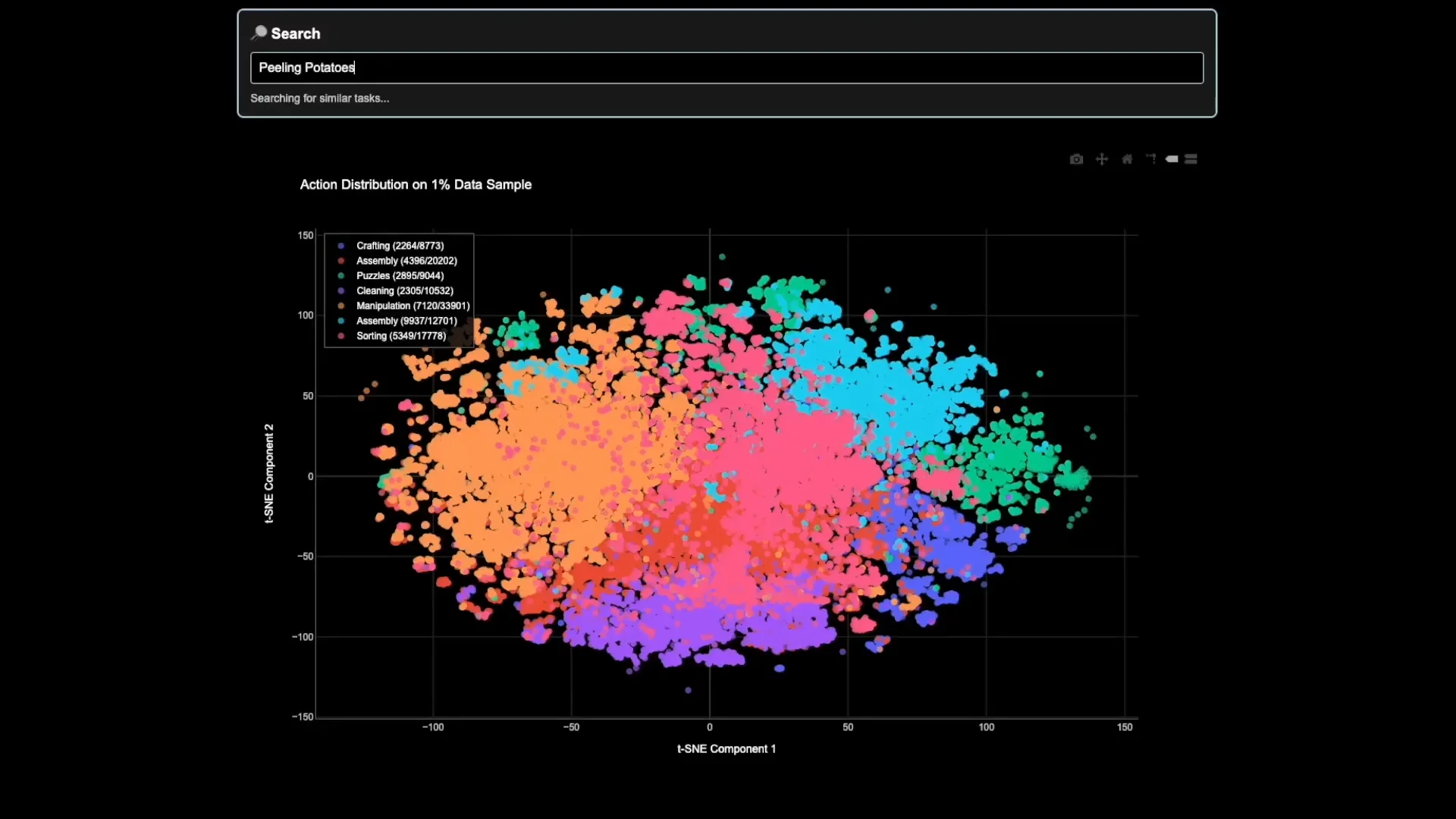
To manage this diversity, the company introduced a visualization tool that maps the "universe of manipulation." This internal search engine allows engineers to navigate millions of activities—from "peeling potatoes" to "threading bolts"—using a t-SNE map of language embeddings. This ensures that the robot isn't just learning to do one thing a million times, but is covering the semantic breadth of human activity.
The weekly humanoid robotics briefing
One email a week: the launches, funding and research that mattered, with context from Humanoids Daily.
Read recent issuesThe Metrics of Movement: MSE vs. Reverse KL
Perhaps the most technical revelation in the addendum is the introduction of specific metrics used to evaluate these data mixtures: Mean Squared Error (MSE) and Reverse Kullback–Leibler (KL) divergence.
While MSE is a standard measure of prediction error (how closely the robot's planned action matches the expert's), Generalist AI argues this isn't enough. They utilize Reverse KL to measure "mode-seeking behavior"—essentially, how well the model captures the distinct "modes" or styles of solving a task without averaging them into a blurry, ineffective middle ground.
- Low Prediction Error + Low Reverse KL: These models are highly precise and mimic the training data closely. The company notes these perform best with Supervised Fine-Tuning (SFT).
- High Prediction Error + Low Reverse KL: Surprisingly, models that "fail" to predict the exact next action but maintain low Reverse KL are described as "distributionally multimodal." The addendum suggests these models are actually better suited for Reinforcement Learning (RL) post-training, as they preserve a wider variety of potential strategies rather than collapsing into a single behavior.
This nuance is critical for the industry's ongoing debate between pure imitation learning and reinforcement learning. Generalist's data suggests that the pretraining mixture dictates which post-training method (SFT or RL) will be most effective.
Infrastructure at "Internet Scale"
The update also sheds light on the physical infrastructure required to ingest this "internet-scale" physical data.
Generalist AI disclosed that its training pipeline now utilizes custom hardware and dataloaders capable of processing data on the order of 10,000 computing cores. The headline statistic here is staggering: the system is reportedly capable of absorbing 6.85 years of real-world manipulation experience per day of training.
To feed this beast, the company has negotiated multi-cloud contracts and laid dedicated internet lines to support the uplink bandwidth from thousands of data collection sites globally.
Scaling Laws and "Ossification"
The addendum reinforces the company's previous claims regarding scaling laws and the "intelligence threshold", providing new charts to visualize the phenomenon of "ossification."
According to the new figures:
- 1B Parameter Models: Show clear "ossification," where the model weights stop absorbing new information and performance plateaus or degrades under data overload.
- 7B+ Parameter Models: Exhibit a "phase transition," continuing to improve predictably as more compute and data are added.
This data supports the company's hypothesis that physical commonsense requires a minimum complexity threshold—echoing Moravec's Paradox—and that we are only just beginning to see the benefits of large-scale robotic pretraining.
With this release, Generalist AI is moving the conversation from how much data is needed to what kind of data matters. As competitors like Figure and Tesla race to build their own datasets, Generalist's granular breakdown of "data mixtures" sets a new technical bar for transparency in the embodied AI space.
Share this article
Read next
- Published on
- Reading time
- 4 min read
Generalist AI Unveils GEN-0, Claims Scaling Laws for Robotics Backed by 270,000 Hours of Real-World Data
- Published on
- Reading time
- 4 min read
The Dark Matter of Robotics: Generalist AI’s Andy Zeng on the Quest for Physical Commonsense
- Published on
- Reading time
- 4 min read
Build AI Scales to 100,000 Hours as Data Scaling Becomes Robotics’ New Frontier
- Published on
- Reading time
- 4 min read
Physical Intelligence Finds 'Emergent' Bridge Between Human Video and Robot Action
- Published on
- Reading time
- 5 min read
Research Spotlight: X-Humanoid ‘Robotizes’ Human Videos to Train the Next Generation of Androids
- Published on
- Reading time
- 5 min read
Generalist AI Unveils GEN-1.5: One-Shot Robot Learning and the End of Heavy Fine-Tuning
The weekly humanoid robotics briefing
One email a week: the launches, funding and research that mattered, with context from Humanoids Daily.
Read recent issues