- Published on
Project Pemba: A Unitree G1 Humanoid is Climbing the World’s Tallest Peaks
One tap, and our reporting appears more often in your Google Top Stories. It makes a real difference to a small newsroom.


Your guide
Rich Robinson
Jee Chee Ren · Executive tour
See China’s AI and robotics ecosystem first-hand.
Six days exploring AI, robotics and advanced manufacturing.
With Rich Robinson, Clinical Professor of Entrepreneurship at Peking University
Beijing · Guangzhou · Shenzhen
29 November–4 December 2026
Referral partnership · We earn a commission on referred bookings.
- A project named Pemba is taking a modified Unitree G1 humanoid on a "Triple Crown" expedition to climb the world's tallest peaks, having recently summited Chimborazo in Ecuador.
- The robot walked autonomously on sections with under a 30-degree incline and was carried for the remainder of the 16-hour summit push.
- The initiative aims to develop highly mobile robotic platforms for wildlife conservation and remote monitoring, reducing the need for extensive stationary camera networks.
- The team is targeting an Everest summit, but currently faces regulatory hurdles as Nepal has no established policies for robotics on the mountain.
- Environmental resilience remains a critical hurdle, requiring custom ventilation systems to manage extreme thermal stress, a challenge that mirrors the G1's previous sub-zero testing.
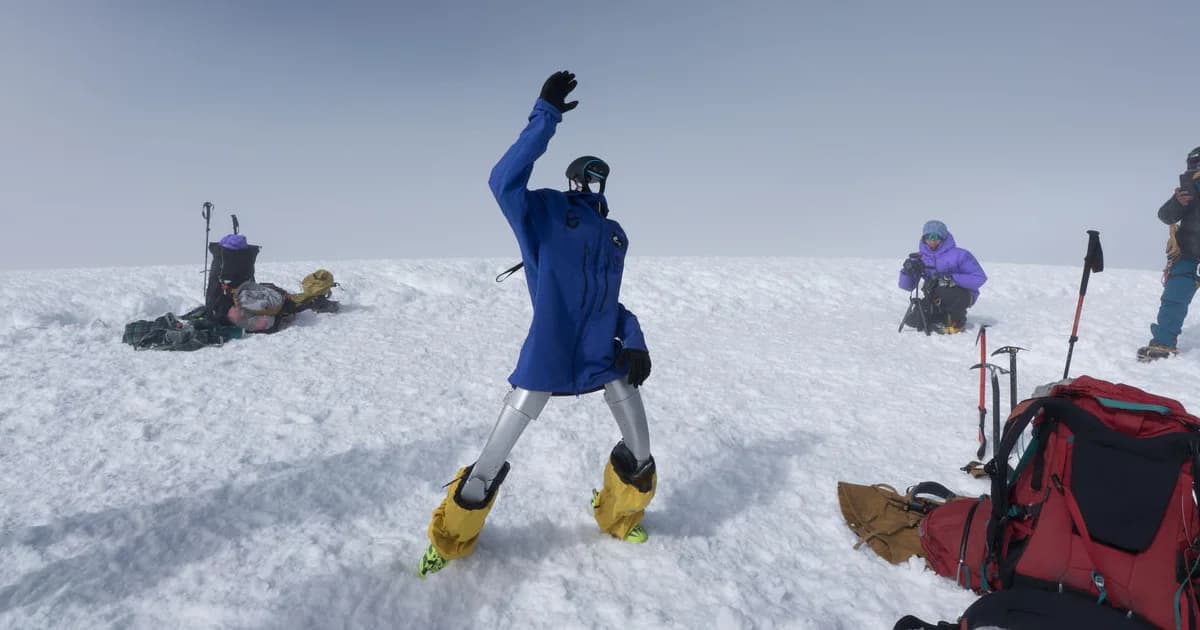
The push to take humanoid robots out of controlled laboratory environments and into the wild has reached new heights. On June 5, 2026, a modified Unitree G1 humanoid robot named "Pemba" successfully summited Chimborazo, a 6,200-meter peak in Ecuador known as the furthest point from the Earth's center.
The climb marks the first completed leg of a "Triple Crown" expedition designed to test the limits of robotic autonomy in some of the most extreme environments on the planet.
Giving Conservation Cameras Legs
The project is spearheaded by an engineer named Pablo, who previously dropped out of a top French engineering school to work with the World Wildlife Fund (WWF) in the Congo and the Amazon. During his time in the field, he observed that traditional robotic systems frequently fail when deployed in unstructured natural environments. Recognizing that 97% of the Earth's surface is inaccessible to wheeled or tracked robots, the Pemba project aims to build highly mobile platforms for conservation efforts.
Remote parks and reserves often rely heavily on live-streaming for research, monitoring, and generating revenue. Rather than deploying 100,000 stationary cameras across the Amazon to assist indigenous populations in protecting their land, the Pemba initiative proposes a more efficient alternative: giving those cameras legs. By utilizing small computers powered by solar energy and Starlink, the team hopes to create agile, autonomous monitoring units.
The weekly humanoid robotics briefing
One email a week: the launches, funding and research that mattered, with context from Humanoids Daily.
Read recent issuesThe Engineering Reality of the Climb
Taking a bipedal robot up a 6,200-meter peak requires significant logistical and technical compromises. Addressing speculation that the robot was simply driven to the top, Pablo clarified that no vehicles are permitted past 4,600 meters on Chimborazo.
During the 16-hour summit push, the G1 walked autonomously on every section of the route that had less than a 30-degree incline. For the steeper and more complex terrain, the robot had to be carried by the expedition team. The engineering team is currently training new reinforcement learning policies to handle these steeper inclines, building toward full autonomy degree by degree.
Survival in these environments also requires extensive hardware modification. Operating at high altitudes subjects the machine to freezing temperatures and extreme thermal stress. The Pemba team developed a custom ventilation system inside the robot's jacket to manage both extreme heat and cold, with the team noting that the system might eventually require an active "breather" mechanism. This focus on environmental resilience aligns with earlier demonstrations of the platform, such as when the G1 survived -47.4°C temperatures during a snowy marketing stunt in the Altay region.
Everest and Regulatory Hurdles
With Chimborazo completed, the expedition is turning its attention to Mauna Kea in Hawaii—the tallest mountain in the world when measured from its underwater base—before attempting Mount Everest.
The Everest attempt, which is being coordinated with a 14-piece expedition team and a top Nepalese logistics company, was initially targeted for earlier this year and is now tentatively scheduled for October 2026. However, the timeline remains uncertain and could slip to April 2027 due to an unexpected bottleneck: government regulation. Nepal currently has no legal framework or policies regarding the deployment of robotics on Everest, forcing the Pemba team to actively collaborate with local authorities to clear a path for the ascent.
To finance the massive logistical and engineering costs of the project, the team has turned to cryptocurrency. Inspired by digital fundraising models used for conservation in the Congo’s Virunga National Park, the expedition is being funded through a tokenization project on the platform Virtuals, with the entire journey broadcast live on-chain.
Share this article
Read next
- Published on
- Reading time
- 4 min read
NVIDIA Releases Flora to Turn Robot Videos Into Training Data
- Published on
- Reading time
- 3 min read
Humanoid Expands NVIDIA Collaboration, Replacing Two Robot Computers With One
- Published on
- Reading time
- 4 min read
Generative Bionics Plans Major Humanoid Training Hub in Italy With AMD
- Published on
- Reading time
- 3 min read
Unitree’s H2-X Flips Off Cars in New Kung Fu “Guardian” Video
- Published on
- Reading time
- 4 min read
Eka Robotics Raises $150 Million to Give Robots a Better Feel for the Physical World
- Published on
- Reading time
- 4 min read
Former Boston Dynamics Roboticist Unveils Voxel, a $20,000 Home-Tidying Robot

The weekly humanoid robotics briefing
One email a week: the launches, funding and research that mattered, with context from Humanoids Daily.
Read recent issues