- Published on
China to Assign Digital ID Numbers to Every Humanoid Robot to Track Lifecycles
One tap, and our reporting appears more often in your Google Top Stories. It makes a real difference to a small newsroom.

- China has launched the Humanoid Full Lifecycle Management Service Platform, a national initiative to assign unique digital identity numbers to every humanoid robot manufactured in the country.
- The 29-character ID code tracks key specifications, manufacturer data, and intelligence levels, while enabling real-time monitoring of maintenance logs, battery status, and joint wear.
- Led by the Ministry of Industry and Information Technology's (MIIT) HEIS committee, the program aims to address a "consistency crisis" and fragmentation across more than 140 domestic robot manufacturers.
- The system establishes clear legal accountability for safety incidents, data security, and ethical compliance as bipedal machines increasingly deploy into industrial and commercial spaces.
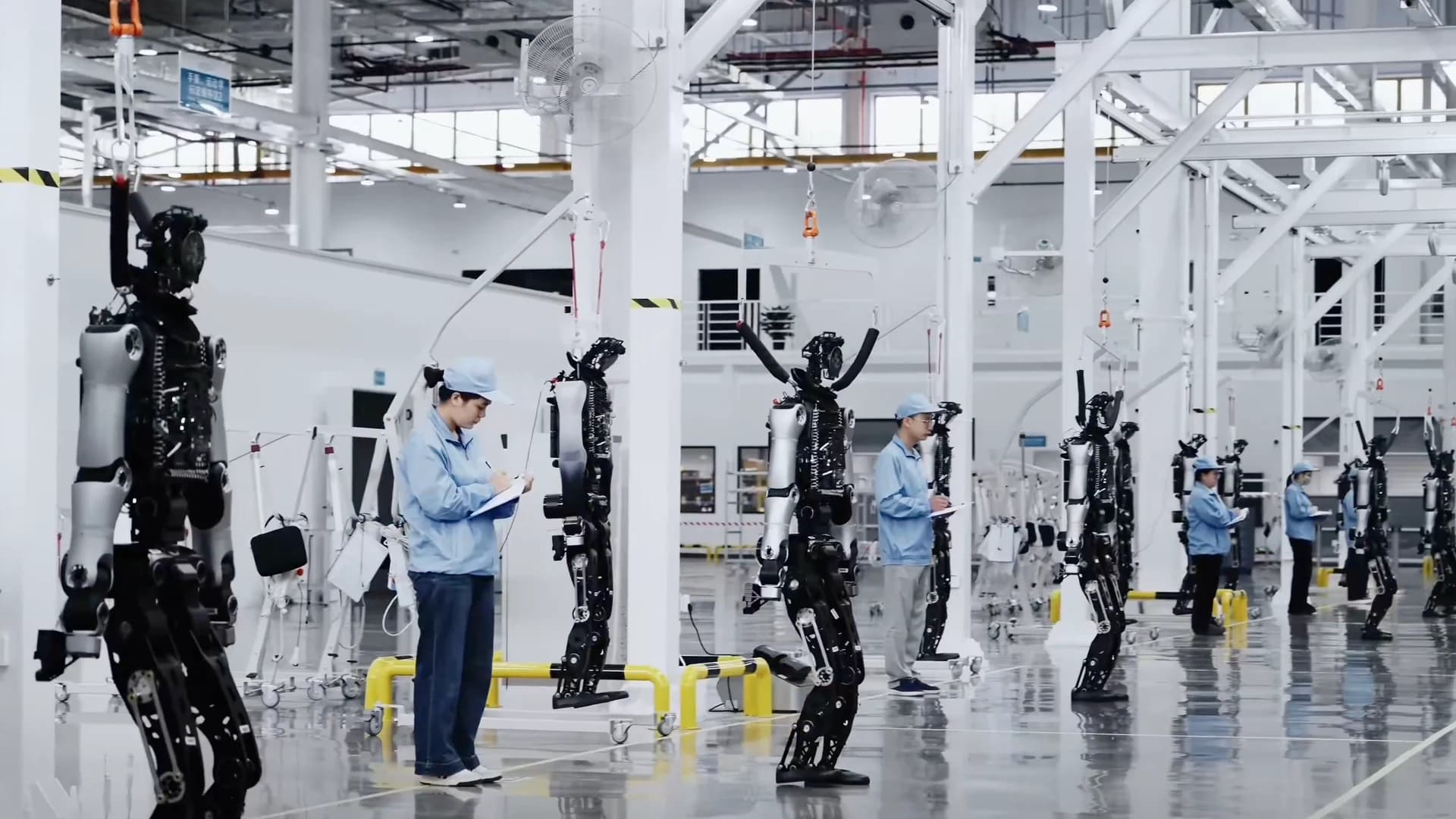
China is taking its top-down approach to regulating artificial intelligence a step further by treating humanoid robots more like citizens than appliances. Under a new national initiative, every humanoid robot manufactured in the country is set to receive a unique personal identification number to track its entire lifecycle, from the factory floor to the recycling plant.
The program, dubbed the Humanoid Full Lifecycle Management Service Platform, was officially launched by the Humanoid Robot and Embodied AI Standardization (HEIS) technical committee under China’s Ministry of Industry and Information Technology (MIIT). The system aims to inject order, traceability, and accountability into a domestic robotics market that has exploded in volume but remains deeply fragmented.
The Anatomy of a Robot ID
The digital identity cards are modeled closely after Chinese citizen IDs but feature an extended format to accommodate technical data. Each robot ID consists of 29 characters—a mix of numerals and English letters—making it 11 characters longer than a standard Chinese resident ID.
According to Liu Chuanhou, chief operating officer of the Hubei Humanoid Robot Innovation Center in Wuhan, which has been leading pilot testing for the project, the 29-character code contains a wealth of embedded information. It explicitly identifies:
The weekly humanoid robotics briefing
One email a week: the launches, funding and research that mattered, with context from Humanoids Daily.
Read recent issues- The robot's brand nationality and manufacturer
- Product model and specific serial number
- Hardware parameters and factory filing records
- The machine’s evaluated intelligence level
Beyond serving as a static serial number, the ID acts as a digital ledger linked to a centralized management platform. Fleet operators and manufacturers can access real-time telemetry data through the ID, monitoring parameters such as joint wear and tear, battery degradation, and operational accuracy.
If a humanoid malfunctions on an assembly line, engineers can parse its operational logs and maintenance records directly via its unique ID to isolate the failure and determine liability. Furthermore, when humanoids are resold or redeployed, new users can instantly verify historical performance metrics without undergoing repetitive safety testing.
Taming a Fragmented Market
The push for mandatory identification comes at a critical juncture for China's robotics sector. According to a March report by Beijing CCID Publishing and Media, global humanoid shipments reached approximately 17,000 units in 2025. Chinese manufacturers accounted for a staggering 84.7% of that global total, shipping roughly 14,400 units across more than 140 domestic companies.
However, this rapid scaling has led to a wild-west ecosystem. "Many enterprises still operate in isolation with incompatible technical standards," Liu noted, pointing to a severe lack of unified norms for data circulation, safety supervision, and product traceability.
The industry's leading players have previously warned that this fragmentation acts as a major bottleneck. Without standardized data formats and sensor baselines, training the massive foundational AI models required for true embodied intelligence is incredibly difficult.
By tying hardware directly to a national database, Beijing is leveraging its regulatory muscle to force competitors onto shared industrial baselines. The initiative builds directly upon the "Humanoid Robot and Embodied AI Standard System (2026 Edition)", which was released by the HEIS committee earlier this year to shift the industry from technical spectacles toward highly regulated industrial commercialization.
Accountability and the "Utility Gap"
As bipedal machines steadily transition from controlled testing labs to public spaces, commercial services, and automotive factories, the safety liabilities are compounding. Unlike statically stable wheeled robots, dynamically stable bipedal humanoids exist in a state of managed instability; if they suffer a power failure or an algorithmic "hallucination," a 150-pound robot can fall and cause severe injury or property damage.
The HEIS committee designed the ID framework to act as a regulatory safety net. In the event of an operational accident, data breach, or information leakage, the unique ID will support rapid traceability to definitively establish whether the fault lies with the hardware manufacturer, the software provider, or the operator.
The Hubei center has already completed initial filing applications and coding tests for a first batch of regional enterprises, including firms like Maxnova, Optics Valley Dongzhi, and Hubei Qirobotics. Several flagship humanoid models have already completed unified coding.
Official, widespread numbering will commence as the MIIT finalizes the corresponding national standards. For Chinese manufacturers currently preparing for mid-year IPOs, compliance with the new ID system is being framed not just as a regulatory hurdle, but as a prerequisite for achieving the trusted, large-scale market expansion needed to prove the commercial viability of humanoid labor.
Share this article
Read next
- Published on
- Reading time
- 2 min read
UBTECH and FAW-Volkswagen Expand Humanoid Robot Partnership Into Factory Logistics
- Published on
- Reading time
- 2 min read
Deep Robotics Tests IP66-Rated DR02 on Traffic Duty in the Rain
- Published on
- Reading time
- 3 min read
GPT-6 Astra Leads SuperCLUE’s Robot-Brain Benchmark, With a Wide Planning Advantage
- Published on
- Reading time
- 2 min read
RoboParty Unveils RP1 Humanoid at IROS, Plans Broader Open-Source Release in Q4
- Published on
- Reading time
- 3 min read
Galbot Prices ET1 Humanoid From 79,000 Yuan Across Three Versions
- Published on
- Reading time
- 3 min read
UBTECH CEO Tours Robot Factory, Says Monthly Output Could Reach 1,500 Units
The weekly humanoid robotics briefing
One email a week: the launches, funding and research that mattered, with context from Humanoids Daily.
Read recent issues