- Published on
RoboParty Opens RP1 Humanoid Designs, From Mechanical Parts to Motion Policies
One tap, and our reporting appears more often in your Google Top Stories. It makes a real difference to a small newsroom.


Your guide
Rich Robinson
Jee Chee Ren · Executive tour
See China’s AI and robotics ecosystem first-hand.
Six days exploring AI, robotics and advanced manufacturing.
With Rich Robinson, Clinical Professor of Entrepreneurship at Peking University
Beijing · Guangzhou · Shenzhen
29 November–4 December 2026
Referral partnership · We earn a commission on referred bookings.
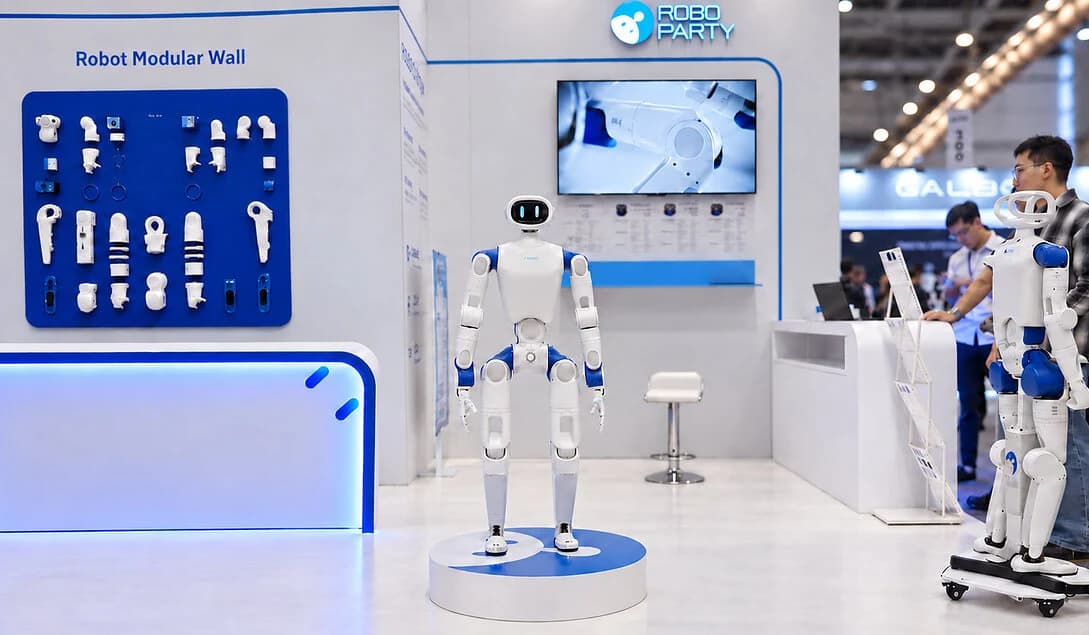
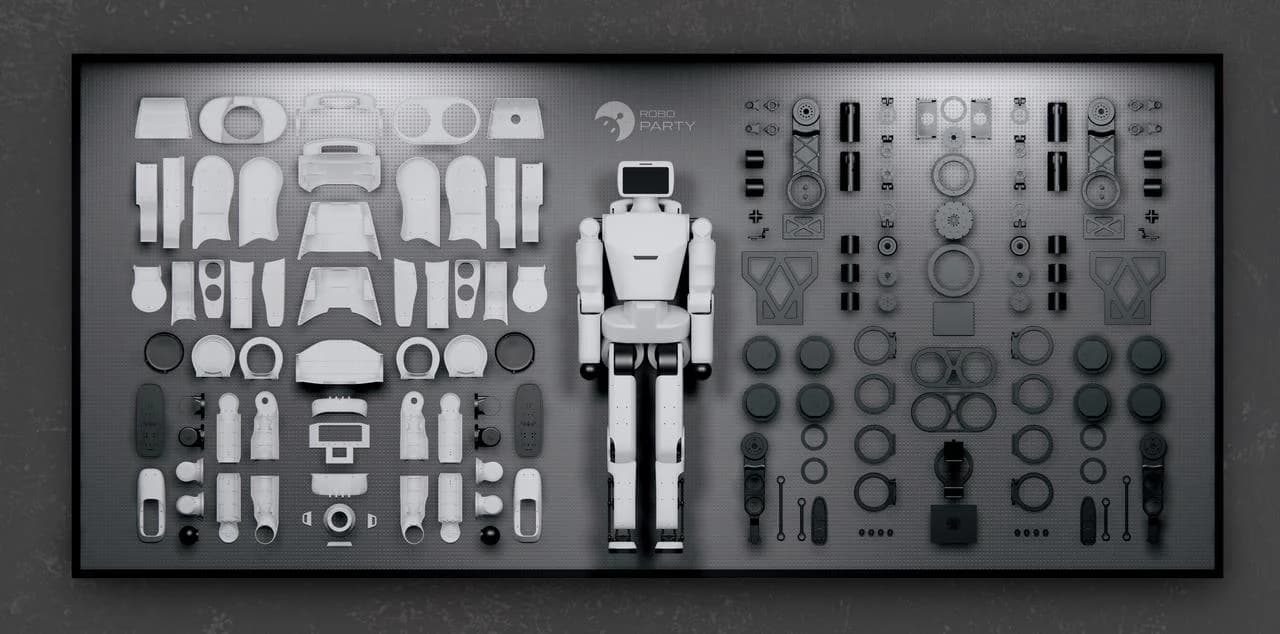
RoboParty has released an open development stack for RP1 (ROBOTO 01), giving researchers access to humanoid hardware files, control software and motion-learning resources. The announcement follows the robot’s IROS debut, when the company outlined plans for a broader release later in the year.
- RP1’s public repositories span mechanical designs, electronics, robot models and development software.
- The hardware release includes manufacturing files and bills of materials; MimicLite lists motion-policy checkpoints for two RP1 configurations.
- Release contents and licenses vary by component. The announcement does not give a retail price or shipping schedule.

From a demonstration to files developers can use
When we covered RP1’s unveiling at IROS, the broader hardware and software release was still a roadmap item. The new RP1 GitHub hub now connects repositories covering the robot’s structure, electronics, joint modules, firmware, simulation models and training tools.
The hardware repository provides STEP models and drawings for manufactured parts, PCB production files, wiring-harness information and configuration-specific bills of materials. These are useful starting points for teams that want to inspect or modify the physical machine alongside its software.
RoboParty’s argument is that a motion error can originate anywhere from the learned policy to the actuator or mechanical structure. Access across those layers could help developers investigate the cause and test changes on hardware, rather than work around an inaccessible subsystem.
The weekly humanoid robotics briefing
One email a week: the launches, funding and research that mattered, with context from Humanoids Daily.
Read recent issuesMotion learning and the scope of the release
RoboParty says RP1 has demonstrated continuous walking, disturbance recovery, getting up after a fall and human-motion tracking. It highlights UFO and MimicLite as part of the connection between learning movements and executing them on a robot.
The MimicLite repository lists released policy checkpoints for 24- and 28-degree-of-freedom RP1 configurations, alongside training, data-conversion and deployment resources. Its published comparison plot, however, evaluates a Unitree G1; those results should not be treated as RP1 performance measurements.
The description of a fully open platform also needs to be read at component level. The ROMOMO repository currently identifies its contents as joint-module documentation, specifications, drawings and test materials. It explicitly excludes software and firmware from that repository and refers readers to separately licensed code repositories.
RoboParty-owned hardware designs use CERN-OHL-W-2.0, while the hardware documentation uses CC BY-SA 4.0. Other repositories and third-party materials have their own terms.
For researchers, the immediate development is access to a broader set of engineering resources. Whether outside teams can reproduce RP1’s demonstrated movements—and adapt them to new experiments—will be the practical test of the release.
Share this article
Read next
- Published on
- Reading time
- 2 min read
RoboParty Unveils RP1 Humanoid at IROS, Plans Broader Open-Source Release in Q4
- Published on
- Reading time
- 4 min read
120 Days to a Run: RoboParty Open-Sources Its "ROBOTO ORIGIN" Humanoid Baseline
- Published on
- Reading time
- 2 min read
Shanghai Wants 8,000 Humanoid Robots in Factories by 2028
- Published on
- Reading time
- 3 min read
Galbot’s PASSAGE Helps Humanoids Step Over, Duck Under and Squeeze Past Obstacles
- Published on
- Reading time
- 3 min read
DeepSeek Reportedly Plans to Lead Winverse AI Seed Round at $400 Million Valuation
- Published on
- Reading time
- 4 min read
Archon Robotics Shares Debut Demo of Its Whole-Body Humanoid Intelligence

The weekly humanoid robotics briefing
One email a week: the launches, funding and research that mattered, with context from Humanoids Daily.
Read recent issues