- Published on
Archon Robotics Shares Debut Demo of Its Whole-Body Humanoid Intelligence
One tap, and our reporting appears more often in your Google Top Stories. It makes a real difference to a small newsroom.


Your guide
Rich Robinson
Jee Chee Ren · Executive tour
See China’s AI and robotics ecosystem first-hand.
Six days exploring AI, robotics and advanced manufacturing.
With Rich Robinson, Clinical Professor of Entrepreneurship at Peking University
Beijing · Guangzhou · Shenzhen
29 November–4 December 2026
Referral partnership · We earn a commission on referred bookings.
Archon Robotics has shared its debut demo, introducing an approach it calls Whole-Body Intelligence (WBI). The Shanghai-based company is developing AI for legged humanoids, with the aim of connecting task understanding to the coordinated movement of the robot’s entire body.
- Archon’s WBI approach combines task understanding with whole-body motion control, using human data for pretraining and real-robot data for post-training.
- The company says the full demonstrations run autonomously at normal speed; motion-control explanations and corrective-data segments include teleoperation.
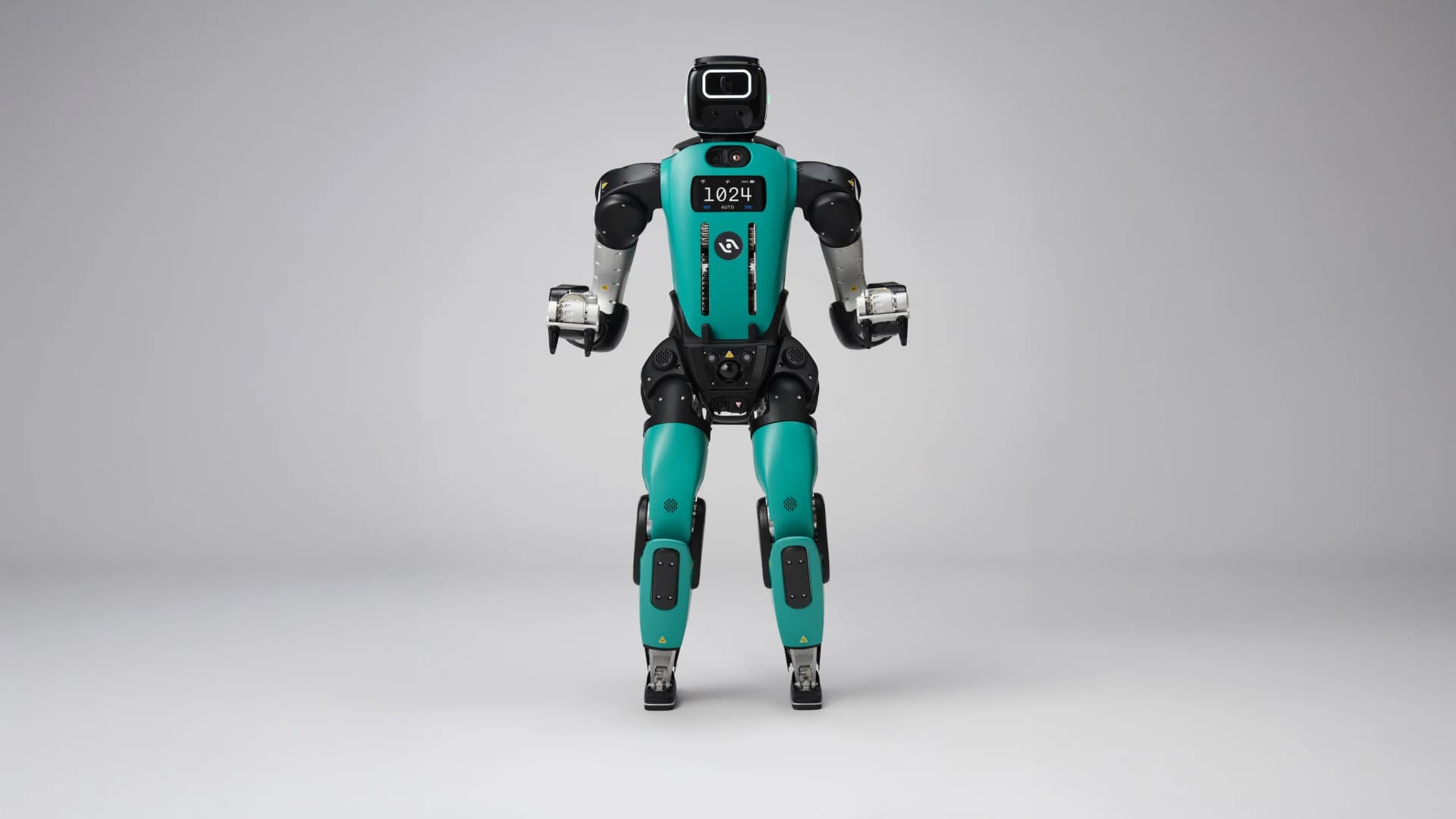
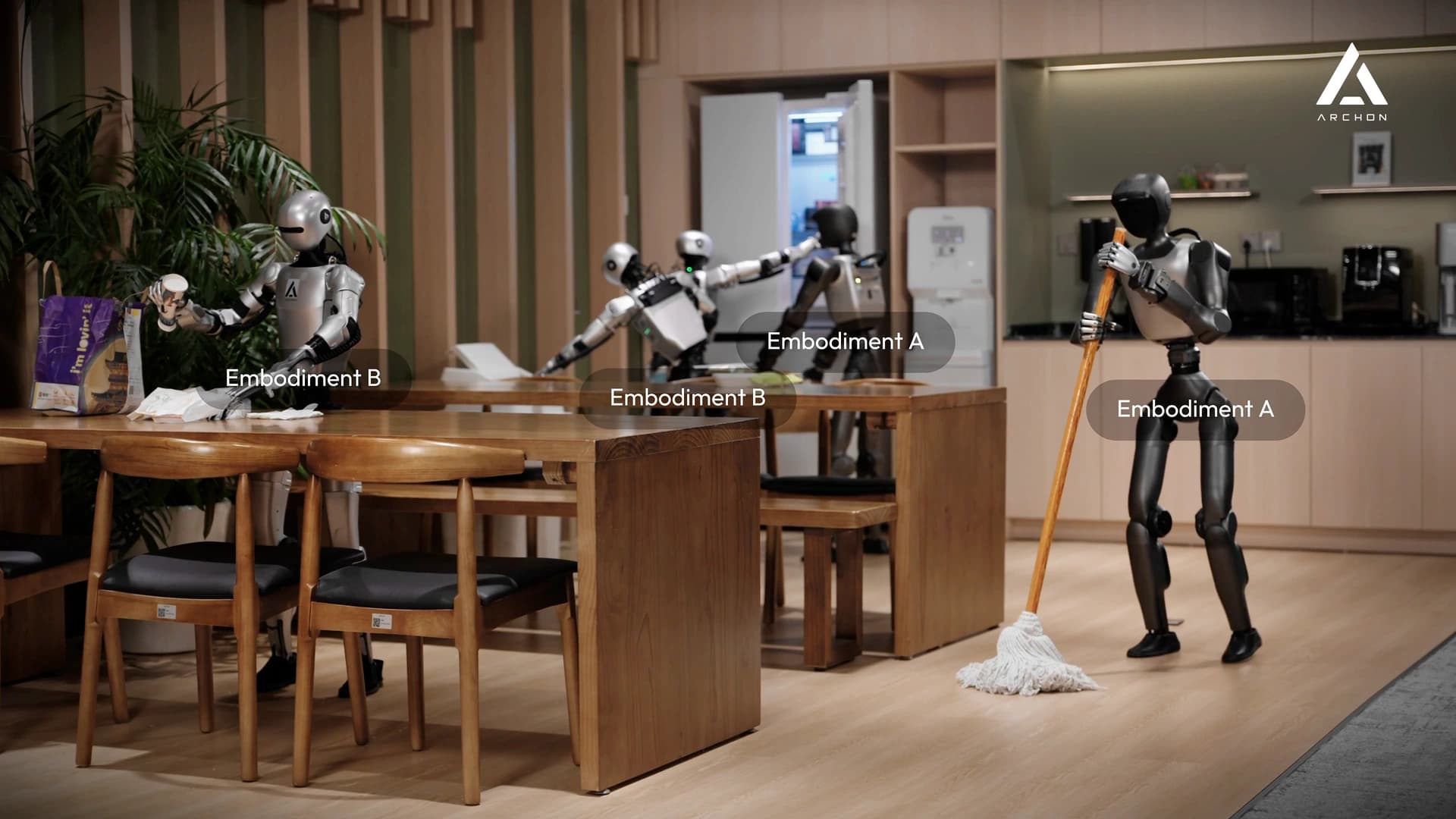
- The footage features an AGIBOT A3, Booster T2 robots and modified Unitree G1s, illustrating Archon’s work across different humanoid platforms.
- The debut video outlines the approach but does not provide task success rates, intervention counts or dataset sizes.
Connecting intent to movement
In its three-minute introduction, Archon starts from a familiar argument for humanoids: buildings, tools and facilities are designed around the human body. Its focus is on teaching robots to use that form effectively.
The video emphasizes two parts of its system. S1 handles task understanding and multimodal information, while S0 handles coordination, stabilization and precise execution. Archon describes the latter as the robot’s cerebellum, translating targets into executable whole-body movements. The company says it has tested the approach on humanoid platforms with different configurations, without providing comparative results in the video.
Archon’s technical blog, published in July, describes a broader four-layer framework, also including task planning and motion generation. The debut video concentrates on S1 and S0; it does not explain whether that narrower presentation reflects an architectural change.
The weekly humanoid robotics briefing
One email a week: the launches, funding and research that mattered, with context from Humanoids Daily.
Read recent issuesThree robot platforms in the demo
The hardware shown gives a more concrete picture of that approach. One sequence features an AGIBOT A3, a Booster T2 and a modified Unitree G1. Another shot shows three modified G1s and two Booster T2s performing different tasks at the same time in a shared kitchen and dining space, including a T2 handling a mop.
These are visual identifications from the footage, rather than a published hardware compatibility list. The scenes illustrate Archon’s work across multiple robot bodies; seeing them operate in the same room does not by itself establish that they are coordinating a shared task or running identical model weights.
Learning from demonstrations—and corrections
Archon says its data platform collects human demonstrations across multiple cities in China for model pretraining, followed by real-robot data for post-training. It describes automatic checks, human spot checks and reviews of flagged samples as part of its quality-control process.
The training material also includes DAgger corrective data: demonstrations intended to help models learn how to correct mistakes and resume execution, alongside examples of successful tasks.
The video’s closing disclosure distinguishes the footage types. Archon says the full demonstrations show autonomous execution at normal speed, while the S0 explanations and DAgger segments show teleoperation. That distinction matters when interpreting the robot’s movements: the video presents both autonomous behavior and the process used to develop it.
An autonomous-driving background
Archon’s founding team includes Hongyang Li, founder and chief robot officer, and Li Chen, co-founder and head of AI, both associated with the UniAD autonomous-driving research project. Co-founder and CEO Tianyu Li previously worked on Huawei’s ADS 4.0 driving system, according to the company.
An HKU biography of Hongyang Li dates Archon’s founding to April 2026. This is therefore a debut demonstration from a team that has already publicly outlined its research direction.
The release provides an introduction to that direction rather than a quantified performance evaluation. Success rates, intervention frequency and results on unfamiliar tasks would help establish how broadly the demonstrated capabilities transfer.
Share this article
Read next
- Published on
- Reading time
- 3 min read
MindOn Claims 142 Garments per Hour in Hour-Long Mind-1 Folding Demo
- Published on
- Reading time
- 3 min read
Unitree’s Wang Xingxing Says GPT-6 Tests Strengthen His Optimism for Embodied AI
- Published on
- Reading time
- 3 min read
China’s Humanoid Robot Rental Prices Fall as Operators Face the Cost of Service
- Published on
- Reading time
- 3 min read
XPENG Targets H2 2027 European Rollout for IRON Humanoid Robot
- Published on
- Reading time
- 3 min read
Robotera’s VPP2 Tops RoboDojo Simulation Benchmark by Linking Video Prediction to Robot Actions
- Published on
- Reading time
- 2 min read
BYD Humanoid Robot Design Emerges in Patent Images

The weekly humanoid robotics briefing
One email a week: the launches, funding and research that mattered, with context from Humanoids Daily.
Read recent issues