- Published on
Yann LeCun Predicts "Paradigm Shift" in Robotics by 2027, Dismisses LLMs as "Intrinsically Unsafe"
One tap, and our reporting appears more often in your Google Top Stories. It makes a real difference to a small newsroom.




- Yann LeCun states that the robotics industry will realize the need for a fundamental paradigm shift away from LLM-based architectures by early 2027.
- He critiques current Vision-Language-Action (VLA) models as "brittle" and overly reliant on massive datasets, contrasting them with the data efficiency of biological learning.
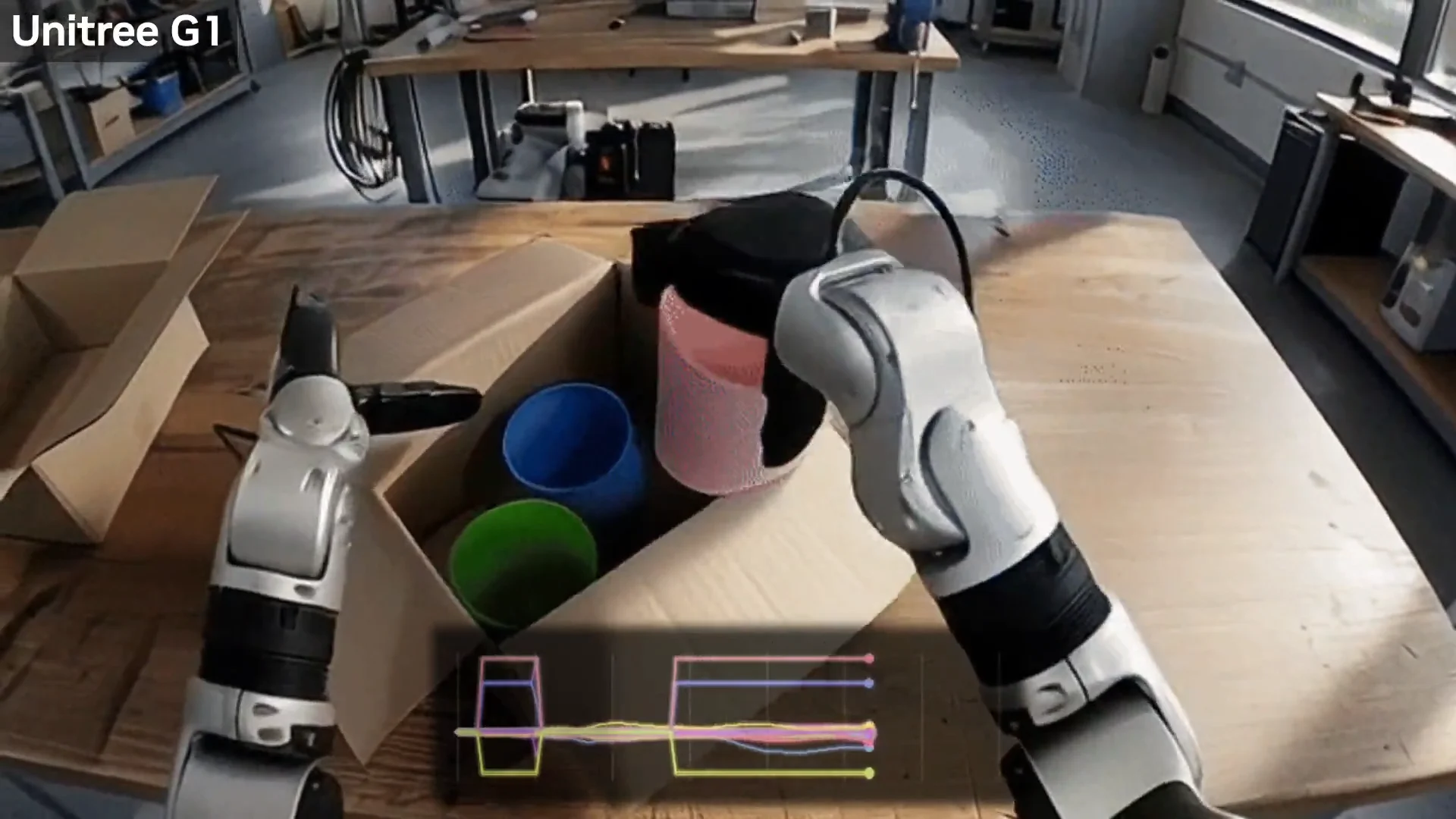
- Despite impressive demonstrations from companies like Figure and Physical Intelligence, LeCun argues these approaches lack the predictive "world model" required for true generalized autonomy.
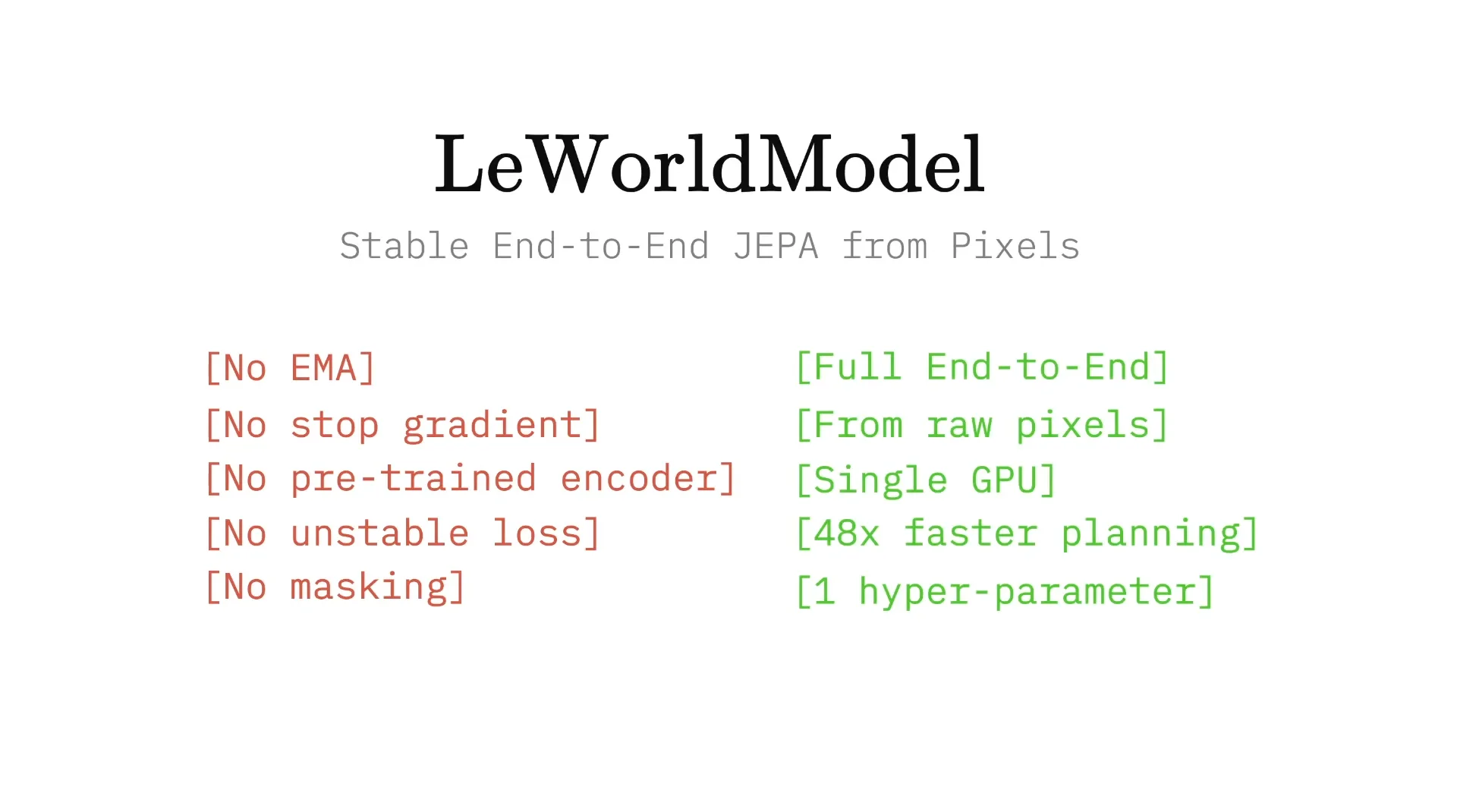
- LeCun's new startup, AMI Labs, which recently secured a $1.03 billion seed round , is pushing forward with LeWorldModel (LeWM) and the JEPA architecture to solve the representation collapse problem.
Yann LeCun is doubling down on his bet against the current consensus in artificial intelligence. In a recent appearance on the Unsupervised Learning podcast with Jacob Effron, the Turing Award winner and former Meta Chief AI Scientist laid out a sweeping critique of the robotics industry's reliance on Large Language Models (LLMs) and autoregressive architectures. According to LeCun, the industry's fixation on scaling current methods is a "dead end" for physical intelligence, predicting that the necessity for a fundamental paradigm shift will become "completely obvious to people by early 2027."
The Data Bottleneck and the Illusion of Progress
The robotics sector has recently been flooded with highly impressive demonstrations of physical capability. Companies like Generalist AI have built foundation models by training from scratch on over 500,000 hours of real-world data. Meanwhile, Figure has demonstrated its Figure 03 humanoid processing tens of thousands of packages autonomously via its Helix-02 network, and startups like Sunday Robotics continue to emphasize data-heavy, iterative hardware pipelines.

However, LeCun views these milestones as indicative of a brittle methodology. He argues that relying on massive datasets and imitation learning is fundamentally inefficient. Drawing a parallel to the autonomous driving sector, which remains unsolved despite millions of hours of training data, he highlighted that true intelligence requires rapid generalization. "How is it that a 17-year-old can learn to drive in a dozen hours?" LeCun asked during the interview, pointing out that current systems require exponentially more data to master even narrow tasks.
Why VLAs Fail and JEPA Succeeds
At the core of LeCun’s critique is the rejection of Vision-Language-Action (VLA) models, which he characterizes as "basically now being seen as a failure" due to their unreliability and massive data constraints (Also read NVIDIA's Dr Jim Fan's take on this). As an alternative, LeCun is aggressively pushing the Joint Embedding Predictive Architecture (JEPA) through his new startup, AMI Labs.
The weekly humanoid robotics briefing
One email a week: the launches, funding and research that mattered, with context from Humanoids Daily.
Read recent issuesUnlike generative models that attempt to predict exact pixels or tokens, JEPA operates in an abstract representation space. This allows a system to ignore irrelevant "pixel noise" and focus on the causal physics of a scene. LeCun confirmed that AMI is actively refining this approach, recently achieving stability with the 15-million parameter LeWorldModel (LeWM) , which utilizes a novel SIGReg (Sketched-Isotropic-Gaussian Regularizer) to prevent representation collapse. By forcing the distribution of variables coming out of the encoder to maximize information without simply generating a constant representation, SIGReg offers a leaner, more stable path to physical reasoning.
The "Intrinsic Unsafety" of LLMs
Beyond robotics, LeCun issued a stark warning regarding the safety of agentic LLMs. He described them as "intrinsically unsafe" because their autoregressive nature prevents them from predicting the actual physical consequences of their actions. While LLMs excel in discrete, tokenized domains like mathematics or coding—where language is the substrate of reasoning—the physical world is continuous, noisy, and high-dimensional.
Without an internal "world model" to simulate and optimize future states against a specific cost function, an LLM-based agent cannot guarantee safe or reliable execution in the real world. This limitation, he noted, precludes their use in high-stakes environments like specialized healthcare and industrial manufacturing, sectors where AMI Labs is currently seeking strategic partnerships.
The 2027 Horizon
While the industry remains largely focused on scaling existing transformer architectures, LeCun’s AMI Labs is positioning itself as the foundational "brain" laboratory for the next era of AI. LeCun expects to demonstrate general methodologies for training hierarchical world models across various modalities within the next 12 to 18 months. If his timeline holds true, the "LLM-pilled" robotics industry may soon be forced to reckon with the limits of imitation learning, pivoting toward systems that actually understand the physical world rather than simply reacting to it.
Watch the interview below:
Share this article
Read next
- Published on
- Reading time
- 4 min read
Yann LeCun’s World Model Vision Gets a Leaner Engine: Introducing LeWorldModel
- Published on
- Reading time
- 3 min read
The Billion-Dollar World Model: Yann LeCun’s AMI Labs Secures $1.03B to Challenge LLM Dominance
- Published on
- Reading time
- 4 min read
The World Model Rebellion: Yann LeCun Launches AMI Labs to Challenge the 'LLM-Pilled' Consensus
- Published on
- Reading time
- 4 min read
NVIDIA Open-Sources DreamDojo: A 44,000-Hour "Dream" to Solve the Robotics Data Gap
- Published on
- Reading time
- 6 min read
Meta AI Chief Yann LeCun Claims Humanoid Firms "Have No Idea" How to Build Generally Useful AI
- Published on
- Reading time
- 5 min read
The World Model Taxonomy: Decoding the Ambiguous Engine of Physical AI




The weekly humanoid robotics briefing
One email a week: the launches, funding and research that mattered, with context from Humanoids Daily.
Read recent issues