Physical Intelligence
San Francisco developer of vision-language-action foundation models intended to control robots and other physically actuated devices built by third parties.
- Founded
- 2024
- Headquarters
- San FranciscoUnited States
- Total funding
- $1.1B
- Valuation
- $5.6B
- Products
- 7
- Our coverage
- 12stories
What it builds
Physical Intelligence — written as π and generally shortened to Pi — is a San Francisco company that builds vision-language-action (VLA) foundation models for robot hardware it does not manufacture. Its own site describes the goal as learning algorithms for a model that will control any robot to do any task. The company was founded in 2024 by researchers from Google DeepMind, UC Berkeley and Stanford — Karol Hausman, Sergey Levine, Chelsea Finn, Brian Ichter, Quan Vuong and Adnan Esmail — together with former Stripe executive Lachy Groom. Hausman is chief executive; the office is in the Mission District.
The model line
π0, described by the company as its first generalist policy, was published in October 2024, followed by π0.5 and the Hi Robot planner; weights and code for π0 and an autoregressive π0-FAST variant were released publicly. In November 2025 the company argued that "RL is back" with π*0.6, trained using a method it calls Recap that mixes demonstrations, teleoperator corrections and autonomous practice. In December it reported gold-tier results on "Robot Olympics" chores and, separately, that transfer from human video emerges with scale rather than requiring bespoke capture hardware. Through early 2026 it added multi-scale memory spanning fifteen minutes, RL Tokens for last-millimetre precision, and in April π0.7, framed around compositional generalization.
Commercial approach
Pi's route to market is a software layer sold or licensed into other people's robots rather than a machine of its own. It has published deployment data from partners, including laundry folding with Weave Robotics and packaging with Ultra, and in 2025 announced a research partnership with Chinese robot maker AgiBot. The company has not disclosed revenue or customer counts; one Korean trade outlet characterised it in March 2026 as having no commercial products or revenue. Prior work spans stationary bimanual arms, mobile manipulators and third-party humanoids, so the registry entry is better read as a supplier to humanoid developers than as a humanoid maker.
Funding and standing
A $600 million round led by Alphabet's CapitalG in November 2025 valued the company at $5.6 billion, with Lux Capital, Bond, Redpoint, Sequoia, Thrive Capital, T. Rowe Price, OpenAI and Jeff Bezos among the investors, bringing disclosed capital to roughly $1.1 billion. Four months later Bloomberg reported the company was in talks for about $1 billion at more than $11 billion, with Founders Fund set to participate and Lightspeed also in discussions. No primary confirmation that the round closed was found; private-market databases disagree on the current totals.
Landscape
Pi's position is unusual in that its models compete less with humanoid builders than with the in-house autonomy stacks those builders maintain, which puts it alongside other robot-foundation-model efforts while making hardware companies both rivals and prospective customers.
Robots & products
A selection of the company's announced products, not a complete catalogue.
π0.7
AnnouncedAI model · announced April 2026
A steerable robotic foundation model the company describes as showing a step change in generalization, including combining known skills on hardware it was not trained on.
RL Token (RLT)
AnnouncedAI model · announced March 2026
A method that extracts a reinforcement-learning token from a VLA model to enable fast online RL on precise manipulation tasks.
Multi-Scale Embodied Memory (MEM)
AnnouncedAI model · announced March 2026
A memory architecture giving the company's policies both short-term video and long-term text memory for tasks running longer than ten minutes.
π*0.6
AnnouncedAI model · announced November 2025
A VLA model trained with the company's Recap method, combining demonstrations, teleoperator corrections and autonomous reinforcement learning.
π0 (pi-zero)
AnnouncedAI model · announced October 2024
The company's first generalist vision-language-action policy for robot manipulation, later released with open weights and code alongside an autoregressive π0-FAST variant.
π0.5
AnnouncedAI model
A follow-on vision-language-action model presented as generalizing to unseen open-world environments.
Hi Robot
AnnouncedAI model
A high-level planner layered on the π0 policy that lets robots reason through complex tasks step by step with human-in-the-loop feedback.
Funding
$1.1B raised| Round | Date | Amount | Valuation | Lead investors |
|---|---|---|---|---|
| Series B | November 2025 | $600M | $5.6B | CapitalG |
Timeline
π0.7 released, claiming compositional generalization
The model directed robots through tasks and hardware combinations it was never explicitly trained on, including a bimanual UR5e laundry setup.
Physical Intelligence Unveils π0.7: The Rise of Compositional Generalization in Robotics- Reported
Reported talks for $1 billion at over $11 billion valuation
Bloomberg reported Founders Fund set to participate with Lightspeed in discussions; no close was confirmed in sources retrieved.
Physical Intelligence in Talks for $1 Billion Round, Eyeing an $11 Billion Valuation RL Tokens introduced for precise online reinforcement learning
The method trains a lightweight actor-critic on a token extracted from the VLA, improving throughput on contact-rich tasks with a few hours of data.
The Last Millimeter: Physical Intelligence Unveils RL Tokens for Hyper-Fast PrecisionMulti-Scale Embodied Memory extends tasks past ten minutes
MEM pairs short-term video memory with long-term natural-language summaries so policies can sustain long-horizon work.
Don’t Forget the Salt: Physical Intelligence Equips Robots with 15-Minute "Multi-Scale" Memory"Physical Intelligence Layer" partner deployment data published
The company released live-deployment results from Weave Robotics laundry folding and industrial packaging firm Ultra, framing its models as a plug-in intelligence layer for third-party hardware.
The API-fication of Robotics: Physical Intelligence Unveils Real-World Performance Data with Weave and Ultraπ0.6 fine-tunes solve "Robot Olympics" chore benchmark
The company reported gold-tier results on three of five categories of everyday manipulation challenges, including washing a greasy pan and unlocking a padlock.
Gold Medals and Greasy Pans: Physical Intelligence Tackles the "Robot Olympics"Human-video transfer reported as emergent with scale
Research showed larger pre-trained models learn from egocentric human video without specialized capture hardware.
Physical Intelligence Finds 'Emergent' Bridge Between Human Video and Robot Action$600 million Series B at $5.6 billion valuation
CapitalG led the round with Lux Capital, taking disclosed funding to roughly $1.1 billion.
bloomberg.com ↗π*0.6 released with Recap reinforcement-learning method
The company said combining demonstrations, teleoperator corrections and autonomous practice roughly doubled throughput on tasks such as laundry folding and espresso making.
Physical Intelligence Claims ‘RL is Back’ With New Model That Learns From Its Own MistakesResearch partnership with China's AgiBot announced
The two companies showed a single policy controlling multiple tasks across different hands and cameras, including tying a scarf on a mannequin.
AgiBot and Physical Intelligence Form Partnership for Advanced Embodied AIπ0, the company's first generalist policy, published
Physical Intelligence released its first general-purpose vision-language-action policy, later followed by open weights and code for π0 and π0-FAST.
physicalintelligence.company ↗Physical Intelligence founded in San Francisco
Founded by Karol Hausman, Sergey Levine, Chelsea Finn, Brian Ichter, Quan Vuong, Adnan Esmail and Lachy Groom to build general-purpose models for robots.
en.wikipedia.org ↗
Latest on Physical Intelligence
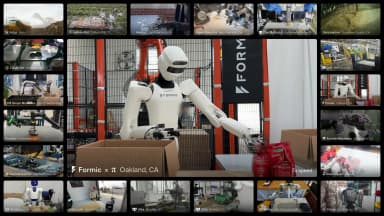
Physical Intelligence Opens API Beta for Robot Model Training and Inference
PI is accepting applications for a managed robot-model API, with early examples spanning manufacturing and heavy machinery.
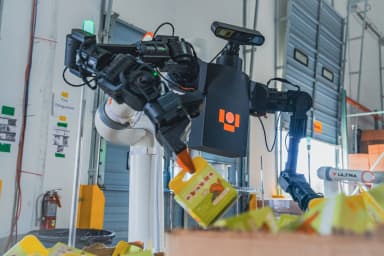
Ultra Raises $50 Million Series A for Warehouse Robots, Deepens Physical Intelligence Partnership
The round brings announced funding to $62 million including seed capital, as Ultra scales its warehouse robot service and work with Physical Intelligence.
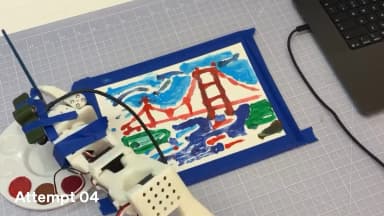
The "OpenAI of Robotics" Debate Reignites as GPT-6 Astra Paints in Real Life
An impromptu painting demonstration using OpenAI’s GPT-6 Astra has triggered a wider industry clash over whether foundation models will commoditize physical AI or hit an unyielding hardware ceiling.
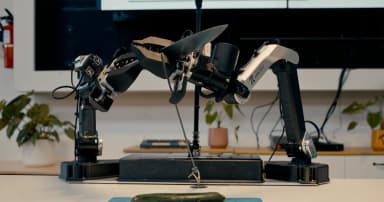
Physical Intelligence Unveils π0.7: The Rise of Compositional Generalization in Robotics
Physical Intelligence has released π0.7, a new foundation model demonstrating "emergent" abilities to combine skills and adapt to new robot hardware without task-specific training.
Physical Intelligence in Talks for $1 Billion Round, Eyeing an $11 Billion Valuation
Just four months after its last major raise, the AI robotics startup is reportedly seeking new capital to double its valuation as it accelerates the development of its "universal brain" for robots.
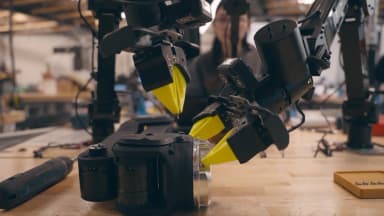
The Last Millimeter: Physical Intelligence Unveils RL Tokens for Hyper-Fast Precision
Physical Intelligence has introduced RL Tokens (RLT), a method that allows robots to master delicate tasks like screwdriving and zip-tying in as little as 15 minutes, eventually outperforming human speed.

Don’t Forget the Salt: Physical Intelligence Equips Robots with 15-Minute "Multi-Scale" Memory
Physical Intelligence (Pi) has unveiled Multi-Scale Embodied Memory (MEM), a hybrid architecture that combines short-term video encoding with long-term textual summarization to help robots master long-horizon tasks like kitchen cleaning and in-context error recovery.
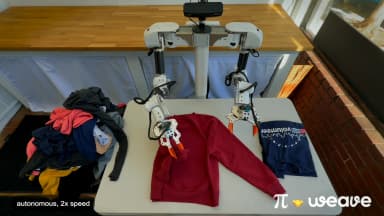
The API-fication of Robotics: Physical Intelligence Unveils Real-World Performance Data with Weave and Ultra
Physical Intelligence (Pi) is positioning its foundation models as a universal 'intelligence layer' for the industry, releasing new data that shows significant reliability gains for laundry-folding and industrial-packaging robots.
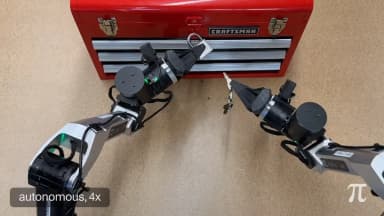
Gold Medals and Greasy Pans: Physical Intelligence Tackles the "Robot Olympics"
By fine-tuning its π0.6 foundation model, Physical Intelligence has demonstrated a wide array of "common sense" physical tasks—from making sandwiches to cleaning windows—proving that the path to general-purpose robotics lies in scaling physical data.
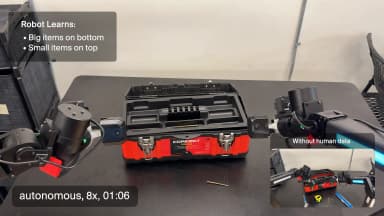
Physical Intelligence Finds 'Emergent' Bridge Between Human Video and Robot Action
The $5.6 billion startup reveals that sufficiently large robot models naturally learn to understand human video, potentially solving the industry's data bottleneck.
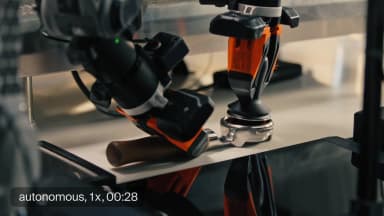
Physical Intelligence Claims ‘RL is Back’ With New Model That Learns From Its Own Mistakes
Physical Intelligence has unveiled π*0.6, a new VLA model that utilizes a training method called "Recap." By combining human demonstrations with autonomous reinforcement learning, the company claims to have doubled performance throughput on complex tasks like laundry folding and espresso making.
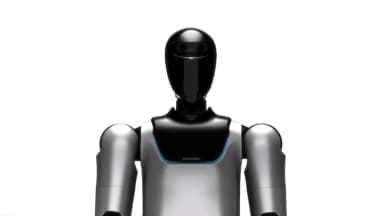
South Korea Challenges US and China with 'KAPEX' Humanoid Robot
LG Electronics and the Korea Institute of Science and Technology (KIST) have unveiled KAPEX, a next-generation humanoid robot designed to learn and adapt in real-world environments, marking a major push to compete in the global race for 'physical AI'.
AgiBot and Physical Intelligence Form Partnership for Advanced Embodied AI
Chinese robotics company AgiBot partners with US-based embodied AI specialist Physical Intelligence (Pi), founded by prominent researchers like Sergey Levine and Chelsea Finn. AgiBot has hired Berkeley alum Dr. Luo Jianlan as Chief Scientist to lead a new research center focused on complex robot tasks. Initial collaboration shows a single AI policy controlling diverse tasks, demonstrated by a robot tying a scarf.
Sources
- Why Robots Still Struggle With Simple Tasks — Karol Hausman, Co-Founder & CEO of Physical Intelligence· checked September 6, 2026
- Physical Intelligence (π) – Join Us· checked September 6, 2026
- VCs are funding the AI-powered robot revolution· checked September 6, 2026
- Physical Intelligence 2026 Company Profile: Valuation, Funding & Investors· checked September 6, 2026
- Physical Intelligence Inc.· checked September 6, 2026
- Robotics Startup Physical Intelligence Valued at $5.6 Billion in New Funding· checked September 6, 2026
- Physical Intelligence (π) – Blog· checked September 6, 2026
- Physical Intelligence (π)· checked September 6, 2026
- π0.7: a Steerable Model with Emergent Capabilities· checked September 6, 2026
- Our First Generalist Policy· checked September 6, 2026
- Physical Intelligence raises $600M to advance robot foundation models· checked September 6, 2026
- Physical Intelligence (@physical_int) / X· checked September 6, 2026