- Published on
AGIBOT Releases Physical Reasoning Dataset to Connect Robot Decisions With Actions
One tap, and our reporting appears more often in your Google Top Stories. It makes a real difference to a small newsroom.


Your guide
Rich Robinson
Jee Chee Ren · Executive tour
See China’s AI and robotics ecosystem first-hand.
Six days exploring AI, robotics and advanced manufacturing.
With Rich Robinson, Clinical Professor of Entrepreneurship at Peking University
Beijing · Guangzhou · Shenzhen
29 November–4 December 2026
Referral partnership · We earn a commission on referred bookings.
AGIBOT has announced Physical Reasoning, the fourth release of its AGIBOT WORLD 2026 dataset, designed to help robots decide what to do as the situation around them changes. The October 22 announcement shifts the emphasis from difficult movements to decisions: which object to choose, what needs to happen first, and whether a task has actually been completed.
- Release 4 records different action paths for the same goal under changing conditions.
- It combines high-level questions and answers with robot action trajectories and detailed annotations.
- Tasks cover nine reasoning abilities, including search, quantity judgments, memory and subtask ordering.
- AGIBOT says it is already using the data for an upcoming agent framework and next-generation foundation model.
The same goal can require different actions
In a press release supplied to Humanoids Daily, AGIBOT illustrates the approach with a hotel minibar. To leave three full bottles, a robot must identify empty bottles, count the full ones and decide what to remove or add. Repeating a fixed sequence would not work across different starting conditions.
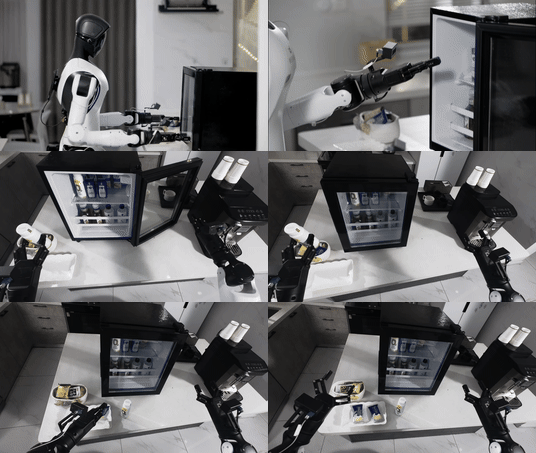
Another example involves searching drawers for toiletries. The next step depends on which drawers have already been checked, even when the current camera view looks the same. Retrieving a key may require moving an obstructing box first, while preparing items for an outing can involve checking a weather forecast before choosing sunscreen or an umbrella.
The AGIBOT WORLD project organizes this release around variations in object quantity, obstructions, available space and task progress. Its nine reasoning categories span selection, manipulation feasibility, action preconditions, search, state tracking, planning, memory and ordering subtasks. Tasks are divided into three difficulty levels, from individual judgments to combinations of goals and constraints.
The weekly humanoid robotics briefing
One email a week: the launches, funding and research that mattered, with context from Humanoids Daily.
Read recent issuesConnecting decisions to robot movements
The annotations link an overall instruction to subtasks and individual actions. Detailed action descriptions specify the target object, where to manipulate it, how the two arms divide the work, gripper state and the expected result. Spatial labels connect those descriptions to locations and motion paths in the images.
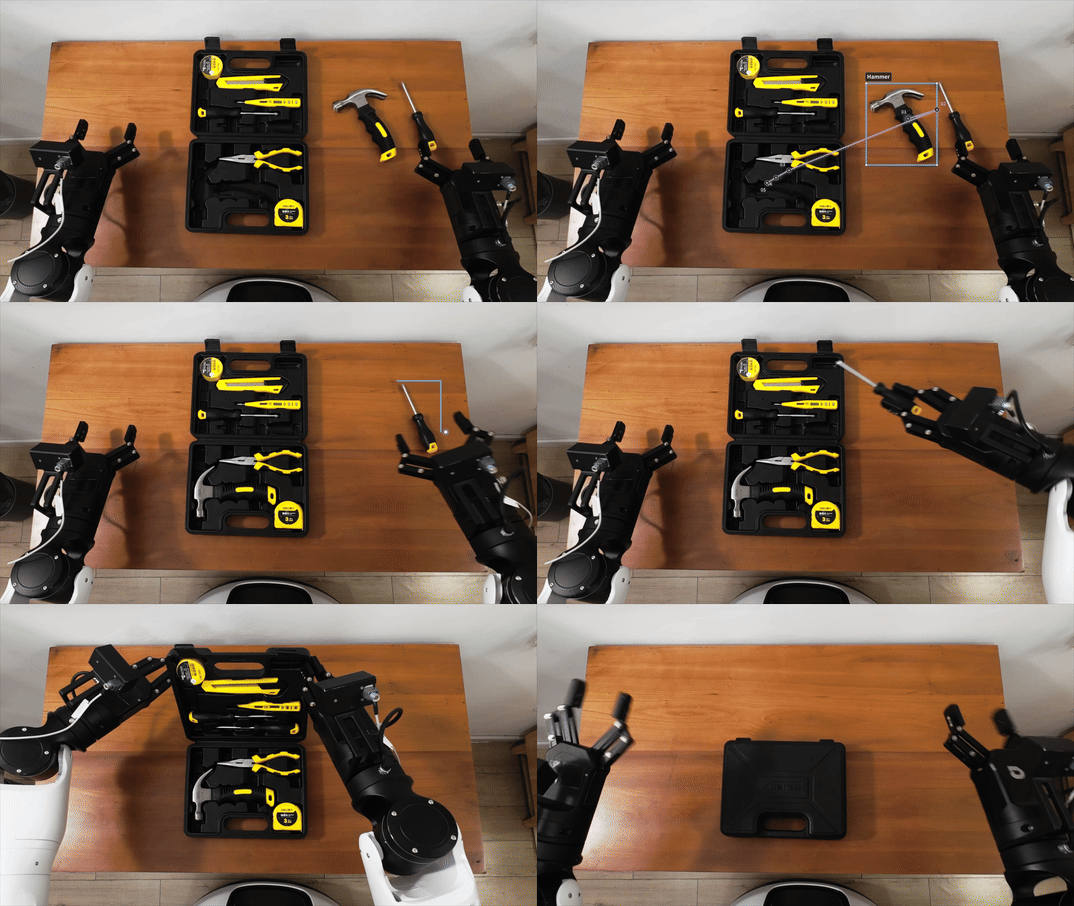
AGIBOT says the release includes successful and erroneous examples, with annotations recording whether the correct object was selected or placed and whether quantity requirements were met. That gives researchers material for studying how a system detects a mistake and adjusts its subsequent actions.
The company says the dataset has already supported its forthcoming agent framework and training of its next-generation foundation model. The press release does not report a Release 4 episode count or quantitative improvements in robot task success.
Available for research, with license conditions
AGIBOT describes the release as open-source and links to the AGIBOT WORLD 2026 repository on Hugging Face. The repository currently lists a CC BY-NC-SA 4.0 license, which includes a non-commercial restriction.
The announcement provides a research resource for connecting decisions with physical execution. Its practical test will be whether models trained on these varied situations can choose the right next action in settings beyond the collected examples.
Share this article
Read next
- Published on
- Reading time
- 7 min read
AGIBOT Open-Sources GE-Act 2.0, Challenging Unitree in the Open Embodied AI Race
- Published on
- Reading time
- 4 min read
The Synthetic Engine: How AGIBOT Genie Sim 3.0 Resolves the Embodied AI Data Bottleneck
- Published on
- Reading time
- 2 min read
RoboParty Unveils RP1 Humanoid at IROS, Plans Broader Open-Source Release in Q4
- Published on
- Reading time
- 7 min read
Unitree Begins Open Release of UnifoLM-WLA-1.0 to Tackle Humanoid Generalization
- Published on
- Reading time
- 4 min read
120 Days to a Run: RoboParty Open-Sources Its "ROBOTO ORIGIN" Humanoid Baseline
- Published on
- Reading time
- 3 min read
IDC Puts H1 Humanoid Shipments Near 25,000, With AGIBOT Leading

The weekly humanoid robotics briefing
One email a week: the launches, funding and research that mattered, with context from Humanoids Daily.
Read recent issues