- Published on
How AGIBOT’s Physical Reasoning Dataset Connects Planning With Robot Actions
One tap, and our reporting appears more often in your Google Top Stories. It makes a real difference to a small newsroom.

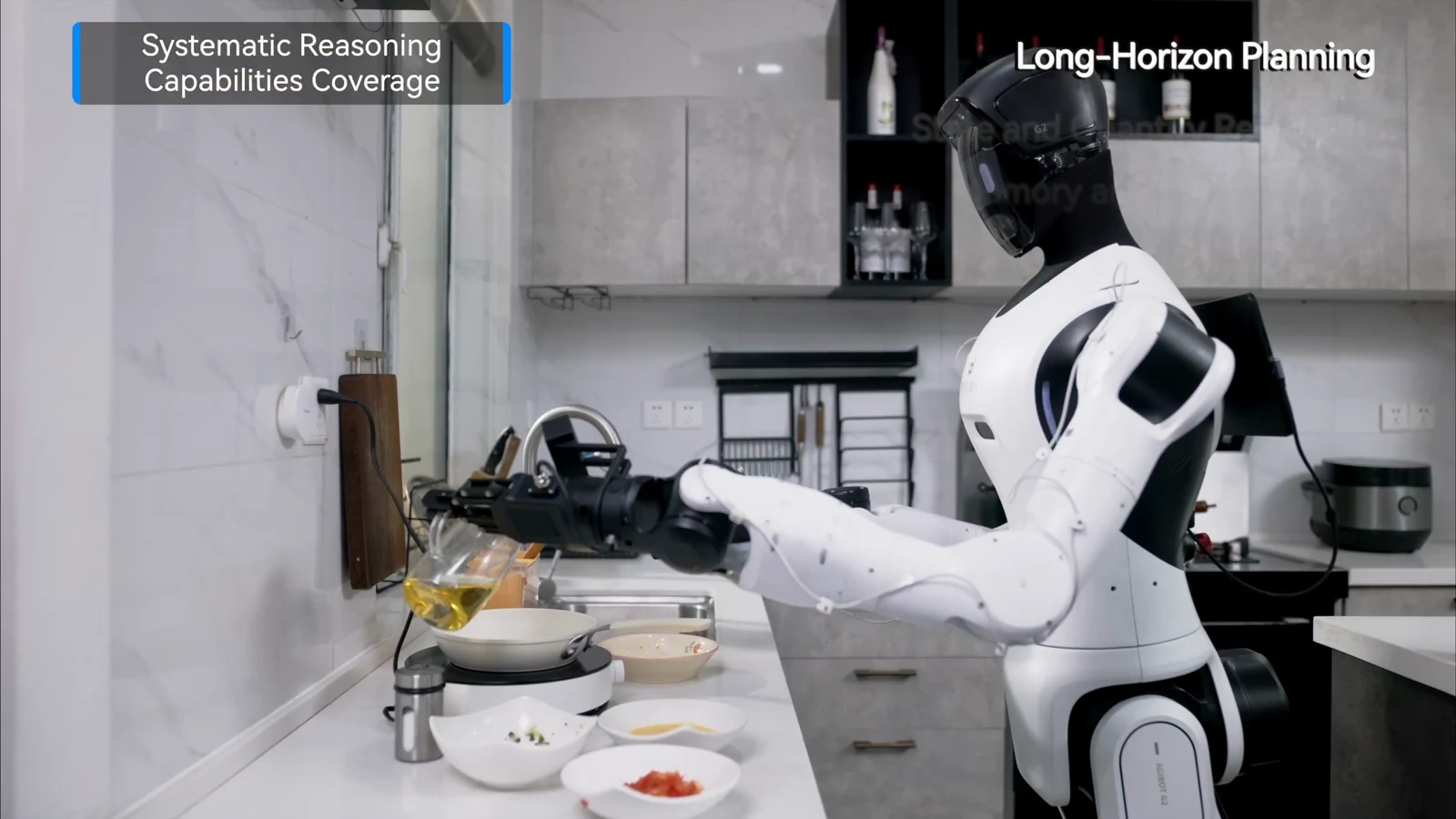
- The same instruction can need different actions: restocking a minibar requires different movements depending on which bottles are empty and how many full bottles remain.
- Some decisions depend on memory: a robot searching drawers must track where it has already looked, not just interpret its current camera image.
- Release 4 links decisions to execution: task stages, action descriptions and spatial annotations give researchers several levels at which to train and evaluate a system.
- Tests have to use unfamiliar setups: useful evaluations must check whether learned decisions transfer to unfamiliar arrangements and whether the robot can recognize mistakes.
Ask a robot to leave three full bottles in a hotel minibar. The instruction sounds straightforward, but it does not specify a fixed set of movements. Before reaching for anything, the robot needs to work out what is already there, which bottles are empty, and what the finished result should look like.
That gap between a goal and the actions needed to achieve it is the focus of AGIBOT WORLD Release 4, the “Physical Reasoning” dataset announced on October 22. We covered the release last week; this explainer looks more closely at what its examples are designed to teach and how its annotations connect planning with physical execution.
A minibar task starts with a decision
AGIBOT’s example asks a robot to restock a minibar to three full bottles. It must identify bottle states and quantities before deciding what to remove or add.
Consider two possible starting arrangements. With one empty bottle and two full ones, the task could involve removing the empty bottle and adding one full bottle. With three full bottles already present, adding another would violate the target. These illustrative cases share the same instruction but require different actions.
Follow humanoid robotics without following every announcement.
Get the week’s most important launches, funding and research—and why they matter—in one email from Humanoids Daily.
Once a week. Unsubscribe anytime.
Read recent issuesThe robot needs a representation of both the desired outcome and the current state. After each action, it also needs to update that state. A successful grasp is not enough if the robot then loses count or places the bottle somewhere that does not satisfy the task.
Release 4 collects decision-making and execution for the same goal under different conditions. AGIBOT highlights object quantity, obstructions, available space and task progress as factors that change the appropriate next step.
What the camera sees is only part of the problem
Retrieving a key illustrates the role of physical preconditions. In AGIBOT’s example, a robot can reach directly for a key if space allows. If a box obstructs access, it must move the box first. The system needs to judge whether an action is currently feasible and, if not, what would make it feasible.
Searching drawers adds a different requirement. The robot needs to remember which drawers it has already checked. Even when the camera view hasn't changed, the right next step depends on which drawers it has already opened.
External information can matter too. AGIBOT describes an agent checking the next day’s weather before selecting items for an outing, such as sunscreen or an umbrella. The robot can't see tomorrow's weather, so what it picks up depends on what the forecast tool returns.
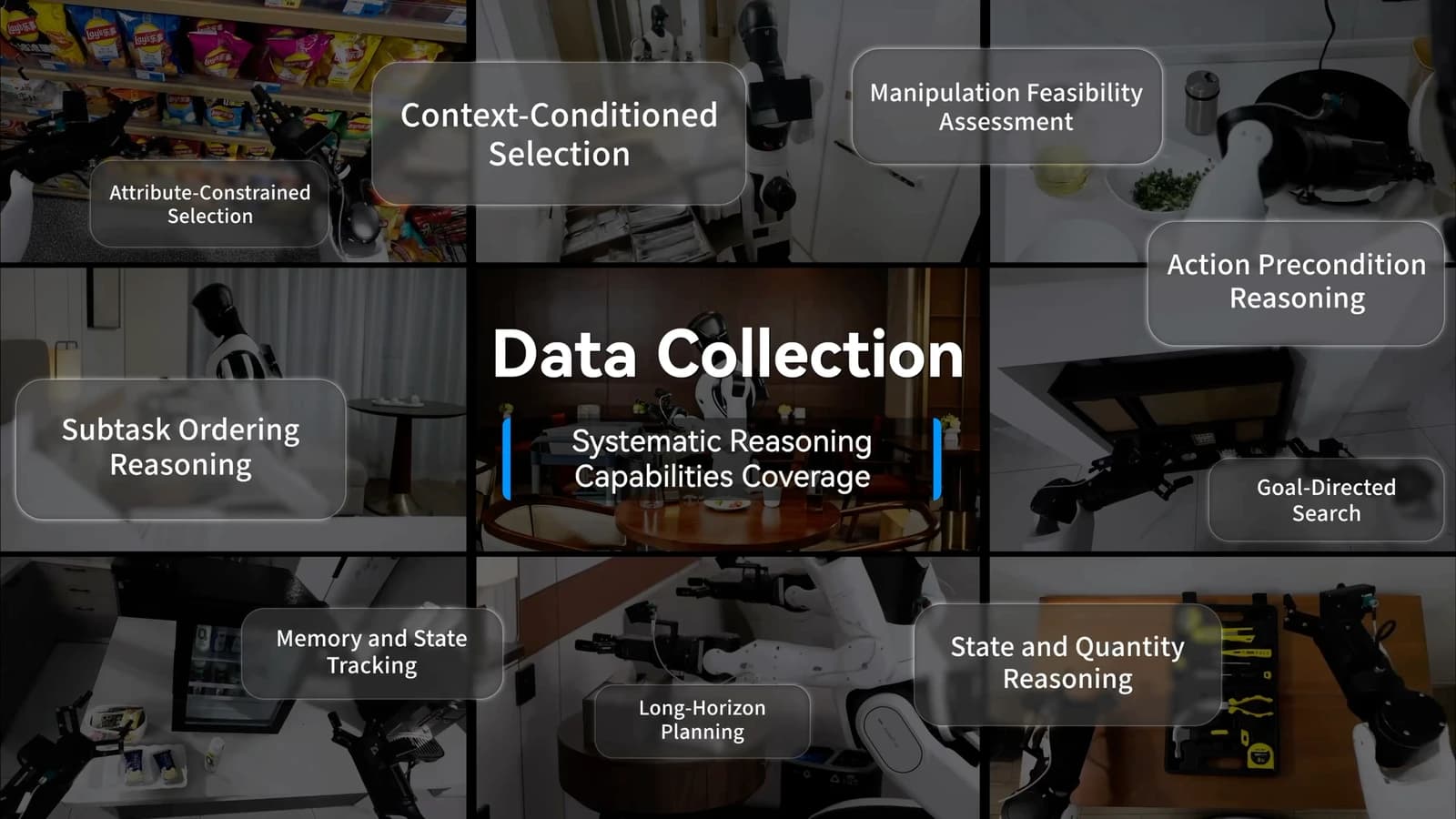
These examples explain why the dataset distinguishes several reasoning abilities. Search, quantity judgments, action preconditions, memory and subtask ordering address different sources of uncertainty, even when they appear together in one workflow.
How annotations connect a plan to a movement
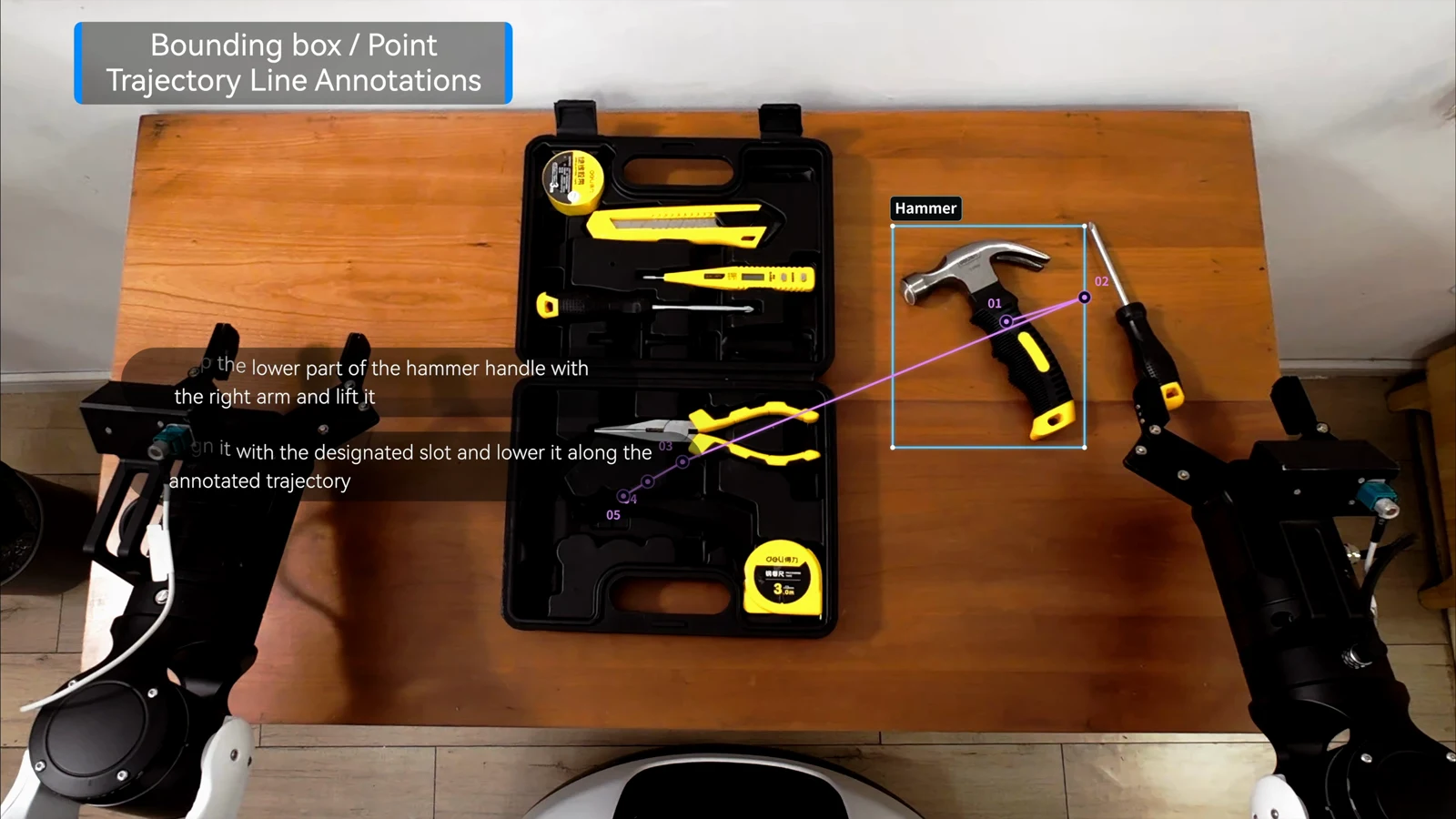
A high-level instruction tells a robot what to achieve. It does not, by itself, explain which object to grasp, where to hold it or how to coordinate two arms.
AGIBOT describes Release 4 as pairing high-level questions and answers with robot action trajectories. Task structures, subtask segments and action steps connect the complete goal to the current stage of execution.
Detailed action descriptions then identify the target object, manipulation region, arm roles, motion, gripper state and expected outcome. Bounding boxes, points and trajectory lines connect language to visible objects and movement paths. AGIBOT's toolbox example shows how these spatial labels can describe returning a tool to its designated location.
For researchers, these layers offer different training signals. A planning model can learn which subgoal comes next, while an action policy learns how to carry out the corresponding manipulation. Their coordination matters: an accurate movement toward the wrong subgoal still fails the overall task.
Why unsuccessful attempts are useful
AGIBOT says successful and erroneous samples receive equal weight, with outcomes annotated for correct selection, placement and quantity. Such examples can support research on recognizing deviations and deciding how to respond. Further annotations mark “success segments” and “adversarial segments,” which help assess whether a task was completed, tell targets apart from distractors and check execution results.
Whether that translates into reliable recovery is a separate question. A useful evaluation would check whether a system notices an incorrect result, updates its understanding and chooses an appropriate next action in a situation it has not memorized.
The dataset’s Easy, Medium and Hard levels provide a way to separate individual judgments from combinations of subgoals and constraints. AGIBOT identifies nine reasoning abilities overall, including attribute-constrained selection, long-horizon planning, and memory and state maintenance.
What this contributes to robot learning
Release 4 supplies material for studying how decisions and manipulation fit together. It does not establish that a robot trained on the data can autonomously handle every housekeeping or retail workflow. AGIBOT says the dataset has already been used to train its next-generation foundation model and to support an upcoming agent framework, but it has not published a quantitative evaluation isolating the dataset’s effect on task success.
The practical question is whether varied training examples help a system keep pursuing the same goal when conditions change. Can it count correctly, remember earlier steps, identify a blocked action and check the result? Those are concrete capabilities that researchers can test separately and in combination.
The project website and AGIBOT WORLD 2026 repository provide access information. The repository currently lists CC BY-NC-SA 4.0; researchers and developers should check its license terms for their intended use.
Share this article
Follow humanoid robotics without following every announcement.
Get the week’s most important launches, funding and research—and why they matter—in one email from Humanoids Daily.
Once a week. Unsubscribe anytime.
Read recent issuesRead next
- Published on
- Reading time
- 7 min read
AGIBOT Introduces Worken, New AI Models and G2 Max at Innovation Day 2026
- Published on
- Reading time
- 3 min read
AGIBOT Coordinates 110 Production Humanoids in Guinness-Certified Dance Performance
- Published on
- Reading time
- 3 min read
AGIBOT Releases Physical Reasoning Dataset to Connect Robot Decisions With Actions
- Published on
- Reading time
- 3 min read
IDC Puts H1 Humanoid Shipments Near 25,000, With AGIBOT Leading
- Published on
- Reading time
- 4 min read
AGIBOT Says 100 X2 Humanoids Are Working Across 100 ASD Retail Stores
- Published on
- Reading time
- 5 min read
AGIBOT Has Built 20,000 Robots—Twice Its March Total