- Published on
AGIBOT Open-Sources GE-Act 2.0, Challenging Unitree in the Open Embodied AI Race
One tap, and our reporting appears more often in your Google Top Stories. It makes a real difference to a small newsroom.


Your guide
Rich Robinson
Jee Chee Ren · Executive tour
See China’s AI and robotics ecosystem first-hand.
Six days exploring AI, robotics and advanced manufacturing.
With Rich Robinson, Clinical Professor of Entrepreneurship at Peking University
Beijing · Guangzhou · Shenzhen
29 November–4 December 2026
Referral partnership · We earn a commission on referred bookings.
- AGIBOT has open-sourced GE-Act 2.0, a native world-action model (WAM) pretrained entirely from scratch for robotic manipulation rather than adapted from generic web video.
- The release directly counters domestic rival Unitree’s launch of UnifoLM-WLA-1.0, intensifying the race for open-source physical AI foundation models.
- GE-Act 2.0 pairs a fast visual planner with an inverse dynamics model, introducing a technique called KASO to stop conflicting visual hallucinations from derailing motor control.
- In zero-shot real-robot tests across 100 manipulation tasks without task-specific fine-tuning, scaling training data from 300 to 30,000 hours boosted overall success from 17.1% to 44.1%.
- Cross-hardware transfer proved viable: the wheeled G2-90D saw a 17.7 percentage point gain despite making up under 2% of the co-training dataset.
The algorithmic battle lines in humanoid robotics are shifting rapidly from proprietary black boxes to open-source foundation models. Just one day after rival Unitree Robotics made waves by open-sourcing its 6-billion-parameter UnifoLM-WLA-1.0, Shanghai-based manufacturer AGIBOT has fired back.
The company has officially released Genie Envisioner Act 2.0 (GE-Act 2.0), an open-source World-Action Model (WAM) engineered to train and scale generalist manipulation policies. While most current physical AI models take existing text-to-video generators and try to bolt robotic controls onto them, AGIBOT built GE-Act 2.0 from scratch on embodied manipulation data—training the visual tokenizer, future state predictor, and action generator from the ground up.
The dual software releases highlight an aggressive strategic pivot between China’s top two humanoid makers. While AGIBOT and Unitree continue to trade jabs over hardware volume—spurred by AGIBOT’s 15,000-unit manufacturing milestone and its lead in H1 2026 global shipments—both are now racing to establish the dominant open operating stack for robotic intelligence.
Envisioning Before Acting
Standard Vision-Language-Action (VLA) models map camera images and language prompts straight into motor commands, effectively treating physical interaction like text completion. The limitation is that they do not explicitly model how the physical world reacts when touched.
Follow humanoid robotics without following every announcement.
Get the week’s most important launches, funding and research—and why they matter—in one email from Humanoids Daily.
Once a week. Unsubscribe anytime.
Read recent issuesWorld-action models address this by predicting what the scene should look like next before deciding how to move. But running conventional video generators inside a real-time robot control loop is notoriously slow and memory-heavy.
To get around this bottleneck, GE-Act 2.0 divides the task into three modular stages:
- A Control-First Visual Tokenizer (CoAE): Instead of saving every pixel, the visual encoder compresses incoming camera frames by 64× into a tiny grid of tokens. It discards cosmetic background details while explicitly preserving physical geometry, boundaries, and motion.
- A Single-Step Visual Planner (SVP): Instead of taking dozens of iterative denoising passes to render a smooth video, the visual planner imagines the future visual scene in a single forward pass. It generates both near-term frames for immediate control and far-horizon frames to stay on task.
- An Inverse Dynamics Model (IDM): A dedicated action network takes that imagined future and works backward to translate visual changes into smooth joint movements.
For developers wanting to dig into the mathematical formulations and architecture blocks, the complete methodology is detailed in AGIBOT's technical paper. Crucially, generating the future in a single step makes the system fast enough to run in closed-loop control while allowing the visual planner and action motor to pretrain separately on completely different datasets. The visual system can learn physical laws from unlabelled human manipulation videos, while the action system trains on unannotated robot play, teleoperation logs, and even thousands of failed attempts.
Bridging the "Validity Gap"
Teaching a robot to act based on imagined futures introduces a subtle but severe trap that AGIBOT terms the validity gap.
Physical manipulation is inherently ambiguous. If an operator tells a robot to pick up a cup, approaching from the left or approaching from the right are both completely correct. But human demonstration datasets only record one path.
If an AI's visual planner envisions approaching from the right, but the recorded training demonstration happened to approach from the left, traditional training algorithms force the robot to execute leftward movements while looking at an imagined rightward approach. This supervision clash erases distinct strategies, often causing policies to freeze or average out into useless motions.
To solve this, AGIBOT designed Knowledge-Aligned Selective Optimization (KASO). During training, the visual planner imagines several possible futures. The action network screens them to find which candidate actually aligns with the recorded demonstration before updating the model's weights. In real-robot ablation tests, adding KASO boosted pick success from 22.5% to 37.5%, confirming that filtering out mismatched visual futures is vital for stable learning.
Scaling Up to 30,000 Hours
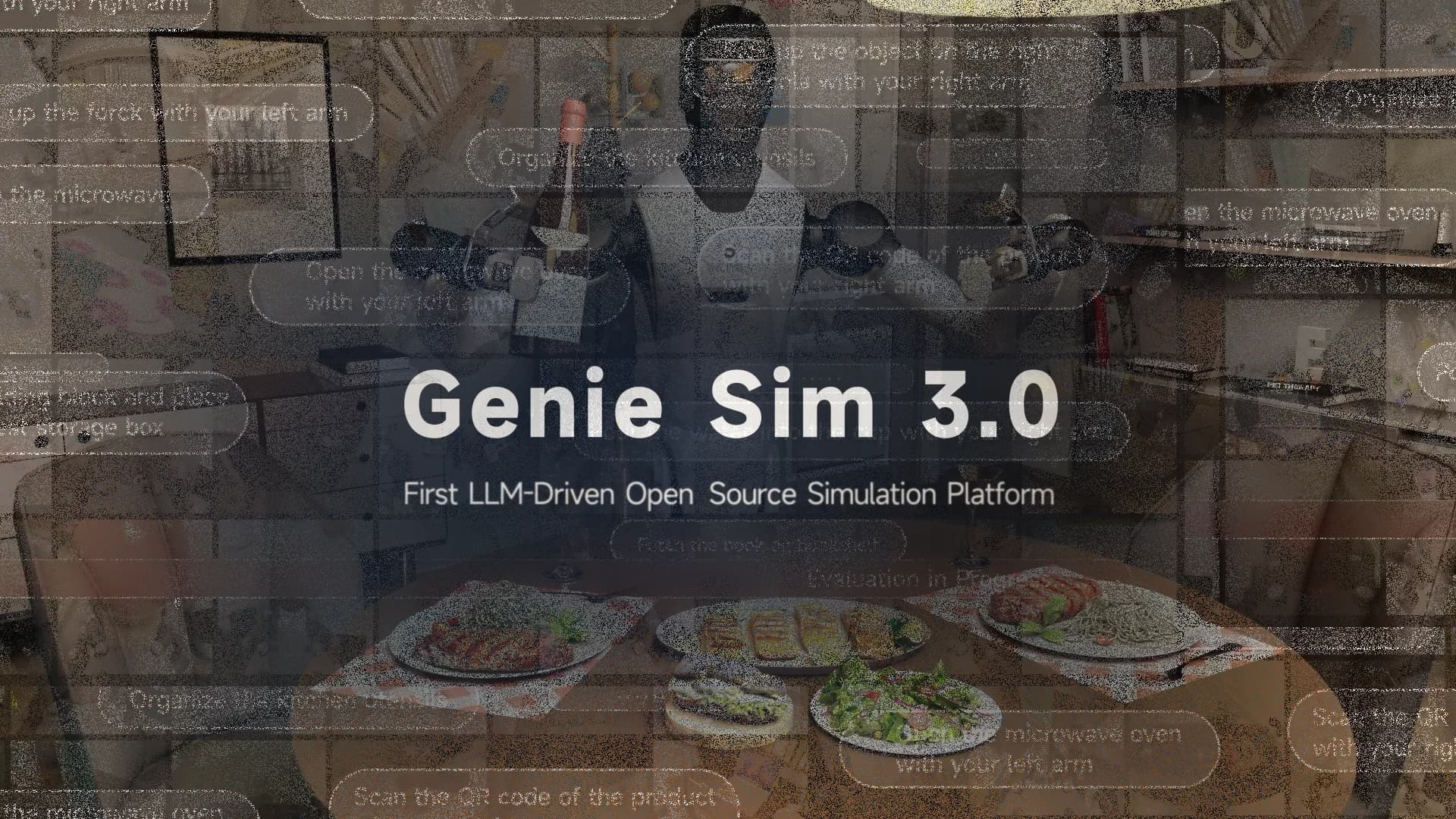
To prove that world-action models scale with data, AGIBOT trained checkpoints across four tiers: 300, 1,200, 5,000, and 30,000 hours of interaction data. The corpus combined teleoperation runs across the bipedal G1-OP and industrial wheeled G2 platform, synthetic simulations from Genie Sim 3.0, open datasets, and roughly 2,000 hours of uncurated failure data.
Rather than fine-tuning the model on specific test environments—which often masks whether a policy is truly generalist—AGIBOT evaluated the model out-of-the-box in zero-shot, out-of-distribution (OOD) tests. The benchmark spanned 100 atomic tasks across 20 manipulation categories, featuring unseen table setups, lighting changes, and novel objects.
| Training Scale | G1-OP Success Rate | G2-90D Success Rate | Working Skills (G1-OP) |
|---|---|---|---|
| 300 Hours | 17.1% | 13.4% | 39 / 100 |
| 1,200 Hours | 22.6% | 21.0% | 51 / 100 |
| 5,000 Hours | 27.3% | 23.5% | 62 / 100 |
| 30,000 Hours | 44.1% | 31.1% | 76 / 100 |
Performance scaled steadily without flattening out. Furthermore, the model exhibited meaningful cross-embodiment transfer: the G2-90D robot gained 17.7 percentage points across the benchmark, despite making up less than 2% of the co-training dataset. Even on tasks where the G2 had under an hour of training data, such as separating paper cups or flipping coasters, the system learned the task by borrowing spatial dynamics learned on other robots.
Data auditing revealed a predictable log-linear scaling curve: zero-shot success correlated strongly with how many hours a skill category received in training. High-volume categories like wiping surfaces (824 hours) reached 76.7% reliability, while under-represented tasks like sweeping with a broom (64 hours) remained near 3.3%.
Overcoming Physical Inertia
In qualitative stress tests, the 30,000-hour model showed an ability to prioritize real-time human instructions over habitual physical routines:
- Mid-Motion Redirection: When commanded to grab a green cup, the robot reached forward. Just centimeters before contact, the command was swapped to "pick up the blue cup". The arm paused for about 1.5 seconds, disengaged, and redirected to pick the blue cup. A similar test swapped arms mid-reach, prompting the right arm to pull back while the left arm completed the pickup.
- Defying Common Associations: When presented with a cup, a shoe, and a shoebox, the robot was instructed to "put the cup into the shoebox". Rather than defaulting to the conventional visual association of packing the shoe into the box, the model followed the exact verbal instruction.
The Open Commons Playbook
AGIBOT’s rapid open release fits neatly into an escalating push to build the foundational infrastructure for embodied AI. Having previously open-sourced its AGIBOT WORLD 2026 dataset and Genie Studio Agent tools, releasing GE-Act 2.0 is an attempt to standardize the manipulation stack across the wider ecosystem.
As hardware margins narrow and industrial operations scale—underlined by AGIBOT’s new manufacturing facility in Serbia—competitive advantage is moving to generalizable software. A 44.1% zero-shot success rate shows that fully autonomous humanoid labor still has a long way to go before conquering unconstrained environments, but GE-Act 2.0 provides clear evidence that native world-action models can scale predictably.
Share this article
Follow humanoid robotics without following every announcement.
Get the week’s most important launches, funding and research—and why they matter—in one email from Humanoids Daily.
Once a week. Unsubscribe anytime.
Read recent issuesRead next
- Published on
- Reading time
- 3 min read
AGIBOT Releases Physical Reasoning Dataset to Connect Robot Decisions With Actions
- Published on
- Reading time
- 4 min read
The Synthetic Engine: How AGIBOT Genie Sim 3.0 Resolves the Embodied AI Data Bottleneck
- Published on
- Reading time
- 2 min read
RoboParty Unveils RP1 Humanoid at IROS, Plans Broader Open-Source Release in Q4
- Published on
- Reading time
- 7 min read
Unitree Begins Open Release of UnifoLM-WLA-1.0 to Tackle Humanoid Generalization
- Published on
- Reading time
- 4 min read
120 Days to a Run: RoboParty Open-Sources Its "ROBOTO ORIGIN" Humanoid Baseline
- Published on
- Reading time
- 3 min read
AGIBOT Coordinates 110 Production Humanoids in Guinness-Certified Dance Performance