- Published on
The Synthetic Engine: How AGIBOT Genie Sim 3.0 Resolves the Embodied AI Data Bottleneck
One tap, and our reporting appears more often in your Google Top Stories. It makes a real difference to a small newsroom.

Supported by RoboStrategySupport for Humanoids Daily comes from RoboStrategy
Sponsored


Investing involves risk, including possible loss of principal. Read the prospectus before investing.

This article is part of AGIBOT AI Week — a collaboration between Humanoids Daily and AGIBOT.
The most significant constraint facing the development of General Purpose Robots is not necessarily the lack of compute or hardware sophistication—it is the scarcity of high-quality, diverse data. While Large Language Models (LLMs) thrived on the vast repository of the internet, embodied AI requires a physical context that cannot be easily scraped from a webpage. Collecting real-world interaction data is notoriously slow, expensive, and difficult to scale.
As part of the ongoing AGIBOT AI Week, following yesterday's unveiling of the AGIBOT WORLD 2026 open source dataset, AGIBOT has introduced Genie Sim 3.0. This release represents a shift in strategy: moving away from simulation as a mere testing sandbox and toward simulation as a foundational, generative infrastructure.
By integrating LLM-driven environment generation with a standardized benchmarking framework, AGIBOT aims to close the gap between "generalized understanding" and "precise micromanipulation."
From Manual Modeling to Spatial World Models
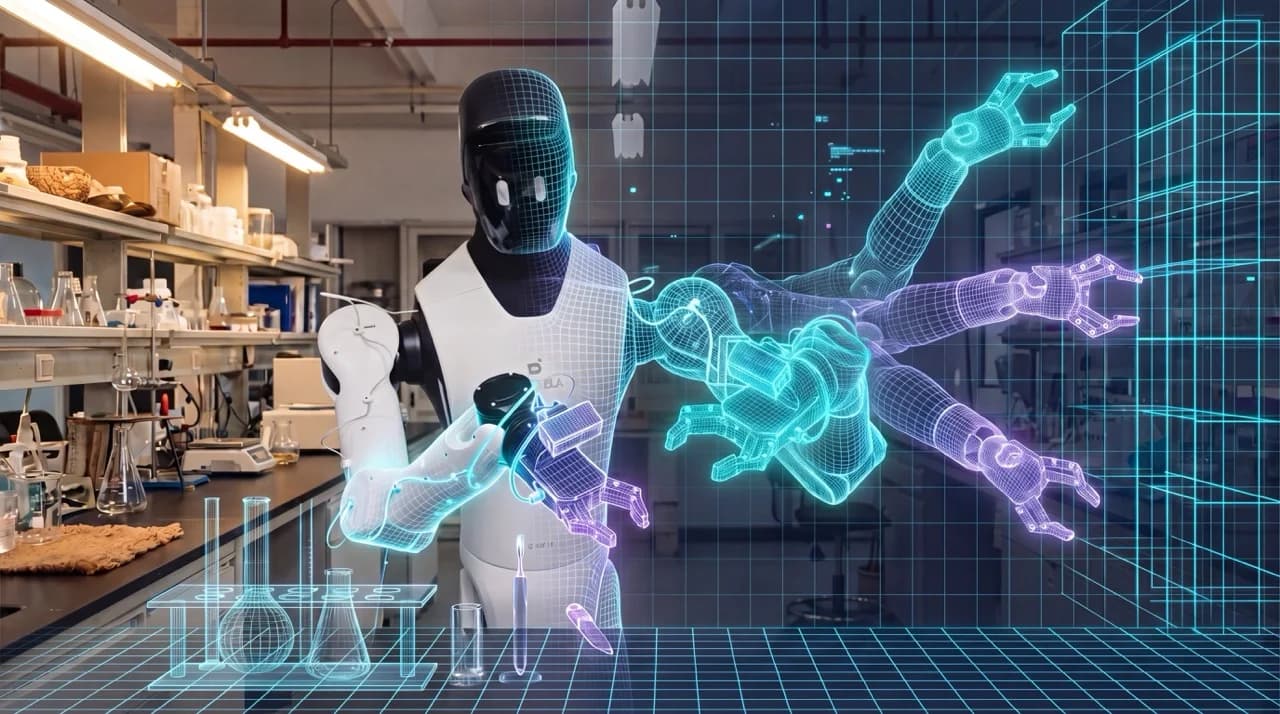
Traditional simulation pipelines often rely on manual CAD modeling and labor-intensive scene assembly, a process that can take hours or days for a single complex environment. Genie Sim 3.0 addresses this through Genie Sim World, a Spatial World Model that leverages neural network inference to generate interactive 3D environments from text or image prompts.
The weekly humanoid robotics briefing
One email a week: the launches, funding and research that mattered, with context from Humanoids Daily.
Read recent issuesUnlike other world models that primarily focus on visual prediction, Genie Sim World produces high-fidelity, multimodal outputs. This includes synchronized RGB, depth, and LiDAR data, ensuring that the robot’s simulated perception aligns perfectly with its real-world sensor suite. By reducing scene creation time from hours to minutes, the platform allows developers to generate the long-tail edge cases—such as rare lighting conditions or specific clutter patterns—that are essential for robust deployment but nearly impossible to capture in the real world.
Standardizing the Metric for Success
The robotics industry has long struggled with fragmented benchmarking. Without a unified standard, comparing the performance of different models like GO-2, the Pi series, or GR00T has been an "apples-to-oranges" endeavor.
The Genie Sim Benchmark introduces a systematic evaluation framework across five critical domains:
- Instruction Following: Measuring the alignment between natural language prompts and robot execution.
- Spatial Reasoning: Testing the robot's ability to understand geometric relationships and semantic context.
- Manipulation Skills: Evaluating both atomic skills and the composition of long-horizon tasks.
- Robustness: Assessing adaptability against sensor noise, lighting shifts, and physical disturbances.
- Sim2Real: Identifying the success rate of zero-shot transfers from the digital twin to the physical hardware.
By providing a multi-dimensional score, Genie Sim 3.0 allows for objective iteration, ensuring that a performance gain in simulation is a reliable indicator of real-world capability.
RLinf: Scaling the Training Pipeline
While Vision-Language-Action (VLA) models provide the high-level reasoning required for robots to understand tasks, the "last mile" of precise physical control is often best refined through Reinforcement Learning (RL).
Genie Sim 3.0 integrates deeply with RLinf, a framework designed for massively parallel simulation. By decoupling the physics and rendering engines, the platform supports high-frequency (1000Hz) physics calculations alongside high-fidelity visuals. This architecture enables higher data throughput, allowing RL agents to converge faster by experiencing millions of interaction steps in a fraction of the time.
The inclusion of standardized Gym interfaces ensures that Genie Sim 3.0 remains compatible with the broader robotics ecosystem, allowing researchers to plug in existing RL pipelines and begin training at scale immediately.
A Unified Infrastructure for AGI
The launch of Genie Sim 3.0 signals AGIBOT’s intent to build the underlying "operating system" for embodied intelligence development. By unifying environment generation, data collection, training, and evaluation, they are reducing the engineering overhead that has traditionally sidelined smaller labs and slowed down large-scale commercial efforts.
As the industry moves closer toward Artificial General Intelligence (AGI), the ability to generate and learn from synthetic experience will be the primary differentiator. Genie Sim 3.0 provides the scale necessary to turn that vision into a physical reality.
To explore the documentation or integrate the platform into your workflow, visit the Genie Sim 3.0 repository.
Share this article
Read next
- Published on
- Reading time
- 4 min read
The Era of Embodied AGI Begins: AGIBOT and Longcheer Deploy World’s First Humanoid-Led Mass Production Line
- Published on
- Reading time
- 4 min read
Modularizing the Last Mile: AGIBOT Unveils Genie Studio Agent to Scale Robot Deployment
- Published on
- Reading time
- 5 min read
From Representation to Reality: AGIBOT Unveils Genie Envisioner 2.0 as a Scalable “World Simulator”
- Published on
- Reading time
- 6 min read
Bridging the Semantic-Actuation Gap: AGIBOT Unveils the GO-2 Embodied Foundation Model
- Published on
- Reading time
- 5 min read
The Data Bottleneck: Why AGIBOT is Open-Sourcing its Real-World Training Library
- Published on
- Reading time
- 7 min read
AGIBOT Open-Sources GE-Act 2.0, Challenging Unitree in the Open Embodied AI Race


The weekly humanoid robotics briefing
One email a week: the launches, funding and research that mattered, with context from Humanoids Daily.
Read recent issues