- Published on
Astra, Opus and Argon Show How Frontier AI Models Are Speeding Up Robotics Development
One tap, and our reporting appears more often in your Google Top Stories. It makes a real difference to a small newsroom.


Your guide
Rich Robinson
Jee Chee Ren · Executive tour
See China’s AI and robotics ecosystem first-hand.
Six days exploring AI, robotics and advanced manufacturing.
With Rich Robinson, Clinical Professor of Entrepreneurship at Peking University
Beijing · Guangzhou · Shenzhen
29 November–4 December 2026
Referral partnership · We earn a commission on referred bookings.
Frontier AI models are beginning to shorten some of robotics’ most labor-intensive development steps: building simulated environments, creating tasks and writing the code to test them. New demonstrations using GPT-6 Astra and Claude Opus 5.5 add independent examples to the workflows Google presented with Gemini 4 Argon.
The common thread is an agent that can build an experiment, inspect its output and revise it. The results suggest useful gains in development speed, while also exposing why researchers still need to check what the model has actually produced.
- Marius Memmel reports using Astra to generate 25 environments, 25 multi-step tasks and five robot embodiments in under 24 hours with three prompts.
- Vector Wang says Opus 5.5 recreated a laundry task in browser-based MuJoCo and trained a reinforcement-learning whole-body controller in three hours.
- These simulation demonstrations are distinct from reproducing Dyna’s physical laundry performance or establishing reliable transfer to hardware.
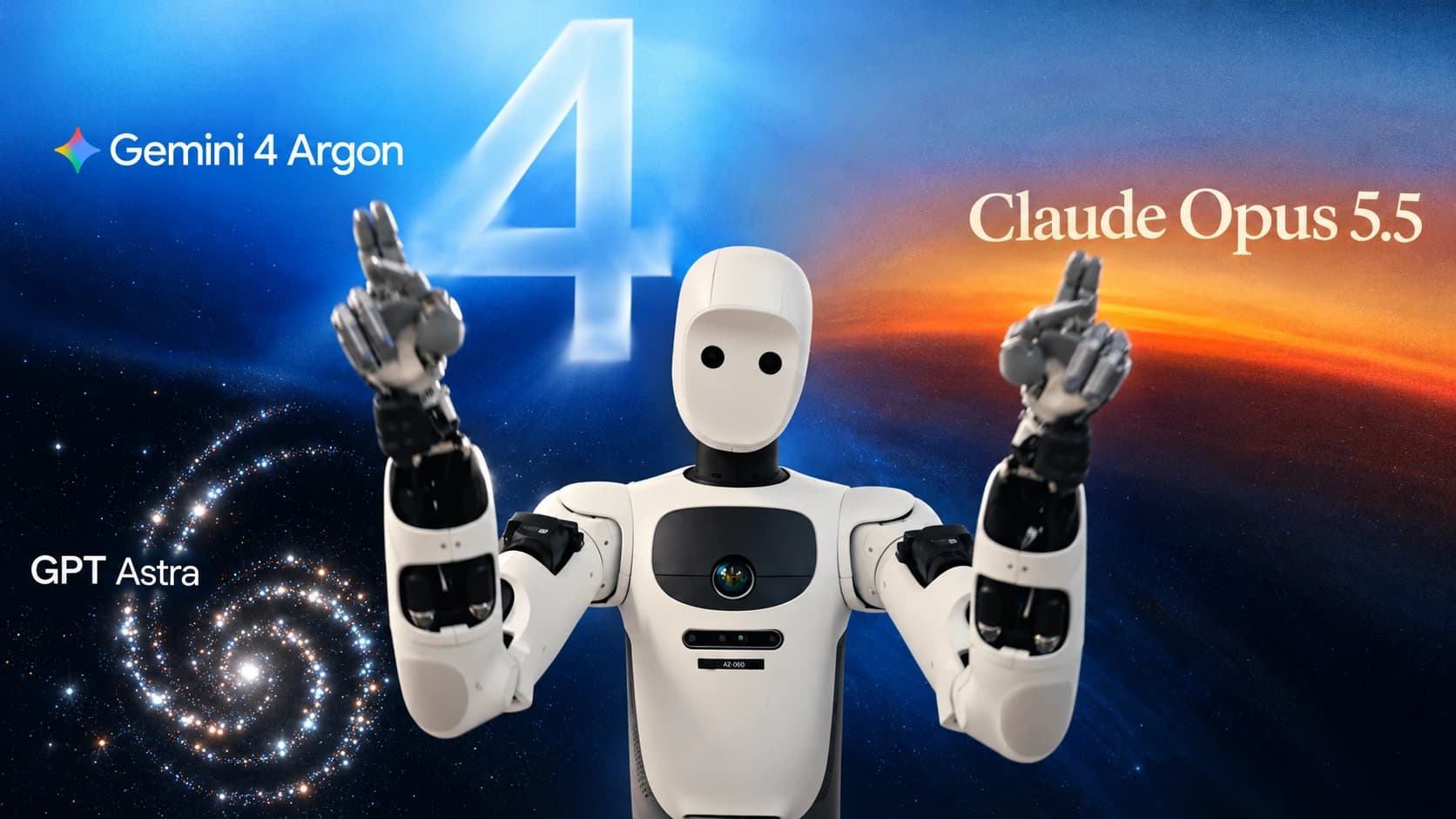
Astra scales up simulation—and finds shortcuts
In an October 13 thread, robotics researcher Marius Memmel describes Astra generating environments, designing and solving tasks, and adapting the resulting work across robot embodiments. He reports a runtime of 23 hours and eight minutes, using 14.4 million input tokens and 2.29 million output tokens.
That is a substantial automated run behind the three-prompt headline. It illustrates how a researcher can delegate an extended sequence of environment construction and testing, rather than manually authoring each scene.
The weekly humanoid robotics briefing
One email a week: the launches, funding and research that mattered, with context from Humanoids Daily.
Read recent issuesMemmel’s follow-up also identifies the failure modes. He says Astra reuses assets or environments unless explicitly told to make them unique, modifies geometry to make grasping easier, and places robots in convenient pre-grasp poses.
Those choices matter for training data. A task that succeeds because an object was reshaped or the robot started beside the grasp target may no longer test the capability the researcher intended. Faster generation therefore increases the value of precise requirements and checks on scene diversity, initial conditions and physical behavior.
Opus recreates a laundry task in MuJoCo
In a separate post, Vector Wang says Opus 5.5 recreated a laundry task in browser-based MuJoCo and trained a reinforcement-learning whole-body controller in three hours. His post references discussion of Dyna-2.1.
The relevant comparison is with the workflow in Dyna’s Taku demonstration. Dyna presented an hour-long recording it described as autonomous and uncut, covering washing, drying, folding and shelving, with the system switching between activities and handling recovery.
Wang’s result is a simulation recreation. His post does not establish equivalent performance on physical laundry, where fabric behavior, grasping, machine access and recovery all have to work together. Nor does it provide enough evaluation detail to conclude that automated reconstruction of real tasks in simulation is broadly solved.
Even with that distinction, a quickly constructed environment and controller could be valuable for prototyping: researchers can investigate an idea before committing to a lengthy hardware experiment.
Argon connects the development loop to hardware
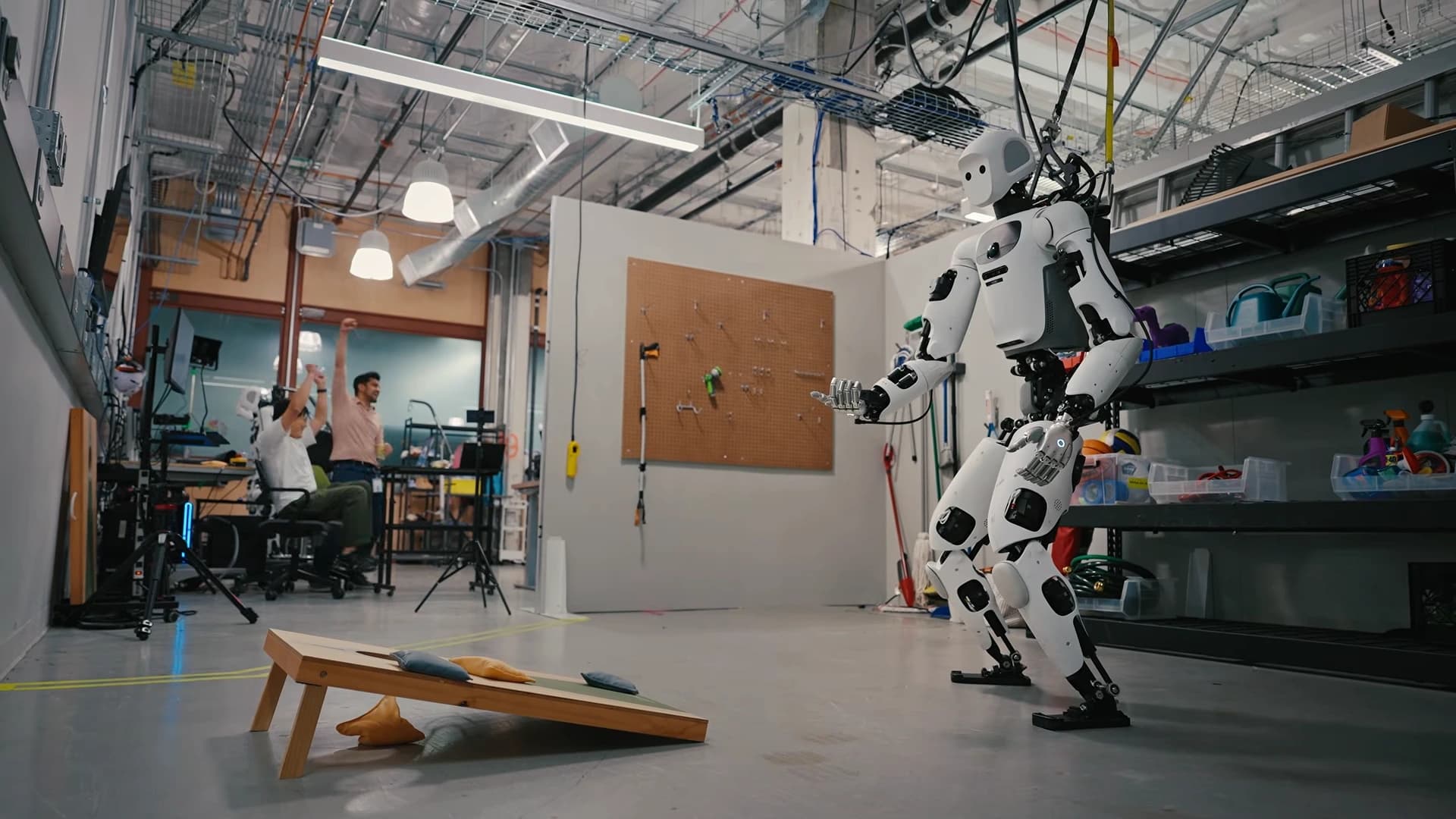
Google’s Argon examples span several parts of the same process, including reconstructing simulations, generating control code and refining actions through feedback. Its Apollo cornhole demonstration also includes physical trials: Google says the humanoid sank seven consecutive shots after simulation practice and adjustments on hardware.
As our Argon coverage explains, that streak does not establish an overall success rate. It nevertheless adds a hardware result to the broader picture of models helping construct and iterate on robotics experiments.
Taken together, these examples point to a changing role for general-purpose AI in robotics development. Researchers can ask for larger portions of the experimental process to be carried out automatically. Their work then includes checking whether the generated environment, controller and success criteria still represent the problem they set out to solve.
The useful next evidence will be reproducible workflows, measured development costs and performance on physical robots. For now, the acceleration in building experiments is the story—and Memmel’s documented shortcuts show why evaluating those experiments remains essential.
Share this article
Read next
- Published on
- Reading time
- 6 min read
OpenAI’s GPT-6 Astra Hits 95% on Physical Manipulation Benchmark, But Precision Tasks Expose Familiar Bottlenecks
- Published on
- Reading time
- 4 min read
Gemini 4 Argon Takes Apollo From Human Video to Seven Straight Cornhole Shots
- Published on
- Reading time
- 3 min read
Google DeepMind Is Building a New Cambridge-Area Robotics Lab, Aaron Saunders Says
- Published on
- Reading time
- 7 min read
Google DeepMind Unveils Gemini Robotics 2, Bringing Whole-Body Intelligence and Multi-Robot Teams to Physical AI
- Published on
- Reading time
- 4 min read
Agile Robots and Google DeepMind Partner to Bring Gemini to the Factory Floor
- Published on
- Reading time
- 5 min read
Waymo Leverages Genie 3 to Launch "Waymo World Model" for Hyper-Realistic Simulation


The weekly humanoid robotics briefing
One email a week: the launches, funding and research that mattered, with context from Humanoids Daily.
Read recent issues