- Published on
Beyond the Screen: Capgemini 2026 Report Signals the Shift to Physical AI
One tap, and our reporting appears more often in your Google Top Stories. It makes a real difference to a small newsroom.

Supported by RoboStrategySupport for Humanoids Daily comes from RoboStrategy
Sponsored

Investing involves risk, including possible loss of principal. Read the prospectus before investing.
- Nearly 80% of global organizations are currently engaging with physical AI, driven primarily by persistent labor shortages and rising operational costs.
- While executive conviction is high, average timelines for scaling humanoid robots extend to seven years due to technical barriers in dexterity and reliability.
- The economic opportunity for physical AI is vast, targeting industrial sectors that represent an estimated $50 trillion to $80 trillion of global GDP.
- Growth in the next 3–5 years will likely be led by intelligence embedded into established form factors like autonomous mobile robots (AMRs) rather than general-purpose humanoids.
For the past decade, the artificial intelligence narrative has been dominated by digital systems—algorithms that analyze data, generate text, and optimize software workflows. According to a new report from the Capgemini Research Institute, the next decade will be defined by "Physical AI," or systems that take intelligence beyond the screen and into the real world.
The report, which surveyed 1,678 senior executives across 15 industries, suggests that the "Space Race" of our time has moved from the laboratory to the factory floor. With over two-thirds (67%) of executives describing the technology as game-changing for their industry, physical AI is no longer viewed as a futuristic experiment, but as a critical driver of future competitiveness.
The Inflection Point: Atoms Meet Ambition
What separates this moment from previous waves of robotics is the convergence of multimodal foundation models and high-fidelity simulation. Traditional robotics relied on deterministic, "hard-coded" instructions that often failed in messy, unstructured environments like construction sites or hospitals. Physical AI, however, utilizes vision-language-action (VLA) models that allow machines to perceive, reason, and adapt to unfamiliar situations without task-specific reprogramming.
The economic stakes are massive. Deepu Talla, VP and GM of Robotics at NVIDIA, noted in the report that while digital AI is significant, physical AI targets sectors—including manufacturing, healthcare, and logistics—that collectively represent between $50 trillion and $80 trillion of global GDP.
The weekly humanoid robotics briefing
One email a week: the launches, funding and research that mattered, with context from Humanoids Daily.
Read recent issuesLabor Pressures Drive Adoption
The rush to deploy is not merely driven by technological curiosity. Structural economic pressures are forcing the issue. Labor shortages were cited by 74% of executives as the top driver for investment, followed closely by rising labor costs at 69%.
This sentiment is particularly strong in nations like Japan, South Korea, and China, where rapidly aging populations are shrinking the workforce. In these regions, physical AI is seen as a necessary bridge for "reindustrialization"—allowing domestic production to scale despite a lack of human staff.
The Humanoid Paradox: Conviction vs. Reality
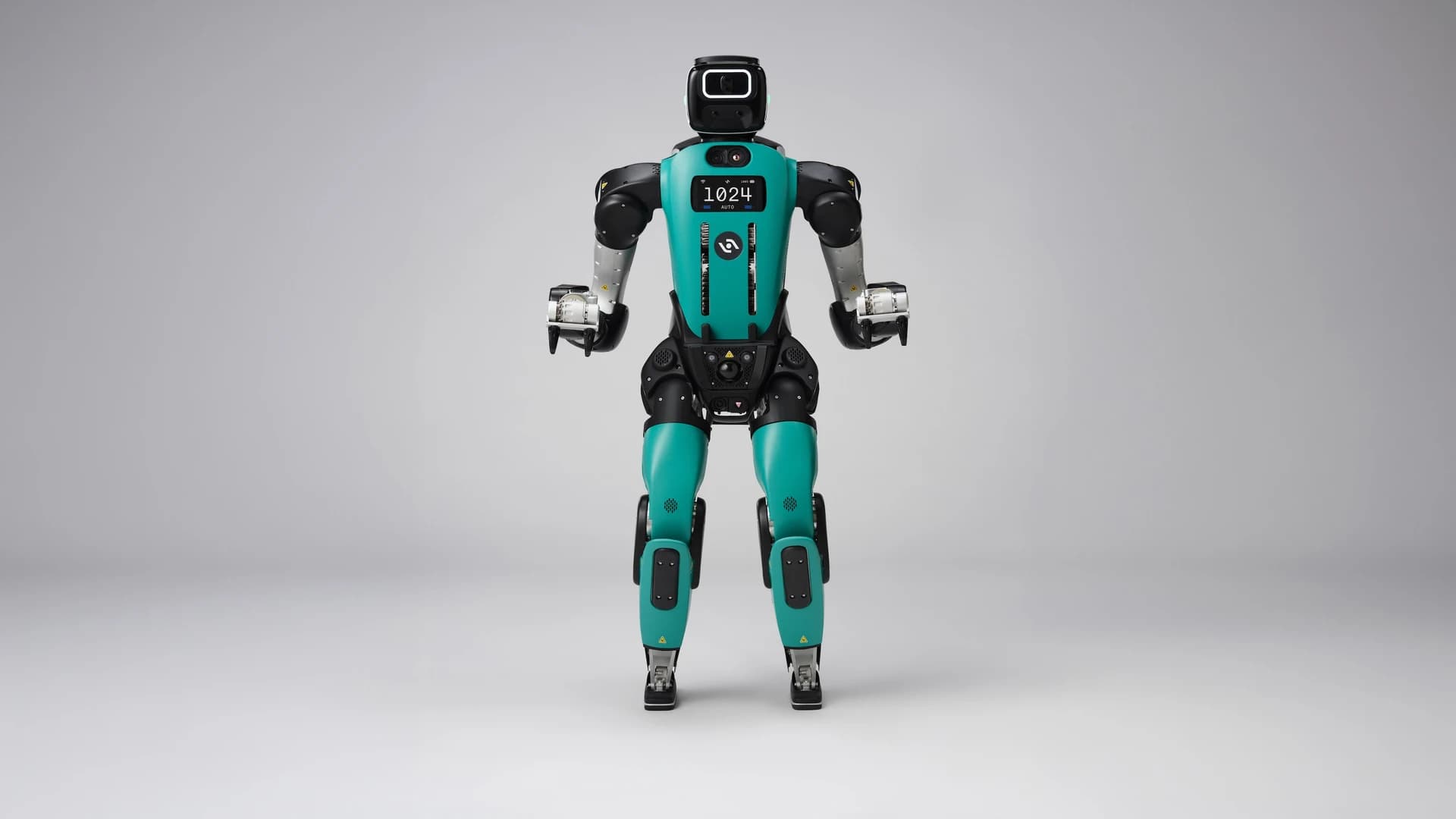
While general-purpose humanoid robots often capture the public imagination, the Capgemini data suggests a more measured reality for the form factor. Two in three executives believe humanoids will ultimately transform their industry, yet only 30% see them becoming viable general-purpose workers within the next three to five years.
The average timeline for scaling humanoids now sits at approximately seven years. Barriers remain significant: 72% of respondents cited technical immaturity, while 63% pointed to high upfront costs and uncertain ROI. This gap between hardware maturity and intelligence layers remains the industry's most significant hurdle.
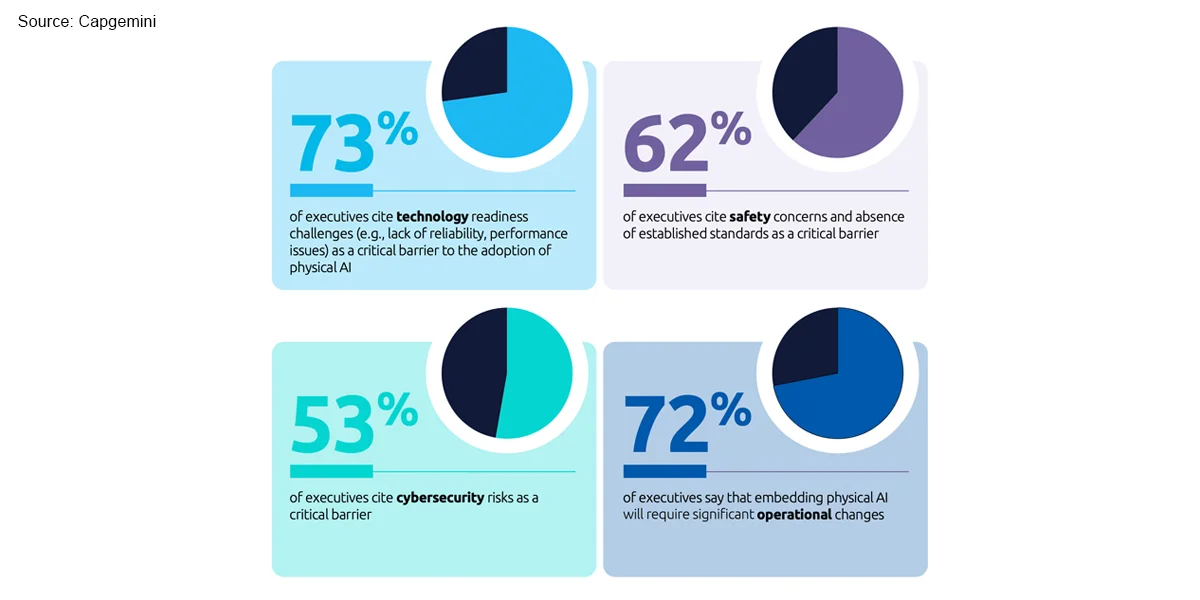
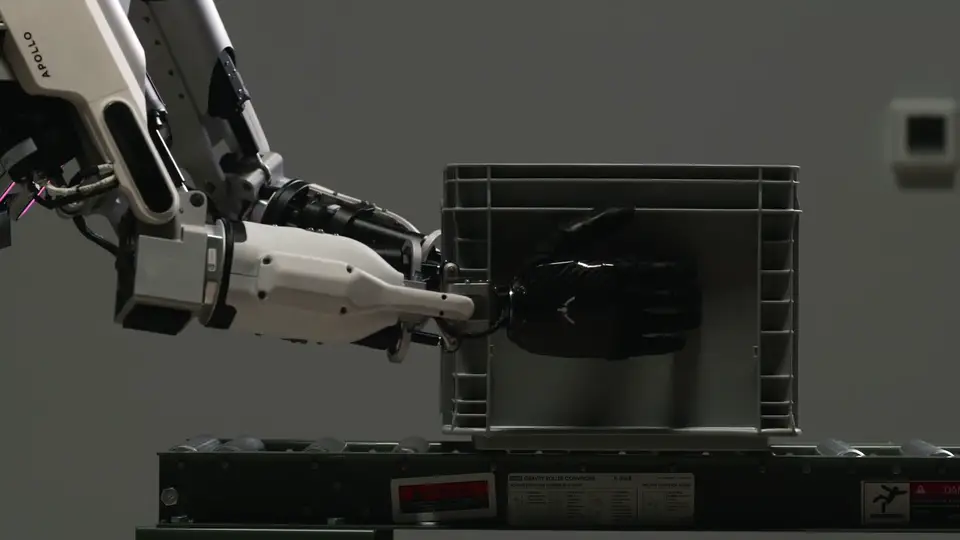
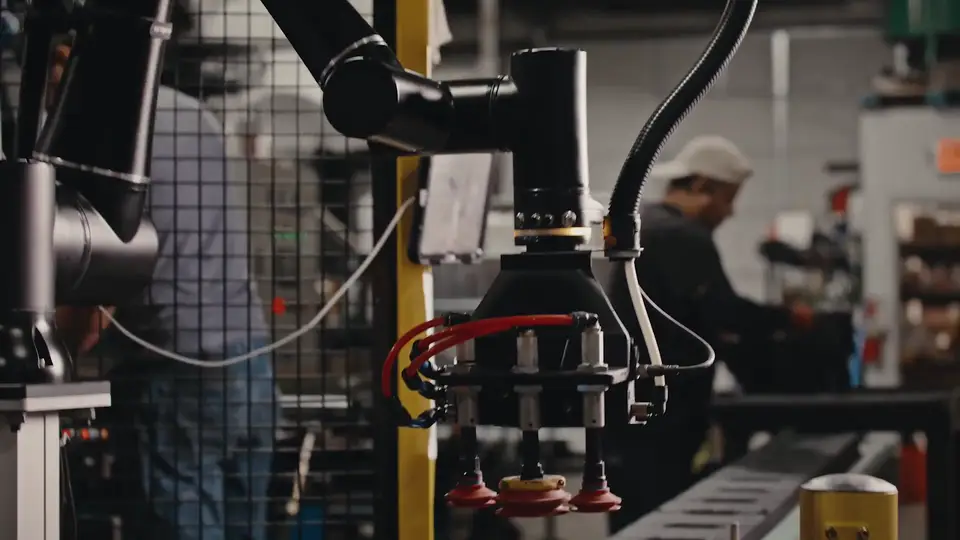
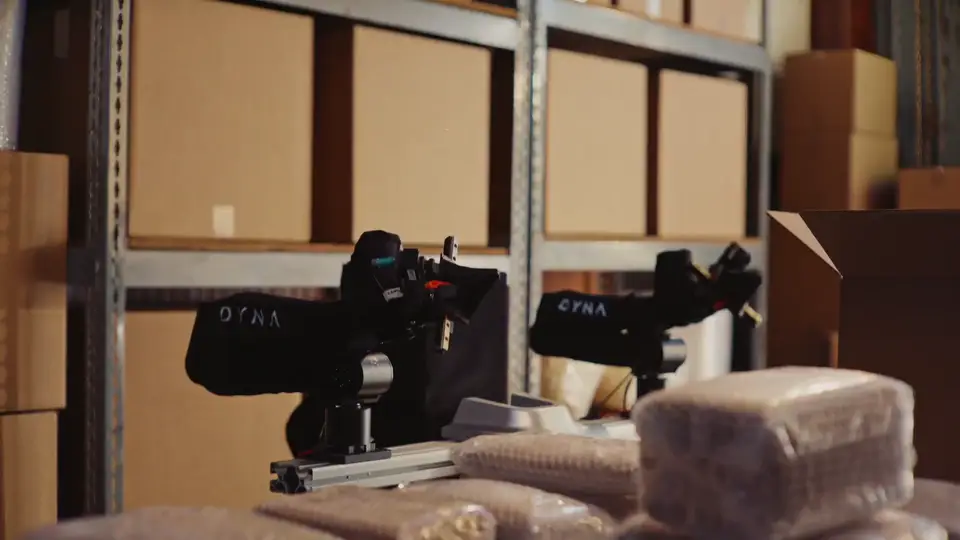
In the interim, the report suggests that growth will be led by "intelligence-first" deployments in proven form factors, such as autonomous mobile robots (AMRs) and stationary industrial arms, which can be enhanced with new AI "brains" today.
Barriers to Scaling: Data and Reliability
Despite record venture capital investment—which hit $40.7 billion for the robotics sector in 2025—the "long tail" of real-world edge cases continues to limit reliability. Unlike language models that can be trained on vast troves of internet text, physical AI requires "action data"—precise records of force, friction, and geometry that are expensive and risky to collect.
"One single failure in a thousand can be catastrophic in safety-critical settings," says Daniela Rus, Director of MIT’s CSAIL. Scaling these systems will require more than just better algorithms; it will demand new "deterministic" safety mechanisms that operate independently of the AI layer to ensure machines remain within safe boundaries even when their reasoning is probabilistic.
As Pascal Brier, Capgemini’s Group Chief Innovation Officer, concludes in the report: "The opportunity is real, provided we focus on what works at scale, and go beyond what looks impressive in demos".
Share this article
Read next
- Published on
- Reading time
- 3 min read
SoftBank Reportedly Agrees to Buy Marc Raibert’s Robotics Institute
- Published on
- Reading time
- 3 min read
IFR Counts 7,000 Humanoid Sales in 2025—Many for Research
- Published on
- Reading time
- 3 min read
AGIBOT Says A3 Ultra Is Going to Work in Hotels, Shops and Metro Inspection
- Published on
- Reading time
- 3 min read
Boston Dynamics IPO Unlikely in 2027, Hyundai Executive Says
- Published on
- Reading time
- 3 min read
Unitree Says It Won’t Become a Robot Integration Company
- Published on
- Reading time
- 8 min read
Inside UBTECH’s 10,000-Unit Super Factory: How Robots Are Building Humanoids in Liuzhou

The weekly humanoid robotics briefing
One email a week: the launches, funding and research that mattered, with context from Humanoids Daily.
Read recent issues