- Published on
Hardware First, Brains Later? The Great American Humanoid Scale-Up of 2026
One tap, and our reporting appears more often in your Google Top Stories. It makes a real difference to a small newsroom.

Supported by RoboStrategySupport for Humanoids Daily comes from RoboStrategy
Sponsored
Investing involves risk, including possible loss of principal. Read the prospectus before investing.
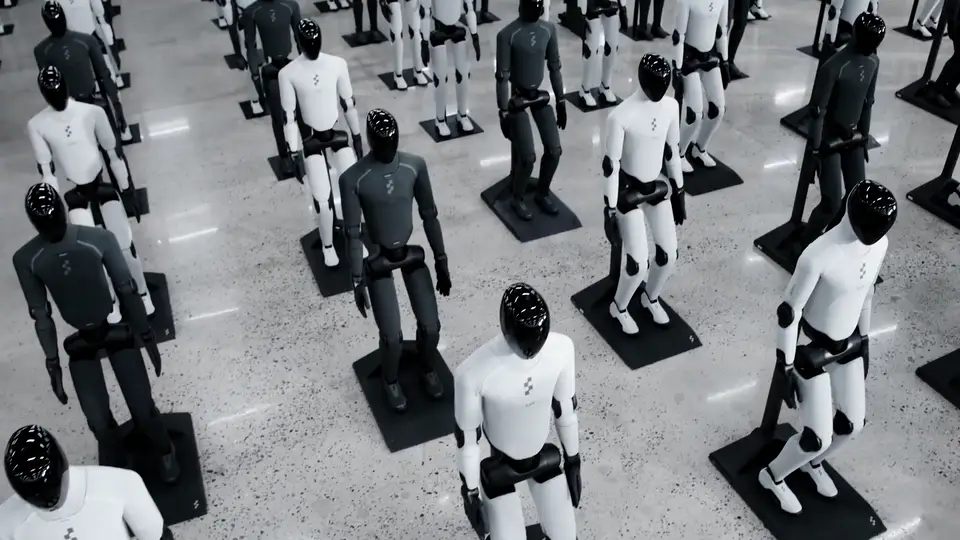
- Major U.S. humanoid developers including Figure, 1X, and Agility have successfully transitioned to high-volume manufacturing, with production capacities now reaching thousands of units annually.
- While hardware maturity is hitting a "commercial viability" milestone, software and AI capabilities remain largely focused on narrow industrial tasks like material handling and box folding.
- Specialized "intelligence layer" startups like Physical Intelligence and Rhoda AI are racing to solve the "general-purpose" bottleneck using diverse strategies ranging from internet video pre-training to simulation-heavy force models.
- Established players like Boston Dynamics and Tesla are facing significant scaling "growing pains," ranging from leadership turnover to missed prototype deadlines.
For the better part of a decade, the humanoid robotics industry has been defined by viral videos and laboratory demos. In 2026, the narrative has shifted decisively to the factory floor. The "Space Race" of our time has entered its industrial phase, with every major American player now racing to prove they can build robots at scale.
However, as the "machine that builds the machine" comes online, a critical question remains: are these robots smart enough to justify their mass production?
The Era of the Hourly Build
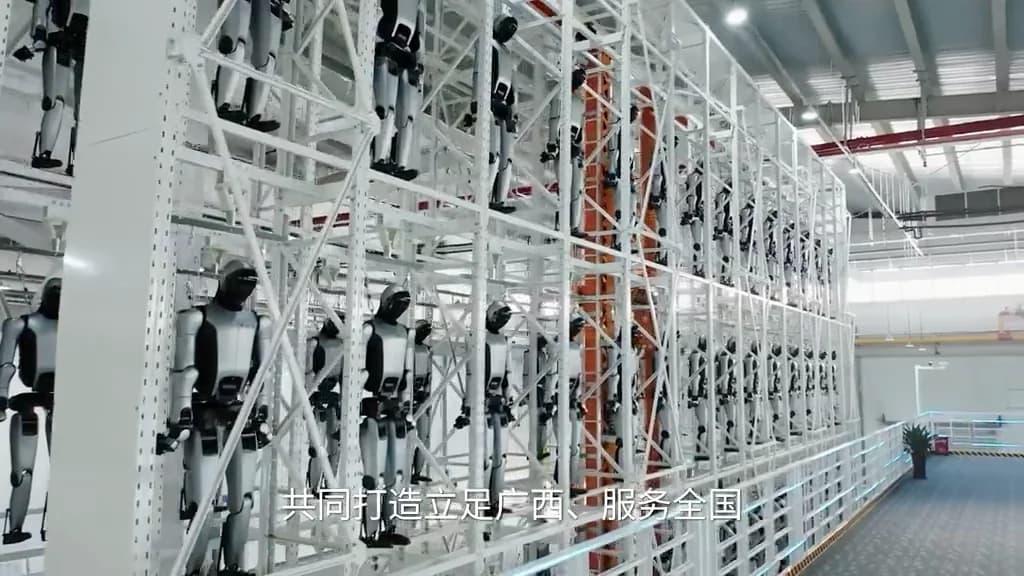
The most visible progress in 2026 is the sheer velocity of manufacturing. Figure recently announced a 24x increase in throughput at its BotQ facility, moving from producing one robot per day to one per hour. With over 350 Figure 03 units already delivered, the company is proving that the transition from functional prototype to scalable fleet is no longer a theoretical hurdle.
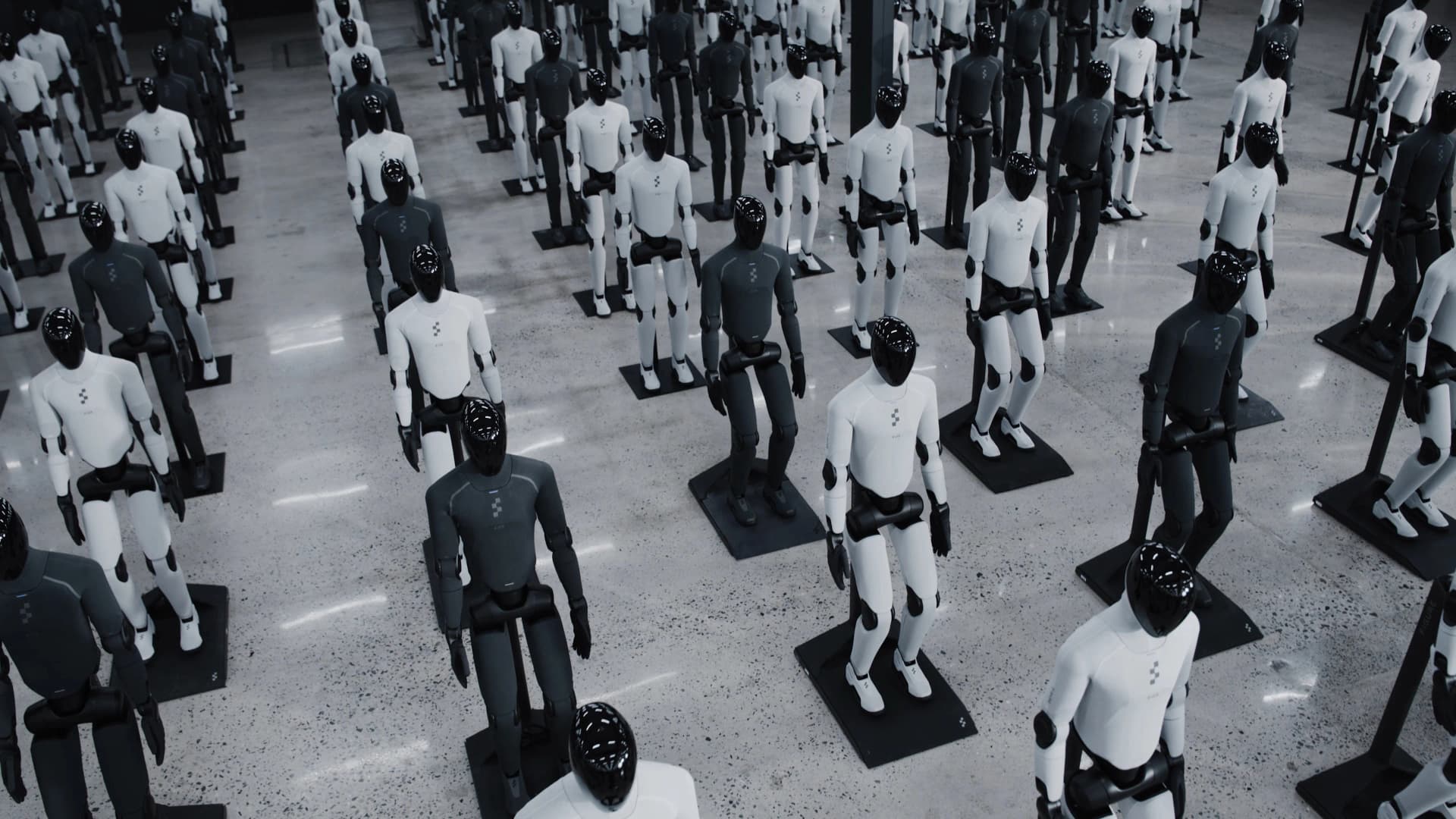
Similarly, 1X Technologies has pulled back the curtain on its 58,000-square-foot "NEO Factory" in Hayward, California. By utilizing a vertically integrated model—manufacturing everything from Revo2 motors to 22-DoF hands in-house—1X is targeting a production capacity of 10,000 units annually, with sights set on 100,000 by the end of 2027.
The weekly humanoid robotics briefing
One email a week: the launches, funding and research that mattered, with context from Humanoids Daily.
Read recent issues
Agility is also positioning itself as an "industrial-first" leader. CEO Peggy Johnson recently confirmed that the company’s Salem, Oregon "Robofab" facility maintains an annual capacity of 10,000 units. Johnson’s vision for late 2026 includes a safety-certified Digit that can "break out of the cage," moving material across facilities alongside human staff without protective barriers.
Scaling Pains and Missed Deadlines
The push for mass production hasn't been without friction. Boston Dynamics, the long-standing pioneer of the space, is currently grappling with a reported "C-suite exodus". The departures of its CEO, CTO, and VP of Robotics Research suggest a turbulent transition from a research-driven culture to the industrial mandate of its owner, Hyundai, which is pushing for "tens of thousands" of humanoids in its carmaking plants.
Tesla is also feeling the heat. Despite plans to clear floor space for a 1-million-unit annual Optimus production line in Fremont, the company missed its self-imposed Q1 deadline for the Gen 3 reveal. While Elon Musk insists the hardware is just receiving "finishing touches," the delay highlights the "agonizing" difficulty of designing "non-existent" parts for mass production.
Meanwhile, Apptronik is taking a "substance over hype" approach, hiring a leadership "dream team" from Waymo and Amazon. Their upcoming next-generation humanoid is expected to be the platform that finally takes the company from logistics pilots to mass deployment.
The Intelligence Bottleneck
The rapid industrialization of humanoids has brought a recurring tension to the forefront: the gap between "hardware readiness" and "general-purpose utility." While firms like Figure and 1X are aggressively scaling their manufacturing lines, the definition of "useful work" remains a moving target.
The "Useful Work" Paradox
This tension was recently underscored during a high-profile tour of Figure’s headquarters on the Sourcery podcast with Molly O’Shea. Walking through the facility, CEO Brett Adcock highlighted a fleet of robots running autonomously 24/7. "We have some robots that we basically have constantly running around the office... greeting people, just basically doing useful work," Adcock noted, explaining that these machines can independently dock, charge, and return to their duties.
However, eagle-eyed viewers and social media critics were quick to point out a telling irony: while the robots were praised for "useful work" like greeting guests, human janitorial staff were clearly visible in the background cleaning the offices. The contrast ignited a wave of jokes and skepticism on social media. If a robot is mature enough for an hourly production cadence, the question becomes why it isn't yet tackling the very "dull and dirty" tasks—like office maintenance—that are frequently cited as the primary use case for humanoids.

Adcock has previously noted that the purpose of scaling the fleet is to encounter "invisible" failures that only appear after thousands of cumulative operating hours. As Figure shifts its focus toward solving the 'long tail' of edge-case failures, the "janitor gap" remains a stark reminder that while the hardware may be ready for the factory floor, the software still struggles with the unstructured messiness of the average office.
The "Data Flywheel" Defense
The industry’s primary defense against the "janitor gap" is the argument that hardware scale is a necessary precursor to software intelligence. At Figure, the recent 24x increase in manufacturing throughput is viewed as a "fundamental shift in development velocity" rather than just an efficiency metric. Every humanoid that rolls off the production line serves as a "data-collection engine," designed to generate the high-fidelity streams required to unlock next-generation autonomous capabilities.
By running larger fleets for longer durations, firms can encounter and resolve "invisible" failures that only manifest after thousands of cumulative operating hours—the "long tail" of edge cases that laboratory prototypes or simulation simply cannot replicate. In theory, this strategy creates a data flywheel, where real-world deployments provide the diverse data needed to harden systems for messy, unstructured environments. In this view, the current state of robotics isn't a failure of vision, but a critical stage of training: today’s "greeters" are the essential data-gatherers for tomorrow’s general-purpose assistants.
The Brain Specialists
While the hardware is increasingly mature, the software "brains" are still catching up. Most live deployments—like Digit’s work at GXO Logistics or Figure’s pilot at BMW—focus on repetitive material handling. The dream of a "general-purpose" machine that can walk into any home or warehouse and begin working "zero-shot" is being chased by a specialized layer of AI startups.
These firms are tackling the "data bottleneck" with wildly different philosophies:
- The Practitioners: Physical Intelligence (Pi) is betting on "compositional generalization," showing that models like π0.7 can learn to fold laundry or use an air fryer by mixing and matching learned motor skills.
- The Simulators: Eka Robotics and Genesis AI argue that "feeling physics" is the key. Eka uses Vision-Force-Action models to master the "last millimeter" of dexterity, while Genesis uses tactile gloves to map human movement to robots at a 1:1:1 ratio.
- The Video-First Movers: Rhoda AI believes the secret to general-purpose skill lies in the internet. Its "Direct Video-Action" model treats the "physics of everything" on YouTube as a pre-training library.
- The Scaling Purists: Generalist AI is ignoring academic labels in favor of raw data, recently releasing its GEN-1 model trained on over 500,000 hours of physical interaction.
Conclusion: The Race to Useful
In 2026, the hardware is no longer the primary mystery. We know how to build humanoids by the thousands, and we know how to make them walk, squat, and lift. The industry is now entering a "Cambrian explosion" where the decoupling of the "brain" and the "body" allows for a new wave of specialization.
As Skild AI attempts to build an orchestrated "omni-bodied" brain for entire warehouses, the pressure is on the hardware titans to prove their fleets can do more than just move totes. The infrastructure is ready; now, the robots just need to get smart.
Share this article
Read next
- Published on
- Reading time
- 3 min read
Humanoid Robots: Insights from Agility Robotics and Apptronik Executives
- Published on
- Reading time
- 4 min read
Actuator Architecture Sparks Debate: Figure CEO Refutes Claim of Using Planetary Roller Screws
- Published on
- Reading time
- 10 min read
The Great Valuation Chasm: A 2025 Guide to the Humanoid Robotics Capital Race
- Published on
- Reading time
- 6 min read
Humanoid Hype vs. Hardware Reality: New Report Scrutinizes Startup IP Strength
- Published on
- Reading time
- 2 min read
Humanoid Robot Market Set for Explosive Growth, Reaching $113B by 2033, Report Finds
- Published on
- Reading time
- 4 min read
Podcast Recap: Inside the Rotary-vs-Linear Actuator Showdown Shaping Humanoid Robots
The weekly humanoid robotics briefing
One email a week: the launches, funding and research that mattered, with context from Humanoids Daily.
Read recent issues