- Published on
Bridging the Semantic-Actuation Gap: AGIBOT Unveils the GO-2 Embodied Foundation Model
One tap, and our reporting appears more often in your Google Top Stories. It makes a real difference to a small newsroom.



This article is part of AGIBOT AI Week — a collaboration between Humanoids Daily and AGIBOT.
The central challenge of embodied AI has never been just "thinking"—it is the translation of thought into reliable motion. While the industry has seen a surge in Vision-Language-Action (VLA) models capable of planning complex tasks, these systems often stumble during execution. This "Semantic-Actuation Gap" occurs when high-level reasoning signals become disconnected from real-world motor commands, leading to accumulated errors and failed tasks.
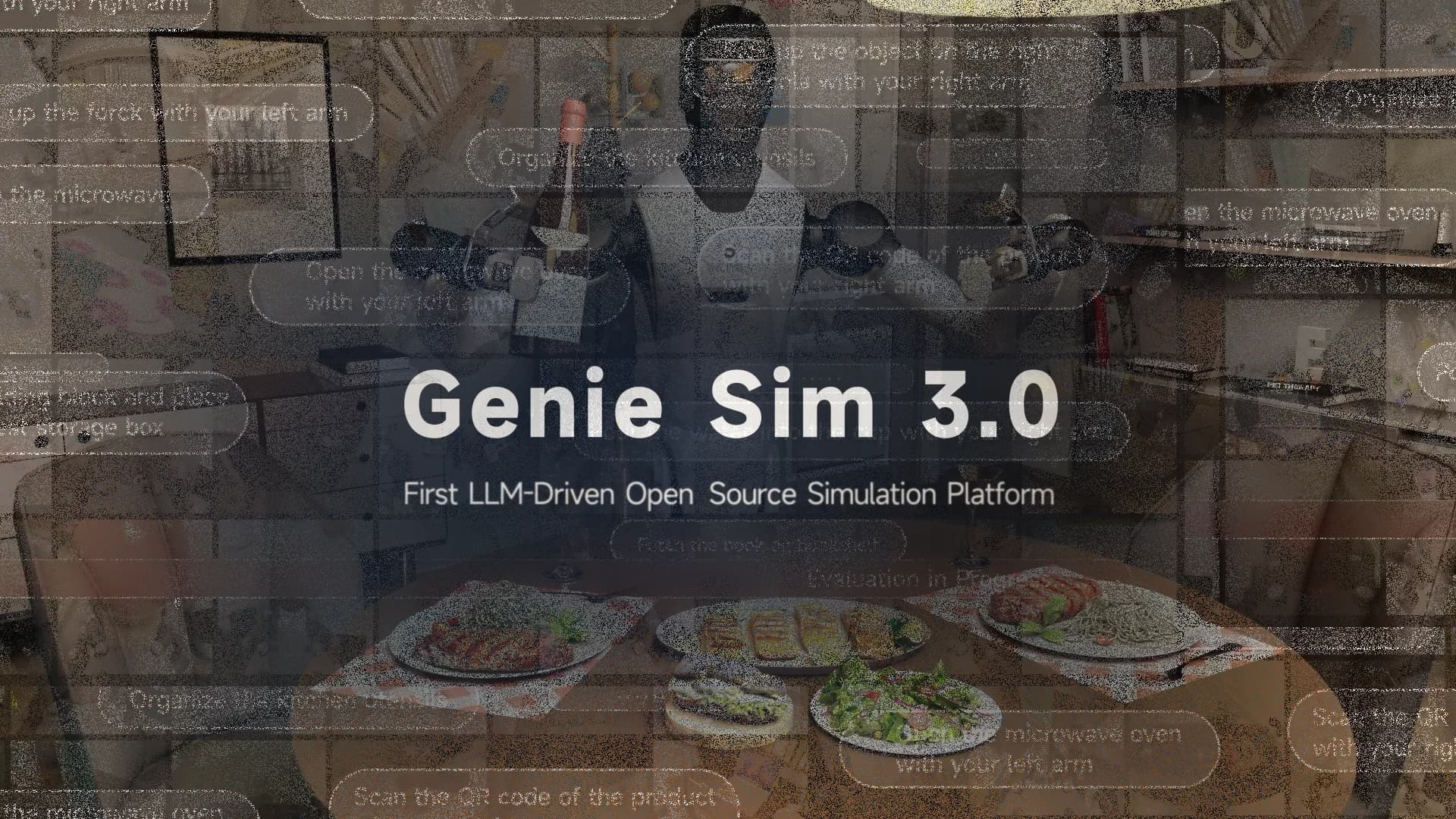
Today, marking the third installment of AGIBOT AI Week, the company has announced Genie Operator-2 (GO-2). Building on the AGIBOT World 2026 dataset revealed on Day 1 and the Genie Sim 3.0 infrastructure launched yesterday, GO-2 represents a fundamental shift toward the "Unity of Reasoning and Action."
Follow our full coverage of the reveals at the AI Week Hub.
Reasoning in Action Space: Action Chain-of-Thought
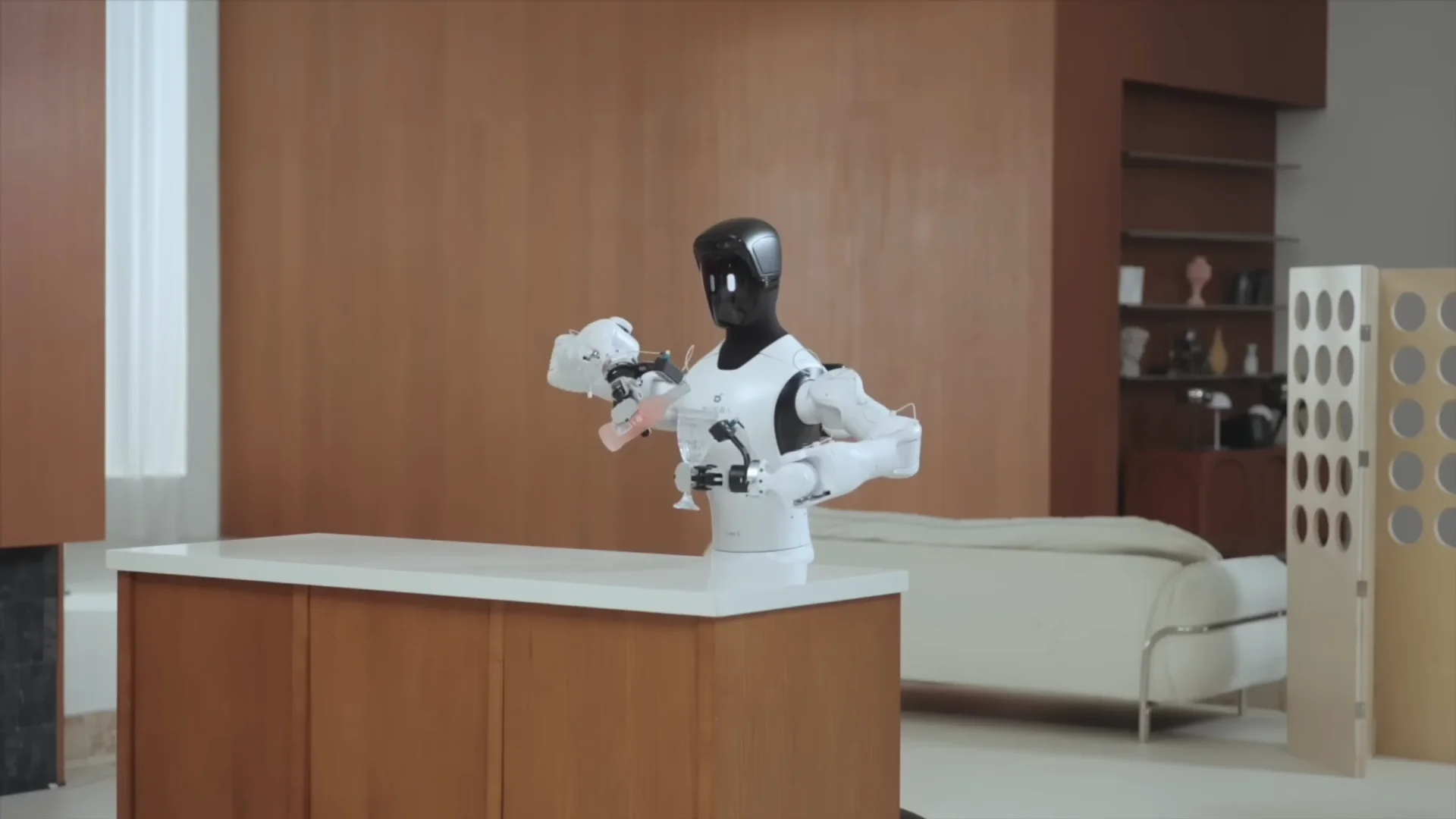
Traditional robotics models often attempt to map sensory input directly to raw motor commands, a "black-box" approach that lacks transparency and robustness. GO-2 introduces Action Chain-of-Thought (Action-CoT), a reasoning framework accepted for presentation at CVPR 2026.
The weekly humanoid robotics briefing
One email a week: the launches, funding and research that mattered, with context from Humanoids Daily.
Read recent issuesInstead of jumping straight to execution, GO-2 generates a macro-plan—a sequence of "action intents" that serve as a mental simulation of the task. By decomposing complex instructions into ordered, logical stages, the robot ensures that every physical movement is grounded in a specific intent. This allows the system to maintain coherence during long-horizon tasks, such as navigating a kitchen to restock a refrigerator—a scenario AGIBOT has been documenting extensively in its AGIBOT WORLD 2026 dataset.
The Asynchronous Dual-System Architecture
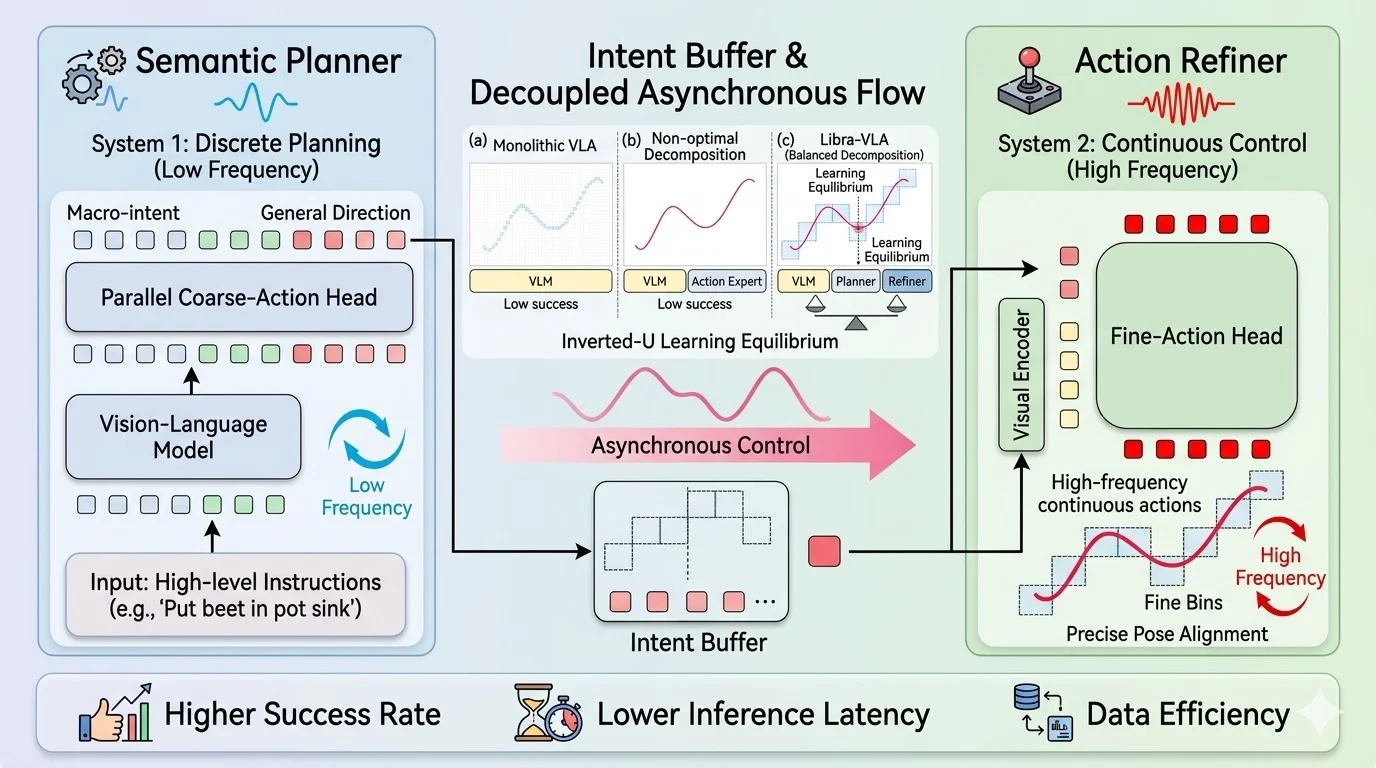
To handle the inherent noise of the physical world, GO-2 utilizes an Asynchronous Dual-System architecture (set to be featured at ACL 2026). This mimics the biological distinction between high-level cognitive planning and reflexive motor control:
- System 2 (Semantic Planning Module): Operates at a lower frequency to act as the "General Commander." It utilizes progressive refinement to generate structured, executable action sequences.
- System 1 (Action Following Module): Operates at a high frequency (aligning with the 1000Hz physics capabilities of Genie Sim 3.0 ). It acts as the "Agile Executor," receiving high-level intents and performing residual refinement to compensate for environmental disturbances in real-time.
By employing a "Teacher Forcing" mechanism during training, AGIBOT ensures that System 1 remains strictly aligned with System 2, even when the reasoning signals are imperfect.
Setting New Benchmarks for Physical AI
The result of this unified architecture is a significant leap in behavioral performance. In head-to-head testing, GO-2 has outperformed existing industry standards like NVIDIA’s GR00T and π0.5 across several key metrics:
| Benchmark | Metric | GO-2 Performance |
|---|---|---|
| LIBERO | Avg. Success Rate (Spatial, Object, Long) | 98.5% |
| LIBERO-Plus | Zero-shot Success (with disturbances) | 86.6% |
| VLABench | Texture/Category Generalization | 47.4 (SOTA) |
| Sim-to-Real | Real-world success from Sim-only data | 82.9% |
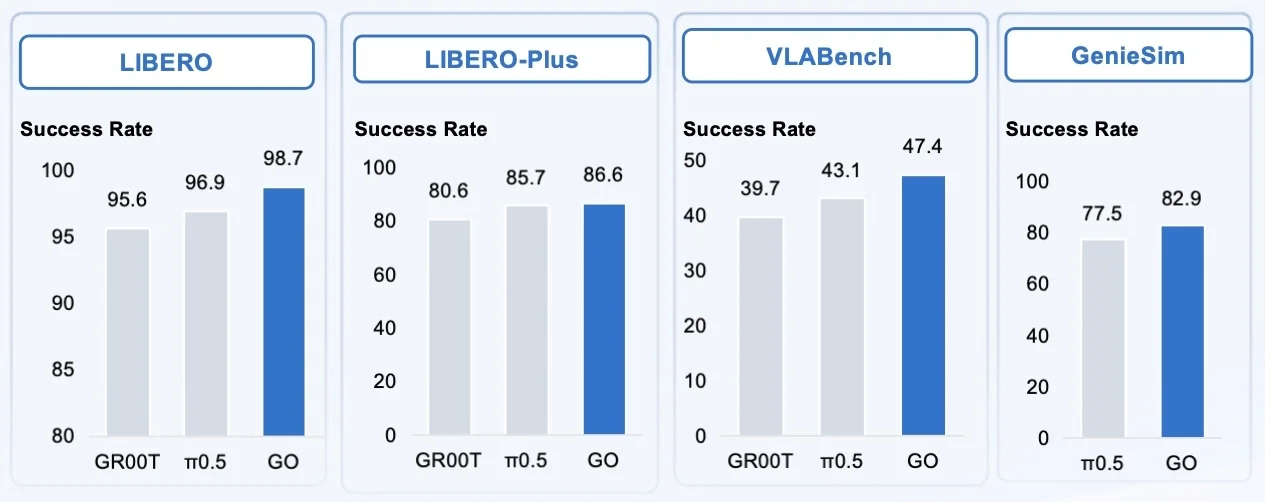
These figures demonstrate that the model is not just a laboratory curiosity but a deployment-ready system. Much of this success is attributed to the industrial-grade data pipeline that feeds GO-2, which utilizes the G2 hardware platform’s 7-DOF torque-sensing arms and 360° LiDAR coverage to capture high-fidelity "physical priors".
From Models to Agents: The Memory Frontier
As AGIBOT moves closer to achieving AGI in the physical realm, the focus is expanding toward long-term intelligence. Alongside GO-2, the company teased the OpenClaw Memory System. This allows robots to store and reuse reasoning traces from previous interactions, enabling them to "remember" and optimize their performance over time.
Integrated with Genie Studio, GO-2 supports massive-scale distributed training across thousands of robots, reducing task startup times to minutes and improving training efficiency by approximately 10×. This ecosystem transforms the robot from a scripted machine into a continuously evolving embodied agent.
For technical documentation and deployment guides, visit the AGIBOT World platform.
Share this article
Read next
- Published on
- Reading time
- 4 min read
The Era of Embodied AGI Begins: AGIBOT and Longcheer Deploy World’s First Humanoid-Led Mass Production Line
- Published on
- Reading time
- 4 min read
Modularizing the Last Mile: AGIBOT Unveils Genie Studio Agent to Scale Robot Deployment
- Published on
- Reading time
- 5 min read
From Representation to Reality: AGIBOT Unveils Genie Envisioner 2.0 as a Scalable “World Simulator”
- Published on
- Reading time
- 4 min read
The Synthetic Engine: How AGIBOT Genie Sim 3.0 Resolves the Embodied AI Data Bottleneck
- Published on
- Reading time
- 5 min read
The Data Bottleneck: Why AGIBOT is Open-Sourcing its Real-World Training Library
- Published on
- Reading time
- 3 min read
IDC Puts H1 Humanoid Shipments Near 25,000, With AGIBOT Leading
The weekly humanoid robotics briefing
One email a week: the launches, funding and research that mattered, with context from Humanoids Daily.
Read recent issues