- Published on
Mimic Robotics Open-Sources "mimic-video" Recipe to Accelerate Video-Action Models
One tap, and our reporting appears more often in your Google Top Stories. It makes a real difference to a small newsroom.


Your guide
Rich Robinson
Jee Chee Ren · Executive tour
See China’s AI and robotics ecosystem first-hand.
Six days exploring AI, robotics and advanced manufacturing.
With Rich Robinson, Clinical Professor of Entrepreneurship at Peking University
Beijing · Guangzhou · Shenzhen
29 November–4 December 2026
Referral partnership · We earn a commission on referred bookings.
Shifting the Foundation from Images to Motion
Zurich-based startup Mimic Robotics has officially open-sourced the "recipe" for mimic-video, its proprietary architecture for Video-Action Models (VAMs). This move marks a significant attempt to steer the robotics industry away from its current reliance on Vision-Language-Action (VLA) models, which Mimic argues are hampered by their origins in static internet data.
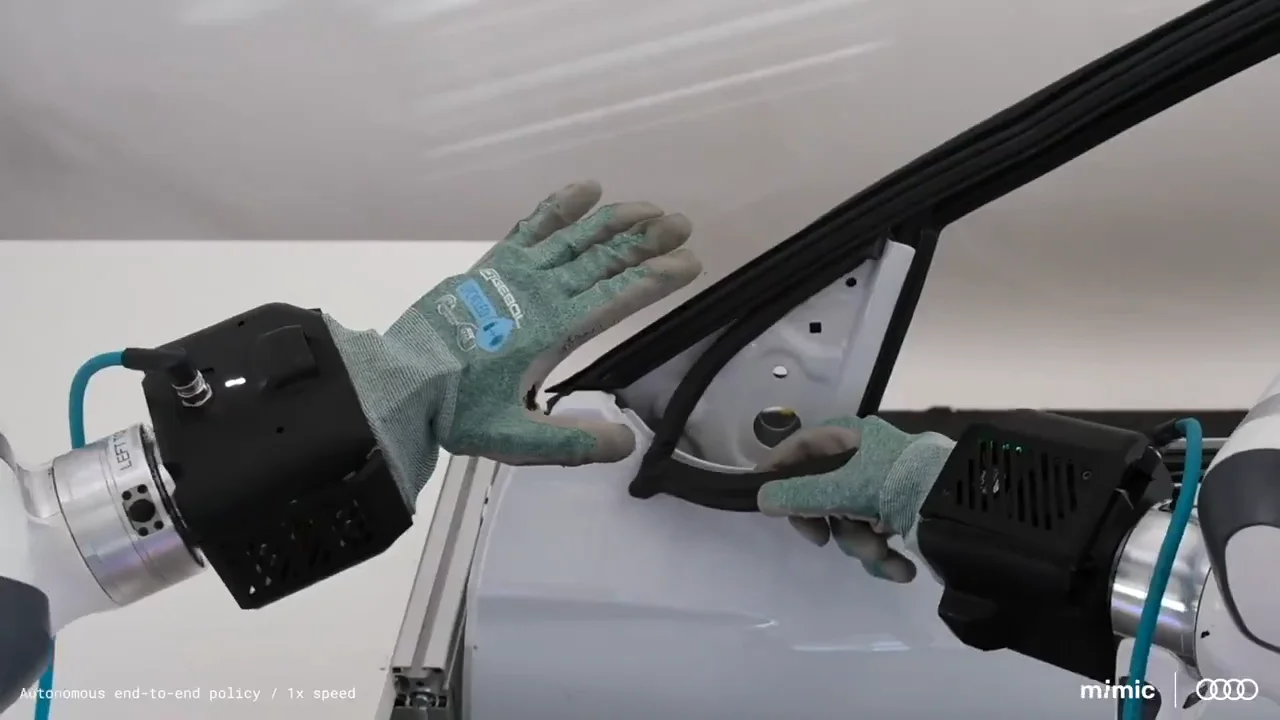
Founded as an ETH Zurich spin-off , Mimic recently made headlines through a strategic assembly partnership with Audi and a $16 million seed round. By releasing the technical framework behind its "pixel-to-action" system, the company is betting that shared foundations will accelerate the development of "Physical AI".
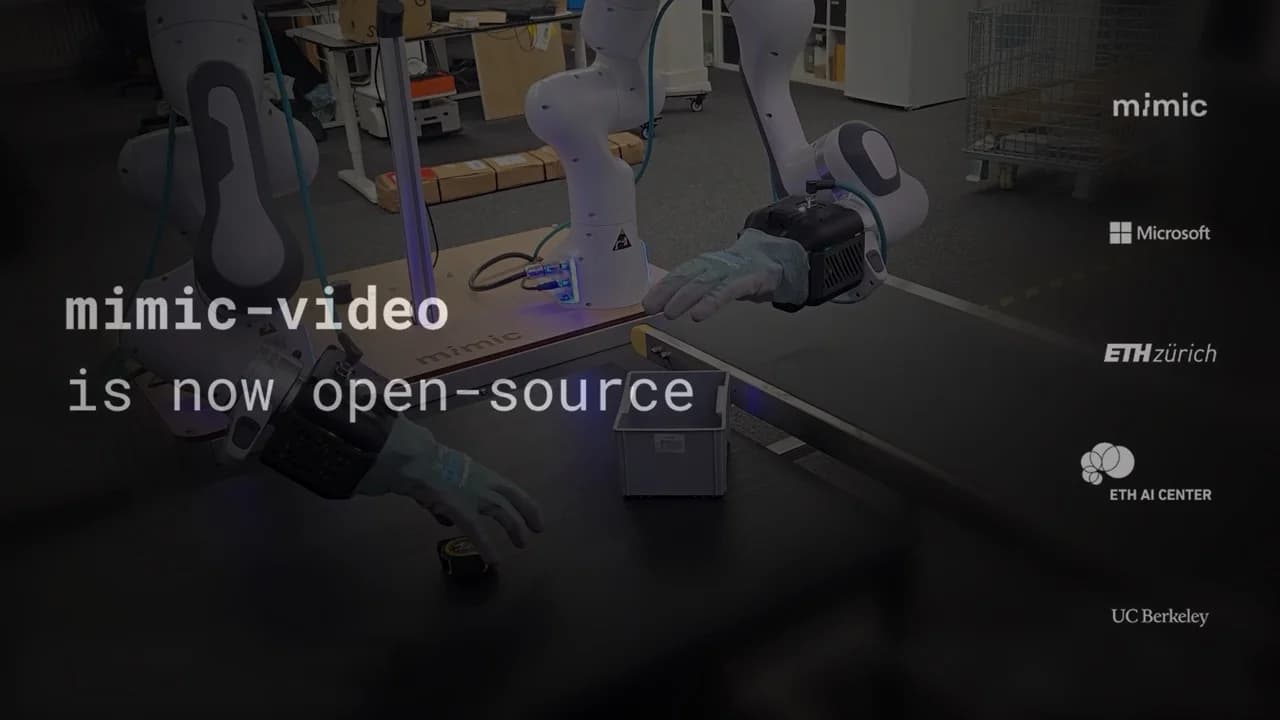
The VAM Advantage: Learning Physics from Video
The core of the mimic-video release is the argument that standard VLAs are "blind to physical causality" because they are pretrained on disconnected image-text pairs. In contrast, VAMs leverage pretrained video backbones that already understand how objects move, deform, and react to forces.
Technical Architecture
The framework released by Mimic integrates several high-end components into a unified pipeline:
The weekly humanoid robotics briefing
One email a week: the launches, funding and research that mattered, with context from Humanoids Daily.
Read recent issues- Generative Backbone: The system utilizes Cosmos-Predict2, an open-source 2-billion parameter latent Diffusion Transformer from NVIDIA, to "imagine" future visual trajectories.
- Inverse Dynamics Model (IDM): Rather than generating full video at every step, a lightweight action decoder extracts intermediate latent representations from the video model to produce low-level motor commands.
- Flow Matching: Both the video and action components utilize Conditional Flow Matching (CFM), a framework that Mimic claims allows for more efficient modeling of complex action distributions.
This categorization places mimic-video within a broader world model taxonomy, specifically as a Video-First approach that generates a visual plan before determining the necessary actions.
Breaking the Data Bottleneck
One of the most striking claims in the released research is a 10x improvement in sample efficiency compared to traditional VLA models. According to Mimic's benchmarks, the mimic-video action decoder can reach peak success rates while requiring only 10% of the training data used by VLM-conditioned counterparts.
This efficiency was demonstrated in real-world trials where the system mastered dexterous bimanual tasks—such as package sorting and tape stowing—using roughly two hours of task-specific data. This stands in sharp contrast to the massive datasets typically required by firms like Generalist AI, which rely on over 500,000 hours of physical interaction.
A "System 1" for Dexterous Manipulation
Mimic's open-source release positions its technology as a fast, reactive "System 1" layer. By stopping the video denoising process early—a strategy called partial denoising—the model can extract semantic features from "noisy" visual plans without the computational cost of full pixel reconstruction.
This approach reportedly allows for real-time inference, as a single forward pass of the video backbone is sufficient to generate a chunk of actions. This focus on high-frequency control mirrors recent "last millimeter" precision efforts from Physical Intelligence, though Mimic’s framework relies more heavily on generative video priors than sub-millimeter reinforcement learning.
Open Source and the "World Model" Race
By making its recipe public, Mimic acknowledges that the systems defining the next era of robotics will likely be built on shared foundations. As the industry moves toward Phase Two of industrial deployment , the success of these video-centric models will be measured by their ability to close the "reactivity gap" and maintain the 99.9% uptime required by global production lines.
Share this article
Read next
- Published on
- Reading time
- 4 min read
Audi Partners with Mimic Robotics for AI-Driven Automotive Assembly
- Published on
- Reading time
- 5 min read
Watch: Inside the Zurich Lab Building the "Android" of Humanoids
- Published on
- Reading time
- 4 min read
Neura Robotics Moves Humanoid R&D to Zurich, Tapping into Europe’s "Robotics Valley"
- Published on
- Reading time
- 4 min read
Hugging Face Drops a $2,500 3D-Printed Humanoid for Open Robot Learning
- Published on
- Reading time
- 4 min read
Hugging Face Introduces Open-Source Humanoid HOPEJr and Desktop Robot Reachy Mini
- Published on
- Reading time
- 4 min read
Hugging Face Acquires Pollen Robotics, Eyes Open Source Future for Humanoid Hardware

The weekly humanoid robotics briefing
One email a week: the launches, funding and research that mattered, with context from Humanoids Daily.
Read recent issues