- Published on
Watch: Inside the Zurich Lab Building the "Android" of Humanoids
One tap, and our reporting appears more often in your Google Top Stories. It makes a real difference to a small newsroom.

Supported by RoboStrategySupport for Humanoids Daily comes from RoboStrategy
Sponsored

Investing involves risk, including possible loss of principal. Read the prospectus before investing.
The European center of the humanoid race is increasingly settling in Zurich, a city now frequently referred to as Europe’s "Robotics Valley". In a new video shared by technologist Andreas Klinger, the industry gets an exclusive tour of Flexion Robotics, the startup that recently emerged from stealth with a $50 million Series A round.
The footage provides a candid look at the "horizontal software" strategy that Flexion believes will break the industry’s current "vertical integration trap". Rather than building its own hardware, Flexion is focusing entirely on the "brain" that allows third-party robots to navigate the messy physical world.
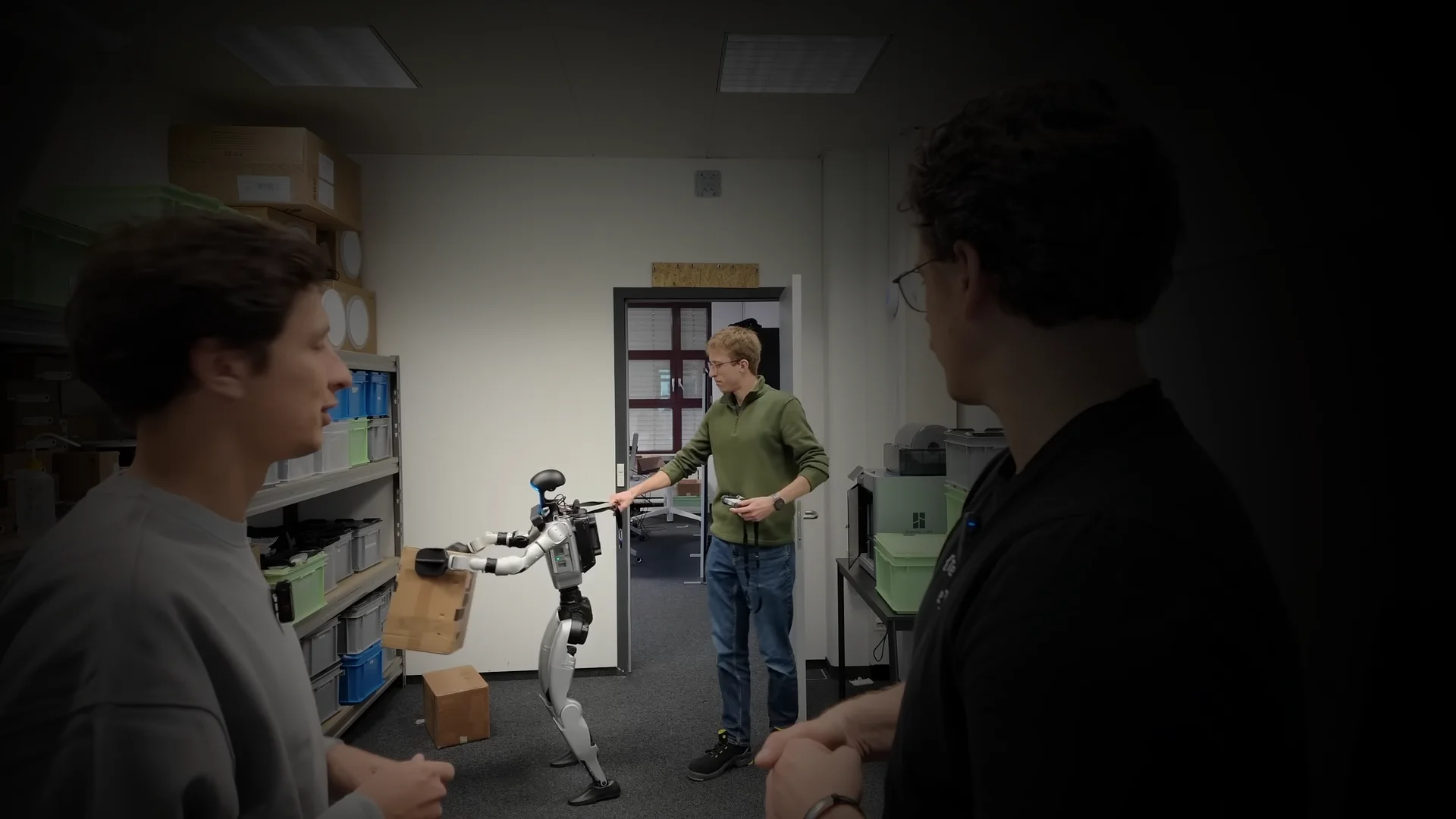
A Fleet of 14 Humanoids
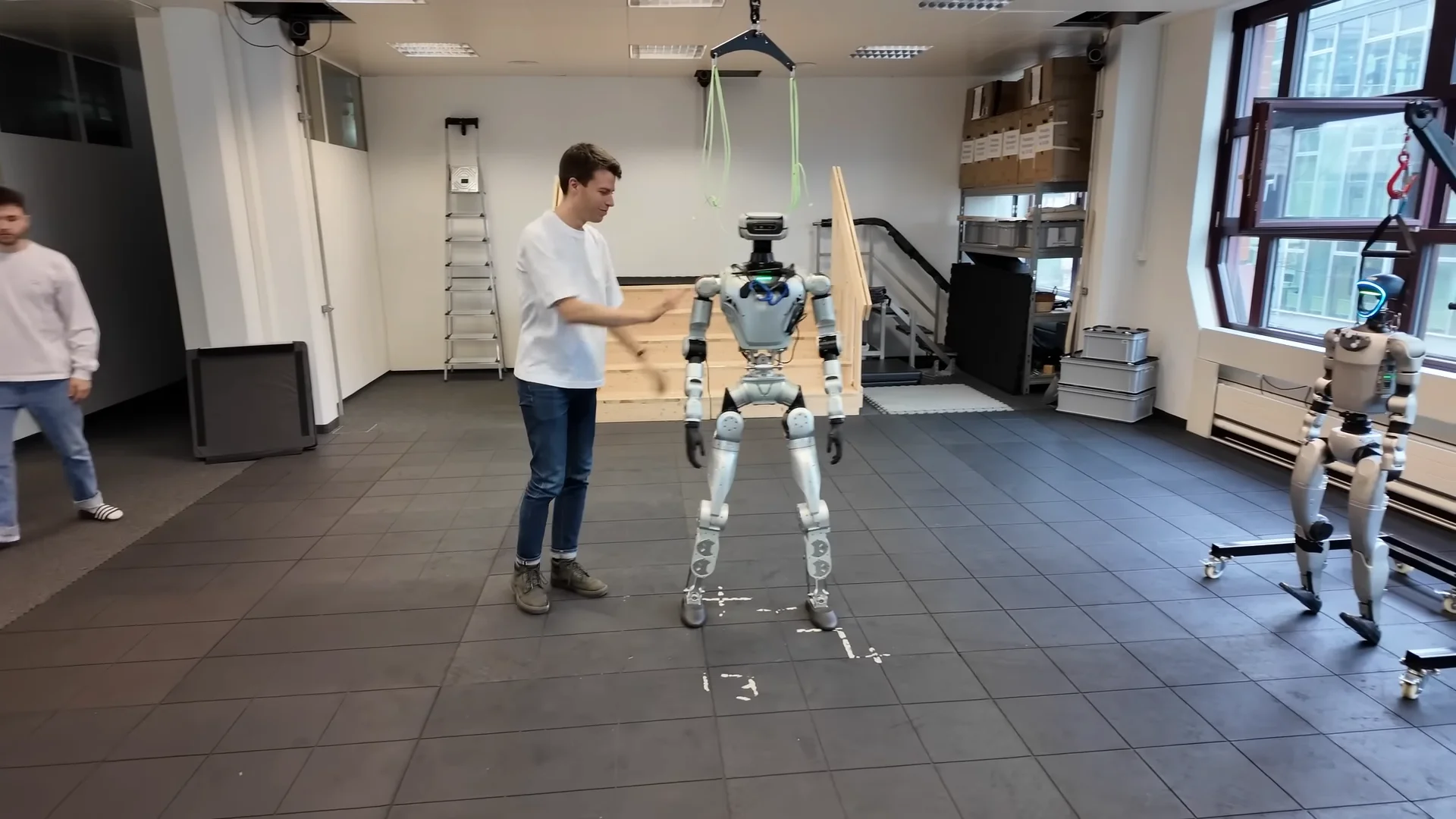
Walking through the Zurich facility, the video reveals a diverse fleet of humanoid robots, including multiple Unitree G1 units, Adam by PNDBotics and the LimX Dynamics Oli. The G1 has become the industry's de facto development kit, while the 1.65-meter Oli serves as a robust platform for autonomous loco-manipulation research.
Flexion CEO Nikita Rudin explains that the goal is to make the software hardware-agnostic. "The learnings we get from the whole fleet accelerate the whole platform," Rudin notes, comparing the potential impact to a "ChatGPT moment" for robotics. By using the same software stack across different hardware, Flexion aims to reduce the engineering effort required to bring a new robot to a new task from years to just a single week.
The weekly humanoid robotics briefing
One email a week: the launches, funding and research that mattered, with context from Humanoids Daily.
Read recent issues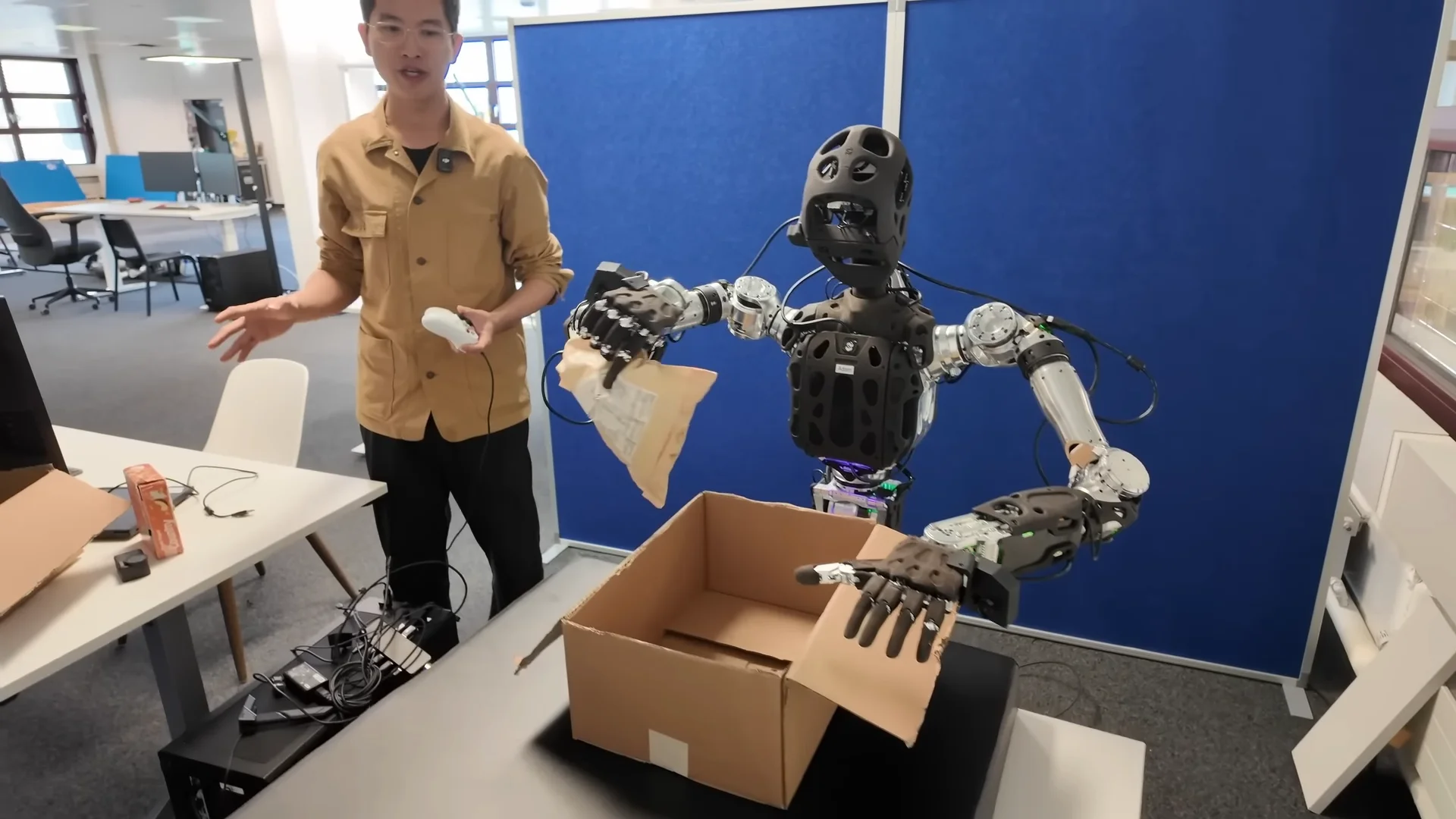
The Three-Layer Intelligence Stack
The tour breaks down the technical architecture that allows these machines to move beyond scripted behaviors. Flexion utilizes a modular three-layer "brain":
- The Agent (Reasoning): A Large Language Model (LLM) or Visual Language Model (VLM) that processes abstract commands—like "go find a box"—and breaks them into sub-tasks.
- Motion Generator (Planning): A diffusion-based model that maps out the robot's intended path and avoids obstacles in 3D space.
- Whole-Body Controller (Reflexes): A reinforcement learning (RL) policy that handles the high-frequency balancing and terrain adaptation.
This hierarchy was demonstrated through several live tests, including a robot autonomously navigating a lab environment to find a specific landmark and another climbing stairs while being physically shoved by a researcher. This level of stability is a hallmark of the A Brain in the Alps: Flexion Raises $50M to Build the ''Android'' of Humanoids philosophy, which emphasizes training in simulation to handle unstructured terrain.
Simulation vs. Puppeteering
A significant portion of the tour focuses on why Flexion favors reinforcement learning over "imitation learning" (teleoperation). In imitation learning, humans "puppeteer" the robot using VR headsets to build a dataset. However, Rudin argues this creates an "upper limit" of human performance.
Instead, Flexion trains 4,000 robots in parallel within NVIDIA Isaac Lab. This "Sim2Real" approach allows robots to discover efficient movements that might feel "unnatural" to a human but are mechanically superior for the robot’s specific kinematics. This method is similar to how the OmniXtreme framework has enabled Unitree hardware to master extreme agility through generative pre-training.
The Path to Factories in 2026
While companies like Unitree are winning the "numbers war" by shipping 5,500 units in 2025, the challenge remains making those units useful in industrial settings. Flexion intends to deploy its software to its first end-customers in factories and warehouses within the first half of 2026.
This move mirrors a broader trend in the European ecosystem. As Neura Robotics relocates its R&D to Zurich, the region is positioning itself as the high-level intelligence hub of the industry, leaving the supply chain scale to China and assembly to Germany. For Flexion, the hardware is becoming a commodity; the real race is to see who can provide the first million robots with a functional brain.
Watch the video below:
Share this article
Read next
- Published on
- Reading time
- 5 min read
Odyssey Unveils Odyssey-3, With Flexion Building Humanoid Control on Its World Model
- Published on
- Reading time
- 4 min read
Mimic Robotics Open-Sources "mimic-video" Recipe to Accelerate Video-Action Models
- Published on
- Reading time
- 4 min read
Audi Partners with Mimic Robotics for AI-Driven Automotive Assembly
- Published on
- Reading time
- 4 min read
Neura Robotics Moves Humanoid R&D to Zurich, Tapping into Europe’s "Robotics Valley"
- Published on
- Reading time
- 5 min read
A Brain in the Alps: Flexion Raises $50M to Build the ''Android'' of Humanoids
- Published on
- Reading time
- 3 min read
UBTECH Brings Walker C1 to Slovenia in Balkan Expansion Push


The weekly humanoid robotics briefing
One email a week: the launches, funding and research that mattered, with context from Humanoids Daily.
Read recent issues