- Published on
From Representation to Reality: AGIBOT Unveils Genie Envisioner 2.0 as a Scalable “World Simulator”
One tap, and our reporting appears more often in your Google Top Stories. It makes a real difference to a small newsroom.


This article is part of AGIBOT AI Week — a collaboration between Humanoids Daily and AGIBOT.
The progression of AGIBOT AI Week has, until now, focused on the fundamental building blocks of robotic intelligence. We have seen the release of the AGIBOT WORLD 2026 dataset to solve the data bottleneck, the launch of Genie Sim 3.0 to provide high-frequency physics, and yesterday’s debut of the Genie Operator-2 (GO-2) foundation model.
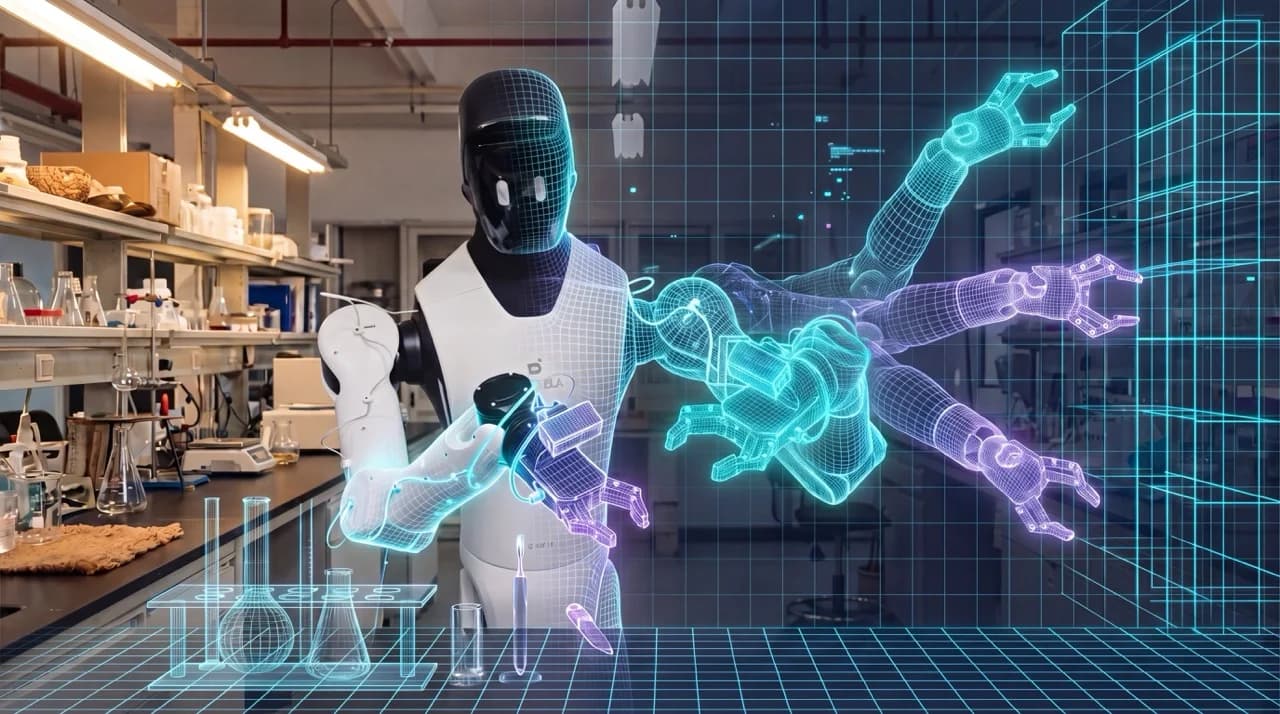
Today, AGIBOT addresses the "where" and "how" of robotic learning. The company has announced Genie Envisioner 2.0 (GE 2-Sim), a system that marks the evolution of world models from passive representation tools into fully interactive, scalable "World Simulators." By transforming the world model into a "physical evolution engine," AGIBOT is moving toward a future where reality is no longer the only—or even the primary—training ground for AGI.
Follow our full coverage of the reveals at the AI Week Hub.
Closing the Loop: The World Action Model (WAM)
The industry-standard approach to world models has largely focused on visual prediction—predicting the next frame in a video sequence. However, for a robot to learn, visual prediction is insufficient. It requires a loop that incorporates its own agency.
The weekly humanoid robotics briefing
One email a week: the launches, funding and research that mattered, with context from Humanoids Daily.
Read recent issuesGE 2-Sim is built upon AGIBOT’s World Action Model (WAM) framework. Unlike traditional models that only account for state transitions, WAM treats "Action" as a first-class variable. The framework follows a strict logic:
State → Action → State Evolution
By explicitly modeling how specific motor commands alter the environment, GE 2-Sim enables robots to conduct "mental simulations" of tasks before execution. This infrastructure builds on previous internal milestones, such as EnerVerse (a 4D computable world model) and Act2Goal (a long-horizon control framework), to bridge the gap between high-level reasoning and physical consequence.
Making the World "Runnable"
The core breakthrough of Genie Envisioner 2.0 is its transition from a generative model to an operational one. To achieve this, AGIBOT has introduced three technical pillars:
- EnerVerse-AC (Action-Conditioned Modeling): This module allows the system to predict future environmental states based on hypothetical robot actions, ensuring physical and semantic consistency.
- Genie Envisioner Sim (GE-Sim): A neural simulator designed for closed-loop policy evaluation. This allows developers to test the GO-2 foundation model in a digital environment that reacts with the fidelity of the real world.
- EWMBench: To ensure these simulations are actually useful for training, AGIBOT has established a benchmark that evaluates three critical metrics: simulation fidelity, action correctness, and semantic alignment.
The Real2Edit2Real Paradigm
One of the most pragmatic additions to the AGIBOT ecosystem is the Real2Edit2Real data workflow. Traditionally, if a developer needed a robot to learn how to handle a specific type of kitchen clutter, they would have to manually arrange that clutter in a lab.
With GE 2-Sim, real-world data captured for the AGIBOT WORLD 2026 dataset becomes "editable." Developers can take a real-world video episode and use GE 2-Sim to procedurally extend it—changing lighting, swapping objects, or introducing environmental disturbances. This Fidelity-Aware Data Composition allows AGIBOT to scale its training library exponentially without a corresponding increase in manual data collection costs.
Technical Capabilities of GE 2-Sim
| Feature | Technical Impact |
|---|---|
| Long-Horizon Modeling | Supports minute-level stable simulation, preventing the "drift" often seen in shorter AI-generated clips. |
| Embodied Spatial Consistency | Unifies multi-view perception and robot proprioception into a single interactive 3D representation. |
| General Reward Model | Enables self-evaluation and Reinforcement Learning (RL) within the world model using natural language feedback. |
| Real-Time Inference | Approaches real-time operation, facilitating live teleoperation within the simulated world. |
Toward an Embodied Scaling Law
The release of Genie Envisioner 2.0 suggests that the path to AGI in robotics may mirror the path taken by Large Language Models: scaling. If world models become stable and high-fidelity enough to serve as simulators, the constraint on robotic intelligence shifts from "human-collected data" to "computational power."
By enabling "RL in World Model," AGIBOT is creating an environment where robots can fail, recover, and optimize millions of times per hour in a synthetic space before ever touching a piece of physical hardware. As AGIBOT notes, "when worlds can be constructed, learning can be scaled."
For technical specifications and to explore the WAM framework, visit the GE World Simulator 2.0 Github page.
Share this article
Read next
- Published on
- Reading time
- 5 min read
1X Reveals Its 'World Model,' A Digital Twin to Accelerate Humanoid AI Training
- Published on
- Reading time
- 4 min read
The Era of Embodied AGI Begins: AGIBOT and Longcheer Deploy World’s First Humanoid-Led Mass Production Line
- Published on
- Reading time
- 4 min read
Modularizing the Last Mile: AGIBOT Unveils Genie Studio Agent to Scale Robot Deployment
- Published on
- Reading time
- 6 min read
Bridging the Semantic-Actuation Gap: AGIBOT Unveils the GO-2 Embodied Foundation Model
- Published on
- Reading time
- 4 min read
The Synthetic Engine: How AGIBOT Genie Sim 3.0 Resolves the Embodied AI Data Bottleneck
- Published on
- Reading time
- 5 min read
The Data Bottleneck: Why AGIBOT is Open-Sourcing its Real-World Training Library

The weekly humanoid robotics briefing
One email a week: the launches, funding and research that mattered, with context from Humanoids Daily.
Read recent issues