- Published on
The World Model Taxonomy: Decoding the Ambiguous Engine of Physical AI
One tap, and our reporting appears more often in your Google Top Stories. It makes a real difference to a small newsroom.


In the spring of 2026, the term "world model" has migrated from a niche corner of reinforcement learning to the absolute center of the robotic foundation model debate. But as the term's popularity has exploded, so has its ambiguity. As researcher Chris Paxton recently noted, the terminology is "pretty frustrating" because it means different things to different people, each with vastly different strengths and weaknesses.
To understand why every major AI lab is suddenly building a world model, we have to look past the "sexy misnomer" and map out the specific technical and strategic bets being placed by the industry’s heavyweights.
The Core Problem: Why Do Robots Need a "World"?
Traditionally, robotics was governed by hand-coded heuristics and explicit kinematic models. While these worked in controlled factory settings, they failed in the "messy" reality of human homes. This failure is rooted in the symbol grounding problem: the challenge of how arbitrary computational symbols acquire real-world meaning.
Modern world models attempt to solve this by anchoring abstract concepts in continuous visual and physical data. The goal is to build a system that internalizes the laws of physics through observation and interaction, rather than following a rigid script.
The weekly humanoid robotics briefing
One email a week: the launches, funding and research that mattered, with context from Humanoids Daily.
Read recent issuesThree Strategic Bets: Cognition, Simulation, and Space
Strategic analyst and VC Natasha Malpani argues that current "world model" projects actually represent three distinct bets on where value will accumulate in the AI ecosystem:
1. The Cognitive Architecture Bet (Yann LeCun / AMI Labs)
This is the longest-term vision. Led by Turing Award winner Yann LeCun, AMI Labs' recent $1.03 billion seed round is a massive industrial wager on the Joint-Embedding Predictive Architecture (JEPA).
Instead of trying to predict every pixel—a task LeCun dismisses as "mathematically difficult and often irrelevant"—JEPA predicts future "latent states". By ignoring unpredictable noise like the flickering of a light, the model focuses on the causal physics necessary for high-level planning and reasoning. We recently saw this theory operationalized in LeWorldModel (LeWM), which can plan up to 48x faster than traditional pixel-based models.
2. The Simulation Infrastructure Bet (NVIDIA / Waymo)
In this framework, the world model is a "Simulation Moat". By creating high-fidelity, interactive environments, companies can generate synthetic data to train robots at a scale impossible in the real world.
NVIDIA’s DreamDojo, for instance, amasses 44,000 hours of human video to simulate dexterous tasks. Similarly, the Waymo World Model leverages Google DeepMind’s Genie 3 to "dream" up rare, safety-critical events like tornadoes or floodwaters to test its autonomous systems.
3. The Spatial Intelligence Bet (Fei-Fei Li / World Labs)
This approach argues that true mastery requires a model to operate in the native 3D geometry of the world. Models like PointWorld represent the environment as "3D point flows". This allows the robot to forecast deformation, articulation, and stability with geometric precision, providing a more grounded model for complex manipulation.
The Technical Hierarchy: How World Models Work
Technically, Chris Paxton categorizes world models into three primary architectural types, each with its own workflow:
| Type | Mechanism | Key Example |
|---|---|---|
| Action-Conditioned | Predicts . Purely dynamics-focused. | V-JEPA 2 |
| Video-First (Hierarchical) | Generates video first, then uses inverse dynamics to find actions. | 1X World Model (1XWM) |
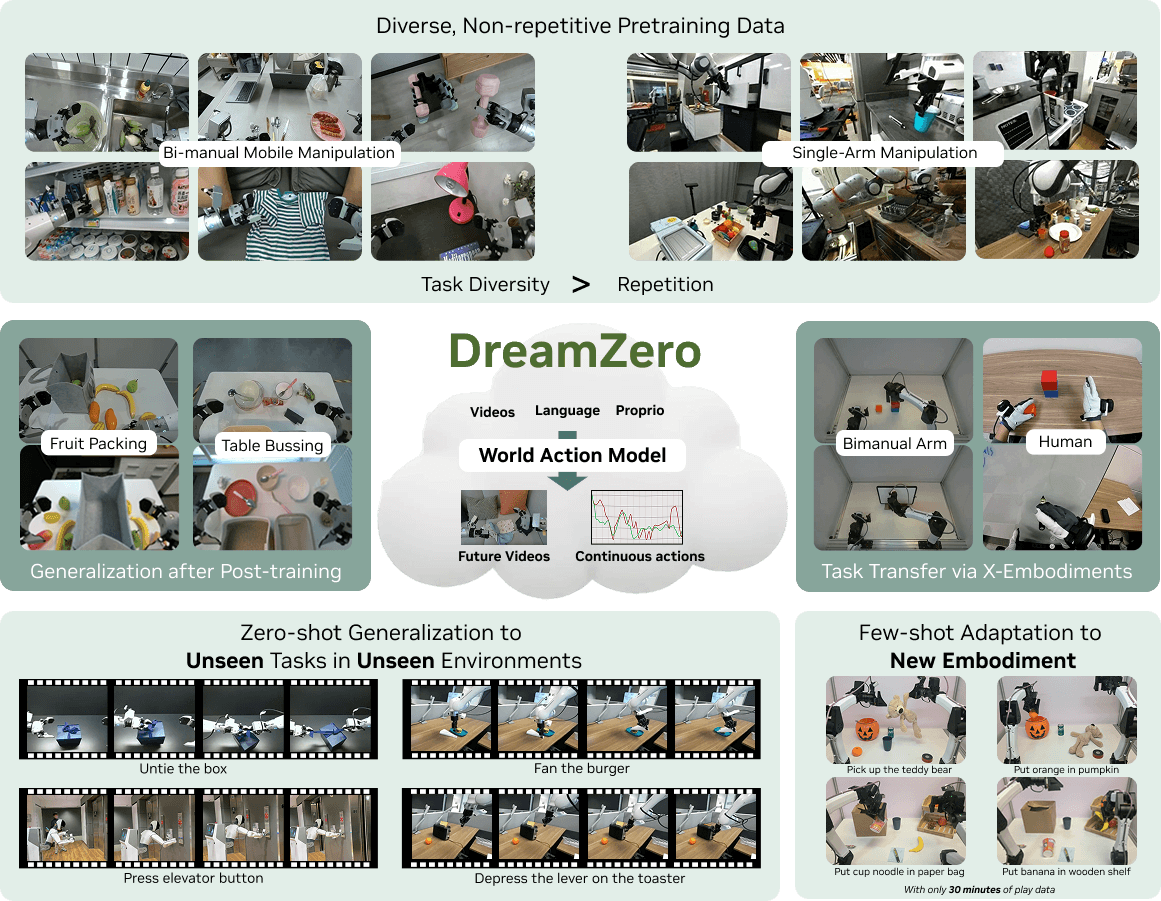
| Joint Modeling (WAMs) | Predicts world state and robot action simultaneously. | DreamZero |
The World Action Model (WAM) has emerged as a particularly potent synthesis. By training on heterogeneous robot data, WAMs can learn from diverse trajectories and even perform cross-embodiment transfer—learning from human videos to improve robot performance.
The Practical Challengers: "From Scratch" vs. Unified Brains
While labs like AMI focus on representation, other organizations are taking a more goal-driven, pragmatic approach.
- Generalist AI: Their GEN-1 model rejects fine-tuning in favor of training "from scratch" on 500,000 hours of human interaction data. This approach has achieved a 99% success rate on tasks where prior state-of-the-art models reached only 64%.
- Tesla: Eschewing modularity, Tesla treats its cars and its Optimus humanoid as parts of a single "Physical AI" mission. Tesla’s unified "neural world simulator" generates high-fidelity video in response to the robot’s actions, allowing it to validate models against "adversarial scenarios" without risking physical hardware.
Limitations and the "Reactivity Gap"
Despite the hype, significant hurdles remain. A primary challenge is the reactivity gap—the time it takes for a massive model to "dream" the future before the robot can act. Generative video models are computationally expensive; if a robot must wait seconds for a 14B parameter model to predict the next state, it cannot respond to real-time changes.
Breakthroughs in 2026, such as AGIBOT's Genie Envisioner 2.0, have attempted to close this loop by treating "Action" as a first-class variable, enabling minute-level stable simulations that prevent the "drift" often seen in shorter AI-generated clips.
As the industry moves toward the late 2020s, the distinction between these approaches is likely to blur into "Hybrid Models" that combine fast inference with robust physical priors. Whether through LeCun’s "cognitive architecture" or Tesla's "bitter lesson" of scaling, the goal remains the same: creating a "universal assistant" that understands the world as well as we do.
Share this article
Read next
- Published on
- Reading time
- 4 min read
Yann LeCun Predicts "Paradigm Shift" in Robotics by 2027, Dismisses LLMs as "Intrinsically Unsafe"
- Published on
- Reading time
- 4 min read
NVIDIA Open-Sources DreamDojo: A 44,000-Hour "Dream" to Solve the Robotics Data Gap
- Published on
- Reading time
- 4 min read
Serving an Ace: LATENT Framework Teaches Unitree G1 Athletic Tennis Skills
- Published on
- Reading time
- 5 min read
1X Reveals Its 'World Model,' A Digital Twin to Accelerate Humanoid AI Training
- Published on
- Reading time
- 5 min read
Imagination as Policy: 1X Director Daniel Ho on Leveraging the World Model Flywheel
- Published on
- Reading time
- 4 min read
NVIDIA DreamZero explained: how its robot AI differs from a VLA



The weekly humanoid robotics briefing
One email a week: the launches, funding and research that mattered, with context from Humanoids Daily.
Read recent issues