- Published on
Generative Bionics Unveils GENE.01: A Smart-Skin Humanoid Built on Peer-Reviewed Ergonomics
One tap, and our reporting appears more often in your Google Top Stories. It makes a real difference to a small newsroom.


Your guide
Rich Robinson
Jee Chee Ren · Executive tour
See China’s AI and robotics ecosystem first-hand.
Six days exploring AI, robotics and advanced manufacturing.
With Rich Robinson, Clinical Professor of Entrepreneurship at Peking University
Beijing · Guangzhou · Shenzhen
29 November–4 December 2026
Referral partnership · We earn a commission on referred bookings.
- Generative Bionics has formally launched GENE.01, a multimodal smart-skin humanoid platform built in just six months following its $81 million seed raise.
- The platform incorporates a distributed tactile skin sensing touch, force, temperature, and proximity to enable safe, force-aware physical interaction with human co-workers.
- Grounded in newly published Nature Machine Intelligence research on its ergoCub predecessor, GENE.01 utilizes physics-native AI to co-optimize physical hardware and motor control around human ergonomic safety.
- Generative Bionics is open-sourcing the robot’s digital twin across PyPI, Conda, and ROS ecosystem repositories, while establishing a sovereign European actuation stack with Germany's Synapticon.
- Former Ferrari production manager Federico Santini has joined as Chief Production & Industrialization Officer to scale manufacturing alongside industrial partners Fincantieri and Italdesign.
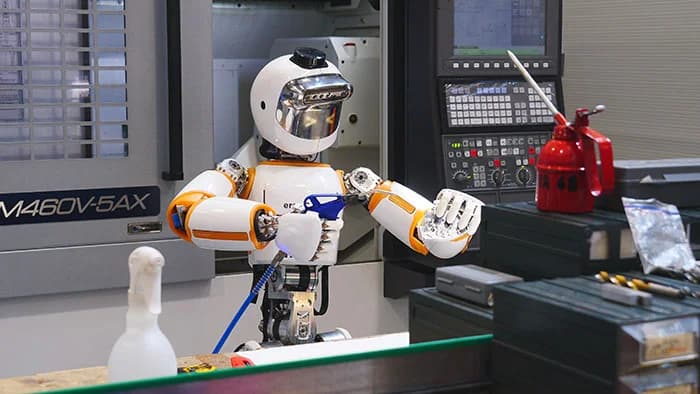
When Generative Bionics exited stealth late last year with an $81 million seed round, the Italian Institute of Technology (IIT) spinout made a bold promise: to transform decades of academic robotics research into commercially viable industrial humanoids at unprecedented speed. Six months after previewing a concept model at CES 2026, the Genoa-based firm has unveiled GENE.01, a fully functional, sensorized humanoid platform designed for safe physical collaboration alongside human workers.
The announcement marks a rapid transition from aesthetic concept to working hardware. Beyond bringing physical units to life, Generative Bionics is backing its platform with peer-reviewed academic validation, open-source developer accessibility, and a strategic manufacturing buildout aimed squarely at European heavy industry.

Multimodal Smart Skin and "Shared Embodied Intelligence"
At the core of the GENE.01 architecture is a full-body distributed tactile skin. Unlike standard vision-only humanoids that perceive their surroundings exclusively through depth cameras and LiDAR, GENE.01’s outer surface is embedded with a multimodal sensor array capable of detecting touch, force, temperature, and proximity.
This tactile capability is engineered to bridge a fundamental gap in robotic learning: force control. While vision-language-action (VLA) models can guide a robot’s end-effector toward an object, they frequently struggle to quantify the precise contact forces required to grasp fragile items or assist a human worker in carrying a heavy load without causing injury. By measuring physical interaction directly across its body, GENE.01 allows operators to teach complex tasks via force demonstration rather than relying solely on teleoperation or video-based imitation learning.
Follow humanoid robotics without following every announcement.
Get the week’s most important launches, funding and research—and why they matter—in one email from Humanoids Daily.
Once a week. Unsubscribe anytime.
Read recent issuesThis design methodology is grounded in academic research published this month in Nature Machine Intelligence. The paper, authored by Generative Bionics CEO Daniele Pucci, lead author Carlotta Sartore, and their former colleagues at IIT, details a framework called "shared embodied intelligence."

Using an earlier prototype named ergoCub, the research demonstrates how a robot's physical morphology (limb lengths, mass distribution, and center of mass) can be algorithmically co-optimized alongside its motion control policies. By modeling the human biomechanical structure—specifically measuring joint torque at the lumbosacral (L5-S1) joint—the architecture automatically calculates movement trajectories and physical proportions that minimize physical strain on human co-workers during collaborative lifting tasks.
However, the published paper also highlights current boundaries of the platform. While the underlying physical intelligence allows real-time adaptation to human movements, interaction in the current framework remains reactive rather than predictive. Incorporating short-horizon human motion forecasting remains an open research avenue for future software iterations.
Open Software Distribution and Sovereign Actuation
To accelerate third-party software development, Generative Bionics is taking an unconventional approach to open-sourcing the robot’s software architecture. Rather than publishing raw CAD files or uncompiled code repositories on GitHub, the company has packaged GENE.01’s digital twin directly into mainstream software package managers.
Developers can import the complete robot description, simulation environments, and physical controllers into existing pipelines using standard package commands across PyPI, conda-forge, and the official Robot Operating System (ROS) build farm. This native integration allows AI researchers and industrial integrators to test and simulate application-specific control policies prior to deploying physical hardware.

Simultaneously, Generative Bionics is emphasizing supply chain sovereignty. As global trade restrictions and geopolitical friction complicate international hardware sourcing, the startup has partnered with German actuation specialist Synapticon to co-develop an EU-protected actuation stack tailored to GENE.01. The agreement encompasses specialized motor-drive integration, calibration, and safety testing conducted entirely within European facilities.
Ferrari Talent to Fuel Industrial Scale-Up
Generative Bionics operates on a modular "one platform, many products" thesis. Rather than designing distinct robots for different industries, the company intends to mass-produce the standardized GENE.01 core platform and customize it across three vectors for specific commercial verticals: distilling task-specific edge AI models, reconfiguring end-effectors, and adjusting outer panel design.
The primary industrial proving ground for this approach remains its multi-year partnership with shipbuilding giant Fincantieri. The partnership centers on developing the GENE.01/W variant, a specialized humanoid welder designed to operate inside the tight, ergonomically challenging environments of naval shipyards. Initial on-site testing for the variant is slated for late 2026 at Fincantieri's Sestri Ponente yard.
To manage the transition from prototype to series manufacturing, Generative Bionics has appointed Federico Santini as Chief Production & Industrialization Officer. Santini brings deep automotive manufacturing experience to the deep-tech startup, having previously served as Plant Manager and Head of Vehicle Assembly at Ferrari. Santini will oversee assembly scaling alongside automotive design house Italdesign, which was contracted in April to engineer GENE.01's outer shell for automated mass production.
Balancing Speed with Industrial Realities
Generative Bionics' claim of moving from concept to functional humanoid in six months is impressive, though it warrants context. The team of nearly 100 engineers—almost half of whom hold PhDs—is drawing on more than 15 years of continuous research developed under IIT's iCub, ergoCub, and iRonCub programs. GENE.01 represents less of a spontaneous six-month creation and more of an industrial distillation of an established research legacy.
The true test for Generative Bionics will lie in moving from controlled lab demonstrations to messy operational environments. While co-designed ergonomics and tactile skin address real workplace safety concerns, unstructured industrial settings like shipyards present dynamic variables—unpredictable debris, extreme ambient temperatures, and volatile electrical interference—that test even the most robust hardware stacks.
Following its public debut at AMD’s Advancing AI event in late July, the industry will get a clearer look at how GENE.01 performs off the stage and whether its physics-native approach can deliver on its aggressive commercial timeline.
Share this article
Follow humanoid robotics without following every announcement.
Get the week’s most important launches, funding and research—and why they matter—in one email from Humanoids Daily.
Once a week. Unsubscribe anytime.
Read recent issuesRead next
- Published on
- Reading time
- 4 min read
Generative Bionics Plans Major Humanoid Training Hub in Italy With AMD
- Published on
- Reading time
- 3 min read
Eni and Generative Bionics Explore Industrial Humanoids, Smart Footwear and AI Computing
- Published on
- Reading time
- 25 min read
The Humanoids of Europe: Built by Their Customers
- Published on
- Reading time
- 5 min read
Fincantieri and Generative Bionics Partner to Bring Humanoid Welders to Italian Shipyards
- Published on
- Reading time
- 3 min read
Generative Bionics Demonstrates Outdoor Locomotion, Taps Italdesign for Mass Production
- Published on
- Reading time
- 4 min read
Italy Enters the Chat: Generative Bionics Raises €70M to Bring "Physical AI" to Industry