- Published on
Andy Rubin's Genki Robotics Shows Its Humanoid to Japan's Prime Minister
One tap, and our reporting appears more often in your Google Top Stories. It makes a real difference to a small newsroom.

Supported by RoboStrategySupport for Humanoids Daily comes from RoboStrategy
Sponsored

Investing involves risk, including possible loss of principal. Read the prospectus before investing.
Genki Robotics, the Tokyo humanoid startup founded by Android creator Andy Rubin, showed its robot in public for the first time on Thursday, at a meeting with Japanese Prime Minister Sanae Takaichi at the Prime Minister's Office. According to the company, the unit on display was a freshly built product prototype: its last parts arrived on Friday, the team assembled it over the weekend, and it took its first steps on Monday.
- Genki Robotics brought its humanoid to Prime Minister Sanae Takaichi's 12 November meeting with physical AI companies, the robot's first public appearance.
- The company says the unit was assembled over the weekend and walked for the first time on Monday, and that it is building its first product model toward the end of the year.
- Genki designs its own actuators and cameras and plans to build on Japanese component makers and supply chains.
- Like Android, the robot's software is meant to be an open platform for outside developers, and Genki is talking to Japanese carriers about putting the robot on cellular networks.
- Rubin co-founded the company in May 2025. It raised a seed round of about $50 million and was reported in April to have reached a valuation of about $1 billion in a Series A.
A robot built last weekend
Takaichi met executives from six robot and component makers at the Kantei on 12 November as part of the government's push on physical AI, one of 17 strategic fields in its growth plan. The government is targeting a 30% global share and a 20 trillion yen (about $130 billion) market by 2040. Takaichi told the attendees she wanted the public and private sectors to roll out physical AI "on a large scale and strategically," and asked economic and fiscal policy minister Minoru Kiuchi to reflect support measures in the growth strategy due at the end of the year.
Genki was represented by Rubin, its CEO, and its CTO Koichi Nishiwaki. Takaichi later posted a summary of what they told her on X, part of a series of posts on each company at the meeting. According to that account, the company has been through several rounds of prototypes and is now building its first product model toward the end of the year. "We brought the product fresh off the line today," the company said. "All the parts arrived last Friday, we assembled it over Saturday and Sunday, and it walked on Monday."
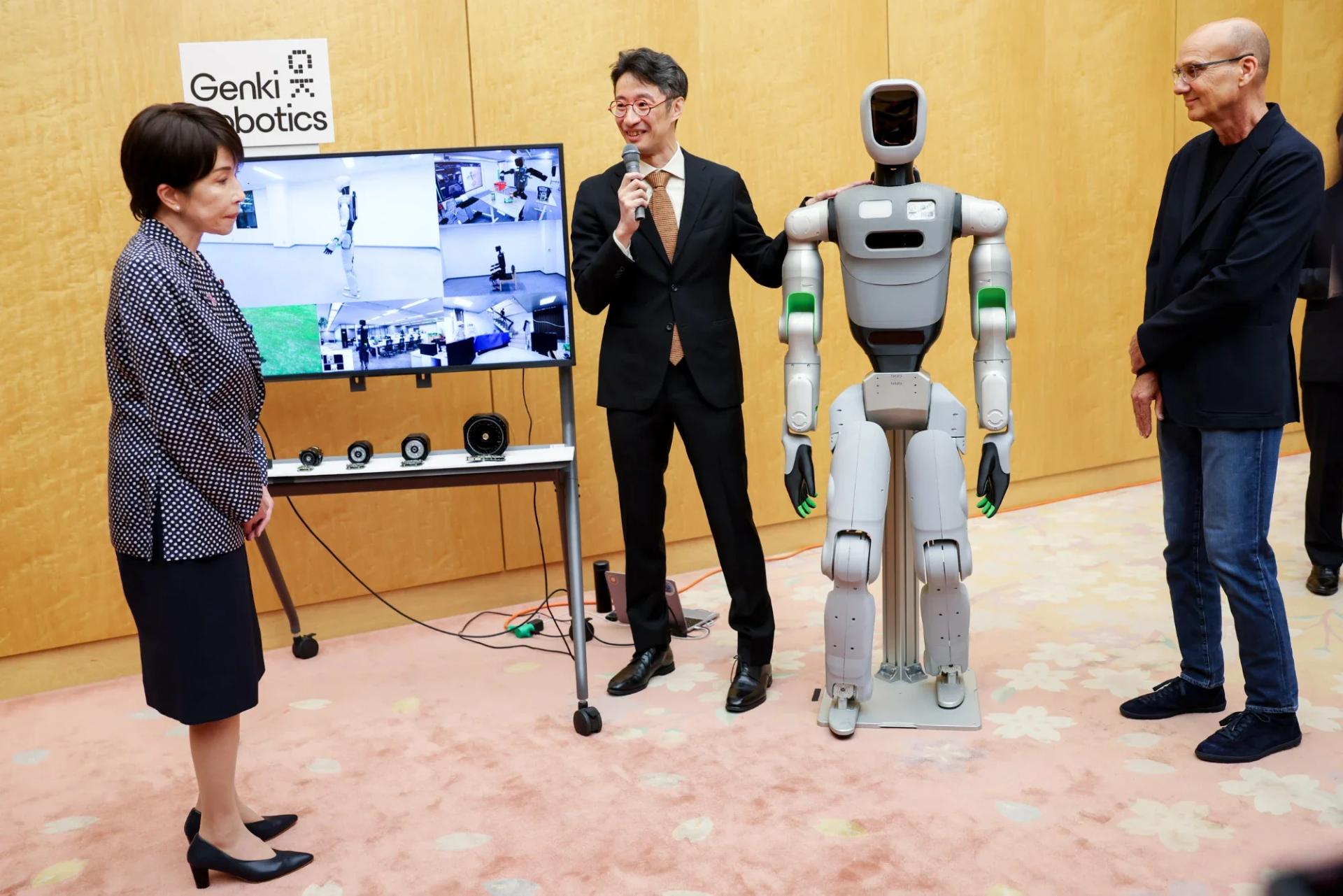
The robot shown at the Kantei is a full-size biped with a grey and white shell, a dark faceplate for a head, green accents on its forearms and black five-fingered hands with green fingertips. At the meeting it stood on a fixed support stand rather than walking. A screen beside it played footage of the robot walking in an empty room, in an office and on grass, and doing tabletop work.
Follow humanoid robotics without following every announcement.
Get the week’s most important launches, funding and research—and why they matter—in one email from Humanoids Daily.
Once a week. Unsubscribe anytime.
Read recent issuesThe company listed the abilities it is aiming for as walking on flat ground and stairs, patrolling and carrying objects: "the movements people make normally while keeping their balance."
In-house hardware, Japanese supply chain
Genki said it designs its hardware itself, "from the parts that move the joints to the cameras." Four of those joint actuators, in four sizes, were laid out on a table next to the robot. The company said it intends to draw on Japan's component technologies, manufacturing base and supply chains to compete globally.
It is also talking to Japanese telecom operators about connecting the robot to domestic mobile networks.
Nishiwaki has worked on humanoid walking since the early 2000s. He earned his PhD in mechano-informatics at the University of Tokyo in 2002 and spent almost a decade at Japan's National Institute of Advanced Industrial Science and Technology (AIST). He joined SCHAFT, the University of Tokyo spinout, in 2013, shortly before Google acquired it under Rubin, and stayed at Google as a robotics engineer until 2019. He later worked at Preferred Networks and at Toyota's Woven unit.
The Android playbook
Rubin built Android into an open operating system that phone makers and app developers could build on, and Genki's pitch to Takaichi was that it wants to do the same for humanoids. "With Android, we built an open ecosystem, brought in all kinds of developers, and it came to be used around the world," the company said. "We want to take a similar strategy with humanoids and build a platform many different people can take part in."
The company added that while it has thought hard about how to win on the software side, it intends to rely on Japanese component technology for the hardware. "We are now at the stage of turning this robot into a product and selling it," it said, adding that creating a market of early users who want to try the robot is the key at this stage.
In July, Rubin told Nikkei Asia that Genki would launch its first product this year and open its operating system to outside developers, who would be able to create and sell new robot behaviors through a marketplace modeled on an app store.
From stealth to the Kantei
Genki operated in stealth for most of its first year, and its website still carries no images or specifications of the robot. Reports of the company first surfaced in November 2025. The startup raised a seed round of about $50 million in 2025, with investors including Andreessen Horowitz, DCM, AMD, Incubate Fund and X&, and Axios reported in April that it had raised a Series A at a valuation of about $1 billion.
Speaking at the FII Priority summit earlier this year, Rubin said he had started the company with two Japanese co-founders he knew from his time running robotics at Google, and that they had built humanoid robots in Japan in the 1990s. At that point Genki had a little over 30 employees. "I don't think I could have started my company in Silicon Valley and recruited the 30-something people that we have today," he said. Rubin framed the robots as a response to Japan's shrinking pool of entry-level workers, calling them "a workforce multiplier" rather than a replacement for jobs.
Rubin led Google's robotics division in 2013 and 2014, when the company bought eight robotics firms including SCHAFT and Boston Dynamics. He left Google in 2014, founded the investment firm Playground Global, and launched the phone maker Essential, which shut down in 2020.
Share this article
Follow humanoid robotics without following every announcement.
Get the week’s most important launches, funding and research—and why they matter—in one email from Humanoids Daily.
Once a week. Unsubscribe anytime.
Read recent issuesRead next
- Published on
- Reading time
- 4 min read
Jensen Huang Resigns as NVIDIA CEO; CFO Colette Kress Steps In
- Published on
- Reading time
- 4 min read
J.P. Morgan Forecasts 300,000 to 400,000 US-Made Humanoids by 2030
- Published on
- Reading time
- 2 min read
Android Founder Andy Rubin Reportedly Launching Humanoid Robotics Startup in Tokyo
- Published on
- Reading time
- 5 min read
San Mateo County Moves to Regulate Humanoid Robots, Threatening Teleoperation Business Models
- Published on
- Reading time
- 5 min read
The World Model Taxonomy: Decoding the Ambiguous Engine of Physical AI
- Published on
- Reading time
- 4 min read
Serving an Ace: LATENT Framework Teaches Unitree G1 Athletic Tennis Skills