- Published on
Swiss Startup Embodied AI Unveils AIR, a Wheeled Robot Built to Work Beside Factory Staff Without a Cage
One tap, and our reporting appears more often in your Google Top Stories. It makes a real difference to a small newsroom.

Embodied AI, a 25-person startup spun out of Swiss technical university EPFL, has unveiled AIR, a two-armed robot on a wheeled base that the company says can work beside factory staff without a safety cage. CEO Francesco Stella is presenting the robot today at Humanoid Europe 2026 in Munich, and the company says it will open orders after the unveiling.
- AIR is a wheeled robot with a torso and two arms. Embodied AI puts the heavy components in the torso and uses light, soft arms that give way on contact, so the robot can share a line with people.
- A remote operator runs AIR from its first shift. The company says the robot takes the task over on its own within about a month, using the data from those shifts.
- Embodied AI reports a 95% average task success rate in paid pilots with manufacturers, including a consumer electronics maker and an automotive and industrial technology supplier. It has not named either customer.
- The company plans CE marking in 2027, when the EU's new Machinery Regulation takes effect. No price, payload or delivery date for AIR has been published.
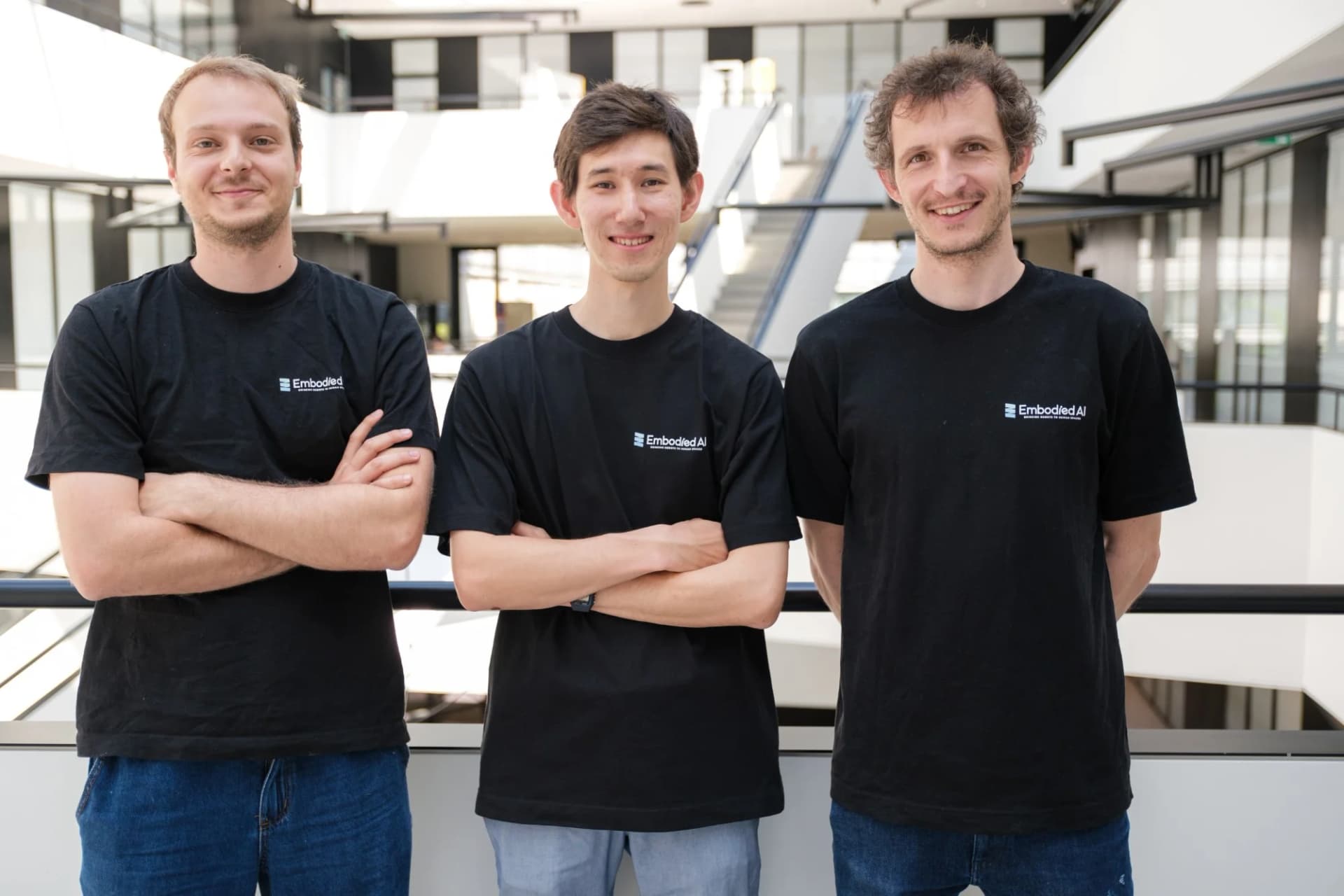
The company is based in Lausanne and has an office in Rome. Stella, 28, earned his robotics PhD at EPFL and did research at MIT. His co-founders are CTO Kai Junge, who did his PhD in robotic manipulation at EPFL after studying at Cambridge, and COO Max Polzin, previously a tech lead at Seervision, a camera-automation startup later acquired by Q-SYS.
Naming a robotics startup after the field's favourite term, embodied AI, is a bold move for anyone hoping to rank in search. The company announced a first funding round led by Faber VC earlier this year without disclosing the amount. Its backers also include Czech AI fund Look AI Ventures, Techshop Capital, Vento, Plug and Play, Kickfund and Excellis.
What AIR is
Embodied AI calls AIR a humanoid, but it has no legs. The robot is a torso with two arms and a head, mounted on a wheeled base.
Follow humanoid robotics without following every announcement.
Get the week’s most important launches, funding and research—and why they matter—in one email from Humanoids Daily.
Once a week. Unsubscribe anytime.
Read recent issuesIt joins a growing group of wheeled "humanoids" we have covered in the past few weeks. Carnegie Mellon's Pixel is a two-armed robot that costs under $15,000 to build and learns from human demonstrations. NYU's open-source MABEL has a parts list of $8,056. Feather has launched a $30,000 wheeled humanoid for developers. Those three are aimed at researchers and developers, while Embodied AI is selling AIR to factories as a working machine.
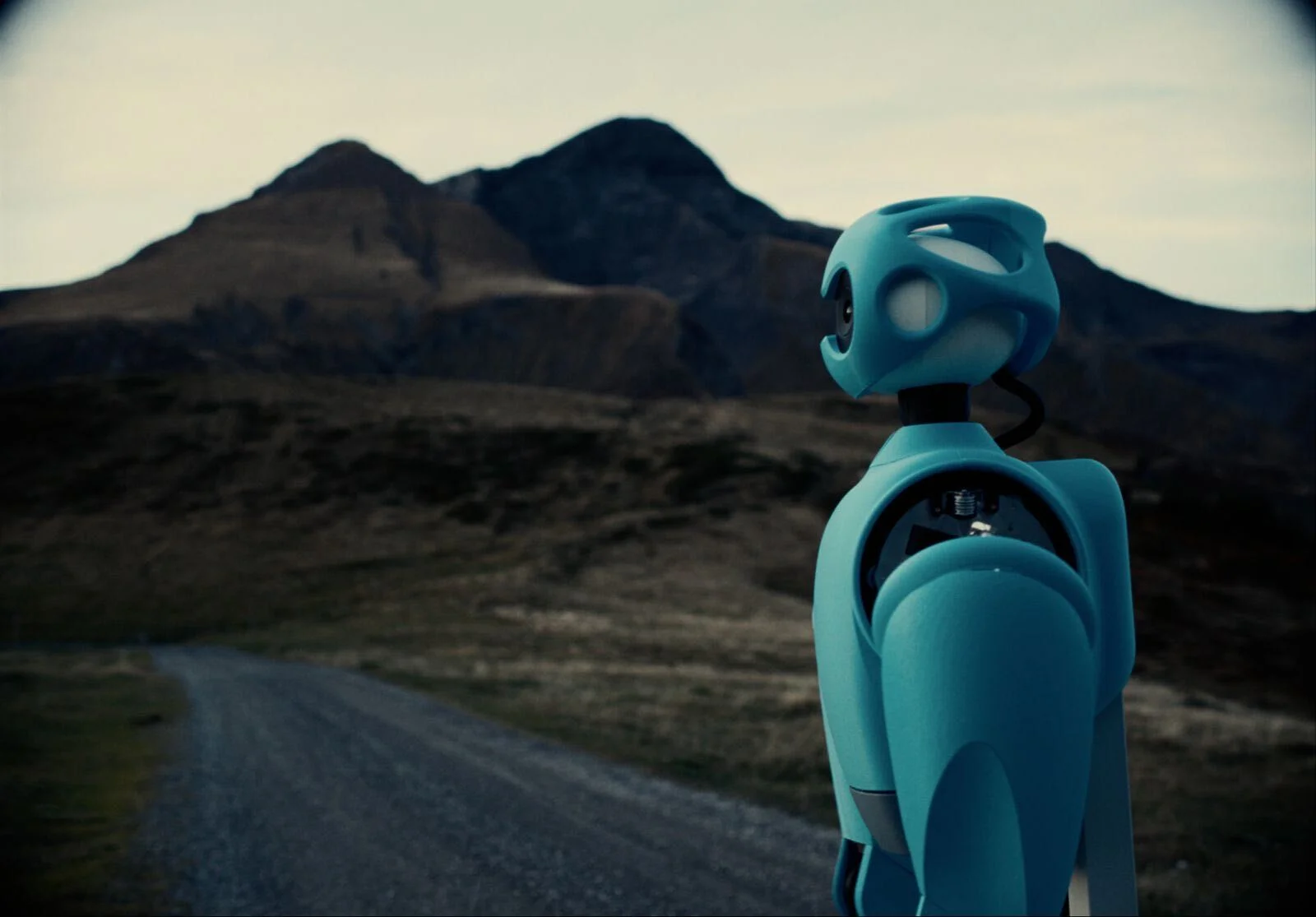
The company's photos show the build. The upper body is covered in a soft, textured teal shell. Behind a circular opening at the shoulder, a metal joint is visible, with cables running out to the upper arm. The head is an open lattice shell with a camera on each side.
The design rationale is about mass. A conventional industrial arm is heavy and stiff, so it causes harm when it hits something and usually has to sit behind a fence or a light curtain. Embodied AI keeps the motors and other heavy parts in the torso and drives the arms through cables, a tendon-driven layout that keeps the moving parts light. The arms are also built to yield when they make contact, a property known as compliance.
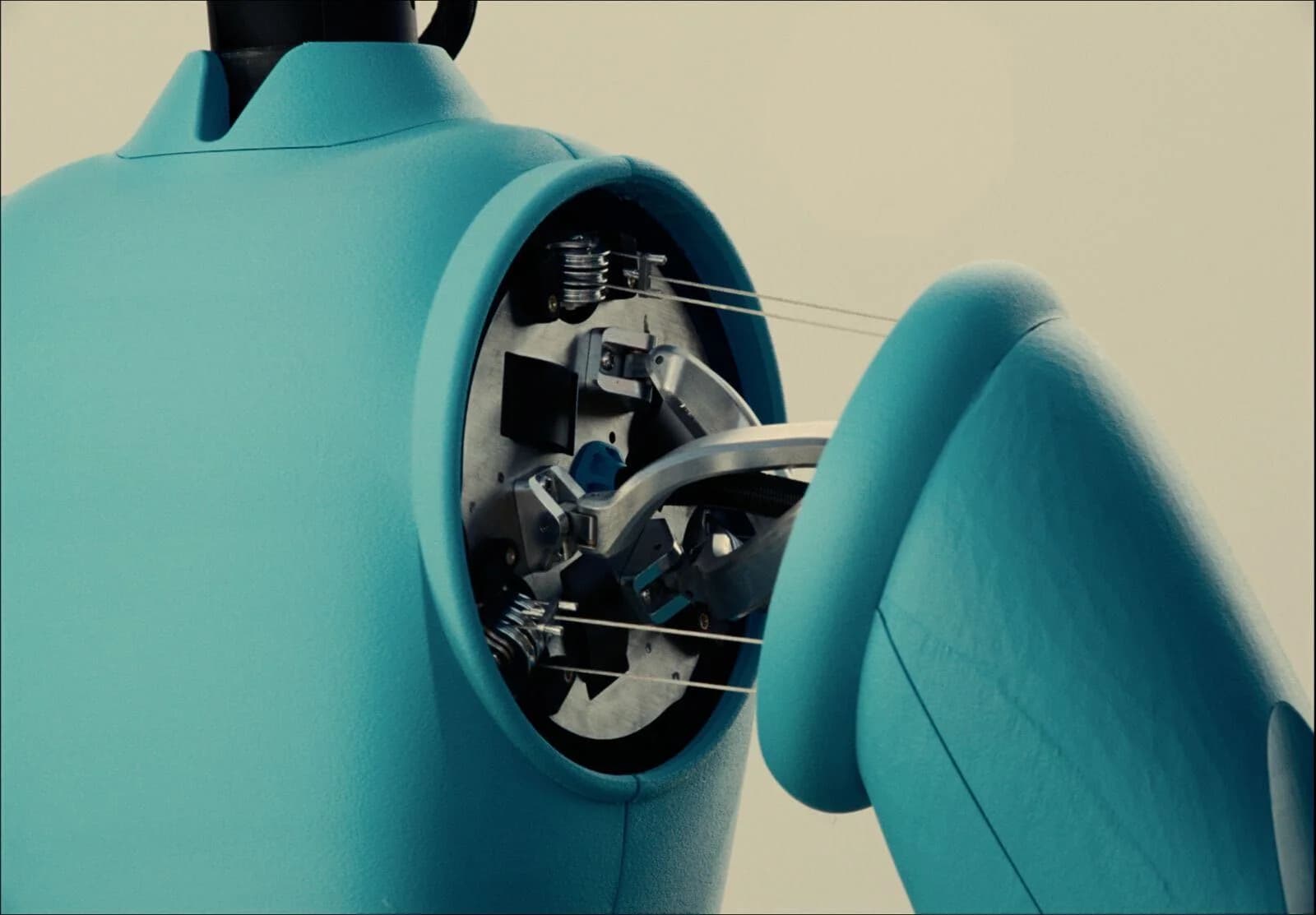
The only arm figures so far come from investor Angelo Burgarello, a partner at Look AI Ventures, who described "a 2 kg tendon-driven arm that lifts 5 kg." The company has not published the robot's height, weight, reach, battery life or full payload.
"If an AI system recommends the wrong product to you, nobody gets hurt. But if a robot makes a mistake and hits someone, obviously you don't want that," Stella said in the announcement.
Embodied AI says it plans to get AIR CE-marked in 2027. That timing lines up with the EU's Machinery Regulation (EU) 2023/1230, which replaces the Machinery Directive from 20 January 2027 and adds requirements for machines with self-evolving behaviour and for collaborative operation near people. Until a robot carries the mark, it cannot be sold as a finished machine in the EU.
Teleoperation first, autonomy later
Embodied AI's deployment model starts with a person in the loop. A remote operator runs AIR through teleoperation from the first shift, so the customer gets work done before any policy has been trained for its task. Each shift is recorded as training data. According to the company, the robot takes the task over on its own within about a month.
Burgarello put the timeline as "deployed in one week and reaching an average 95% task success rate within a month."
The company describes its software as an AI stack built from task-specific models, not a single general-purpose robot model. That stack is already running on a customer production line, in a two-armed robot cell Embodied AI sold before AIR existed. AIR uses the same stack, which is why the company can cite pilot results for a robot it only unveiled today.
The 95% figure is an average across paid pilots, and the company has not said how many tasks it covers, how success is defined, or how long the pilots have run. The two pilot customers are described only as "a leading consumer electronics manufacturer" and "a global automotive and industrial technology supplier."
Embodied AI also says that, depending on the task, one AIR can handle the workload of up to three people per shift. It has not said which tasks that applies to.
Where it sits in the market
Several companies are pitching robots that can work near people in factories. Agility Robotics and FORT are connecting Digit 5 to a factory's external safety systems through an Offboard Safety Bridge. Fellow Swiss startup mimic robotics raised $16 million to fit dexterous hands to standard industrial arms. Embodied AI's approach differs from both: a wheeled, upper-body robot whose physical design limits the force it can apply, combined with a remote operator who runs it until it has learned the task.
The company has said orders open after Humanoid Europe, but has not published pricing or a delivery schedule.
Share this article
Follow humanoid robotics without following every announcement.
Get the week’s most important launches, funding and research—and why they matter—in one email from Humanoids Daily.
Once a week. Unsubscribe anytime.
Read recent issuesRead next
- Published on
- Reading time
- 3 min read
Reflex Robotics to Build Latin America’s First Humanoid Robot Factory in Mexico
- Published on
- Reading time
- 4 min read
Neura Robotics Moves Humanoid R&D to Zurich, Tapping into Europe’s "Robotics Valley"
- Published on
- Reading time
- 6 min read
NVIDIA and Agility Team Up on "Halos," the First Full-Stack Safety Architecture for Humanoids
- Published on
- Reading time
- 4 min read
Tesla’s Miami Mishap Highlights the Fragile Reality of Teleoperation
- Published on
- Reading time
- 5 min read
Agility Robotics Secures OSHA-Recognized Safety Approval, Widening the Gap Between ''Demo'' and ''Deployment''
- Published on
- Reading time
- 5 min read
Ex-Safety Head Sues Figure AI, Alleging Retaliation Over "Skull-Fracturing" Robot Risks