- Published on
J.P. Morgan Forecasts 300,000 to 400,000 US-Made Humanoids by 2030
One tap, and our reporting appears more often in your Google Top Stories. It makes a real difference to a small newsroom.

J.P. Morgan expects humanoid robot production in the US to reach 300,000 to 400,000 units by 2030 and about 1.5 million units by 2035, as the industry moves from demonstrations to commercial deployment, Reuters reported on Thursday. The bank names labor shortages, improving economics and rising production capacity as the drivers, with manufacturing, logistics and warehousing as the first markets.
- J.P. Morgan forecasts US humanoid production of 300,000 to 400,000 units by 2030 and about 1.5 million by 2035.
- It estimates humanoid costs are nearing parity with labor, and that running robots across multiple shifts could save a customer about $100,000 a year.
- The bank names hands, actuators, the robot's AI "brain" and production capacity as the binding bottlenecks, and says most US makers other than Tesla are targeting 10,000 to 30,000 units a year.
- Its near-term picks are component suppliers: Timken, ROBOTIS, Leader Drive, Orbbec and Cognex. It expects the market for parts such as actuators, motors and vision systems to approach $30 billion by 2035.
The figures as reported do not say whether the 2030 and 2035 numbers are annual output or a cumulative total. J.P. Morgan's note itself has not been published.
Supply, not demand, sets the pace
"Near-term progress remains supply constrained, with a few binding bottlenecks: hands, actuators, the brain, and production capacity," the brokerage said. It also lists AI training data and compute among the constraints on deployment.
On capacity, J.P. Morgan says most US manufacturers outside Tesla are targeting 10,000 to 30,000 units a year. That matches what the companies have said publicly. Figure built its BotQ plant for an initial 12,000 robots a year, with a goal of 50,000. Agility's cost plan for Digit 5, which Chief Operating Officer Jen Hunter presented at the company's Analyst & Investor Day in October, takes the bill of materials from about $150,000 at launch to a target of $30,000 at 10,000 units a year.
Follow humanoid robotics without following every announcement.
Get the week’s most important launches, funding and research—and why they matter—in one email from Humanoids Daily.
Once a week. Unsubscribe anytime.
Read recent issuesTesla began Optimus production in Fremont in October and expects deliveries to outside customers toward the end of 2027. It wants roughly 10,000 to 20,000 robots for its own training fleet first.
Committed orders are still far smaller than the forecast. Earlier today, GXO Logistics signed a letter of intent with Apptronik for up to 1,000 Apollo robots over four years, conditional on trials meeting agreed targets. Agility's largest Digit 5 commitment, a $300 million order for 1,000 robots, releases units in tranches as each use case is proven.
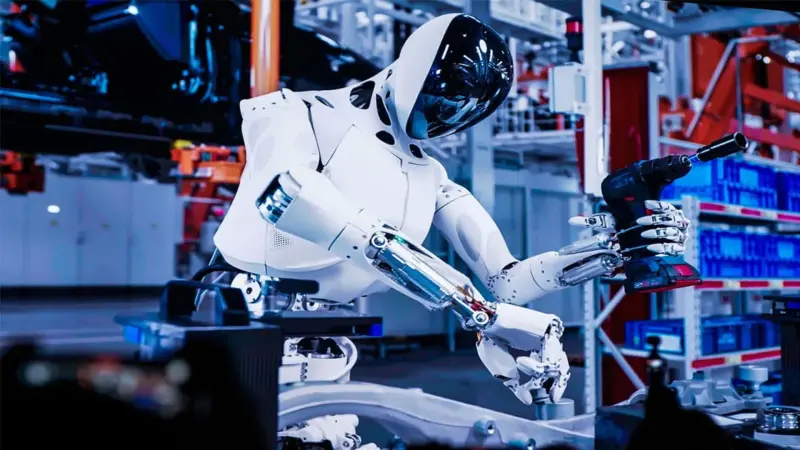
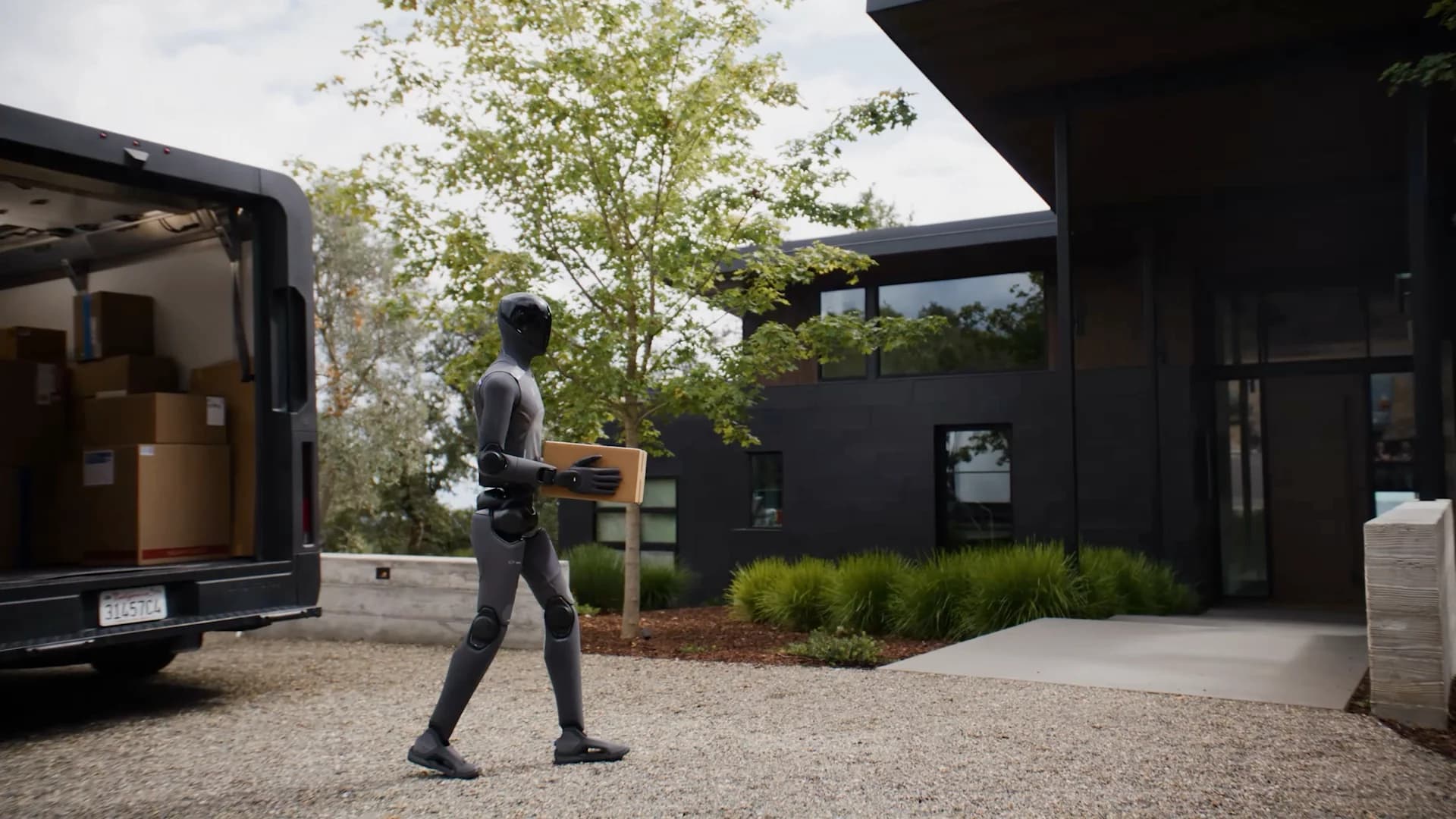
The bank lists Tesla's Optimus, Agility Robotics' Digit, Boston Dynamics' Atlas, Figure AI's Figure robots and Apptronik's Apollo as the key US platforms. Agility has traded on Nasdaq as AGLT since November 5.
Labor-cost parity
J.P. Morgan estimates that humanoid robot costs are nearing parity with labor costs, and that a customer running robots across multiple shifts could save about $100,000 a year. The reported figures do not include the bank's per-robot price or wage assumptions.
For comparison, Agility's chief financial officer Michael Beer said in October that a Digit under its robots-as-a-service model brings in about $500,000 over an assumed five-year life, or roughly $100,000 a year per robot including the deployment fee.
Tariffs and domestic production
On October 28, President Donald Trump said that imported robotics and industrial machinery pose national security risks. J.P. Morgan says that finding could lead to tariffs or other measures to boost domestic production.
Component suppliers first
J.P. Morgan sees component suppliers as the biggest near-term opportunity and expects the market for key parts such as actuators, motors and vision systems to approach $30 billion by 2035. It favors five:
- Timken (NYSE: TKR), the US maker of bearings and precision drives
- ROBOTIS (KOSDAQ: 108490), the South Korean actuator and robot maker whose dual-arm AI Worker runs on CJ Logistics fulfillment lines
- Leader Drive (Shanghai: 688017), the Suzhou-based maker of harmonic reducers
- Orbbec (Shanghai: 688322), the Shenzhen-based 3D vision sensor maker
- Cognex (Nasdaq: CGNX), the US machine-vision company
Two of the five are listed in Shanghai, while the bank's policy outlook points toward measures favoring US production. Morgan Stanley took a similar supplier-first approach with its Humanoid Tech 25 list last December.
Over time, J.P. Morgan expects value creation to shift toward the robot makers and platform integrators.
Share this article
Follow humanoid robotics without following every announcement.
Get the week’s most important launches, funding and research—and why they matter—in one email from Humanoids Daily.
Once a week. Unsubscribe anytime.
Read recent issuesRead next
- Published on
- Reading time
- 7 min read
Inside Unitree's Hangzhou Factory, Robots Are Still Mostly Built by Hand
- Published on
- Reading time
- 3 min read
Humanoid Robots: Insights from Agility Robotics and Apptronik Executives
- Published on
- Reading time
- 4 min read
Actuator Architecture Sparks Debate: Figure CEO Refutes Claim of Using Planetary Roller Screws
- Published on
- Reading time
- 8 min read
Hardware First, Brains Later? The Great American Humanoid Scale-Up of 2026
- Published on
- Reading time
- 4 min read
Podcast Recap: Inside the Rotary-vs-Linear Actuator Showdown Shaping Humanoid Robots
- Published on
- Reading time
- 10 min read
The Great Valuation Chasm: A 2025 Guide to the Humanoid Robotics Capital Race