- Published on
NYU's MABEL Puts a 56-DOF Mobile Bimanual Robot on an $8,056 Open-Source Parts List
One tap, and our reporting appears more often in your Google Top Stories. It makes a real difference to a small newsroom.

A team at New York University has released the full design of MABEL, a wheeled two-armed robot with 56 functional degrees of freedom and dexterous hands, and published a bill of materials that comes to $8,056 in parts.
- MABEL is an open-source mobile bimanual robot from NYU's Center for Robotics and Embodied Intelligence (CREO), with two 7-DOF arms, two 17-DOF ORCA hands, a pitching torso, a lift, a 3-DOF neck and a swerve-drive base.
- The base configuration's parts come to $8,056. The paper's own comparison table lists Mobile ALOHA at $32,000 and Galaxea R1 Pro at $70,000.
- CAD, firmware, the ROS 2 stack and MuJoCo/Isaac Lab models are released under CERN-OHL-S-2.0 (hardware) and Apache-2.0 (software).
- The team teleoperates the full body with an Apple Vision Pro, and an ACT policy trained on 38 minutes of demonstrations picked and placed an object in 8 of 10 trials.
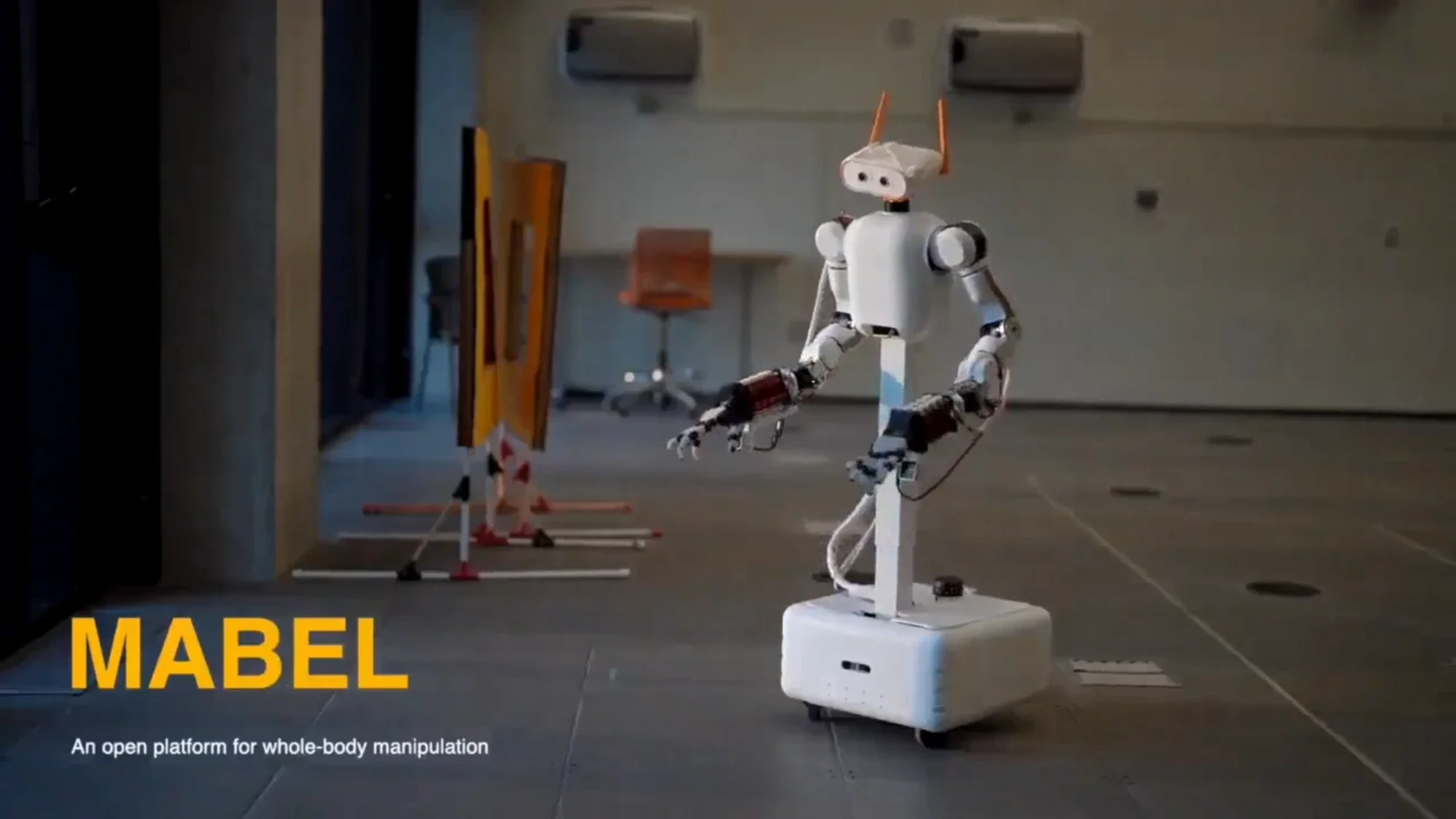
The robot is described in a paper posted to arXiv on 2 November, "MABEL: An Open Anthropomorphic Mobile Bimanual Platform for Teleoperation and Learning." Lead author Qilong Cheng, who started the project at NYU's Center for Robotics and Embodied Intelligence (CREO) and finished it after moving to the University of Toronto, announced the release on X. NYU roboticist Ludovic Righetti is the paper's senior author, and six other CREO researchers are co-authors.
What the robot is
MABEL stands for Mobile Anthropomorphic Bimanual Embodiment for Learning. It combines parts that low-cost research robots usually ship one or two at a time:
- Arms: two 7-DOF arms adapted from Enactic's open-source OpenArm, driven by DAMIAO actuators. The arms and torso are back-drivable and run joint-space impedance control, so a person can push the robot around by hand.
- Hands: two 17-DOF tendon-driven ORCA hands (16 finger joints plus a wrist), the open design from ORCA Dexterity and ETH Zurich. The wrist mount also takes other hands or OpenArm's parallel gripper.
- Torso and lift: a quasi-direct-drive torso that pitches from -60° to 15°, mounted on the column of a FlexiSpot E7 standing desk that gives 0.635 m of vertical travel.
- Head: a 3-DOF neck carrying a stereo camera with a 63 mm baseline, roughly matching human eye spacing.
- Base: a holonomic base on three REV MAXSwerve modules, a design borrowed from FIRST Robotics competition robots. The team used three modules instead of four to save about $700.
Together, the lift and torso give fingertip reach from the floor to 2.23 m. The team's own reach chart puts Mobile ALOHA at 0.65 to 2.00 m.
Follow humanoid robotics without following every announcement.
Get the week’s most important launches, funding and research—and why they matter—in one email from Humanoids Daily.
Once a week. Unsubscribe anytime.
Read recent issuesThe robot weighs 61.8 kg, stands between 1.16 m and 1.80 m tall depending on lift height, and sits on a 0.49 x 0.49 m chassis. The paper lists a load limit of about 3.5 kg. A 24 V battery pack gives about four hours of runtime, and the robot can also run on swappable 40 V power-tool batteries (about two hours) or wall power.
Because the three-wheel base has a small support polygon (0.34 x 0.35 m), the controller limits base motion according to lift height, using a centre-of-mass tip-over model.
What $8,056 buys
The $8,056 figure is the parts subtotal for the cheapest "Essential" build, priced on 31 July 2026. It uses a Raspberry Pi 5 as the onboard computer, with policies running on a separate machine, and cheap USB cameras in place of the ZED Mini and Intel RealSense D405 cameras the paper's experiments used. It excludes shipping, taxes, labour and optional sensors.
The project site breaks the core build down as follows: arms $2,622, mobile base $1,912, hands $1,195, torso $889, electronics and cabling $492, head $235, structural hardware $184 and 3D-printing filament $121. Two larger configurations list at $9,283 and $14,721. The BOM page notes that NVIDIA raised Jetson prices by 33% to 101% on 22 July, taking the Jetson AGX Thor developer kit from $3,499 to $5,499.
The paper says the team assembled a second robot from the published files and BOM in about two weeks, from parts to a fully tested machine.
The paper's comparison table (list or reported prices as of October 2026, which the authors note are not scope-matched) puts MABEL against:
| Platform | Arms | Hand DOF | Load per arm | Price |
|---|---|---|---|---|
| Mobile ALOHA | 2 x 6-DOF | 0 (gripper) | 0.75 kg | $32,000 |
| YOR | 2 x 6-DOF | 0 (gripper) | n/a | $9,300 |
| Reachy 2 | 2 x 7-DOF | 3 | 3 kg | $70,000 |
| Galaxea R1 Pro | 2 x 7-DOF | 0 (gripper) | 3.5 kg | $70,000 |
| Astribot S1 | 2 x 7-DOF | 2 | 5 kg | $69,000 |
| Rainbow RB-Y1 | 2 x 7-DOF | 2 | 3 kg | $80,000 |
| DexMate Vega | 2 x 7-DOF | 6 | n/a | $98,000 |
| MABEL | 2 x 7-DOF | 17 | 3.5 kg | $8,056 (parts) |
The hand column is where MABEL differs most. Every other platform in the table ends in a gripper or a hand with six or fewer degrees of freedom.
What's open
According to the paper, "all design files (STEP format), fabrication files, electronics, firmware, ROS 2 software, and simulation models are released." Hardware is licensed under CERN-OHL-S-2.0, a reciprocal licence that requires modified designs to be shared under the same terms, software under Apache-2.0 and documentation under CC BY 4.0. The files are on GitHub, with build and wiring guides on the project site.
The control electronics are a custom Teensy-based board with up to three CAN buses. The host runs ROS 2, and the team has tested the software on an M1 MacBook Pro, a Raspberry Pi 5, a Jetson Orin and a Jetson Thor.
The simulation models cover all 59 actuated joints in MuJoCo and Isaac Lab, with 35 pre-built scenes. The same retargeting and whole-body controller run in simulation and on the real robot.
Teleoperation with a Vision Pro
The operator wears an Apple Vision Pro and controls the robot with the headset's built-in head and hand tracking, without handheld controllers. Head and hand poses stream at 60 Hz, and the operator sees the robot's stereo camera feed at true angular scale.
A 10-second calibration measures the operator's arm reach and hand size. After that, leaning forward pitches the torso, crouching or standing moves the lift, and walking drives the base. A second mode puts the base and lift on on-screen joysticks. The robot can also be driven from an iPhone, a browser or a Pico headset.
Mean glass-to-glass video latency was 137 ms over the robot's own Wi-Fi hotspot, 150 ms on a local network and 161 ms over Tailscale. The camera itself accounted for 101 to 108 ms of that on every route.
A first learned policy
To test the full pipeline from teleoperation to autonomy, the team collected 80 Vision Pro demonstration takes of a pick-and-place task with the ORCA hands: 117 episodes, 38 minutes and 68,364 frames at 30 Hz. The data was exported in LeRobot format and used to train an Action Chunking with Transformers (ACT) policy, which took six hours on an Apple M1 Max.
The policy takes the left head camera and both wrist cameras at 320 x 240, plus one second of joint history, and predicts four seconds of joint references for the whole body, executing the first second before re-planning. With the object placed randomly within a 20 x 20 cm area and a 60-second limit, it succeeded in 8 of 10 trials.
The authors note that the demonstrations kept the base and lift near their starting positions, so the result validates the pipeline rather than mobile manipulation. The project site lists Diffusion Policy, π0.5 and world-action-model tracks alongside ACT, but the paper reports results for ACT only.
The paper also reports a median arm repeatability of 1.65 mm and wheel odometry that stayed within 13.5 mm RMS of a visual-inertial reference over a 5.72 m path.
Limitations and next steps
The paper says the desk-column lift "trades speed for affordability," and that OpenArm's link proportions differ from a human arm's, which affects reach and retargeting. Planned work includes a faster folding body with waist, knee and ankle joints in place of the lift, more human-proportioned arms, onboard mapping and localisation, and longer-horizon whole-body policies.
The project site carries a "Buy now (waitlist)" button, with ordering marked as coming soon. No assembled-robot price has been published.
Share this article
Follow humanoid robotics without following every announcement.
Get the week’s most important launches, funding and research—and why they matter—in one email from Humanoids Daily.
Once a week. Unsubscribe anytime.
Read recent issuesRead next
- Published on
- Reading time
- 5 min read
Sharpa Launches D01 Robot, W02 Hand and AE01 Haptic Glove at IROS 2026
- Published on
- Reading time
- 5 min read
BitRobot and Hugging Face Drop HIW-500: A Massive 10TB Real-Home Humanoid Dataset
- Published on
- Reading time
- 4 min read
Hugging Face Drops a $2,500 3D-Printed Humanoid for Open Robot Learning
- Published on
- Reading time
- 4 min read
The Human Scale: NVIDIA’s EgoScale Unlocks High-Dexterity Robotics via 20,000 Hours of Human Video
- Published on
- Reading time
- 3 min read
NVIDIA "Supersizes" Humanoid Control: SONIC Open-Sources Whole-Body Tracking at Scale
- Published on
- Reading time
- 4 min read
Experts Weigh In on Wuji Tech’s Robotic Hand: A “Remarkably Robust” Direct-Drive Contender